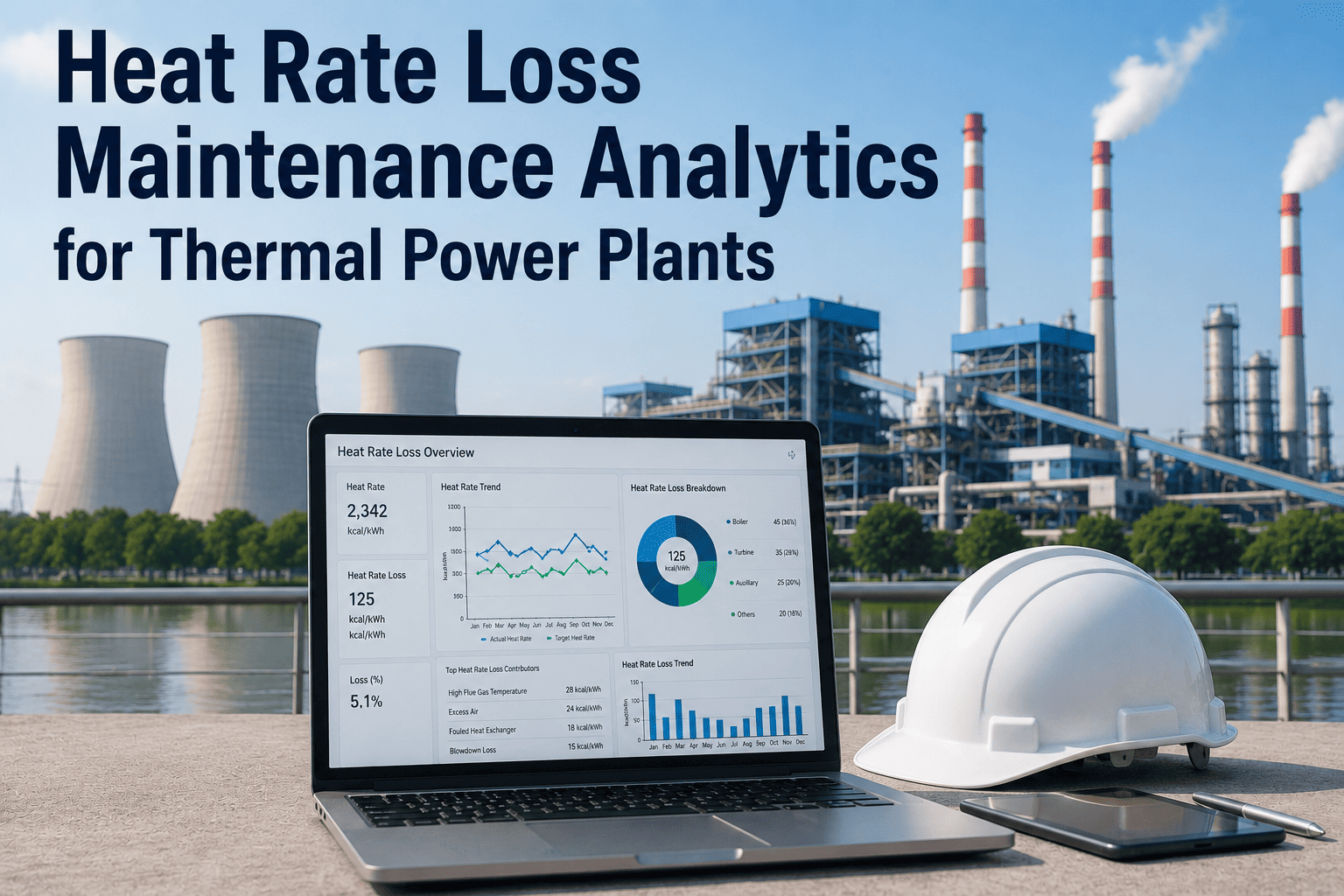
Every power plant has a number buried in its monthly reports that quietly predicts millions in lost margin — the heat rate trend line. A 1% heat rate rise on a 500 MW gas plant adds roughly $1.2M to annual fuel spend; a 3% rise adds $3.6M. Yet most plant managers cannot tell you, asset by asset, which deferred maintenance tasks are responsible for that creep. The link between maintenance discipline and thermal efficiency is mathematical, traceable, and fixable — but only if your CMMS is tracking PM compliance against heat rate in the same system. Book a demo to see how Oxmaint connects heat rate trends to the maintenance gaps driving them.
1%
Heat Rate Rise = 1% Higher Fuel Cost
$1.2M
Annual Fuel Cost Per 1% Rise — 500MW Gas Plant
40%
Turbine Efficiency Loss From Bucket Tip & Packing Leakage
2–5%
Heat Rate Recoverable Through Structured Maintenance
What Heat Rate Actually Measures — And Why It's a Maintenance Scorecard
Heat rate is the amount of fuel energy required to produce one kilowatt-hour of electricity, typically expressed as Btu/kWh. A coal plant with a heat rate of 10,000 Btu/kWh runs at 34.12% thermal efficiency. A modern combined-cycle gas plant at 6,500 Btu/kWh reaches 52%. The lower the number, the less fuel burned for the same output — and the wider the operating margin. Heat rate is the clearest operational-to-financial translator in power generation, which is exactly why its degradation pattern is the single most revealing signal of maintenance health across an entire plant.
The Silent Degradation Curve
How heat rate drifts upward between major maintenance events — and what each percentage point costs
Heat Rate
Deviation
0%Month 0 — Post-Overhaul
0.4%Month 3 — Fouling Begins
1.1%Month 6 — Calibration Drift
2.0%Month 9 — Leakage Builds
3.2%Month 12 — Compounding Loss
4.8%Month 18 — Deferred PM
$480KMonth 3 lost margin
$1.3MMonth 6 lost margin
$2.4MMonth 9 lost margin
$3.8MMonth 12 lost margin
$5.8MMonth 18 lost margin
The Five Maintenance-Linked Root Causes of Heat Rate Drift
Heat rate never degrades from a single cause. It creeps upward from five recurring, preventable mechanisms — each with a documented contribution to total efficiency loss and a specific maintenance task that reverses it. Plants that track these in their CMMS recover 2–5 percentage points of heat rate; plants that don't, continue burning fuel that shows up as a mystery line on the monthly P&L.
Bucket Tip & Packing Leakage
Steam bypasses the turbine buckets through eroded seals and packing — pure energy loss with no work extracted. Inspection and repair intervals recover the majority of this loss.
CMMS fix: scheduled packing inspection at 8,000-hour intervals; condition-based repair when backpressure trend rises 2%
Nozzle Roughness & Erosion
Solid particle erosion roughens nozzle surfaces, disturbing steam flow geometry and reducing aerodynamic efficiency. The drift is slow, invisible without inspection, and permanent if deferred past the cost-of-repair threshold.
CMMS fix: hot gas path inspection scheduled against fired hours; nozzle surface measurement logged per outage
Condenser Fouling & Air In-Leakage
Tube-side fouling reduces heat transfer; air in-leakage raises backpressure directly. Condenser degradation is often the single largest obstacle between a unit and its design-spec heat rate — and it responds to cleaning faster than any other intervention.
CMMS fix: condenser cleaning triggered by backpressure threshold; quarterly air in-leakage testing logged as PM
Cycle Isolation & Valve Leakage
High-energy fluid leaking through misaligned or worn valves bypasses useful work — a constant, undetected drain. Cycle alignment programs recover 50 Btu/kWh (~0.5%) at some of the lowest cost per efficiency point available in power generation.
CMMS fix: quarterly cycle isolation walkdowns; valve performance logged against stem temperature and acoustic readings
Burner Calibration & Air-Fuel Ratio
Burner nozzles wear, air-fuel ratios drift, and O2 sensors decalibrate — combustion efficiency falls and fuel per MWh climbs. This is among the cheapest categories to fix and the most frequently deferred on paper-based PM programs.
CMMS fix: quarterly burner calibration as scheduled PM; O2 trim sensor validation logged per shift
Stop Guessing Which PMs Are Worth Doing
Make Your Heat Rate Trend Line a CMMS Metric
Oxmaint ties PM completion status directly to heat rate performance by asset — so you stop defending maintenance spend with words, and start defending it with financial data.
Calculating the Real Cost of Heat Rate Drift at Your Plant
The fuel cost of heat rate degradation is straightforward arithmetic — but most plant managers never sit down and run the number for their own unit. The table below shows what each 1% of heat rate rise costs across different plant sizes and fuel types, using current market fuel prices. Every row is a conversation every plant engineer should have with finance. Want to see this math mapped to your actual unit? Book a demo to model heat rate cost against your plant's fuel and MW profile.
| Plant Type |
Capacity |
Capacity Factor |
Cost per 1% Heat Rate Rise |
Cost of 3% Drift |
| Combined-Cycle Gas |
250 MW |
65% |
$590,000 per year |
$1.77M per year |
| Combined-Cycle Gas |
500 MW |
72% |
$1.28M per year |
$3.84M per year |
| Simple-Cycle Gas Peaker |
200 MW |
18% |
$140,000 per year |
$420,000 per year |
| Coal-Fired Baseload |
600 MW |
78% |
$1.05M per year |
$3.15M per year |
| Coal-Fired Cycling Unit |
350 MW |
55% |
$430,000 per year |
$1.29M per year |
| Supercritical Coal |
800 MW |
80% |
$1.55M per year |
$4.65M per year |
Why Paper-Based Maintenance Hides the Cost of Drift
Heat rate degradation doesn't live in one system. Performance data sits in the DCS historian, fuel consumption sits in accounting, PM completion sits on paper checklists or a spreadsheet, and condition monitoring lives in specialist silos. No one correlates them in real time — which is exactly why a 3% heat rate rise burns through a budget cycle before anyone asks the right question. The split below is what a CMMS closes.
Without Integrated Tracking
NoHeat rate reported monthly in finance — lagging by 30–60 days behind the actual degradation
NoPM completion tracked on paper or spreadsheet — no link back to performance trend
NoCondition monitoring data lives in a separate specialist silo, rarely acted on by the PM scheduler
NoMaintenance budget defended with anecdotes, not data — cuts land on the most visible line items
NoRoot cause of efficiency loss identified only during the next planned outage, often 12–18 months late
With Oxmaint CMMS
YesHeat rate trend visible on the maintenance dashboard — not waiting for month-end reporting
YesPM compliance correlated to performance trend at the asset level — see exactly which deferrals cost what
YesCondition data triggers work orders automatically when threshold breached — no specialist hand-off
YesMaintenance investment justified with fuel cost math — board-ready, asset-specific, auditable
YesDrift flagged at 0.5% deviation — fixed within the current operating cycle, not the next overhaul
The Four-Stage Maintenance-to-Efficiency Workflow in Oxmaint
Connecting heat rate to maintenance is not a dashboard trick — it's a workflow that moves data from sensor to work order to completion record to performance review in one loop. Oxmaint runs this loop per asset, across every turbine, condenser, burner, and valve in the cycle. Each stage below is a module that links the operational signal to the financial outcome.
01
Baseline & Trend Capture
Heat rate, fuel consumption, backpressure, and auxiliary load captured per asset from DCS tags or manual entry. Baseline established at post-overhaul and recalibrated quarterly.
Asset-level trend — not just unit total
02
Threshold-Triggered Work Orders
When an asset's efficiency contribution drifts past a configurable threshold — 0.5%, 1%, or 2% from baseline — Oxmaint auto-generates a prioritised work order with linked inspection templates and historical parts usage.
From drift detection to dispatched crew in under 24 hours
03
PM Compliance vs Performance Link
Every work order closure records the before-and-after efficiency impact. Missed or deferred PMs are flagged with the cumulative efficiency cost — the hidden price of the "we'll get to it next shutdown" decision.
CFO-ready evidence of maintenance ROI
04
Heat Rate–Indexed Budget Reporting
Monthly reports rank assets by efficiency drift contribution and the maintenance action that would close it — turning the maintenance budget conversation from "what did we spend?" into "what will we recover?"
Budget justification in the CMMS, not the spreadsheet
Oxmaint Results: Heat Rate Recovery by Intervention Type
Not every maintenance task delivers the same heat rate return. The chart below ranks common interventions by typical percentage-point recovery — so plant managers can prioritise by financial impact, not just by what's on the PM calendar. These are field-validated ranges from power generation CMMS deployments.
Cycle isolation & valve leak audits — low cost, fast payback0.5–0.8%
Condenser cleaning & air in-leakage repair0.8–1.5%
Burner tuning & O2 trim recalibration0.3–0.7%
Turbine packing & seal replacement at overhaul1.0–2.0%
Feedwater heater tube plugging & cleaning0.4–0.9%
Insulation repair & steam line leak closure0.2–0.5%
Compressor water wash & gas path cleaning (gas turbines)1.5–3.0%
From Drift Signal to Financial Argument: The Oxmaint Asset View
Every asset in a thermal power cycle has a unique heat rate contribution fingerprint. Oxmaint surfaces this per asset so plant engineers can move from "maintenance costs money" to "this specific deferred PM on condenser B is costing $18,400 per month." The table below shows the transition from unclear budget defence to data-driven investment argument.
| Asset Class |
Drift Signal |
Monthly Cost of Deferral |
Oxmaint Recommended Action |
| Steam Surface Condenser |
Backpressure rise of 0.4 inHg above baseline |
$18,000–$42,000 |
Condenser cleaning work order; air in-leakage test within 48 hours |
| HP Steam Turbine |
Stage efficiency drop of 1.2% over 6 months |
$55,000–$95,000 |
Plan packing inspection at next scheduled outage window |
| Boiler Feed Pump |
Motor amperage drift of 4% above baseline |
$6,500–$14,000 |
Bearing vibration check; impeller clearance measurement logged |
| Feedwater Heater |
Terminal temperature difference rise of 5°F |
$9,800–$22,000 |
Tube leak inspection; level control calibration check |
| Gas Turbine Compressor |
Inlet pressure drop of 0.8% below baseline |
$28,000–$74,000 |
Online water wash scheduled; offline wash planned against firing hours |
| Main Steam Isolation Valves |
Stem temperature rise indicating seat leakage |
$4,200–$9,500 |
Cycle isolation walkdown; valve reseat in next available outage |
Frequently Asked Questions
QHow quickly can a plant start linking heat rate data to CMMS records?
QDoes Oxmaint need IoT sensors to track heat rate drift?
No. Oxmaint ingests DCS historian tags, manual log entries, or sensor data — whichever your plant already uses. IoT accelerates drift detection but is not a prerequisite for linking PM compliance to performance.
QHow much heat rate recovery is realistic in the first year on Oxmaint?
Plants moving from reactive to CMMS-driven maintenance typically recover 2–4% of heat rate drift in the first 12 months. On a 500MW gas unit that equates to $2.4M–$4.8M in annual fuel savings.
Book a demo to model your recovery potential.
QCan Oxmaint help justify maintenance spend to finance and the board?
QWhat's the difference between preventive and predictive maintenance for heat rate?
Preventive maintenance runs on fixed schedules; predictive maintenance is triggered when performance drifts past a threshold. Predictive catches heat rate degradation earlier and eliminates unnecessary PM work — both outcomes improve efficiency.
QWhich plant types benefit most from heat rate–CMMS integration?
Baseload coal, combined-cycle gas, and supercritical units see the highest absolute dollar recovery because fuel cost is their largest operating expense. Peakers and cycling units see faster percentage gains due to thermal stress-driven drift.
The Maintenance Investment Case, Quantified
Every 1% of Heat Rate Is a Line Item on Your Fuel Bill
Oxmaint links PM completion to heat rate performance at the asset level — so plant managers can defend maintenance spend with fuel cost math, not anecdotes. Live in 14 days.