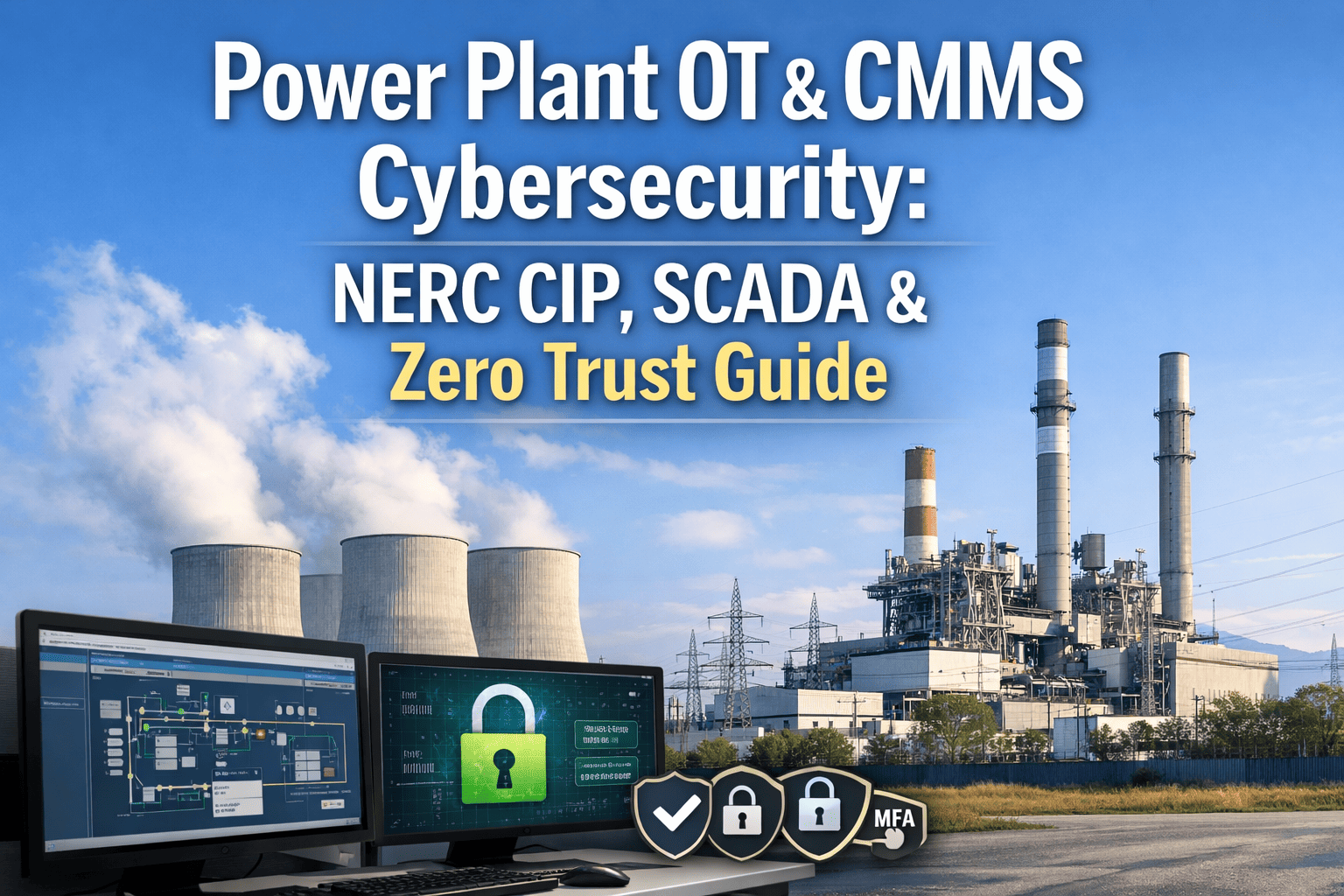
Power plants, substations, and energy generation facilities now rank as the single most targeted sector for state-sponsored and ransomware cyberattacks globally — and the attack surface is no longer just control rooms. Every CMMS platform managing work orders, asset records, and technician access across your OT environment is a credential vector, a lateral movement opportunity, and a compliance liability if it is not built and configured with NERC CIP, zero-trust, and SCADA-aware security from the ground up. This guide is written for operations directors, chief engineers, and IT/OT security leads at power generation facilities who need to close the gap between their maintenance software and their cybersecurity posture — before an auditor or an adversary does it for them.
Power Plant OT & CMMS Cybersecurity: The Complete Guide for Energy Operations Teams
From SCADA network segmentation to NERC CIP-compliant maintenance records — here is what every power facility must get right in 2025 and beyond.
Why Power Plants Are the Most Attractive Target in Critical Infrastructure
The energy sector does not attract more attacks because of weak security teams. It attracts more attacks because a successful breach has asymmetric leverage — disrupting electricity to a regional grid creates economic, social, and political pressure at a scale no other sector can match. The 2015 and 2016 Ukraine power grid attacks demonstrated this. The 2021 Colonial Pipeline ransomware incident demonstrated it again in North America. CISA advisories from 2023 and 2024 confirm that threat actors are actively pre-positioning inside OT networks of U.S. power generation facilities — waiting, not acting immediately.
Legacy human-machine interfaces running Windows XP or unpatched Windows 7 remain operational in a majority of U.S. power facilities. These systems cannot receive security patches without vendor revalidation — making them permanent soft targets once network segmentation fails.
96% exploitation success rate on unpatched HMI endpointsCMMS platforms used by field technicians represent a privileged access pathway into asset control systems. When CMMS logins lack MFA and role-based access control, a single stolen credential provides adversaries with asset history, maintenance schedules, and system access across the entire facility.
89% of OT breaches use legitimate credentials at some stageFlat networks — where corporate IT and operational technology share the same network segment — allow malware or an authenticated attacker to move from a business email compromise directly into DCS or SCADA environments. Purdue Model violations are the root cause in the majority of post-incident analyses.
78% of energy sector breaches cross the IT/OT boundaryThird-party maintenance vendors, OEM service technicians, and remote monitoring partners require periodic access to OT environments. Without strict session management, time-limited access controls, and audit logging, every vendor connection is a persistent exposure window — whether the vendor knows it or not.
71% of power sector vendors lack OT-specific security controlsNERC CIP Compliance: What Power Facilities Must Satisfy — and Where CMMS Fits
NERC CIP (North American Electric Reliability Corporation Critical Infrastructure Protection) standards are mandatory for all bulk electric system operators in North America. Non-compliance carries penalties of up to $1 million per violation per day. The standards most directly relevant to your CMMS and maintenance operations platform are CIP-002 through CIP-014 — and your maintenance software is almost certainly in scope for several of them.
OxMaint Is Built for NERC CIP-Ready Power Operations
Role-based access control, MFA enforcement, complete audit trails, and asset-level documentation — all designed to satisfy the standards regulators check first.
Zero Trust Architecture for OT Environments: The Framework That Actually Works
Zero Trust is not a product — it is a security philosophy that assumes breach and requires every user, device, and system to continuously verify before being granted access. For power plant OT environments, applying Zero Trust does not mean replacing SCADA systems overnight. It means implementing it as a layered approach across the systems that can support it — starting with your CMMS and maintenance software, which is the highest-traffic, highest-credential-volume system your operations team interacts with daily.
Every person accessing your CMMS, DCS, or maintenance records must be verified with multi-factor authentication — not just a password. MFA eliminates 99.9% of credential-based account takeover attacks and is the single highest-ROI security control available to OT environments.
Role-based access control ensures that a maintenance technician can see and update their assigned work orders — but cannot access asset configuration records, compliance documentation, or other properties outside their operational scope. Granular RBAC eliminates the blast radius of any single compromised account.
OT networks must be separated from corporate IT networks using industrial DMZ architecture, data diodes, or unidirectional security gateways. CMMS platforms that require two-way connectivity should be deployed in the DMZ — never with direct connectivity into the control network. Purdue Model compliance is the baseline.
Every action — work order creation, asset record modification, login event, permission change — must be timestamped, attributed to a specific user, and retained in an immutable audit log. This layer is simultaneously your NERC CIP compliance evidence and your forensic foundation in the event of an incident.
Your CMMS Is an OT Attack Surface — Here Is What That Means in Practice
Most power facility security assessments focus on SCADA, DCS, and PLCs. Very few begin by auditing the CMMS — which is a significant blind spot. Your maintenance management platform holds the keys to your OT environment: asset inventories, maintenance schedules, technician access credentials, vendor contacts, and in many cases direct integration points with control systems for condition monitoring. If an adversary wants to understand your critical assets, map your maintenance windows for an attack, or move laterally using a trusted credential, your CMMS is the starting point.
Phishing, credential stuffing, or vendor credential theft targets CMMS login. No MFA = immediate access. Average time from credential exposure to CMMS login: 8 minutes.
Asset registry, maintenance history, and PM schedules reveal critical system locations, maintenance windows (low-staff periods), and equipment vulnerabilities.
CMMS integration with historian databases, sensor networks, or ERP systems provides a pathway into OT-adjacent environments without triggering SCADA-level detection.
Adversary deploys ransomware against maintenance records (destroying compliance audit trails), or uses access for long-term pre-positioning inside the OT network perimeter.
OxMaint Security Architecture for Power Generation Facilities
OxMaint is purpose-built for industrial and energy operations — and its security architecture reflects the NERC CIP and SCADA-environment requirements that standard CMMS platforms ignore. The following security features are available to all power generation customers and are the controls NERC CIP auditors, insurance underwriters, and your own security team will want to verify are in place.
MFA enforcement on every login — mobile authenticator, hardware token, or SSO-based. No user can access work orders, asset records, or compliance documentation without a verified second factor. Session expiry and automatic lockout on repeated failure are configurable by administrators.
Granular RBAC across facility, asset category, work order type, and data field. A turbine technician sees turbine work orders. A compliance officer sees compliance records. A vendor sees only what the session permits — nothing else. Access changes are logged and time-stamped.
Every action in OxMaint — work order creation, asset modification, login event, data export — is recorded in a tamper-evident log with user attribution, timestamp, and IP address. Audit logs can be exported directly for NERC CIP compliance reviews and insurance audits.
Third-party maintenance vendors and OEM service partners receive time-limited, scope-restricted access credentials that expire automatically. No standing vendor access. Every vendor session is logged with start time, end time, and every action taken — available for supply chain risk review at any time.
Centralized asset registry with BES Cyber System classification support. Every asset can be tagged with its NERC CIP criticality level, electronic security perimeter membership, and associated maintenance requirements — giving your CMMS records dual purpose as compliance evidence and operational documentation.
All OxMaint data is encrypted in transit using TLS 1.3 and encrypted at rest using AES-256. Mobile technician access uses certificate-pinned connections. API integrations with historian databases or ERP systems use authenticated, encrypted endpoints — no unencrypted data paths to OT-adjacent systems.
SCADA Security Starts With Securing What Accesses It
Your CMMS is in scope for NERC CIP and in scope for every threat actor targeting your facility. OxMaint's security architecture closes the gap between your maintenance operations and your cybersecurity posture.
Frequently Asked Questions — Power Plant OT & CMMS Cybersecurity
Close the Gap Between Your Maintenance Operations and Your Cybersecurity Posture
Every day your CMMS runs without MFA, RBAC, and audit trails is a day your NERC CIP posture has an open gap — and your OT environment has an uncontrolled credential vector. OxMaint gives power generation facilities the maintenance operations platform that satisfies both your engineers and your auditors.