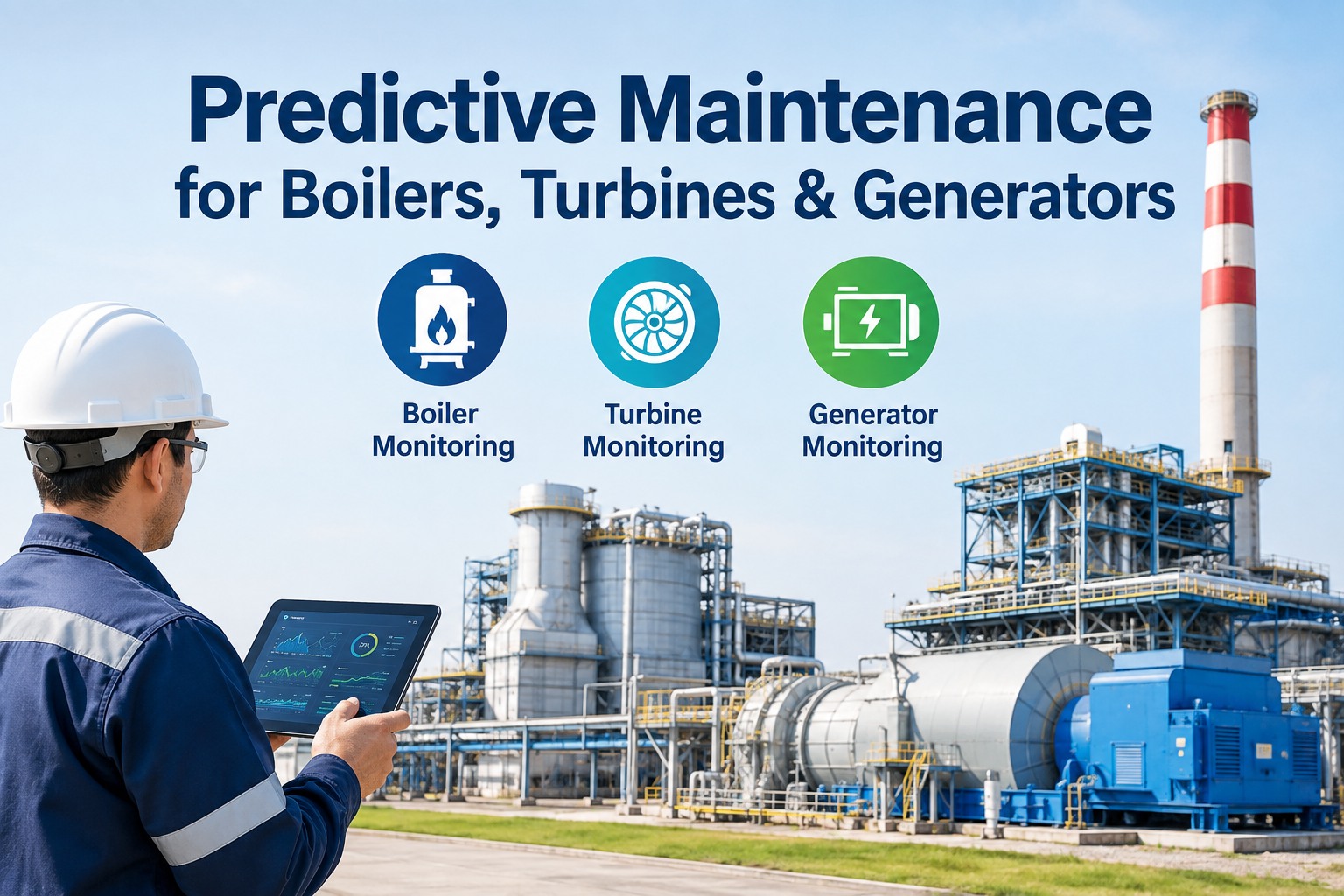
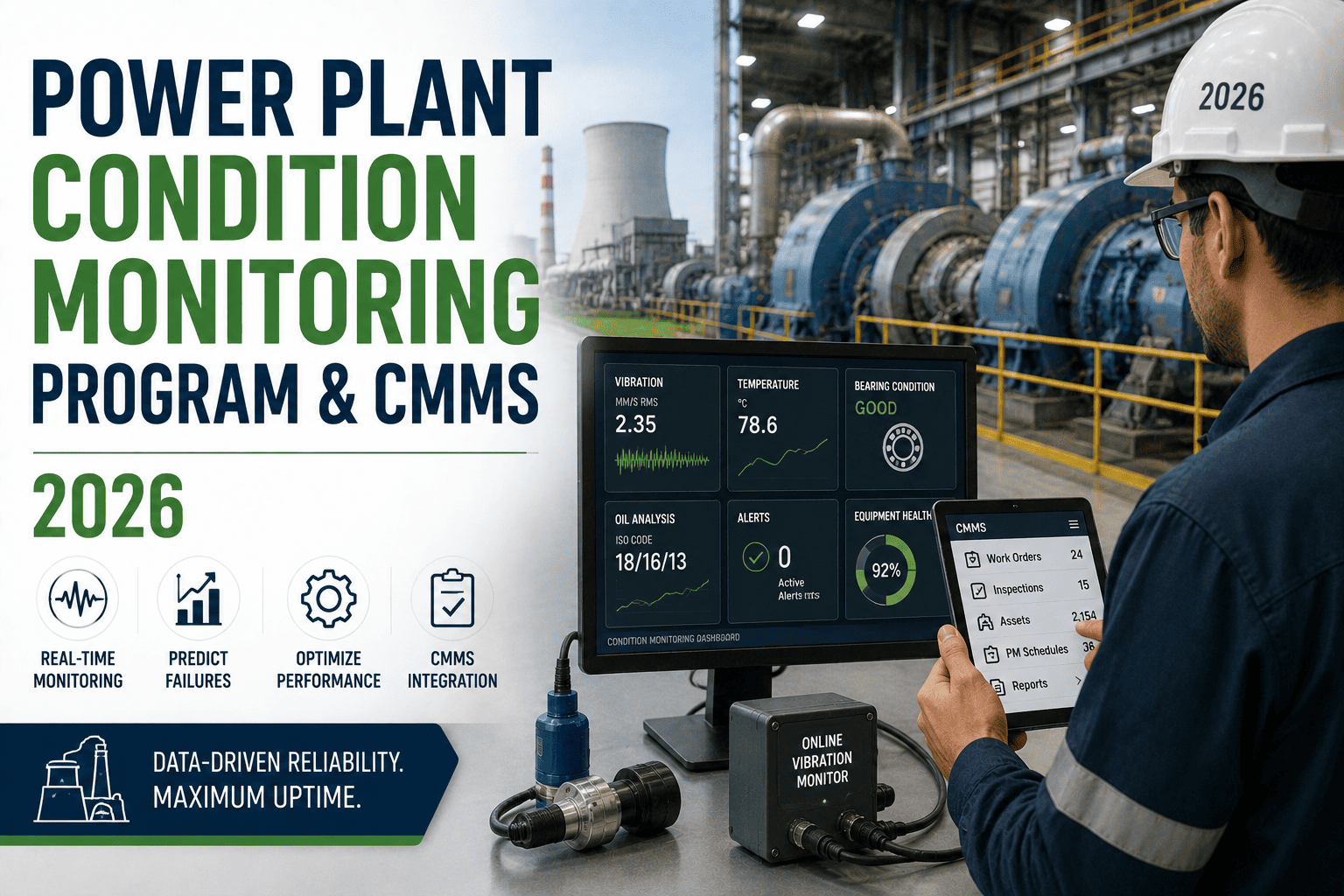
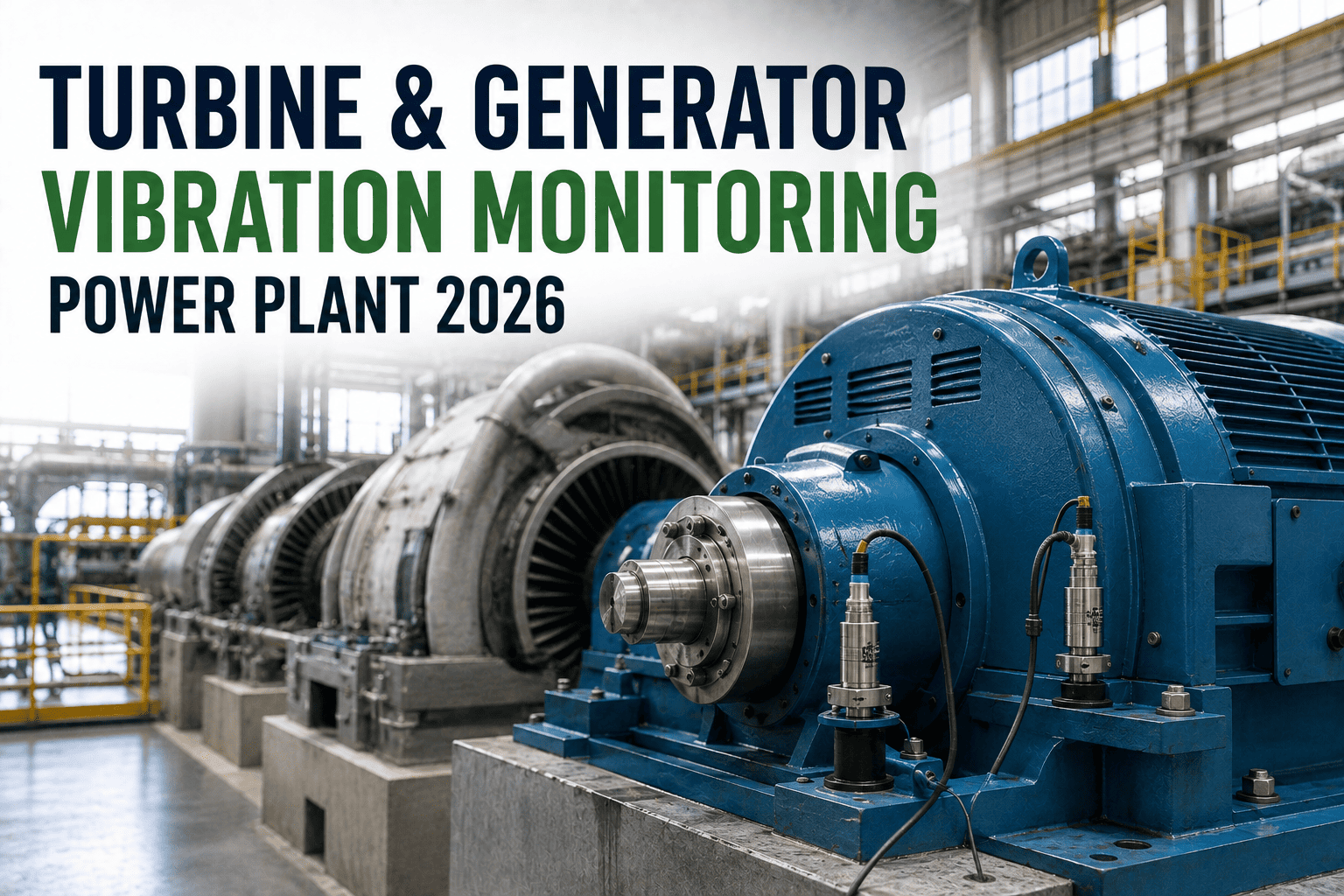
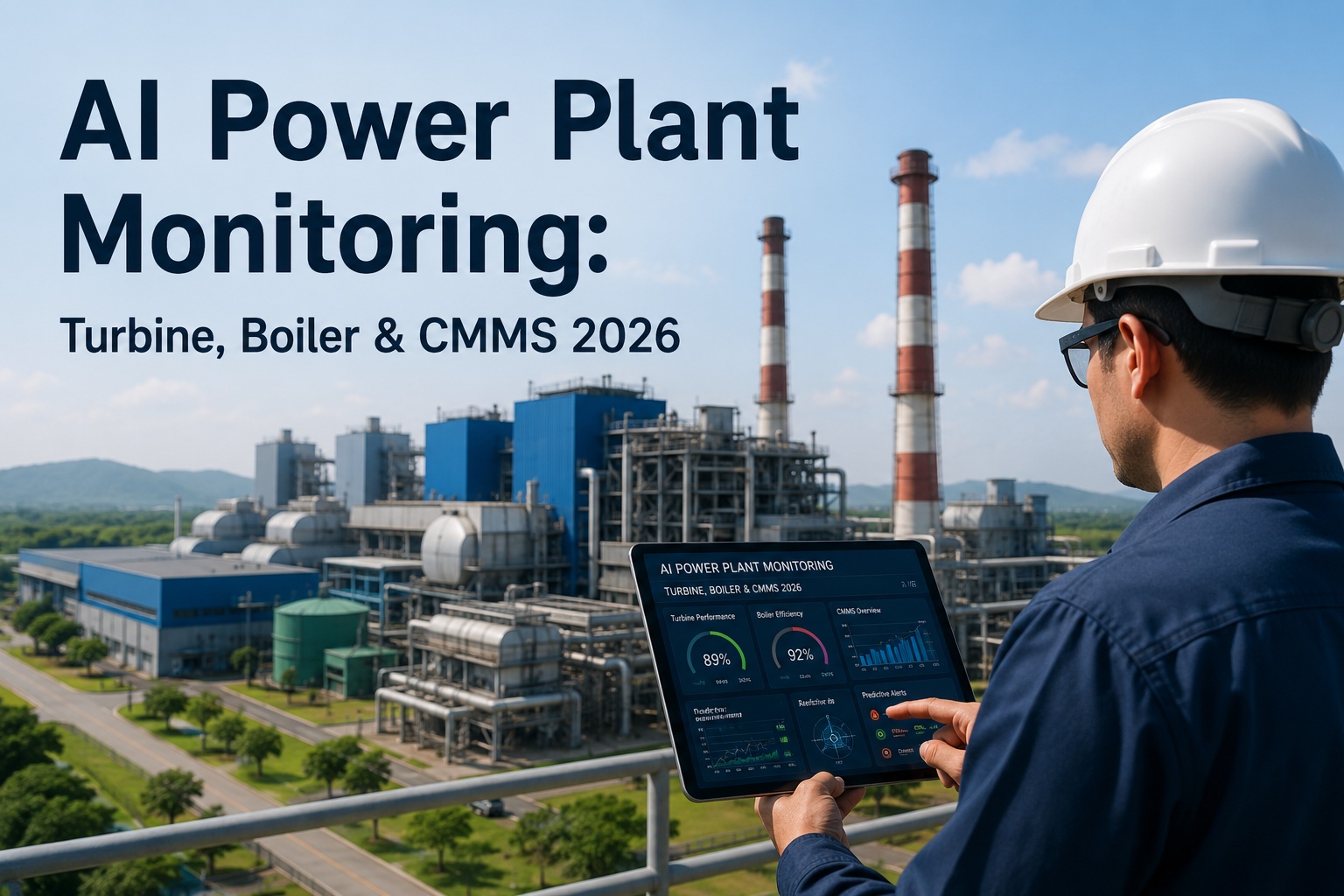
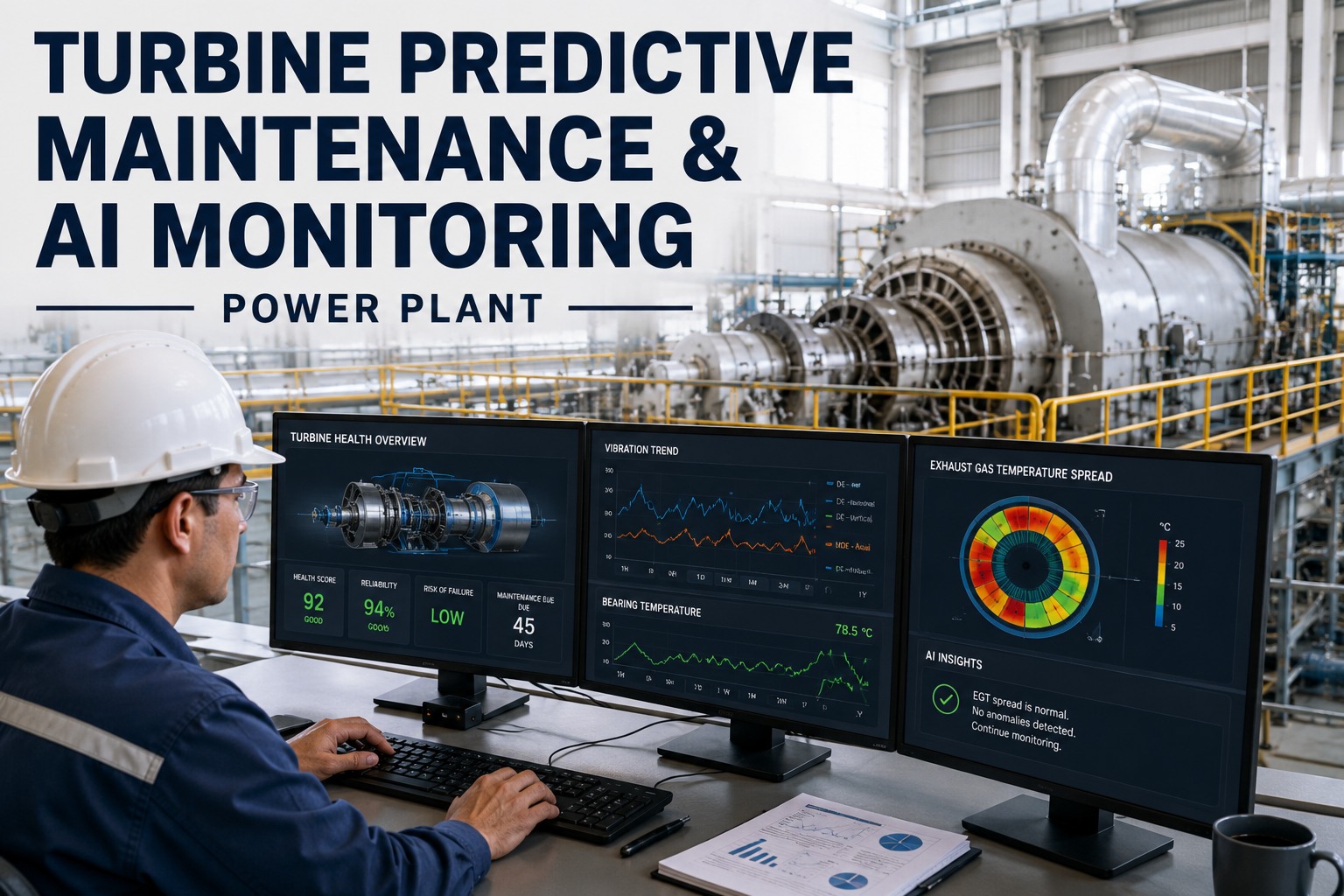
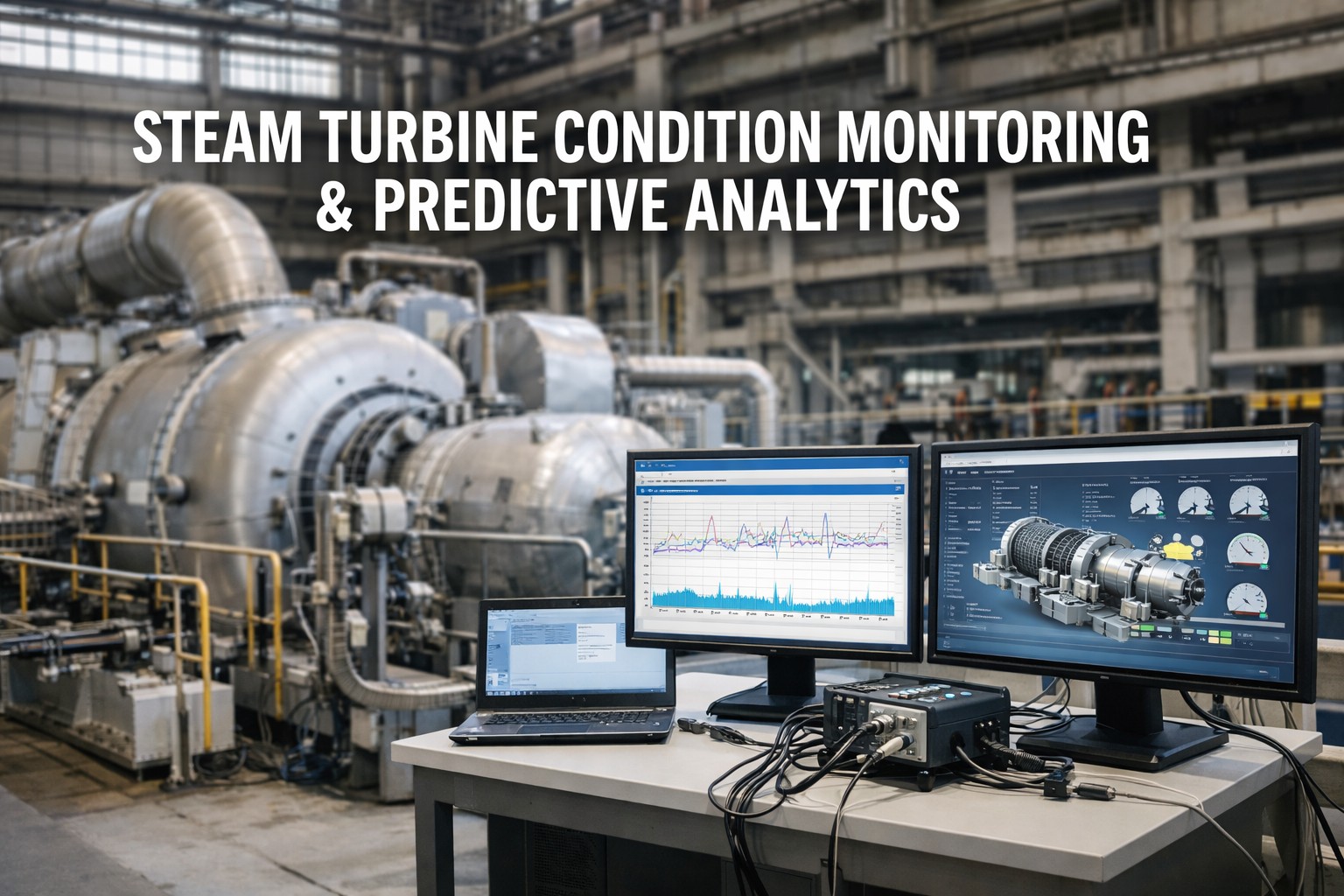
In a power plant the boiler, turbine, and generator sit on one shaft of consequence a failure in any of the three can take the whole unit off the grid. Yet each fails in a completely different way, on a different timescale, readable by a different sensor. Predictive maintenance works here only when it respects that: the right signal, watched continuously, for the right failure mode, on each machine. This guide breaks down predictive maintenance for boilers, turbines, and generators asset by asset — the failure modes, the sensing that catches each early, and how a flagged anomaly becomes a work order before the unit trips. Start free on OxMaint to connect your unit, or book a demo.
Boiler · Turbine · Generator · Condition-Based · AI
Predictive Maintenance for Boilers, Turbines & Generators
Three machines, three failure physics, one goal — catch the degradation weeks before it becomes a forced outage.
B
Boiler — tube thinning, fouling, and thermal fatigue read by thickness, temp, and pressure
T
Turbine — vibration, blade, and bearing signatures, the classic condition-monitoring domain
G
Generator — winding insulation and partial discharge, an electrical failure story
Why One PdM Approach Doesn't Fit All Three
The temptation is to buy one condition-monitoring system and point it at the whole train. It doesn't work, because the three machines don't speak the same failure language. A boiler degrades chemically and thermally — metal loss, scale, creep. A turbine degrades mechanically — imbalance, blade wear, bearing fatigue, best seen in vibration. A generator degrades electrically — insulation breakdown and partial discharge. Predictive maintenance that treats them alike over-instruments one and misses the dominant mode on another. The program has to be built machine by machine.
Boiler
Chemical & Thermal
Fails by metal loss, fouling, and fatigue over months to years. Read by wall-thickness, temperature distribution, and pressure trends.
Turbine
Mechanical
Fails by imbalance, blade damage, and bearing wear. Read overwhelmingly by vibration analysis and bearing temperature.
Generator
Electrical
Fails by insulation degradation and partial discharge. Read by PD sensors, insulation testing, and winding temperature.
Boiler · Chemical & Thermal Degradation
The boiler is the slowest-burning of the three and the one where inspection history matters most. Its failures are metal-loss and fatigue processes — a tube doesn't fail suddenly so much as thin until it can't hold pressure. Predictive maintenance here is about trending the wall and the thermal picture so the tube gets replaced on a plan, not on a rupture.
| Failure Mode | Early Signature | Sensing |
|---|
| Tube wall thinning | Wall thickness trending down · localized metal loss at erosion zones | Ultrasonic thickness · inspection history |
| Fireside / waterside fouling | Flue-gas temp rise · efficiency drop · tube-metal temp climb | Temperature distribution · efficiency trend |
| Thermal fatigue / creep | Cyclic stress accumulation · dimensional change at hot sections | Metal temp history · cycle counting |
| Refractory degradation | Casing hot-spots · shell-temperature anomalies | Thermography · shell temp |
Turbine · The Vibration Story
If any machine defined condition monitoring, it's the turbine. A rotating mass at thousands of RPM broadcasts its health through vibration — and the frequency content of that vibration tells you which fault is developing. This is where predictive maintenance is most mature and gives the clearest, earliest warning of the three.
Imbalance / Misalignment
Shows as characteristic vibration at running speed and its harmonics. The earliest and most common developing fault — trendable long before damage.
Blade Damage / Fouling
Erosion, deposits, or cracking shift the vibration signature and stage efficiency. Caught by vibration plus performance trending together.
Bearing Wear
Specific bearing-defect frequencies emerge in the spectrum, alongside bearing-temperature rise — often weeks of warning.
Rubbing / Looseness
Contact and mechanical looseness produce distinct spectral patterns and can escalate fast — continuous monitoring earns its keep here.
Connect Each Machine's Signal to a Work Order — Free Forever
Boiler thickness trends, turbine vibration, generator PD — three data streams, one destination. Load your unit into OxMaint and let each anomaly, on each machine, open a diagnostic work order against the right asset. No card, no time limit.
Generator · The Electrical Failure Story
The generator fails differently from everything upstream of it — its dominant risk is insulation. Winding insulation degrades under electrical, thermal, and mechanical stress, and the first observable sign is usually partial discharge activity, often appearing weeks before a dielectric failure. Predictive maintenance on the generator is an electrical-diagnostics discipline.
01
Partial Discharge
Rising PD activity in the stator winding is the leading indicator of insulation weakening — trended continuously, it gives weeks of warning before breakdown.
02
Winding Temperature
Hot-spots and rising winding temperature signal cooling problems or overload accelerating insulation aging.
03
Insulation Resistance
Declining insulation resistance and polarization index track the slow loss of dielectric strength over time.
04
Rotor & Bearing
Vibration and bearing signatures on the generator rotor — the mechanical layer shared with the turbine side.
The Common Thread · Signal to Work Order
Different as the three machines are, predictive maintenance pays back the same way on all of them — only when the detected anomaly becomes a tracked, closed repair. A vibration spike, a thinning tube, a rising PD trend: each is worthless as a dashboard blip and valuable as a work order fired in time.
01
Sense
Thickness, vibration, temperature, and PD streamed continuously from each machine.
→
02
Detect
AI flags trend and multivariate drift per machine, matched to the likely failure mode.
→
03
Route
A diagnostic work order opens against the asset with the signal delta attached.
→
04
Close
Crew acts, closes with evidence, and the record feeds reliability history.
Being straight about it: predictive maintenance reduces risk, it doesn't eliminate it. Some faults develop faster than any sampling interval catches, and coverage depends on where the sensors are. What it reliably delivers is earlier, better-organized warning — turning surprise forced outages into planned interventions on far more of the failure modes than a run-to-fail or calendar-only program ever could.
How OxMaint Runs Predictive Maintenance Across the Unit
Boiler, turbine, and generator all sit in one asset hierarchy, each with its own sensing layers and failure-mode logic, so a thinning tube, a vibration spike, and a PD trend all land the same way — a routed, evidence-packed work order — and the whole unit's reliability rolls up in one view.
Boiler
Thickness & Thermal Trending
Wall-thickness and temperature history trended per tube section so replacement is planned, not triggered by a rupture.
Turbine
Vibration & Bearing
Vibration and bearing-temperature feeds monitored for the spectral signatures of imbalance, blade, and bearing faults.
Generator
PD & Insulation
Partial discharge, winding temperature, and insulation trends tracked as the electrical-failure early-warning set.
Detect
Per-Machine AI Baselines
Each machine baselined on its own normal operation so anomalies are specific to that asset's failure physics.
Route
Anomaly → Work Order
A flag on any machine opens a diagnostic WO to the right craft with the signal delta and recommended check attached.
Report
Unit Reliability Rollup
MTBF, lead time, and forced-outage rate across boiler, turbine, and generator in one reliability view.
Turn Three Data Streams Into One Reliability Program
Free forever plan — no card, no time limit. Connect the boiler, turbine, and generator, let each machine's anomalies route to work orders, and see the whole unit's reliability in one place. Or book 30 minutes and we'll map your generating unit onto the platform end to end.
Frequently Asked Questions
Why can't one condition-monitoring system cover the boiler, turbine, and generator?
Because the three fail in different physics. A boiler degrades chemically and thermally — metal loss, fouling, creep — read by thickness and temperature. A turbine degrades mechanically and is read by vibration. A generator degrades electrically and is read by partial discharge and insulation tests. A single generic approach over-instruments one machine and misses the dominant failure mode on another, so the program is built machine by machine even though it rolls up into one dashboard.
What's the most important signal for turbine predictive maintenance?
Vibration. A turbine is a high-speed rotating mass that broadcasts its health through vibration, and the frequency content identifies the specific fault — imbalance and misalignment at running speed and its harmonics, bearing defects at characteristic bearing frequencies, blade issues in combination with performance trends. Paired with bearing temperature, vibration analysis is the most mature and earliest-warning technique of the three machines.
How does generator predictive maintenance differ from the turbine?
The generator's dominant risk is electrical, not mechanical. Its main failure path is winding-insulation degradation, whose leading indicator is partial discharge activity — often visible weeks before a dielectric failure — supported by winding temperature and insulation-resistance trends. It shares a mechanical layer (rotor and bearing vibration) with the turbine, but the electrical diagnostics are what set it apart.
Does predictive maintenance eliminate forced outages?
No — it reduces them, and any claim otherwise oversells it. Some faults develop faster than a sampling interval can catch, and detection depends on sensor coverage and calibration. What predictive maintenance reliably delivers is earlier, better-organized warning across far more failure modes than a calendar-only or run-to-fail program, converting many surprise outages into planned interventions.
Book a demo to see realistic coverage.
How does predictive maintenance connect to the maintenance workflow?
Through the work order. On every machine, a validated anomaly — a thinning tube, a vibration spike, a rising PD trend — auto-generates a diagnostic work order against the specific asset with the signal delta and recommended check attached, routed to the right craft, and closed with evidence that feeds the reliability history. Without that link, monitoring is just another screen nobody acts on.
Start free to wire it in.