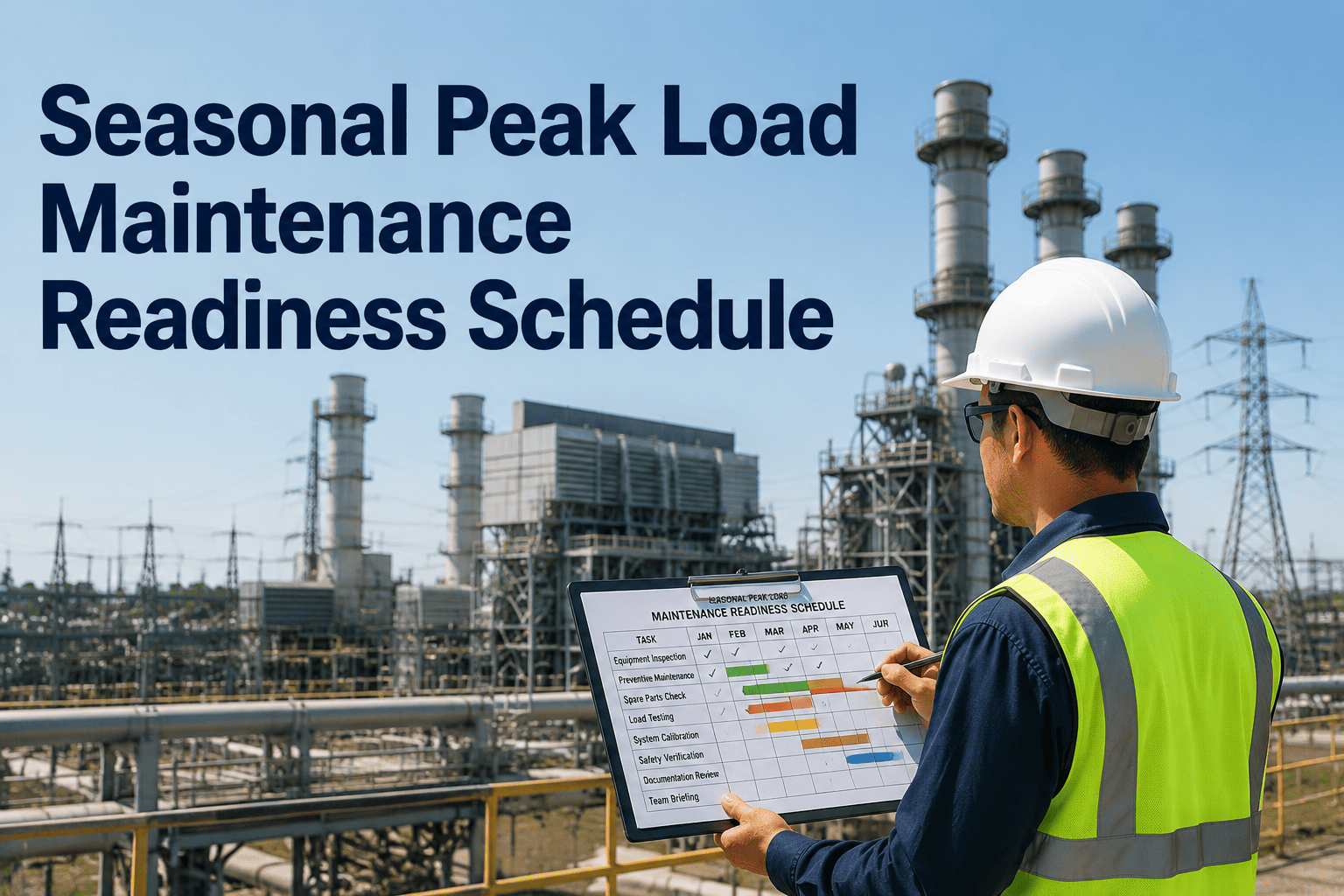
Peak demand season exposes every maintenance shortcut taken during the shoulder months. Equipment that ran comfortably at 70% load for half the year suddenly carries sustained full-load duty, and the assets most likely to fail are exactly the ones that were deferred because they "still seemed fine." A seasonal readiness schedule turns peak preparation from a scramble into a structured countdown, with the right inspections completed in the right order before demand actually arrives. Build your peak season readiness schedule in OxMaint or book a live demo to see automated seasonal PM in action.
Peak Demand Readiness
Seasonal Peak Load Maintenance Readiness Schedule
The grid doesn't care if your maintenance backlog caught up before peak season. Your readiness schedule has to.
Pre-Season
In-Season
Post-Season
Why Sustained Full-Load Running Breaks Different Equipment
Most of the year, a thermal unit cycles between partial loads, giving bearings, cooling systems, and electrical connections time to recover thermally between demand swings. Peak season removes that recovery window. Equipment runs at or near rated capacity for days or weeks at a stretch, and any marginal weakness left unaddressed gets discovered by sustained heat, not by a routine inspection.
01
Cooling Systems Lose Margin
Condenser and cooling tower performance that looked adequate at partial load can fall short once ambient temperatures and load both peak together.
02
Electrical Connections Run Hotter
Switchgear and transformer connections with marginal resistance generate more heat under sustained full load than they ever showed during partial-load operation.
03
Lubrication Demand Increases
Bearings under continuous high load consume and degrade lubricant faster, and oil sampling intervals set for normal operation can fall behind actual need.
04
Backup Systems Get Called On
Standby pumps, redundant fans, and emergency cooling paths that rarely run during shoulder months are suddenly needed and may not have been exercised recently.
The Three-Phase Peak Readiness Schedule
Phase 1: Pre-Season -- 6 to 8 Weeks Before Peak
Cooling tower fill inspection and basin cleaning completed before ambient temperatures rise
Thermal imaging survey of all switchgear and transformer connections under current load
Backlog review -- every deferred work order on a critical asset closed or formally risk-accepted
Standby and redundant equipment exercised under load, not just confirmed available on paper
Spare parts inventory confirmed for the highest-risk components identified in the backlog review
Phase 2: In-Season -- During Sustained Peak Demand
Daily vibration and temperature trend review on all units running continuous full load
Oil sampling frequency increased on heavily loaded bearings and gearboxes
Non-critical PM work deferred to protect technician availability for emergency response
Daily review of any trending alarm, with escalation before it becomes a forced derate
Phase 3: Post-Season -- Within 4 Weeks After Peak
Full inspection of every asset that ran at sustained full load, regardless of whether alarms occurred
Deferred PM work from the in-season period rescheduled and closed out
Post-season lessons learned review -- which components ran closest to their limits
Next season's pre-season checklist updated based on what was found this cycle
Asset Risk Under Sustained Peak Load
| Asset Group |
Peak-Season Stressor |
Pre-Season Action |
In-Season Monitoring |
| Cooling Tower / CW System |
Elevated ambient temperature plus sustained heat rejection load |
Fill cleaning, basin inspection, fan gearbox check |
Daily approach temperature trend |
| Switchgear and Transformers |
Sustained current flow heating marginal connections |
Thermal imaging survey of all connections |
Continuous thermal monitoring where available |
| Generator Cooling |
Reduced cooling margin at high ambient and full output |
Cooler performance verification, hydrogen purity check |
Stator and cooler temperature trend |
| Standby and Redundant Pumps |
Called into service after extended idle periods |
Functional test under load, seal inspection |
Vibration check on first activation |
Don't Build Your Peak Schedule From Memory
Automate Your Three-Phase Readiness Plan in OxMaint
OxMaint generates pre-season, in-season, and post-season work orders on a fixed calendar tied to your historical peak window, so nothing depends on someone remembering to start the countdown. Backlog review, thermal surveys, and standby equipment tests are all tracked to completion before peak demand arrives.
Expert Review
"The plants that struggle most during peak season aren't the ones with old equipment, they're the ones that treat peak readiness as a single pre-season checklist instead of a three-phase program. The post-season inspection is the step everyone skips, and it's the one that actually tells you what almost failed this year, before it fails next year." Reviewed by OxMaint's Reliability Engineering Advisory Team, drawing on seasonal readiness programs across thermal generation sites.
Frequently Asked Questions
How far in advance should peak season maintenance prep begin?
Pre-season readiness work should begin six to eight weeks before your historical peak demand window, giving enough time to complete thermal imaging surveys, backlog reviews, and standby equipment testing without rushing critical inspections. Starting later compresses the schedule and forces deferred items into the highest-risk period.
OxMaint can auto-generate this countdown based on your site's historical peak data.
What should be inspected first when preparing for peak load season?
Cooling systems and electrical connections should be prioritized first, since both lose performance margin under the combination of elevated ambient temperature and sustained full-load operation that defines peak season. A thermal imaging survey of switchgear and a cooling tower basin inspection typically surface the highest-risk findings.
Book a demo to see a prioritized pre-season checklist built for your asset mix.
Should routine PM work continue during peak season?
Non-critical PM work is typically deferred during sustained peak demand so technician capacity is protected for emergency response and daily monitoring, while critical-asset monitoring increases rather than decreases. Deferred work should be tracked, not forgotten, and closed out immediately in the post-season phase.
OxMaint automatically reschedules deferred PM into the post-season window.
What is the purpose of a post-season inspection?
A post-season inspection identifies which components ran closest to their physical limits during sustained peak load, even if no alarm was triggered, so those findings can shape next year's pre-season checklist. Skipping this step means the same marginal components enter the next peak cycle unaddressed.
Talk to OxMaint about structuring a post-season lessons-learned review.
Can seasonal readiness schedules be automated in a CMMS?
Yes, a CMMS can trigger pre-season, in-season, and post-season work orders automatically based on a fixed calendar date or historical demand pattern, removing dependence on any single person remembering to start the process each year. This also ensures every phase is documented for year-over-year comparison.
Set up automated seasonal scheduling in a free OxMaint trial.
Peak Demand Doesn't Send a Calendar Invite
Get Ahead of Peak Season Before It Gets Ahead of You
A readiness schedule only works if it starts on time every year, regardless of who's on shift or how busy the backlog looks. OxMaint keeps your three-phase peak plan running automatically, season after season.