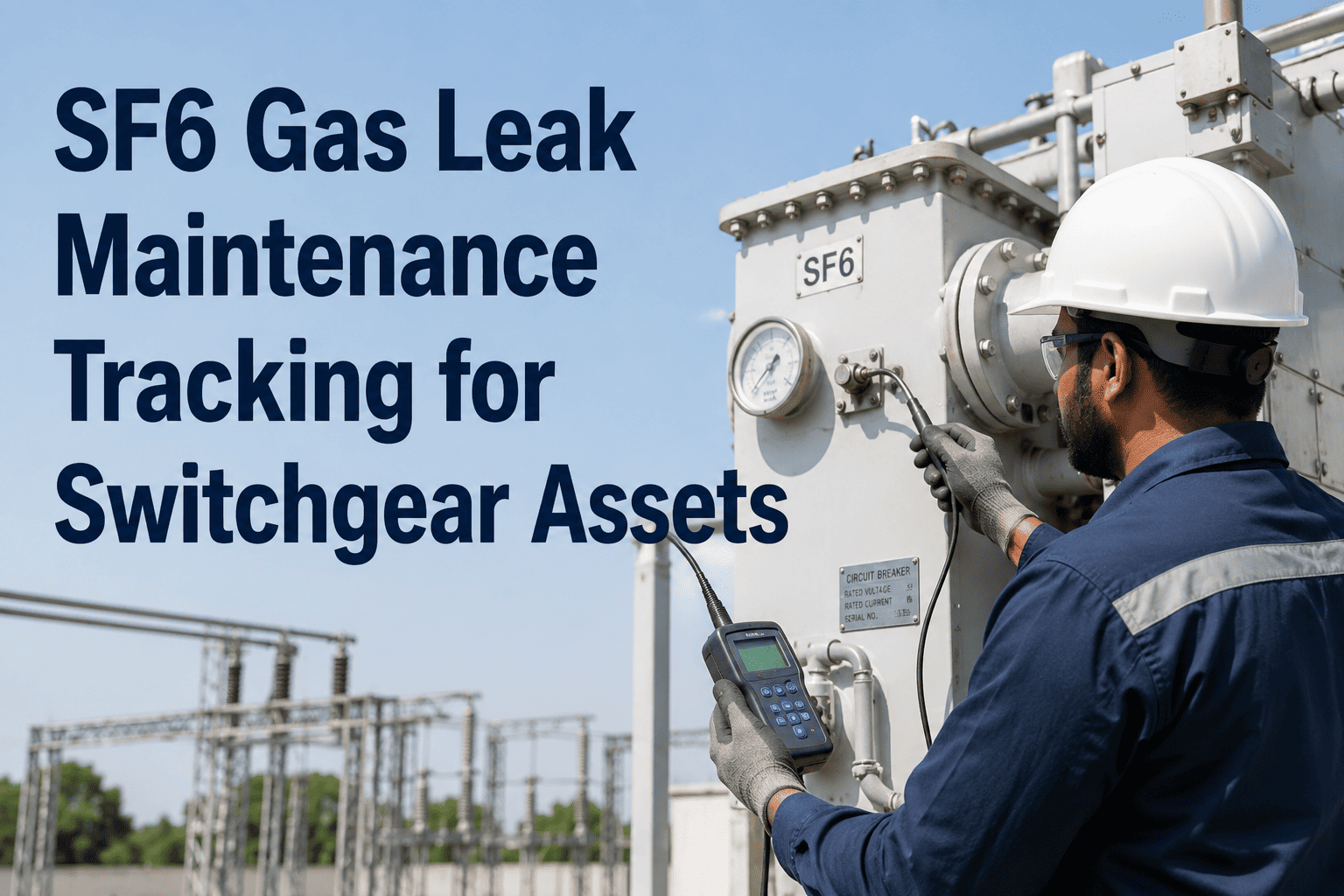
SF6 is the most potent greenhouse gas commercially in use — with a global warming potential 23,900 times that of CO2 — and regulators in both the United States and European Union have tightened requirements on how power utilities detect, document, and remediate every confirmed gas leak from circuit breakers, gas-insulated switchgear (GIS), and disconnectors. For substation maintenance teams, the compliance challenge is not finding the leak. It is proving to auditors and environmental regulators that every detected leak triggered a documented maintenance response within the required timeframe, that the gas recovered during service was properly handled under IEC 62271-4, and that no asset in the GIS lineup has an unresolved open leak event in its maintenance record. OxMaint gives substation maintenance teams a structured asset-level tracking system for every SF6 compartment in their lineup, so a leak event goes from field detection to documented close-out in a single traceable workflow. Start a free trial and configure your first SF6 asset register today.
23,900x
GWP of SF6 vs CO2 — highest of any industrial gas
80%
Of SF6 circuit breakers show pressure loss before scheduled inspection
IEC 62271-4
Standard governing SF6 handling, leak repair, and gas recovery procedures
3 yrs
Maximum interval between full SF6 compartment gas density inspections
Why this matters now
SF6 leak tracking is an environmental compliance obligation, not just a maintenance task
The EPA's Greenhouse Gas Reporting Program (GHGRP) under 40 CFR Part 98, Subpart DD requires electric power systems that contain SF6 to report annual SF6 emissions. Reporting is calculated from nameplate capacity, gas additions, and disposals — and an untracked leak that results in gas refill without a work order creates an emissions accounting gap that cannot be reconciled at year-end. On the EU side, the F-Gas Regulation (EU) 2024/573 imposes leak check frequency requirements by gas quantity and mandates certified technician documentation for every service event. In both regulatory regimes, the maintenance record is the compliance record.
US
EPA GHGRP — 40 CFR Part 98, Subpart DD
Annual SF6 emissions reporting. Gas additions and removals must be tracked per equipment nameplate. Untracked refills create reporting gaps subject to enforcement.
EU
EU F-Gas Regulation 2024/573
Leak check intervals based on CO2-equivalent gas charge. Equipment with leaks must be repaired immediately or within 30 days. Certified technicians required. Records retained 5 years minimum.
IEC
IEC 62271-4 — SF6 Handling Procedures
Governs gas recovery, refilling, and leak-testing procedures for HV switchgear. Requires documented gas handling logs and certified equipment records for every service event involving SF6 gas.
The leak lifecycle
What happens between leak detection and closed work order — and where documentation fails
An SF6 leak event has a predictable lifecycle: pressure alarm or density monitor alert, field inspection and leak location, service decision (immediate repair or scheduled remediation), gas recovery if service is required, and close-out documentation. Most substations handle the physical steps correctly. The documentation chain breaks at three specific points: the leak location is noted verbally rather than logged against the GIS compartment asset, the gas addition is recorded on a paper refill log that never reaches the CMMS, and the close-out has no timestamp that supports the regulatory response-time requirement.
1
Density alarm or scheduled inspection triggers leak event
Logged as work order against GIS compartment asset
2
Field technician locates leak using detector or pressure data
Leak point and severity documented in mobile work order
3
Service decision: immediate repair or schedule with interim monitoring
Decision and rationale must be documented — often missing
4
Gas recovery, repair, refill with certified technician
Gas quantity and technician certification rarely filed to asset record
5
Post-repair leak test and close-out confirmation
Close-out timestamp becomes regulatory response-time evidence
Every SF6 event. Every compartment. Every timestamp.
OxMaint turns your GIS lineup into a traceable SF6 compliance record
From density alarm to close-out, every step of the SF6 leak lifecycle is logged against the specific GIS compartment it belongs to. Regulatory reporting, annual gas accounting, and inspection interval compliance are always current and exportable.
PM framework
SF6 switchgear inspection schedule aligned to IEC 62271 and F-Gas requirements
Leak check intervals under the EU F-Gas Regulation are determined by the CO2-equivalent charge of each compartment. Compartments with CO2-equivalent charges above certain thresholds require annual or semiannual checks, not just a three-year default interval. Mapping each GIS compartment's nameplate gas charge to the correct inspection frequency is the first step in building a compliant PM program — and it requires the compartment to be a structured asset in your CMMS with gas quantity recorded, not a row in a spreadsheet.
Daily
Density monitor and low-pressure alarm status review
Visual or SCADA check of all SF6 density indicators for any threshold warnings
Monthly
Pressure and temperature compensated density trend review
Compare current readings against baseline. Flag any compartments with unexplained negative trend over prior 30 days
6-Monthly
Formal leak check — high CO2-equivalent compartments
Required under F-Gas Regulation for compartments above applicable tonne CO2e threshold. Must use calibrated detector, certified technician, documented result
Annual
Gas quantity reconciliation and GHGRP data preparation
Compare nameplate capacity against refill records and density readings. Generate SF6 emissions figures for EPA GHGRP Subpart DD annual report
3-Year
Full GIS compartment inspection and gas purity test
SF6 gas purity check, moisture content, and decomposition products. Required before gas handling or service events under IEC 62271-4
On-Event
Post-fault SF6 gas quality analysis
After any internal arc or fault event, SF6 gas must be analyzed for decomposition products before compartment is re-energized. Corrective WO mandatory
Common questions
What substation teams ask before deploying SF6 tracking in a CMMS
How does OxMaint handle gas quantity tracking for EPA GHGRP annual SF6 emissions reporting?
Each GIS compartment is configured as an asset with its nameplate SF6 charge recorded. Every gas addition and removal during service is logged against that asset record. At year-end, OxMaint generates the net SF6 additions report by equipment type, supporting the GHGRP Subpart DD annual calculation without manual reconciliation.
Start a free trial to configure your GIS asset register with gas quantity fields.
Can the system track certified technician credentials for SF6 service events under the F-Gas Regulation?
Yes. Technician certification records are stored in OxMaint and linked to work orders. When a gas handling task requires a certified F-Gas technician, the work order enforces assignment to a qualified employee and attaches the certification document to the completed event record. The documentation stays with the asset history, not in a separate HR file.
What is the best way to set up SF6 density alarm notifications so a leak event always creates a work order?
OxMaint connects threshold-based alerts from SCADA or sensor inputs to automatic corrective work order generation. When a density monitor reading crosses its low-pressure threshold, a work order is created at the specific GIS compartment asset with the event timestamp before a technician even opens the system.
Book a demo to see the alert-to-WO workflow configured for a typical GIS lineup.
How do we track SF6 gas across a large substation with 40 or more individual compartments?
Each compartment is a separate asset in the OxMaint hierarchy — structured under the bay or panel it belongs to. PM schedules, leak check intervals, and gas quantity records are managed at the compartment level. Fleet-level reporting rolls up across all compartments for the annual GHGRP submission and the regulatory inspection interval dashboard.
Does OxMaint support the post-fault SF6 gas quality analysis workflow required by IEC 62271-4?
Yes. Post-fault SF6 quality analysis is configured as a mandatory corrective work order task triggered by any fault event on an SF6 asset. The work order requires documented gas purity results and decomposition product analysis before the task can be closed, preventing re-energization without completed evidence.
SF6 compliance built into your maintenance workflow
Every leak event should create a compliance record, not a documentation gap
Regulators reviewing SF6 compliance are not looking at your gas — they are looking at your records. Every untracked refill, every undocumented leak location, and every missing certified technician log is an exposure that surfaces at audit time. OxMaint closes the documentation chain from density alarm to annual GHGRP submission, so your SF6 compliance is continuous, not a year-end reconstruction project.