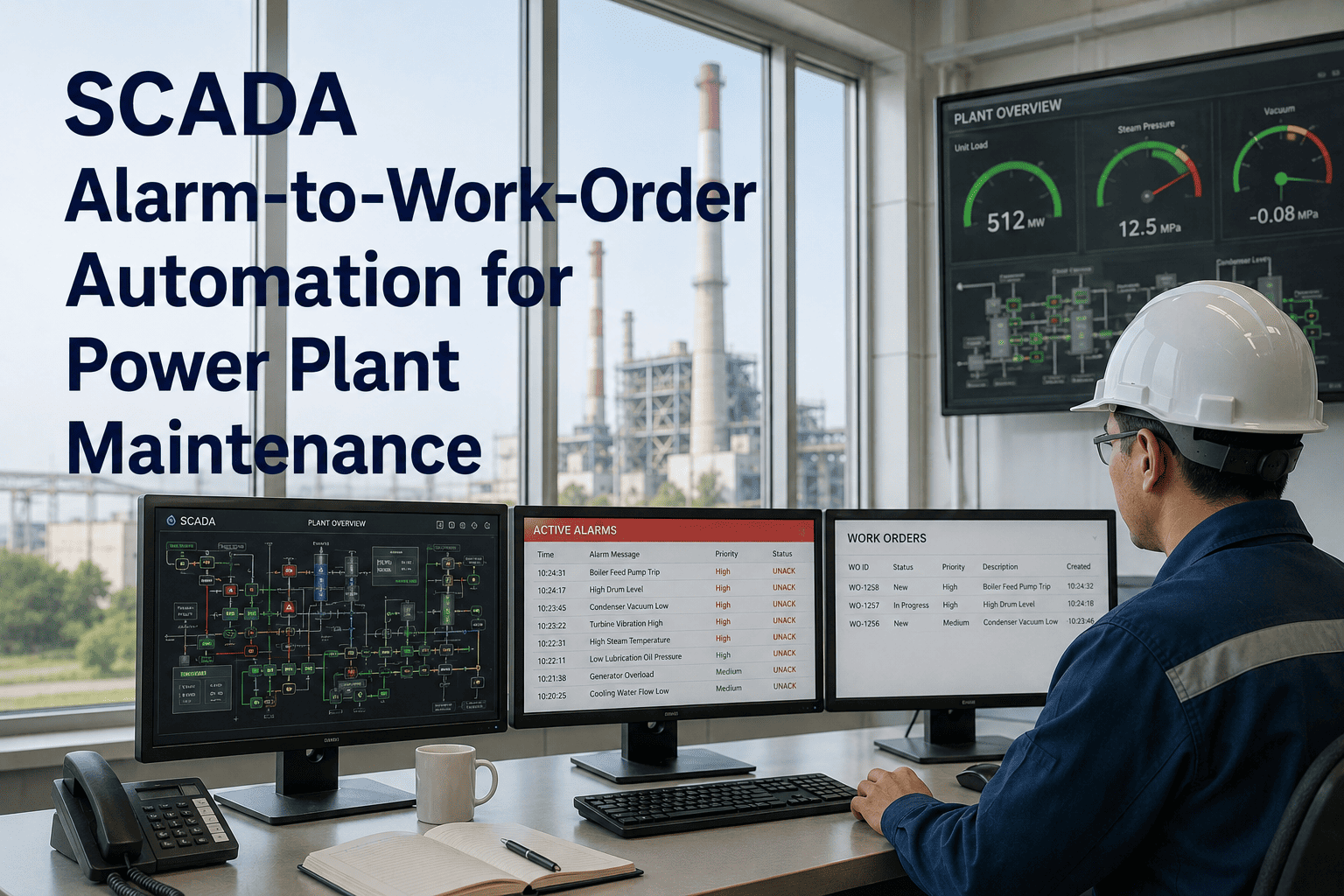
Small and mid-size power plants — from 10 MW gas peakers to 200 MW combined-cycle facilities — are running the same critical equipment as utility-scale operations, but with a fraction of the maintenance staff and budget. When a boiler feed pump fails at 2 AM or a transformer shows thermal anomalies two weeks before a scheduled outage, the difference between a $40,000 planned repair and a $400,000 emergency shutdown comes down to whether your team has a CMMS built for how you actually operate — not one designed for a 100-person enterprise maintenance department that costs as much to implement as the problem it solves.
$8
Per user/month — Oxmaint starts here, no IT infrastructure required
4 Days
Average migration time from spreadsheets to live CMMS for small plants
27%
Average reduction in unplanned downtime after CMMS adoption
47%
Work order completion rate improvement within first 30 days reported by plant teams
The Real Problem: Enterprise CMMS Was Not Built for Your Plant
When a 50–200 MW plant tries to implement IBM Maximo or SAP PM, they hit the same wall every time: 6-month implementation timelines, expensive consultants, IT infrastructure requirements, and interfaces so complex that technicians abandon the system and go back to paper within weeks. The result is a CMMS investment that produces no maintenance data because the people on the floor refuse to use it.
Enterprise CMMS for Small Plants
6-12 month implementation timelines
Requires dedicated IT team or consultant
$50K–$200K implementation costs before going live
Complex interfaces technicians avoid using
Expensive per-module add-ons for basic features
Maintenance data stays stale or incomplete
Oxmaint for Small & Mid-Size Plants
Live in 4–7 days with guided onboarding
Cloud-based — no IT infrastructure needed
From $8/user/month — full features included
Mobile-first — technicians actually use it on the floor
All core capabilities in a single subscription
Real-time maintenance data from day one
Your Plant Doesn't Need a Six-Month Implementation. It Needs to Go Live This Week.
Oxmaint is purpose-built for asset-intensive operations where maintenance teams are small, schedules are tight, and downtime is expensive. Start your free trial today — no IT team, no infrastructure, no consultant required.
What Small & Mid-Size Power Plants Actually Need from a CMMS
The maintenance challenges at a 50–200 MW plant are different from a large utility — but no less demanding. Your team is smaller, your margin for error is tighter, and you cannot afford a system that creates more work than it eliminates. Here is what a CMMS needs to do to earn its place in a lean plant operation.
Work Order Management
Create, Assign, and Track Every Job Without Email Chains
Oxmaint replaces the whiteboard, radio calls, and paper work request pads with a single mobile interface. Technicians create work requests from their phones, managers assign with one tap, and every job has a real-time status — open, in progress, pending parts, complete. No more end-of-week data entry from paper logs.
Work Order Status
Completed
72%
In Progress
18%
Pending Parts
7%
Overdue
3%
PM Schedule — Next 30 Days
Gas Turbine GT-01 Lube Oil Filter — 3 days
Cooling Water Pump CWP-03 Inspection — 9 days
Generator G-01 Brush Inspection — 14 days
Transformer TR-02 Oil Sampling — 22 days
Boiler BFP-01 Bearing Check — 28 days
Preventive Maintenance
Automated PM Schedules That Run Without You Chasing Them
Configure PM intervals once — by calendar days, running hours, or equipment cycles — and Oxmaint generates, assigns, and tracks every scheduled task automatically. Mobile alerts reach technicians before due dates. Overdue PMs escalate to supervisors. Nothing gets missed because someone was on leave.
Asset Management
Full Equipment History — Searchable in Seconds
Every turbine, pump, motor, and valve in your plant gets its own digital record with manufacturer specs, installation date, full maintenance history, and next scheduled service. When an auditor asks what was done to GT-02 in the last 18 months, the answer is three taps away — not a 2-hour document hunt.
Asset Health Overview
Gas Turbine GT-01
Good
Boiler Feed Pump BFP-02
Monitor
Generator G-01
Good
Cooling Tower CT-03
Action Needed
Transformer TR-01
Good
Air Compressor AC-01
Good
Key CMMS Capabilities by Plant Size — What You Actually Need
Not every CMMS feature earns its cost at a small or mid-size plant. This table maps the features that deliver measurable ROI at each scale — so you can evaluate platforms based on what your operation actually needs, not a feature list built for a national utility.
CMMS Capability
Small Plant (10–50 MW)
Mid-Size Plant (50–200 MW)
Oxmaint Support
Mobile Work Orders
Critical — small teams need field-first
Critical — shift coordination
Native iOS & Android
Preventive Maintenance Scheduling
Critical — no dedicated planner
Critical — multi-asset scheduling
Automated by interval or hours
Asset History & Records
Important — compliance basis
Critical — audit readiness
Full lifecycle per asset
Spare Parts Inventory
Important — avoid emergency orders
Critical — large parts catalog
Inventory linked to work orders
Condition Monitoring / IoT
Optional — key equipment only
Important — critical assets
Sensor integration available
Outage Planning
Optional — basic scheduling
Important — coordinated shutdowns
Multi-task outage windows
Analytics & KPI Reporting
Important — MTBF & downtime
Critical — management reporting
Real-time MTBF, MTTR dashboards
ERP/Finance Integration
Optional at this scale
Useful but not critical
API available for integration
How Small Plants Typically Get ROI in Year One
The business case for CMMS at a small or mid-size plant does not require sophisticated modeling. It comes down to four numbers: how much your unplanned downtime costs per day, how many unplanned events you had last year, how much overtime your reactive maintenance model creates, and how much you spend on emergency parts orders at premium prices.
1
Downtime Reduction
A 10 MW peaker plant losing 3 days of unplanned generation per year at $15,000/day recovers $45,000 annually from a 30% downtime reduction — against a CMMS cost of under $5,000/year for a 5-person maintenance team.
2
Overtime Elimination
Reactive maintenance drives 20–40% of maintenance labor into overtime rates. A CMMS shifts work to planned windows — a 5-person team can save $30,000–$60,000 in overtime annually by eliminating after-hours emergency calls for preventable failures.
3
Emergency Parts Premium Elimination
Emergency spare parts orders carry a 2.4x cost premium over planned procurement. Plants running reactive maintenance on even three or four critical components per year typically spend $20,000–$80,000 in avoidable parts premiums that CMMS-driven inventory planning eliminates.
4
Compliance & Audit Preparation
Regulatory audits that previously required 2–3 days of document preparation become same-day report pulls. For small teams where that time comes from plant managers and senior technicians, this alone saves 40–80 hours of high-cost labor per audit cycle.
Frequently Asked Questions
Most small plants with under 200 assets are live in 4–7 days with guided onboarding. You import your asset list, configure PM schedules for your critical equipment, and your team starts logging work orders immediately. Start your free trial to see how the setup works — no IT team or infrastructure required to begin.
Absolutely — small teams often see the fastest ROI because a single missed PM on a critical asset can take down the entire plant. Oxmaint's mobile-first interface means one technician can manage work orders, log readings, and update asset records from their phone during normal rounds. Book a demo to see how small-team workflows are configured in Oxmaint.
Yes. Oxmaint accepts data from IIoT sensors via REST API, MQTT, and OPC-UA — allowing condition-based work order triggering when sensor thresholds are crossed. For small plants, this is typically configured for the two or three most critical assets first. Start your free trial to explore the integration options.
Migrating from spreadsheets to Oxmaint is a structured import process, not a development project. Your asset list, PM schedules, and maintenance history can be imported via CSV templates during onboarding. Most small plants complete migration in a single day. Book a walkthrough to see exactly what the migration involves for your data setup.
Yes. Oxmaint supports multi-unit asset hierarchies — gas turbines, steam turbines, diesel generators, solar inverters, and battery systems can all live in the same asset register with technology-specific PM templates. Start your free trial to configure your specific asset mix.
Your Small Plant Has the Same Equipment Risks as a Large Utility — With Less Room for Error
Oxmaint gives small and mid-size power plants enterprise-grade maintenance management at a price and deployment speed that fits your operation. No IT team. No consultant. No six-month timeline. Go live this week and see the difference in your first 30 days.