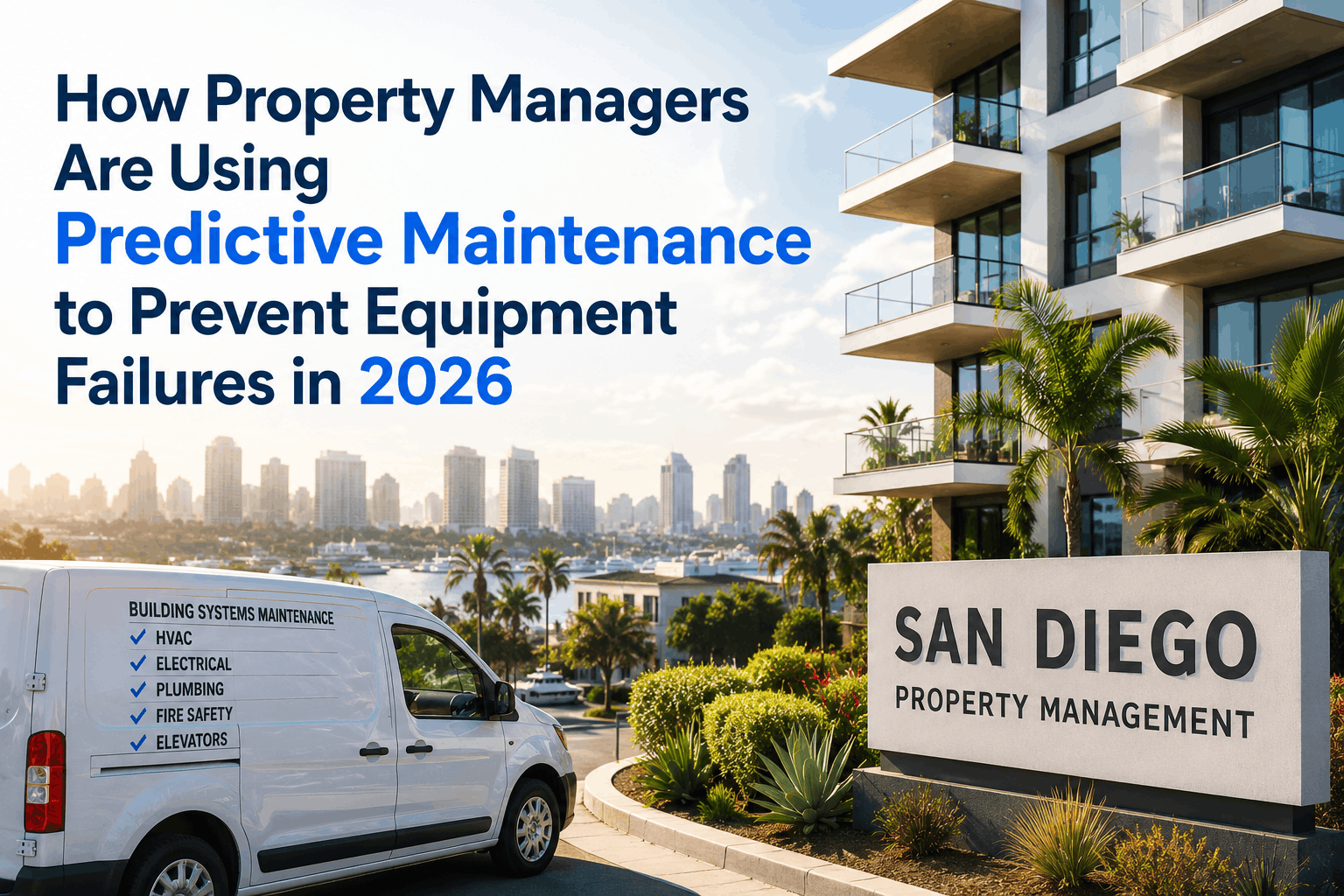
Property managers juggle hundreds of assets across buildings—HVAC systems, elevators, plumbing, electrical panels, roofing—and most still wait for something to break before acting. The cost of this reactive approach is staggering: emergency repairs cost 3-7x more than planned maintenance, tenant complaints spike, and property values erode silently. AI-driven predictive maintenance changes this equation entirely by analyzing sensor data, work order history, and environmental patterns to predict failures before they happen. Modern CMMS platforms with AI capabilities are making predictive maintenance accessible to property management teams of every size, eliminating the guesswork that leads to costly breakdowns and unhappy tenants.
This guide covers how AI predictive maintenance works in property management, the specific building systems that benefit most, implementation strategies for property portfolios, and the measurable ROI you can expect from making the shift.
AI Predictive Maintenance Defined
Using machine learning to predict equipment failures before they occur in managed properties
The Predictive Maintenance Shift
Why Property Management Needs Predictive Maintenance
Property management has unique maintenance challenges that make AI prediction especially valuable. Unlike manufacturing where downtime means lost production, property failures directly impact tenant safety, comfort, and lease renewals. Talk to our property maintenance experts about assessing your portfolio's predictive maintenance readiness.
The Reactive Maintenance Trap
60%+ of property teams are stuck hereMost property managers operate in firefighting mode—responding to emergency calls, dispatching technicians reactively, and paying premium rates for urgent repairs that could have been prevented.
The Real Costs
The AI Predictive Advantage
25-40% cost reduction typicalAI-driven predictive maintenance analyzes patterns across your entire property portfolio to forecast failures weeks or months in advance—giving you time to plan, budget, and schedule repairs at optimal cost.
Key Benefits
Building Systems That Benefit Most from AI Prediction
Not every building system justifies AI-driven monitoring. Focus predictive maintenance on systems where failure is expensive, disruptive, or safety-critical. Oxmaint's AI engine prioritizes alerts based on asset criticality and predicted failure impact.
HVAC Systems
The #1 maintenance cost driver in properties. AI monitors compressor performance, refrigerant levels, airflow patterns, and energy consumption to predict failures 2-6 weeks out.
Plumbing & Water Systems
Water damage is the most expensive property claim. AI detects micro-leak patterns, pressure anomalies, and pipe corrosion indicators before catastrophic failures occur.
Elevators & Vertical Transport
Elevator downtime directly impacts tenant satisfaction and ADA compliance. AI monitors motor performance, door mechanisms, and cable wear to predict service needs.
Additional High-Impact Systems for AI Prediction
Electrical Systems
Panel overloads, transformer degradation, and arc fault detection prevent fire hazards.
Roofing & Envelope
Moisture intrusion detection and thermal imaging identify roof failures early.
Fire & Life Safety
Sprinkler valve monitoring, fire pump performance, and alarm system health tracking.
Parking & Access
Gate mechanisms, lighting systems, and security hardware predictive monitoring.
Start Predicting Failures Before They Happen
Oxmaint's AI-powered CMMS analyzes your work order history and equipment data to predict failures, automate scheduling, and reduce emergency maintenance costs across your entire property portfolio.
How AI Predictive Maintenance Works in Properties
Understanding the AI pipeline helps property managers set realistic expectations and make better implementation decisions. The process follows four stages, each building on the previous one.
Stage 1: Data Collection
Foundation LayerAI needs data to learn from. Modern property systems generate massive amounts of usable data without expensive sensor retrofits.
Data Sources
- IoT sensors (temperature, vibration, humidity)
- Building Management Systems (BMS/BAS)
- Smart meter energy consumption data
- Historical work order records from CMMS
- Tenant complaint logs and service requests
- Equipment manufacturer specifications
Stage 2: Pattern Analysis
Intelligence LayerMachine learning algorithms analyze historical and real-time data to establish normal operating baselines and identify deviation patterns.
AI Analysis Methods
- Anomaly detection (deviations from normal)
- Degradation curves (performance decline trends)
- Correlation analysis (linked failure patterns)
- Seasonal pattern recognition (weather impacts)
- Portfolio-wide benchmarking (cross-property)
- Failure mode classification
Stage 3: Failure Prediction
Insight LayerThe AI generates specific predictions with confidence scores, estimated failure windows, and risk assessments for each monitored asset.
Prediction Outputs
- Remaining useful life estimates
- Failure probability scores (next 30/60/90 days)
- Risk rankings across property portfolio
- Recommended maintenance actions
- Cost-of-inaction projections
- Optimal repair timing windows
Stage 4: Automated Action
Execution LayerPredictions trigger automated workflows—work orders, parts procurement, technician scheduling—without manual intervention.
Automated Responses
- Auto-generated work orders with priority
- Technician scheduling and dispatch
- Parts pre-ordering for predicted repairs
- Tenant notification for planned service
- Budget allocation and cost tracking
- Compliance documentation generation
Key AI Predictive Metrics for Property Managers
Tracking the right metrics ensures your AI predictive maintenance program delivers measurable results. These KPIs help you prove ROI and continuously improve. Oxmaint tracks these metrics automatically across your entire portfolio.
Prediction Accuracy Rate
The percentage of AI-predicted failures that actually occur within the predicted timeframe. This is the core measure of your AI system's effectiveness.
Emergency Work Order Reduction
The decrease in unplanned, emergency maintenance calls since implementing predictive maintenance. This directly translates to cost savings and tenant satisfaction.
Mean Time Between Failures (MTBF)
Average operating time between equipment failures. AI-optimized maintenance should steadily increase MTBF across all monitored assets.
Maintenance Cost Per Square Foot
Total maintenance spend divided by total managed square footage. The property-specific metric that boards and owners care about most.
Tenant Satisfaction & Complaint Rate
Track maintenance-related tenant complaints and satisfaction survey scores. The business case for predictive maintenance extends beyond cost—it protects revenue.
AI vs. Traditional Maintenance Approaches
Understanding where AI predictive maintenance fits compared to traditional strategies helps property teams make smarter investment decisions. Schedule a consultation to assess where your properties fall on this spectrum.
AI Predictive Maintenance
Data-driven, condition-based approach that learns and improves over time.
Advantages
- Repairs happen at optimal timing—not too early, not too late
- Portfolio-wide insights identify systemic issues
- Continuously improves with more data
- Reduces both emergency costs and unnecessary PM
- Predicts cascading failures across systems
Considerations
- Requires initial data collection period (3-6 months)
- Upfront technology investment needed
- Staff training for new workflows
Traditional Reactive/Calendar PM
Time-based or break-fix approaches that don't account for actual equipment condition.
Limitations
- Calendar PM wastes 30-40% of maintenance budget
- Reactive repairs cost 3-7x planned maintenance
- No visibility into equipment health trends
- Cannot predict or prevent cascading failures
- Tenant disruption from unexpected breakdowns
The Result
- Higher costs, lower reliability, unhappy tenants
- Difficulty justifying capital expenditure timing
- Staff burnout from constant firefighting
Alert Configuration for Property Portfolios
AI generates predictions continuously, but not every prediction demands the same response. Configure alerts based on urgency, impact, and property type to avoid alert fatigue.
Critical – Act Now
Imminent failure predicted on life safety systems, water leak detected, elevator fault code, HVAC failure in extreme weather, gas leak indicators.
Warning – Schedule This Week
Equipment degradation trending toward failure in 2-4 weeks, unusual energy consumption patterns, compressor performance declining, bearing vibration increasing.
Advisory – Plan Next Month
Predicted failure in 1-3 months, equipment approaching end of optimal life, seasonal preparation recommendations, efficiency degradation detected.
Budget – Capital Planning
Asset replacement needed within 6-12 months, major system overhaul recommended, roof membrane approaching end of life, boiler efficiency below replacement threshold.
Insight – Portfolio Trend
Cross-property failure pattern detected, vendor performance declining, seasonal trend approaching, energy efficiency opportunity identified across buildings.
Compliance – Regulatory
Inspection deadline approaching, code-required maintenance due, fire system testing overdue, ADA compliance issue detected, insurance requirement upcoming.
Intelligent Alerts for Your Entire Portfolio
Oxmaint's AI-powered alerting system delivers the right notification to the right person at the right time—via email, SMS, or mobile push—with automatic escalation when action isn't taken.
Implementation Roadmap for Property Managers
Implementing AI predictive maintenance across a property portfolio requires a phased approach. Rushing the technology without data foundation leads to poor predictions and team distrust.
Assessment & Data Foundation (Weeks 1-4)
Pilot Property Deployment (Weeks 5-12)
Portfolio Expansion (Months 4-6)
Optimization & Automation (Months 7-12+)
Frequently Asked Questions
How much does AI predictive maintenance cost for property management?
Implementation costs vary based on portfolio size and sensor needs, but most property managers see ROI within 6-12 months. Cloud-based CMMS platforms like Oxmaint include AI capabilities in standard subscriptions, eliminating the need for expensive standalone analytics tools. IoT sensor costs have dropped 70%+ in recent years, making hardware investment modest. The key cost comparison: predictive maintenance investment vs. the emergency repairs, tenant turnover, and shortened equipment life you're already paying for.
Do we need IoT sensors on every piece of equipment?
No—start with your highest-cost, highest-impact systems. AI can generate useful predictions from work order history and BMS data alone, without any new sensors. Add IoT sensors selectively to critical HVAC units, water systems, and elevators where the cost of failure justifies monitoring investment. A typical 100-unit apartment building might start with 15-20 sensors on critical systems and expand based on results.
How accurate are AI failure predictions for building systems?
Modern AI achieves 80-90%+ accuracy after sufficient training data. HVAC predictions tend to be most accurate because these systems generate rich data. Plumbing predictions are improving rapidly with moisture and pressure sensors. The key factor is data quality and volume—AI needs 6-12 months of clean historical data to build reliable models. Accuracy improves continuously as the system learns from your specific equipment and conditions.
Can AI predictive maintenance work for older buildings without smart systems?
Yes—AI doesn't require a smart building to deliver value. Even without a BMS, you can retrofit IoT sensors on critical equipment at low cost. More importantly, AI can analyze patterns in your existing work order history, tenant complaints, and maintenance records to identify failure patterns. Many of the most impactful predictions come from historical data analysis, not real-time sensor feeds. Start with data you already have.
How does predictive maintenance impact property valuation and NOI?
Predictive maintenance directly improves NOI through lower operating costs and higher tenant retention. Properties with documented predictive maintenance programs command higher valuations because buyers see lower capital risk, better-maintained assets, and more predictable operating expenses. Reduced emergency maintenance spend flows directly to the bottom line, while higher tenant satisfaction reduces costly turnover. Some property managers report 10-15% NOI improvement within 18 months of implementation.