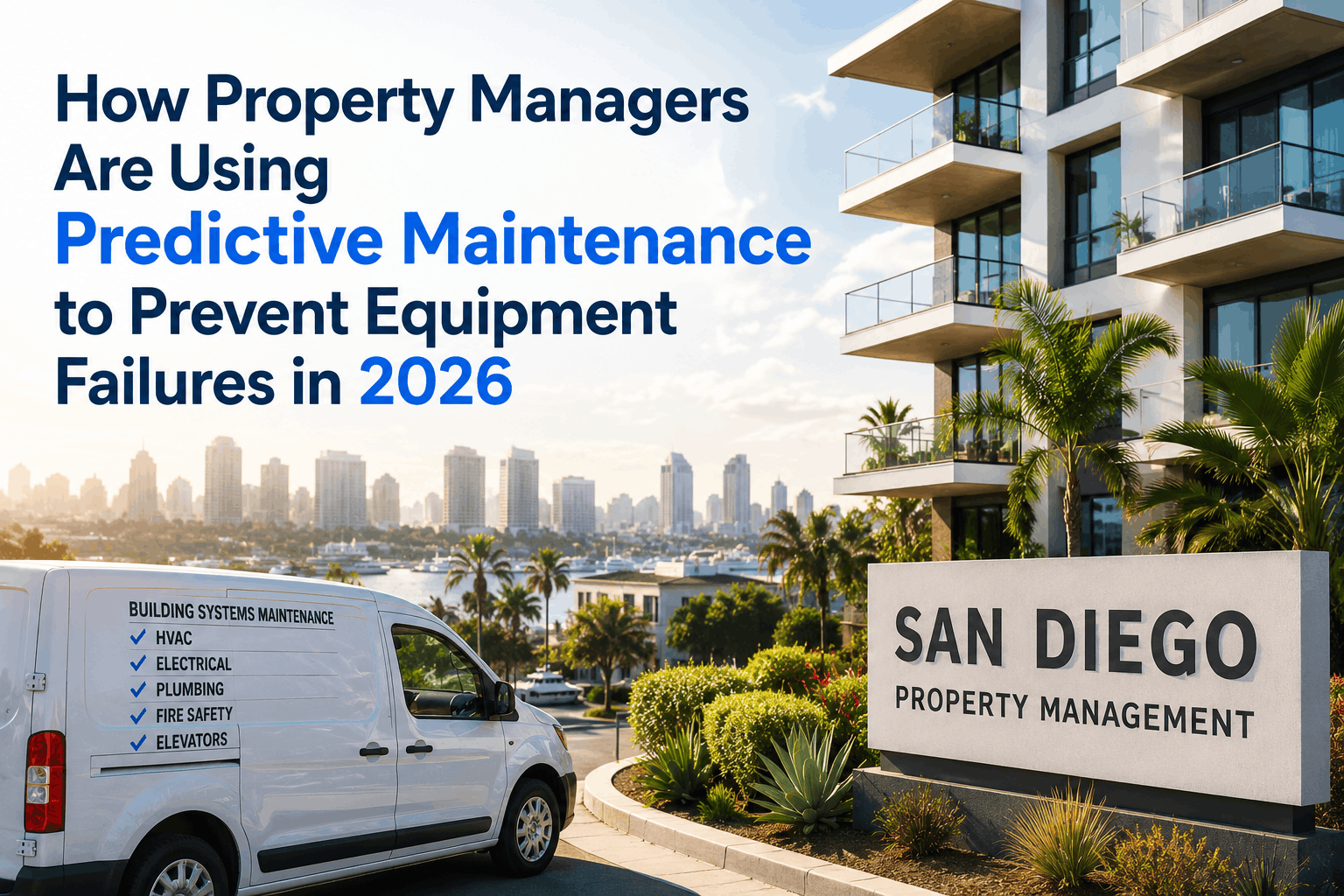
Predictive maintenance using AI and sensor data is no longer a future concept — it is the operational baseline for property managers serious about efficiency in 2026. The technology shifts maintenance from reactive firefighting (fix it when it breaks) to precision-scheduled, data-driven intervention (fix it before failure occurs). Properties implementing AI-driven predictive maintenance typically reduce total maintenance costs by 25–40% while improving tenant satisfaction scores by 15–30%. The 2026 frontier is here: facility teams across the USA, UK, Canada, and Europe are detecting equipment failures 14–28 days before they happen, preventing emergency repairs worth $47,000+, and extending asset lifespan by several years. Only 27% of facilities have adopted predictive maintenance today — meaning 73% are still paying for failures that sensor data and machine learning could have prevented. This guide walks property managers, HOA directors, and facility professionals through exactly how AI predictive maintenance works, what equipment it covers, the ROI timeline, and how to deploy it without enterprise-level IT projects.
How Property Managers Are Using Predictive Maintenance to Stop Equipment Failures
Your building's HVAC, elevators, and electrical systems are already sending failure signals weeks in advance. AI listens to that data, flags problems before tenants notice, and automates the work order — turning maintenance from reactive crisis management into proactive asset health. OxMaint's predictive maintenance detects failures 14–28 days early and prevents the $47,000+ emergency repairs.
From Reactive to Predictive: The Three Maintenance Paradigms
Property maintenance operates across three fundamentally different models, each with distinct cost and outcome profiles. Reactive maintenance (fix it when it breaks) is the operational status quo for 73% of facilities. Equipment runs until failure, then an expensive emergency contractor is dispatched. Downtime is unplanned, disruptive, and tenant-facing. Emergency repairs cost 3–5x more than planned maintenance for the same failure mode. Preventive maintenance (fix it on a schedule) improves on reactive by scheduling work in advance. HVAC units get serviced every 90 days, filters are replaced quarterly, and systems get inspected on a calendar basis. This eliminates most emergency calls, reduces labor costs, and extends asset lifespan. But preventive schedules are often inefficient — equipment gets serviced before it needs it, wasting labor and parts on equipment that still has useful life remaining. Predictive maintenance (fix it when data says it needs it) is the optimization layer on top of preventive. AI monitors equipment condition in real-time, identifies early failure signatures invisible to calendars, and triggers work orders only when needed. The same HVAC unit might not need service for 120 days one year and 65 days the next, depending on actual operating stress. Predictive maintenance adapts to real conditions, eliminating both emergency calls and unnecessary preventive visits. The result: 25–40% lower maintenance costs than preventive schedules alone, extended asset lifespan, and zero emergency disruptions.
What Equipment Does AI Predictive Maintenance Cover in Property Management?
Predictive maintenance works best on equipment with measurable failure signatures — systems where sensor data reveals degradation before catastrophic failure. HVAC chillers, air handlers, cooling towers, and heat pumps are the highest-value targets because they operate continuously, are expensive to replace ($60K–$150K), and have clear failure patterns (vibration, pressure, temperature anomalies). Elevators generate continuous operational data (load, acceleration, vibration) that AI models can analyze to detect mechanical wear, brake degradation, or suspension issues weeks before they require emergency repair or statutory shutdown. Electrical panels and distribution systems can be monitored for power quality degradation, load imbalances, and thermal stress. Boilers and hot water systems show clear patterns of scale buildup, pressure loss, and combustion efficiency decline. Pumping systems (chilled water, condenser water, hot water return) have measurable vibration, pressure, and temperature signatures. Generators and emergency systems show fuel quality issues, load capacity decline, and battery degradation through operational data. The common thread: all high-value, continuous-operation equipment with detectable physical degradation patterns. Low-value, intermittent systems (bathroom exhaust fans, door locks, light fixtures) are less suitable for predictive monitoring because sensor costs exceed replacement costs. But the core facility equipment that drives 80% of maintenance spend and generates 95% of emergency call costs is ideal for predictive AI models. OxMaint's pre-trained models cover HVAC chillers, AHUs, cooling towers, pumps, elevators, generators, electrical panels, boilers, and conveyor systems — the equipment that typically represents 60–75% of portfolio maintenance spend.
The ROI Timeline: When Does Predictive Maintenance Pay for Itself?
Predictive maintenance platforms typically cost $500–$2,000 monthly for a small to mid-size portfolio, or $3,000–$8,000 for a large institutional property portfolio (30+ assets). The ROI timeline depends on how many major emergency repairs the platform prevents. The first prevented emergency repair — a chiller avoiding a $60,000 failure, an elevator avoiding a statutory 72-hour shutdown, a boiler avoiding catastrophic pressure failure — typically recovers the full annual platform cost in a single event. Most properties experience at least one major preventive opportunity every 12–18 months. A typical 250-unit property with baseline emergency repair frequency of 2–3 major incidents annually can expect to prevent at least one of those incidents within the first year, paying for 12+ months of platform costs. For institutional portfolios managing 50+ properties, the statistical probability of multiple major failures increases dramatically — and the ROI window often compresses to 3–6 months. Beyond the obvious emergency repair prevention, additional ROI streams include energy efficiency improvements (2–3% annual HVAC efficiency gains), reduced maintenance staff overtime (predictable, scheduled work vs. emergency dispatch), extended asset lifespan (2–5 years additional useful life per major equipment), and reduced tenant turnover driven by improved system reliability. When all factors are included, the total ROI on predictive maintenance typically exceeds 200–300% over five years for mid-to-large portfolios.
Deploying Predictive Maintenance Without Enterprise IT Projects
A common misconception is that predictive maintenance requires major infrastructure changes, data science teams, and months of IT project management. In reality, modern cloud-native predictive platforms like OxMaint deploy in 3–5 days without any IT projects. The platform connects to existing building management systems (Siemens Desigo, Honeywell EBI, Johnson Controls Metasys, Schneider EcoStruxure) via standard APIs (BACnet/IP, REST). It does not require replacement of existing BAS hardware, database changes, or server infrastructure. Deployment workflow: (1) Platform credentials established and API connection configured (2–3 hours). (2) Building equipment inventory uploaded (existing maintenance records, equipment models, asset lists) (1–2 days). (3) Sensor data begins flowing; AI models start analyzing operational patterns (immediate). (4) First anomaly alerts appear within 5–7 days as baseline patterns stabilize. (5) Maintenance teams receive automated work order generation when failure risks cross configurable thresholds. The entire deployment is cloud-based, requires no on-premises infrastructure, and integrates alongside existing CMMS platforms. Most facilities deploy OxMaint without touching their current systems. For facilities without building management systems at all — common in smaller multifamily or mid-market commercial properties — IoT sensor retrofits add $5,000–$15,000 in hardware costs but still deliver ROI faster than emergency repair premiums. Read OxMaint's predictive maintenance KPI dashboard template to understand exactly what metrics you should be tracking once deployment begins.
We deployed OxMaint on our 8-property, 1,800-unit portfolio in two weeks. On day 26, the system flagged a chiller bearing showing early degradation. We scheduled maintenance for the following Tuesday — a $4,500 repair that would have become a $58,000 emergency replacement within 30 days based on the bearing wear curve the AI detected. One prevented repair paid for 11 months of platform cost immediately. We've now prevented four major failures across the portfolio in the first year, extended equipment lifespan by measurable years, and reduced maintenance staff stress because work is planned instead of crisis-driven. The ROI conversation ended on day 26. Everything after that is upside.
Frequently Asked Questions
Start Detecting Equipment Failures Before They Happen
OxMaint's AI predictive maintenance deploys in days, integrates with your existing systems, and prevents the emergency repairs that cost thousands. Download our implementation checklist.