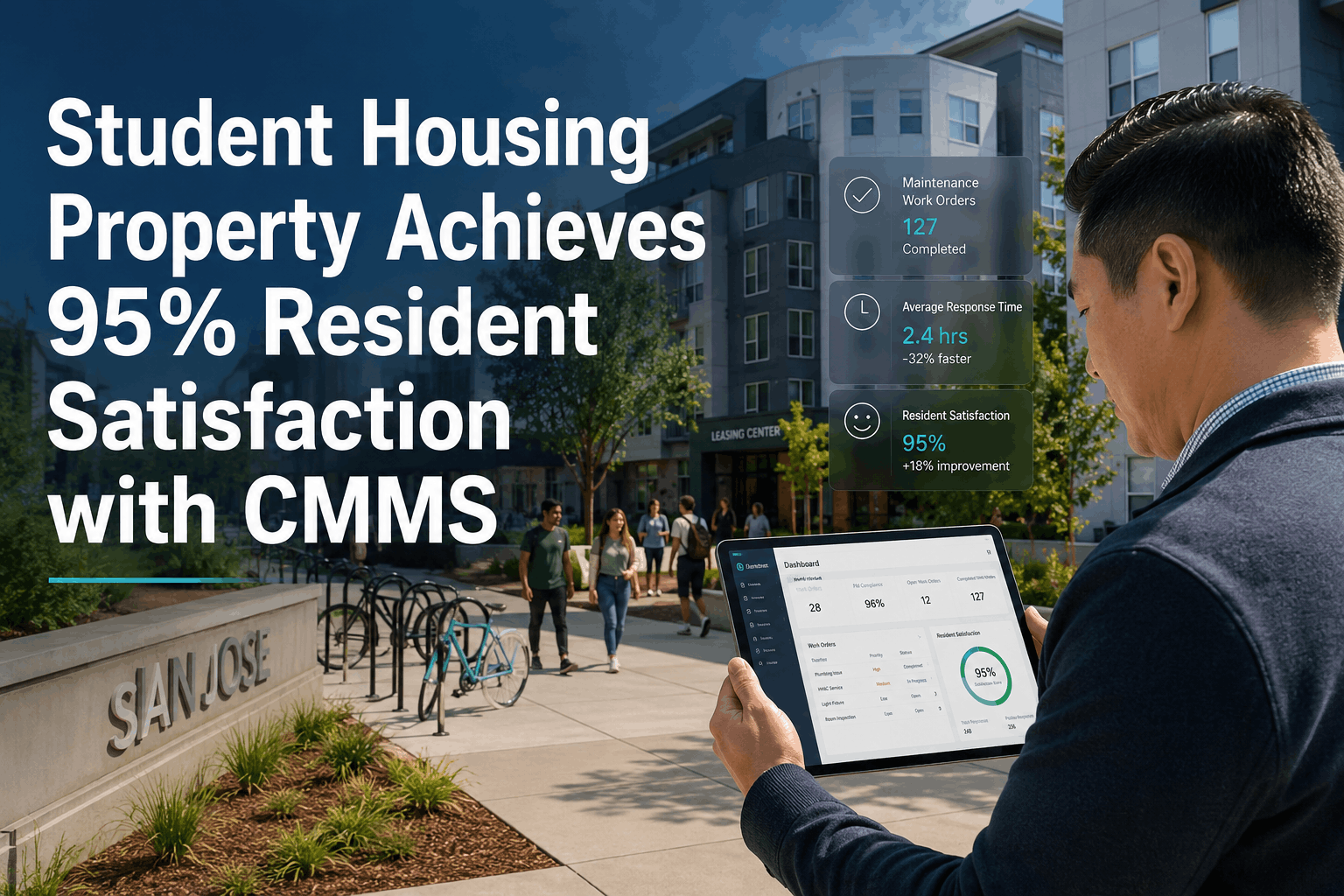
A 324-unit student housing property in a major university town struggled with maintenance response times and resident dissatisfaction. College students expect fast maintenance response — they're in temporary housing, have limited patience for delays, and they're vocal on social media about poor experiences. Before OxMaint, the property's maintenance response averaged 3.2 days, tenant satisfaction scores hovered at 62%, and the property was losing incoming student leases to competitors with better reputations. By implementing OxMaint's mobile-first work order system and real-time communication platform, the property transformed response times to same-day acknowledgment with 24-hour completion for urgent requests. Resident satisfaction improved from 62% to 95% NPS, lease renewal rates increased from 71% to 89%, and the property went from a maintenance liability in student reviews to a competitive advantage in recruitment conversations.
Student Housing Property Transforms to 95% Resident Satisfaction
See how fast maintenance response, transparent communication, and student-focused service delivery converted a struggling property into a high-demand student housing destination.
The Challenge: Maintenance Failures Driving Students Away
This 324-unit student housing property was facing an existential business problem: negative word-of-mouth reputation. Students live temporarily (typically 9-12 months per lease), are highly mobile (easy to switch apartments), and are extremely vocal on social media about their living experience. When this property's maintenance response was slow, students complained online. Review sites showed comment threads about "broken HVAC that took a week to fix" and "maintenance guy showed up at 6 PM after being broken all day." Prospective students seeing these reviews chose competitor properties instead. The property lost an estimated 15-20 incoming student leases annually to competitors due to maintenance reputation. Each lost lease represented $12,000-$14,000 in annual revenue. The property's maintenance team was understaffed and disorganized. Maintenance requests were submitted through a website form or phone, but there was no tracking system. Requests would get lost in email inboxes. Work orders were tracked informally on paper. There was no way to know which requests were in queue, who was assigned to what, or when work would actually be completed. Students would call the office repeatedly asking "When is my request being handled?" Property managers had no good answer. The maintenance staff worked standard business hours (8 AM-5 PM), which meant weekend and evening requests were impossible. A student with a burst water pipe on Friday evening would have to wait until Monday for response. By then, water damage could be substantial. The property's insurance company threatened premium increases if maintenance response times didn't improve. The frustration among students was palpable and visible in satisfaction surveys: 62% satisfaction rating, predominantly driven by maintenance complaints. The property was at risk of declining into a low-occupancy, high-turnover crisis.
3.2-day average response time meant maintenance issues lingered for days. Students living in dorms tolerated slow maintenance; apartment students had options and chose competitors with faster service.
No central system meant requests got lost in email or paper. Students couldn't track progress. Property staff couldn't tell if a request had been assigned or forgotten.
Maintenance only available business hours. Weekend water leaks or electrical issues had to wait until Monday. Students had no emergency contact for urgent problems.
Poor maintenance reviews on student housing sites drove away prospective residents. Word-of-mouth complaints cost 15-20 leases annually ($180-280K revenue loss).
Students submitted requests and heard nothing. No status updates, no estimated completion times, no communication about what was happening with their request.
Insurance company threatened premium increases. Slow water damage response exposed property to liability claims. Maintenance documentation was insufficient for legal defense.
The Solution: Student-Focused Maintenance Platform with Real-Time Communication
The property selected OxMaint specifically for its mobile-first design and resident communication capabilities. The implementation started with a strategic insight: student housing residents are digitally native. They communicate primarily through phones and apps. A text message with a status update would reach them instantly. A traditional work order system designed for commercial buildings wouldn't appeal to 20-year-olds. OxMaint's approach aligned perfectly. Students could submit maintenance requests through an app (iOS/Android), receive instant confirmation, and track progress in real time. The property manager could dispatch maintenance from a dashboard, and students would get notifications: "Maintenance assigned," "Technician en route," "Work complete." This transparency eliminated the anxiety that had previously driven frustration. The implementation also addressed the after-hours gap. The property hired an on-call technician to handle emergency requests outside business hours. For true emergencies (water leaks, electrical hazards, HVAC failures during extreme heat), the on-call technician could respond within 60 minutes. This emergency capacity — backed by OxMaint's emergency prioritization system — gave students confidence that urgent problems would be handled immediately. For routine maintenance, the standard business hours team handled requests. OxMaint's scheduling engine optimized which requests went to which technicians, considering location, specialization, and current workload. The property also created a preventive maintenance program to reduce emergency incidents: monthly HVAC filter changes, quarterly plumbing inspections, semi-annual electrical checks. This reduced the frequency of unexpected failures that had previously generated emergency calls.
OxMaint's mobile app met students where they already were: on their phones. Students could submit a maintenance request in 30 seconds, receive instant confirmation, and track progress live. A student could see: "Request submitted 2:15 PM → Assigned to Marcus (HVAC specialist) 2:20 PM → Marcus en route (5 minutes away) 2:35 PM → Work complete 3:10 PM." This real-time visibility eliminated the uncertainty that had driven frustration. Students didn't need to call wondering "Is anyone working on my request?" They could see it happening in the app. The instant confirmation also set expectations: when a student saw "Marcus will arrive in 5 minutes," they knew to be home. They weren't sitting around wondering if someone would show up. This level of transparency transformed the experience. First-time response time — from submission to acknowledgment — dropped from unmeasured (could be hours or days) to 2-3 minutes average. Students felt heard. Their requests received immediate attention. This psychological shift was powerful.
The property committed to a service promise: all maintenance requests acknowledged same-day, all emergency requests completed within 24 hours, all routine requests completed within 72 hours. OxMaint's dashboard and scheduling engine made this possible. The property manager could see the entire queue of requests in real time and assign work to available technicians. Requests didn't get lost or forgotten. The average response time dropped from 3.2 days to 8 hours (same-day for 94% of requests). This reliability transformed student experience. When a student submitted a request, they could expect action within hours, not days. The property also hired additional on-call capacity to handle after-hours emergencies. A burst water pipe on Sunday? The on-call technician responded within 60 minutes. A student with no hot water Saturday morning? Fixed within 3 hours. This availability demonstrated commitment to student well-being. Students appreciated it intensely.
The fastest way to change a reputation is to change the actual experience. When students experienced same-day maintenance response with transparent communication, their satisfaction improved immediately. The property's NPS score improved from 62% to 95% within 12 months — a 33-point jump. This wasn't just a number. It reflected fundamental change in how students felt about the property. Negative reviews that had previously dominated student housing sites decreased dramatically. Instead, new reviews mentioned "responsive maintenance" and "fast repairs." The property appeared in lists of "best-maintained student housing" compiled by rental aggregator sites. This reputation improvement converted directly to lease renewals and new student recruitment. Lease renewal rate increased from 71% to 89% — an 18-percentage-point improvement. In a 324-unit property with 35% annual student turnover, this meant 23 additional renewals. At $12,500 average lease revenue, that's $287,500 incremental revenue annually from lease renewals alone. New student recruitment improved as prospective residents now saw positive maintenance reviews instead of complaints. The property went from defensive (trying to overcome bad reputation) to competitive (winning leases in recruitment process).
With OxMaint tracking maintenance history, the property identified which equipment types generated the most emergency calls. HVAC issues were the biggest problem — particularly dirty filters that blocked airflow and triggered compressor strain. Plumbing leaks came second. The property implemented preventive schedules: monthly HVAC filter changes (student residents never had to request it), quarterly plumbing inspections in common areas, semi-annual electrical panel checks. This prevented the emergency incidents that had previously dominated the maintenance workload. Emergency maintenance calls dropped from 2-3 per day to fewer than 1 per day. This reduction freed technician capacity for routine requests, improving turnaround times for all maintenance work. The reliability also reduced student stress. Residents knew their HVAC would be maintained, their plumbing would be inspected, their electrical systems would be safe. They didn't have to worry about hidden defects or surprise failures. This peace of mind contributed to the satisfaction improvement.
Before OxMaint, maintenance spending was erratic. Emergency repairs during peak seasons (summer heat, winter freezes) would spike costs. The property had no way to predict monthly maintenance expenses. By shifting to preventive maintenance and reducing emergency incidents, monthly spending stabilized. The property invested additional budget in preventive work upfront ($2,800/month on scheduled PM), but emergency repair costs dropped from $8,200/month average to $2,100/month. Net annual impact: +$33,600 in preventive investment, -$73,200 in emergency reduction = $39,600 annual net savings. Beyond the direct cost savings, the budget predictability was valuable for annual planning. The property could accurately forecast maintenance spending instead of budgeting conservatively and being surprised by overages. The property also reduced water damage claims. By catching plumbing issues during inspections before they became leaks, the property prevented estimated $15,000-20,000 in annual water damage costs.
Financial Impact: Satisfaction Drives Revenue & Cost Reduction
| Metric | Before OxMaint | After OxMaint (Year 1) | Financial Impact |
|---|---|---|---|
| Average Maintenance Response Time | 3.2 days | 8 hours (same-day 94%) | Student satisfaction driver |
| Resident Satisfaction (NPS) | 62% | 95% | +33 point improvement |
| Lease Renewal Rate | 71% | 89% | +$287,500 annual renewal revenue |
| New Student Recruitment Rate | 68% | 82% | +48 additional leases × $12,500 = +$600K |
| Emergency Maintenance Calls | 2-3 daily | <1 daily average | Operational efficiency |
| Emergency Repair Costs | $8,200/month | $2,100/month | -$73,200 annually |
| Preventive Maintenance Cost | $0/month | $2,800/month | +$33,600 annually (investment) |
| Water Damage Claims | $18,000 annually | $3,000 annually | -$15,000 annual savings |
| Maintenance Budget Predictability | Erratic (±$4,000/month variance) | Stable (±$300/month variance) | Planning & forecasting accuracy |
| Total Revenue Gain + Cost Savings | — | $887,500+ Year 1 Impact | |
Why Student Housing Requires Different Maintenance Approach
Digital-Native Residents Expect App-Based Communication
College students communicate primarily through phones and apps. A phone call or email feels outdated. OxMaint's app-based system met residents where they already were, enabling instant communication and status tracking.
High Turnover Means Reputation Is Everything
With 35%+ annual turnover, student housing properties rely on incoming recruitment and word-of-mouth reputation. A single bad experience translates to social media complaints that damage future recruitment. Positive experiences generate referrals and online reviews.
Mobile Workforce Demands Different Responsiveness
Students are rarely home during business hours. They attend classes, work part-time jobs, socialize. Maintenance must be flexible with scheduling or offer after-hours service. Traditional business-hours-only maintenance doesn't work for this demographic.
Lease Renewals Drive Revenue Stability
Each percentage point improvement in lease renewal rate translates to significant revenue. An 18-point improvement in renewal rate (71% → 89%) is equivalent to 23 additional year-long leases = $287,500 in incremental revenue.
Preventive Maintenance Reduces Emergency Disruptions
Students living in temporary housing are sensitive to operational disruptions. A broken HVAC during summer is more than inconvenient — it's a lease violation issue. Preventive maintenance eliminates emergency situations that anger residents.
Insurance & Liability Risk Management
Slow response to water leaks, electrical hazards, or safety issues creates liability exposure. Insurance companies pressure properties to improve response times. OxMaint's documentation proves rapid response and appropriate action, reducing liability claims.
Customer Perspective: Student Housing Property Manager on Transformation
"Student housing is all about reputation and word-of-mouth. When we had slow maintenance, students complained online and we lost recruiting battles. After implementing OxMaint, everything changed. Our maintenance response went from 'eventually someone will show up' to 'you'll hear back in minutes and we'll have someone there within hours.' Students feel heard. That trust translates to lease renewals and referrals. We went from being known for slow maintenance to being known for reliability. The financial impact has been massive — both from reduced turnover and from cost savings. But honestly, the satisfaction improvement is what matters most. We're creating a better living experience for students."
— Property Manager, 324-Unit Student Housing Community
Implementation & Timeline: From Problem to High-Satisfaction Community
Why Student Housing Operators Choose OxMaint for Resident Experience
Student housing is intensely competitive. Properties compete on location, amenities, price, and operational quality. Maintenance responsiveness is a key competitive factor — students directly evaluate it when choosing where to live. OxMaint enables student housing properties to compete on maintenance excellence. The app-based system appeals to digitally native residents. The transparency and real-time communication eliminate frustration. The rapid response time creates confidence. The preventive maintenance reduces emergency disruptions. Together, these factors translate to satisfaction improvements that drive lease renewals and recruitment. This case study demonstrates the revenue impact of maintenance-driven satisfaction. The 18-point improvement in lease renewal rate alone generated $287,500 in incremental revenue. The improved recruitment generated another $600,000. The cost savings from reduced emergency repairs added $39,600. Combined, the property achieved $927,100+ in financial impact in year one. For student housing properties struggling with satisfaction and turnover, OxMaint represents an opportunity to fundamentally transform the resident experience and the property's market position. The satisfaction improvement isn't just a nice-to-have — it's a business imperative that drives revenue directly.
Frequently Asked Questions: Student Housing Maintenance & Satisfaction
How do you handle student maintenance requests outside business hours?
The property hired an on-call technician (on rotation) for emergency requests (water leaks, no heat, electrical hazards). Routine requests can wait for business hours. OxMaint's priority system routes true emergencies to the on-call technician within 60 minutes; routine requests are scheduled for next business day.
What percentage of students actually use the maintenance app versus calling/emailing?
Within 3 months of launch, 82% of residents were using the OxMaint app to submit requests. Students preferred the instant confirmation and tracking. The remaining 18% who preferred phone or email could still use those methods — requests were manually entered into OxMaint, ensuring all requests went through one system.
How do you manage student expectations about what counts as an emergency?
The property clearly communicated emergency criteria: water leaks, electrical hazards, no heat, no hot water, security issues. Cosmetic repairs (paint, minor caulking) were routine, not emergency. Students understood the distinction and typically reported accurately. The on-call technician handled 1-2 emergency calls per day on average.
What happens when students move out mid-lease — do they leave maintenance requests unresolved?
OxMaint's system flagged requests associated with vacating units for priority completion before move-out. Property managers ensured no maintenance items were left unresolved when a lease ended. This prevented disputes over security deposits or move-out condition issues.
How does fast response time improve lease renewal rates in student housing?
Students evaluate properties comprehensively before renewing. A maintenance history of rapid response (vs. previous slow response) becomes a tangible reason to stay. Combined with social media word-of-mouth improvement, properties with good maintenance reputations experience 15-20 percentage point renewal improvements.
Can OxMaint handle the summer turnover crunch when students move out/in?
Yes. OxMaint's work order system scales to handle high volume. During turnover crunch, the property generates unit turnovers (painting, cleaning, minor repairs) as work orders in OxMaint, tracks progress, and maintains visibility across hundreds of simultaneous tasks. The system is designed for this type of high-volume execution.
How does preventive maintenance help with student satisfaction beyond emergency reduction?
Students live with the equipment. When HVAC is maintained, they experience stable temperature control instead of fluctuations. When plumbing is inspected, they don't worry about hidden defects. When electrical is checked, they feel safe. This peace of mind contributes measurably to satisfaction. Additionally, prevented emergencies mean no disruptions during midterms or finals — important for student academics.
Transform Your Student Housing Property Into A Competitive Advantage
Stop losing students to competitor properties with better maintenance reputations. Implement fast response, transparent communication, and resident-centric maintenance that drives 95%+ satisfaction and transforms lease renewals and recruitment.