Commercial HVAC Maintenance Checklist for Property Managers
By Josh Turley on March 28, 2026
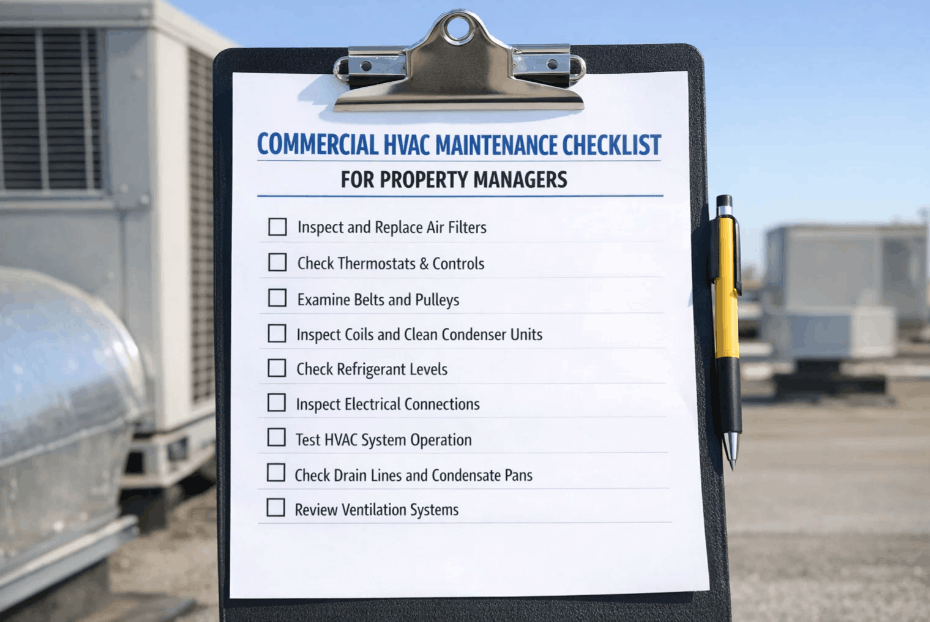
Commercial HVAC systems are the backbone of tenant comfort, indoor air quality, and energy efficiency across office buildings, retail centers, industrial facilities, and multi-family properties. Without a structured commercial HVAC maintenance checklist, property managers face unplanned equipment failures, skyrocketing energy bills, violated lease obligations, and regulatory penalties that compound over time. A disciplined preventive maintenance program — organized by monthly, quarterly, and annual intervals — keeps rooftop units, split systems, chillers, and cooling towers operating at peak efficiency throughout every season. Book a Demo to see how OxMaint streamlines commercial HVAC scheduling and compliance documentation from a single platform.
OxMaint: Preventive Maintenance Scheduling for Commercial HVAC
Automate HVAC inspection schedules, assign service tasks to certified technicians, track filter replacements, and generate audit-ready maintenance logs — all from one mobile-friendly platform built for property operations teams.
Why Commercial HVAC Preventive Maintenance Is Critical
HVAC systems account for 40–60% of total commercial building energy consumption, making them the single largest operational cost driver for property managers. Deferred maintenance accelerates component wear, degrades indoor air quality, and creates lease compliance risks when tenants experience comfort failures. Insurance carriers and lenders increasingly require documented HVAC service records, while municipalities impose fines for systems that fail environmental or refrigerant handling inspections.
40%
reduction in HVAC energy consumption with consistent preventive maintenance
3×
higher emergency repair cost versus scheduled preventive service visits
15 yrs
average equipment lifespan extended through structured PM programs
$18K+
average cost per compressor replacement on a commercial rooftop unit
Monthly HVAC Maintenance Checklist
Monthly tasks protect system performance between major service visits by addressing high-wear consumables, airflow restrictions, and control system calibration. These checks should be performed by a qualified in-house technician or contracted HVAC service provider and logged with time-stamped entries for warranty and compliance purposes. Book a Demo to access pre-built monthly HVAC inspection templates.
Monthly — Filters, Airflow, and Controls Inspection
Quarterly HVAC Maintenance Checklist
Quarterly inspections target mechanical system performance, refrigerant integrity, and electrical component condition — tasks that require licensed HVAC technicians and specialized test equipment. Quarterly service visits are the backbone of any commercial PM program and must be fully documented for manufacturer warranty protection and insurance compliance. Sign Up Free to schedule and track quarterly HVAC service with automated technician assignments.
Quarterly — Mechanical, Electrical, and Refrigerant System Service
Annual HVAC Maintenance Checklist
Annual inspections encompass full system commissioning, compliance documentation, and infrastructure assessments that require factory-authorized technicians or professional engineering review. Annual service records are mandatory for most equipment warranties and are increasingly required by commercial insurance carriers as a condition of HVAC-related coverage. Book a Demo to build annual HVAC compliance workflows into your property management program.
Annual — Full System Commissioning and Compliance Review
Rooftop Unit (RTU) Specific Maintenance Checklist
Rooftop units serve as the workhorses of commercial HVAC systems in low-rise and mid-rise buildings, handling both heating and cooling from a single packaged platform exposed to weather extremes. RTU-specific maintenance tasks go beyond standard AHU procedures and must address the unique challenges of rooftop equipment environments.
RTU-Specific — Packaged Rooftop Unit Maintenance
Chiller and Cooling Tower Maintenance Checklist
Chillers and cooling towers serve large commercial, institutional, and industrial facilities where central plant cooling is required. These systems demand specialized maintenance practices, licensed refrigerant technicians, and water treatment expertise that goes beyond standard commercial HVAC service competency.
Chiller and Cooling Tower — Central Plant Maintenance
Critical Control Points: High-Risk HVAC Failure Areas
Specific HVAC components carry outsized risk due to their safety implications, operating costs, or hidden failure modes. Every inspection cycle must prioritize these components regardless of the maintenance schedule tier being performed.
System Component
Failure Risk
Inspection Frequency
Key Inspection Focus
Heat Exchanger
Critical — CO exposure hazard
Annual visual and combustion test
Cracks, pitting, combustion gas crossover
Refrigerant Leak Points
High — EPA compliance and capacity loss
Quarterly leak check; annual electronic survey
Joint integrity, schrader valves, coil headers
Condensate Drain System
High — water damage and mold risk
Monthly pan inspection and flush
Pan level, drain line flow, biological growth
Electrical Connections
Critical — fire and equipment failure risk
Quarterly thermal scan or torque check
Heat discoloration, loose terminals, insulation
Cooling Tower Water
Critical — Legionella public health risk
Monthly water treatment test; quarterly basin clean
Biocide levels, conductivity, basin sediment
Economizer Dampers
Medium — energy waste and comfort failure
Quarterly cycle and seal inspection
Full range of motion, blade seal condition, actuator response
Common Commercial HVAC Failure Patterns
These are the most frequent — and most preventable — HVAC failures in commercial buildings. Each one results from missed inspections, not equipment age. Book a Demo to see how OxMaint helps you prevent these failures with automated PM schedules, or Sign Up Free to start tracking your HVAC inspections today.
Compressor Failure — Liquid Slugging
What Happens: Liquid refrigerant enters the compressor due to low charge or a failed TXV valve, destroying pistons or scroll wraps instantly. Replacement cost: $5,000–$18,000.
Root Cause: Missed quarterly refrigerant charge or metering device inspection.
Fix: Check refrigerant superheat every quarter. Inspect TXV annually. Install hard-start kits on reciprocating compressors.
Condenser Coil Corrosion
What Happens: Airborne chlorides and pollutants eat through copper coil walls within 3–5 years, causing refrigerant leaks often misdiagnosed as mechanical failures.
Root Cause: No protective coil coating applied in coastal or industrial environments.
Fix: Apply epoxy coil coating on installation. Inspect for blue-green oxidation at every quarterly service visit.
BAS Sensor Drift
What Happens: Temperature and CO2 sensors drift out of calibration over 2–3 years, causing the building to overcool or overheat — raising energy bills and triggering tenant complaints.
Root Cause: Sensor calibration skipped in annual service contracts.
Fix: Calibrate all BAS sensors annually. Mount reference thermometers next to critical sensors for ongoing cross-check.
Evaporator Coil Freeze-Up
What Happens: Blocked airflow from a dirty filter causes coil temperatures to drop below freezing, icing over the entire coil face and shutting down the system. Water damage follows during defrost.
Root Cause: Delayed filter replacement — the most preventable HVAC failure.
Fix: Inspect filters monthly without exception. Install differential pressure alarms across filter banks to catch restriction early.
HVAC Documentation Requirements for Property Managers
Commercial property managers face documentation requirements from multiple overlapping authorities — local building departments, insurance underwriters, equipment manufacturers, and environmental regulators. Incomplete HVAC maintenance records expose properties to warranty voidance, insurance coverage disputes, and regulatory enforcement actions that are entirely preventable with a structured digital recordkeeping system.
EPA Section 608 Refrigerant Records
Technician certification numbers, refrigerant type and quantity added or recovered, leak inspection dates, and repair records for all appliances with 50 lbs. or more refrigerant charge. Required by federal law and subject to EPA enforcement inspection.
Retain: 3+ years
Preventive Maintenance Service Reports
Dated service reports for every PM visit including technician identification, tasks performed, measurements recorded, parts replaced, and deficiencies noted. Essential for equipment warranty claims and insurance coverage disputes following mechanical failures.
Retain: Equipment lifespan
Cooling Tower Water Treatment Logs
Weekly chemical treatment records, monthly Legionella risk assessments, quarterly basin cleaning reports, and annual water management plan documentation required by ASHRAE 188 and local health department regulations for building water systems with cooling towers.
Retain: 5+ years
Energy and Performance Benchmarking Records
Annual HVAC energy consumption data, system efficiency measurements, and ENERGY STAR Portfolio Manager submissions required by building performance standards (BPS) laws now active in many major U.S. municipalities with financial penalties for non-reporting properties.
Retain: 5+ years
Seasonal HVAC Preparation Checklist
Cooling Season Startup — Spring Preparation
Remove winter covers from condenser units and inspect coil fins for winter weather damage
Check refrigerant charge and inspect all service valve cores before startup
Lubricate all condenser fan motor bearings and verify fan blade pitch and balance
Clean evaporator and condenser coils before the first cooling cycle of the season
Test all economizer dampers and actuators for full range of motion after winter inactivity
Replace all air filters with fresh media before the high-demand cooling season begins
Verify BAS cooling setpoints and scheduling programs reflect current occupancy patterns
Commission cooling tower fill, distribution nozzles, and chemical treatment program
Heating Season Startup — Fall Preparation
Test heat exchanger integrity and perform combustion analysis on all gas heating equipment
Verify gas valve operation, igniter condition, and flue venting integrity before first firing
Test all low-limit freeze stats and low-ambient lockout controls for proper trip points
Inspect heat pump reversing valves and defrost control boards before heating season demand
Winterize and drain cooling tower basins, inspect basin heaters in cold climates
Check glycol concentration in chilled water and condenser water loops for freeze protection
Test all emergency heat circuits and backup heating sequences in heat pump systems
Perform full BAS heating sequence test under occupied conditions before cold weather arrives
Implementing a Digital Commercial HVAC Maintenance Program
Paper-based HVAC service logs and clipboard PM checklists consistently fail in complex commercial property environments — technician handwriting is illegible, tasks get skipped under time pressure, and critical refrigerant records are lost or incomplete when inspectors arrive. A digital maintenance management platform eliminates these gaps by automating inspection scheduling, capturing equipment readings from mobile devices in the field, and producing complete compliance histories on demand. Sign Up Free on OxMaint to start scheduling and documenting your entire commercial HVAC maintenance program from one platform — or Book a Demo to see how it works for your property team.
When evaluating a CMMS for commercial HVAC, prioritize mobile-first technician interfaces, automated work orders triggered by out-of-range readings, refrigerant tracking built for EPA compliance, warranty expiration alerts, and audit-ready report exports for health departments and insurance carriers.
OxMaint: The HVAC Maintenance Platform for Commercial Property Teams
Schedule recurring HVAC inspections, track refrigerant logs and filter replacements, generate compliance-ready audit exports, and manage your entire HVAC contractor workflow — all from one platform your team can use on any device, in any building.
How often should commercial HVAC systems be serviced?
Commercial HVAC systems require monthly filter inspections and controls checks, quarterly full mechanical service visits covering refrigerant, electrical, and mechanical components, and a comprehensive annual inspection including heat exchanger testing, refrigerant leak surveys, BAS sensor calibration, and equipment performance benchmarking. High-use facilities such as hospitals, data centers, and large retail properties benefit from more frequent service intervals given continuous operation demands and the cost impact of any system downtime on tenant operations.
What are the EPA refrigerant recordkeeping requirements for commercial HVAC?
Under EPA Section 608 regulations, operators of appliances containing 50 pounds or more of regulated refrigerant must maintain records of the quantity of refrigerant added during each service visit, the technician's certification number, dates of all leak inspections, dates of any repairs performed, and the results of verification leak tests following repairs. These records must be retained for a minimum of three years and must be made available to EPA inspectors upon request. Facilities using digital maintenance management platforms can automatically generate compliant refrigerant logs from mobile technician entries during each service visit.
How do I prevent Legionella in commercial cooling towers?
Effective Legionella risk management in cooling towers requires maintaining an active water treatment program with biocide residuals tested weekly, conducting quarterly basin cleanings to remove sediment that creates protected microenvironments for bacterial growth, maintaining blowdown conductivity cycles to prevent concentration of dissolved solids, and operating under a written Water Management Plan compliant with ASHRAE Standard 188. Property managers should retain water treatment service records and Legionella risk assessment documentation for a minimum of five years, as regulatory agencies in many jurisdictions now require this documentation following any Legionellosis outbreak investigation in the building's vicinity.
What is the typical lifespan of commercial HVAC equipment?
Commercial rooftop units have an expected service life of 15–20 years under a consistent preventive maintenance program, compared to 10–12 years with deferred maintenance. Centrifugal and screw chillers in properly maintained central plants routinely achieve 25–30 year service lives. Cooling towers last 15–25 years depending on water treatment quality and structural materials. Air handling units in conditioned spaces can exceed 20–30 years when motors, coils, and controls are serviced and replaced on schedule. In each case, the single greatest variable in equipment lifespan is the consistency and quality of the preventive maintenance program — not the original equipment quality or initial installation cost.
What documentation do I need for a commercial HVAC warranty claim?
Most commercial HVAC equipment warranties require documented proof of a preventive maintenance program performed at manufacturer-specified intervals, completed by technicians holding NATE certification or equivalent credentials, using manufacturer-approved maintenance procedures. Warranty claims are routinely denied when property managers cannot produce dated service reports showing filter changes, coil cleanings, refrigerant charge verification, and lubrication performed at required intervals. Digital maintenance platforms that capture technician names, service dates, measurements taken, and parts installed provide the strongest possible warranty claim documentation and eliminate the risk of paper record loss.



.png)
