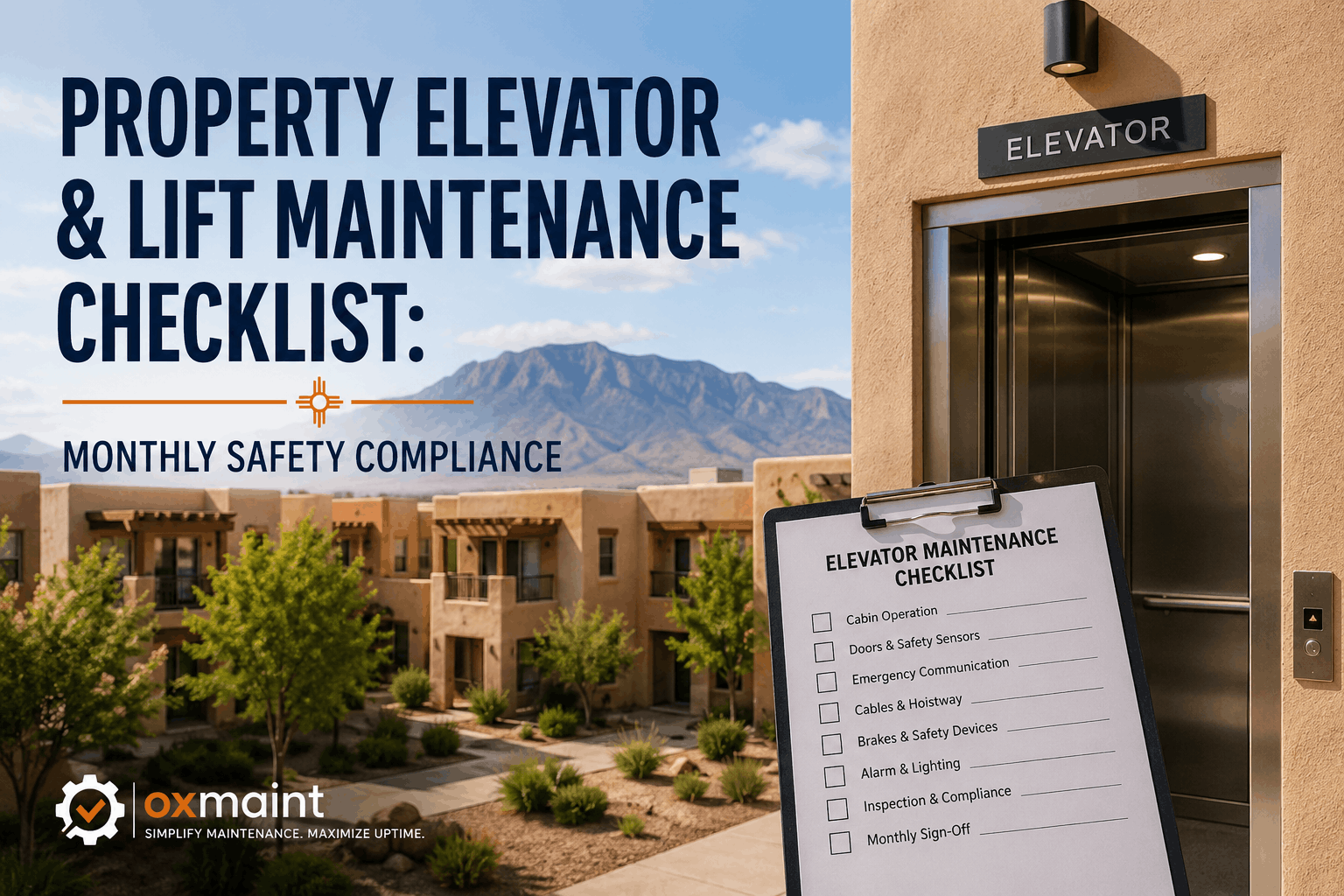
Elevators are among the highest-liability, highest-cost assets in any commercial building — and they are among the most under-tracked. A single elevator outage in a Class A office building can affect 400+ tenants, trigger lease default clauses, and generate regulatory citations that cost more than a year of preventive maintenance contracts. Yet most property teams still manage elevator compliance on spreadsheets, paper logs, and vendor-managed schedules with no independent audit trail. If your elevator records are not audit-ready today, book a demo and see how Oxmaint gives you full compliance visibility in under a week.
$35K
Average cost of a single unplanned elevator failure in a commercial high-rise including downtime and emergency repair
4.8x
Higher cost per elevator repair when reactive vs. preventive maintenance schedules are used
78%
Of elevator compliance violations trace back to missed inspection cycles or incomplete documentation
20yr
Rated lifespan of a commercial elevator — reduced to 13-15 years without structured preventive maintenance
Track Every Elevator Inspection, Service Record, and Compliance Deadline in One Place
Oxmaint gives property managers a centralized elevator asset registry with automated compliance scheduling, full technician history, and audit-ready documentation — no spreadsheets required.
What Is Commercial Elevator Maintenance?
Commercial elevator maintenance is the structured program of inspections, lubrication, component testing, compliance certifications, and modernization planning required to keep vertical transportation assets safe, legal, and operational throughout their rated lifecycle. Unlike most building systems, elevators are subject to mandatory inspection cycles governed by state and local elevator codes (ASME A17.1 in the US, BS EN 81 in the UK, and equivalent standards elsewhere) that require documented third-party certification on annual or semi-annual schedules. A missed inspection does not just create a compliance risk — it creates a liability risk for every passenger in the building.
Preventive Maintenance (PM)
Scheduled lubrication, adjustment, and component inspection performed on monthly, quarterly, or annual cycles to prevent failures before they occur. PM programs extend elevator lifespan by 25-35%.
Mandatory Compliance Inspection
State or jurisdiction-mandated third-party inspection producing a Certificate of Operation. Required annually in most US states. Buildings without valid certificates face immediate shutdown orders.
Condition-Based Monitoring
IoT sensors on motor drives, door operators, and hydraulic systems tracking performance in real time. Alerts flag deviations before failure — reducing emergency call-outs by up to 60%.
Modernization Planning
Structured capital program for controller upgrades, cab renovation, drive replacement, and ADA compliance updates. Elevators older than 20 years face modernization costs of $100K-$350K per unit.
Elevator Compliance: What Inspections Are Required and When
Compliance requirements vary by jurisdiction but follow a consistent framework. The table below covers the primary inspection categories across major markets. Missing any single cycle triggers fines, operational shutdowns, and insurance complications. If tracking these deadlines across multiple buildings feels like a full-time job, book a demo and see how Oxmaint automates compliance scheduling for every elevator in your portfolio.
Annual
Full Safety Inspection
Third-party inspection of all safety devices, brakes, buffers, governors, and door systems. Produces Certificate of Operation. Mandatory in all US states and most international jurisdictions.
Annual
Category 1 Test (Hydraulic)
Full-load safety and operation test for hydraulic elevators. Tests pressure relief valves, lowering valve, and cylinder integrity. Required under ASME A17.1 Rule 8.6.
5-Year
Category 5 Test (Traction)
Full-load and no-load safety test for traction elevators including governor and safety device testing. One of the most complex and costly inspection types — requires advance scheduling and documentation.
Monthly
PM Service Visit
Lubrication, adjustment, and minor component checks performed by the elevator service contractor. Monthly PM visits are the foundation of lifespan extension — buildings skipping these see 2-3x higher major repair frequency.
Quarterly
Governor and Safety Chain Test
Functional test of overspeed governor and safety chain components. Required in high-traffic commercial buildings processing 500+ trips per day. Failure to document these creates liability exposure.
As Required
Modernization Compliance Review
When elevator components are replaced or upgraded, a re-inspection is required before return to service. Buildings without tracked modernization histories frequently fail to trigger these reviews, creating non-compliant operation.
6 Elevator Maintenance Failures Costing Property Managers Most
These are not edge cases. They are systematic failures that occur in buildings where elevator maintenance is managed reactively or tracked manually. These failures are entirely preventable — book a demo and we will identify which ones are live risks in your portfolio right now.
01
Expired Certificates of Operation
Operating an elevator with an expired Certificate of Operation exposes building owners to $5,000-$50,000 in fines per elevator per day in many US jurisdictions. 78% of violations trace to missed inspection scheduling — a purely administrative failure.
02
No Independent Audit Trail
When elevator maintenance is managed entirely by the service contractor, the property owner has no independent record of what was done, when, and by whom. In litigation following an incident, this is a $2M+ liability exposure. Only owner-maintained records are defensible.
03
Untracked Component Aging
Door operators, hydraulic seals, and controller components have rated replacement intervals. Teams without asset-level records do not know when components were last replaced. This leads to component failures in equipment that "just had service" — the most common elevator emergency type.
04
Deferred Modernization Surprises
Without rolling CapEx models tied to elevator condition scores, modernization requirements arrive as budget emergencies. A controller replacement that costs $85,000 as a planned capital project becomes a $140,000 emergency when failure forces unscheduled replacement.
05
Tenant Impact Ignored
In multi-tenant commercial buildings, elevator downtime during business hours directly violates service level obligations in leases. 3+ outages per year increases lease non-renewal risk by 2.4x for affected tenants. Each vacancy event in Class A buildings costs $50,000-$200,000 in lost rent.
06
Contractor Over-Reliance
Full-service elevator contracts averaging $8,000-$25,000 per elevator annually often include incentives to recommend component replacements ahead of schedule. Without independent condition scoring and service history, property owners cannot audit contractor recommendations or negotiate from a position of data.
Stop Relying on Your Elevator Contractor's Records as Your Only Audit Trail
Oxmaint gives you independent, owner-maintained elevator records — inspection history, component tracking, compliance deadlines, and condition scores — all separate from and verifiable against contractor-provided logs.
How Oxmaint Manages Elevator Compliance and Lifecycle Tracking
Elevator management in Oxmaint is built around the asset hierarchy that reflects how elevators actually exist in your portfolio — from the portfolio level down to individual components like door operators and hydraulic cylinders. Start a free trial and register your first elevator with full compliance scheduling in under 30 minutes.
Step 01
Elevator Asset Registry
Each elevator is registered as an asset with full specifications: installation date, manufacturer, rated capacity, drive type, jurisdiction, and current Certificate of Operation expiry. Component-level records track door operators, controllers, hydraulic systems, and safety devices independently.
Step 02
Automated Compliance Scheduling
Annual, Category 1, Category 5, and monthly PM cycles are scheduled against each elevator's compliance calendar with automated reminders. No inspection deadline is missed. All completed inspections are logged against the asset with certificate numbers and inspector credentials.
Step 03
Independent Work Order History
Every service event — whether performed by your team or a contractor — is logged as a work order against the elevator asset record. Parts used, labor hours, technician name, and resolution notes are captured permanently. This is your independent audit trail.
Step 04
Condition Scoring Per Elevator
Each elevator receives a live condition score based on age, maintenance frequency, inspection results, and component replacement history. Condition scores drive maintenance priority queues and feed directly into CapEx replacement models.
Step 05
Modernization CapEx Forecasting
Rolling 5-10 year capital models project controller replacements, cab renovations, drive upgrades, and full modernizations based on condition scores and component ages. Ownership groups see defensible replacement timelines, not contractor-generated estimates.
Step 06
Portfolio-Level Compliance Dashboard
View compliance status across every elevator in every building simultaneously. Certificates expiring in 30, 60, or 90 days surface automatically. Compliance reports export in under 2 minutes for ownership review or regulatory submission.
Elevator Maintenance: Reactive vs. Planned Operations
The cost difference between reactive and planned elevator maintenance is not abstract. It shows up in emergency repair invoices, contractor negotiating leverage, compliance fines, and tenant lease renewals every single year. Book a demo and we will run these numbers against your current elevator count and maintenance spend in 30 minutes.
Repair Costs
Emergency call-outs at 4.8x standard rates. A $3,500 controller repair becomes a $16,800 emergency weekend replacement.
Scheduled repairs at standard labor rates. Parts sourced in advance. 25% average reduction in total annual elevator spend.
Compliance Status
Manual calendar tracking. 78% of violations trace to missed cycles. Fines reach $50,000 per elevator per day in some jurisdictions.
Automated compliance calendar per elevator. Zero missed inspection deadlines. Always audit-ready documentation.
Asset Lifespan
20-year rated elevator lasts 13-15 years reactively. $250K modernization arrives 5 years early as an unbudgeted emergency.
Condition-based PM extends rated lifespan by 25-35%. Full lifecycle value extracted from every unit before capital replacement.
Audit Trail
Contractor-managed records only. No independent history. Post-incident liability exposure of $2M+ without owner documentation.
Owner-maintained independent record per elevator. Every technician, part, and service event logged permanently against the asset.
CapEx Planning
No condition data. Modernization arrives as a budget surprise. CapEx overruns average 28% in reactive elevator portfolios.
Condition-scored rolling CapEx models. Replacement timelines defensible. 40% faster ownership approval on capital requests.
Tenant Impact
Average 3+ outages per year. 2.4x higher lease non-renewal. Each vacancy in Class A costs $50K-$200K in lost annual rent.
Off-hours scheduled maintenance. 45% fewer unplanned disruptions. Tenant satisfaction and retention improve measurably.
Elevator Maintenance Cost Drivers: Where Budget Actually Goes
Understanding cost concentration across the elevator maintenance lifecycle is essential for both budget defense and contractor negotiation. These figures represent mid-rise commercial elevator benchmarks.
Emergency Call-Out and After-Hours Repairs
4.8x premium
Controller and Drive Replacement
$85K-$140K
Door Operator Components
Top failure
Compliance Fines (Expired Cert)
$50K/day
Annual PM Contract (Full Service)
$8K-$25K
Full Cab and Drive Modernization
$100K-$350K
Cost severity index across elevator maintenance categories — relative impact weighting based on commercial mid-rise benchmarks
Know Exactly What Every Elevator in Your Portfolio Has Cost and Will Cost
Oxmaint tracks actual elevator spend per asset and feeds it into rolling CapEx models so you can defend every maintenance budget line — and negotiate contractor invoices from a position of data.
Smart Elevator Investment Analysis: Costs vs. Returns
IoT-enabled elevator monitoring combined with structured CMMS tracking delivers clear, measurable returns at every investment tier. The cost of inaction — emergency repairs, compliance fines, and premature modernization — far exceeds the cost of implementation. We can run a custom elevator ROI projection for your portfolio in a 30-minute session — book a demo and we will bring the numbers.
| Solution |
Implementation Cost |
Annual Savings |
Payback Period |
| Elevator Compliance Scheduling (CMMS) |
$1,200 / building |
$48,000 / avoided fines and emergency repairs |
Under 2 weeks |
| Component Condition Scoring and Tracking |
$900 / building |
$35,000 / deferred modernization costs |
Under 2 weeks |
| IoT Sensor Monitoring (Motor, Door, Hydraulic) |
$2,400 / building |
$52,000 / prevented failures and call-outs |
Under 4 weeks |
| Modernization CapEx Forecasting |
$1,800 / portfolio |
$28,000 / budget accuracy and overrun reduction |
Under 3 weeks |
| Compliance Audit Documentation Automation |
$1,100 / portfolio |
$19,000 / labor and citation reduction |
Under 3 weeks |
| Full IoT + CMMS Platform Deployment |
$8,500 / building |
$143,000 / building annually |
Under 6 months |
Complete IoT implementation delivers 3.2x ROI within 18 months, with most solutions paying for themselves in under 6 months.
Investment Reality: Full IoT deployment costs average $8,500 per building but returns $143,000 annually. The 3.2x ROI makes IoT investment essential for competitive operations.
The Numbers Behind Structured Elevator Maintenance
35%
Lifespan extension achieved by elevators on structured condition-based PM programs vs. reactive-only maintenance
60%
Reduction in emergency elevator call-outs after deploying IoT condition monitoring on motor drives and door operators
40%
Faster CapEx approval from ownership when elevator modernization requests are backed by condition scores and remaining useful life data
$2M+
Typical liability exposure per incident for buildings without owner-maintained independent elevator service records
Frequently Asked Questions
How often do commercial elevators need to be inspected for compliance?
Inspection frequency depends on elevator type and jurisdiction. In most US states, annual full safety inspections are mandatory for all commercial elevators, producing a Certificate of Operation required to legally operate. Hydraulic elevators require annual Category 1 tests. Traction elevators require Category 5 tests every five years. Monthly PM service visits are required to maintain most full-service contracts. Buildings without a current Certificate of Operation face shutdown orders and fines up to $50,000 per elevator per day in high-enforcement jurisdictions.
Book a demo to see how Oxmaint automates compliance calendar tracking for every elevator in your portfolio.
What are the most common causes of unexpected elevator failures?
Door operator malfunctions account for the majority of unplanned elevator outages in commercial buildings — over 50% of emergency call-outs by most estimates. Controller component failures and hydraulic seal degradation are the next most common. The majority of these failures are preceded by detectable warning signs (door reopening frequency, unusual motor current draw, slow leveling) that condition-based monitoring systems identify weeks before failure. Buildings with PM programs and IoT monitoring reduce emergency call-outs by up to 60% compared to reactive-only operations.
See how Oxmaint condition scoring surfaces these warning signs before they become emergencies — book a demo today.
Should property managers maintain their own elevator records separately from the contractor?
Yes — this is one of the most important and most frequently neglected practices in commercial elevator management. When a contractor manages all records and an incident occurs, property owners frequently find they cannot produce independent documentation of service history. Courts and regulators treat contractor records as self-serving evidence. Owner-maintained records in a CMMS are treated as the authoritative property history. In post-incident litigation, the difference between having and not having independent records is typically the difference between a defensible position and a $2M+ liability exposure. Every service event should be logged against the asset in a system the property owner controls.
How do you plan for elevator modernization costs without overspending or being caught off guard?
The answer is condition scoring and rolling CapEx models. Elevators have predictable component lifecycles — controllers typically need replacement at 20-25 years, hydraulic cylinders at 15-20 years, cab interiors at 10-15 years. When you track each component's age and condition score in Oxmaint, the platform projects replacement timelines on a rolling 5-10 year horizon. Ownership groups see defensible capital requests with data backing rather than contractor-generated estimates. Teams using condition-backed CapEx requests receive approval 40% faster than those submitting estimate-only budgets.
Start a free trial and build your first elevator CapEx model this week.
What is the real cost difference between reactive and preventive elevator maintenance?
The direct repair cost gap is 4.8x — the same repair performed reactively in an emergency costs nearly five times what it costs scheduled in advance at standard labor rates. But the indirect costs compound this further: tenant disruption leading to lease non-renewal ($50K-$200K per vacancy), compliance fines for missed inspections ($5K-$50K per elevator per day in many jurisdictions), and premature modernization triggered by accelerated component wear ($100K-$350K per unit arriving 5 years early). Total annual reactive cost differential for a 10-elevator portfolio frequently exceeds $400,000 compared to a structured preventive program.
Book a demo and we will calculate this gap for your specific portfolio.
Can Oxmaint handle elevator maintenance across multiple buildings and properties?
Yes. Oxmaint's asset hierarchy (Portfolio, Property, System, Asset, Component) is specifically designed for multi-site commercial portfolios. Every elevator across every building is tracked in the same system, with compliance calendars, condition scores, and work order histories organized by property. Portfolio-level compliance dashboards show certificate expiry status across all elevators simultaneously. As your portfolio grows from 5 buildings to 50, the data structure scales without rebuilding anything. Most teams reach full compliance visibility within the first week of deployment, with no heavy onboarding or implementation fees.
See how Oxmaint scales to your current elevator count in a live walkthrough — book a demo at your convenience.
Every Elevator in Your Portfolio Deserves an Independent, Auditable Service History.
Oxmaint gives commercial property teams automated compliance scheduling, owner-maintained elevator records, condition-based CapEx forecasting, and portfolio-wide compliance dashboards. One platform. Every building. Every elevator. No implementation fees. Live in days.
Automated compliance calendar per elevator
Independent owner-maintained service records
Condition scoring and component-level tracking
Rolling modernization CapEx models