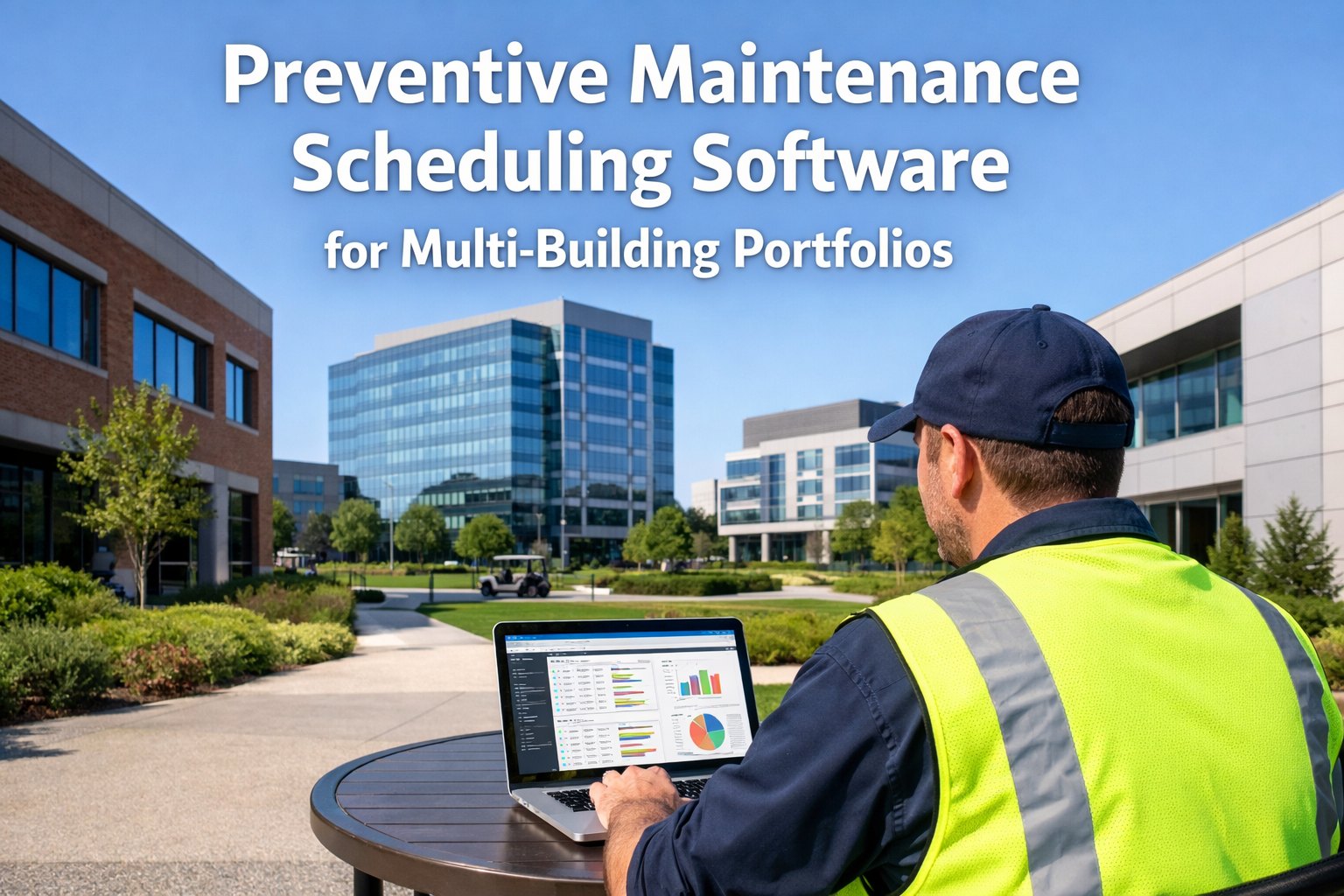
Building assets — from rooftop HVAC units to underground plumbing networks — represent some of the most significant capital investments any facility owner or property manager will ever make. Yet in many organizations, these assets are managed reactively: maintained only after something breaks, replaced only after failure becomes unavoidable. This approach is expensive, disruptive, and entirely avoidable. A structured preventive maintenance strategy is the single most effective tool available for extending asset lifespan, reducing operational costs, and keeping building systems performing at their peak for decades longer than reactive maintenance ever could.
Ready to Build a Smarter Maintenance Program?
Explore how AI-powered facility management platforms help you schedule, track, and optimize preventive maintenance across every building asset.
Understanding Asset Lifespan and Why It Degrades Prematurely
Every building system carries a manufacturer-rated service life — but in practice, assets rarely reach that threshold without deliberate maintenance investment. A commercial rooftop HVAC unit rated for 20 years may last only 12 under reactive maintenance. A fire suppression system maintained only when code compliance demands it can develop hidden failures that compromise the entire building's safety profile. Asset lifespan degrades prematurely for three primary reasons: deferred maintenance that allows small issues to compound into structural failures, the absence of real-time performance monitoring that would otherwise catch early degradation signals, and poor documentation that prevents maintenance teams from building the historical picture needed to predict failure before it occurs.
Preventive maintenance directly counters all three of these failure modes. By establishing scheduled inspection cycles, standardized servicing protocols, and digital maintenance records, facility managers gain both the visibility and the institutional knowledge necessary to intervene early — extending useful asset life while substantially reducing the capital expenditure that unplanned replacements demand. Platforms like OxMaint are designed to put exactly this kind of structured intelligence at the center of daily maintenance operations.
The Four Building Systems That Benefit Most from Preventive Maintenance
While every building asset benefits from a structured maintenance program, four systems account for the overwhelming majority of facility capital expenditure — and offer the greatest return on preventive maintenance investment. Understanding the specific failure modes and maintenance requirements of each system is foundational to building a program that delivers measurable lifespan extension. Start a Free Trial to see how OxMaint tracks and manages each of these system types out of the box.
Heating, ventilation, and air conditioning systems represent the largest single category of building mechanical expenditure. Coil fouling, refrigerant degradation, belt wear, filter bypass, and compressor stress are all progressive failure modes that preventive maintenance catches long before they cascade into catastrophic equipment failure. Quarterly filter changes, annual coil cleaning, semiannual belt inspections, and refrigerant pressure checks can extend HVAC service life by 30–40% while improving energy efficiency by up to 18% annually.
Commercial roofing systems are among the most expensive single assets in any building portfolio, with replacement costs frequently exceeding $15–25 per square foot. Membrane punctures, flashing failures, drainage blockages, and sealant degradation are all early-stage conditions that biannual inspections and prompt minor repairs can address before moisture intrusion compromises roof deck integrity. A well-maintained commercial roof rated for 20 years routinely achieves 28–35 years of service life under a consistent preventive maintenance regime.
Building plumbing systems degrade through corrosion, scale accumulation, seal deterioration, and fixture wear — all of which progress silently until a failure event forces emergency intervention. Annual water heater inspections, backflow preventer testing, drain line jetting, and pressure regulator checks represent low-cost maintenance activities that prevent the far more expensive consequences of pipe failures, water damage, and mold remediation. In commercial buildings, water damage is consistently among the top three most costly maintenance emergencies.
Thermal imaging inspections, switchgear cleaning, connection torque verification, and breaker load testing are preventive maintenance activities that significantly reduce the risk of electrical failure, fire, and costly service interruptions. Electrical systems operating under preventive maintenance programs demonstrate substantially lower arc flash incident rates and service disruption frequencies than those managed reactively. Generator load bank testing and UPS battery replacement schedules are particularly high-value PM activities in facilities with mission-critical uptime requirements.
Building a Preventive Maintenance Schedule That Actually Works
The gap between a preventive maintenance program on paper and one that reliably extends asset lifespan in practice comes down to scheduling quality, task specificity, and accountability. Many facilities have PM programs that exist in spreadsheets or binders but are never actually executed consistently — and inconsistent preventive maintenance delivers far less lifespan extension than its theoretical potential would suggest. Effective PM schedule design requires attention to four core principles.
Frequency Based on Manufacturer Specifications and Operating Conditions
PM intervals should reflect both manufacturer-recommended service frequencies and the actual operating environment of each asset. A rooftop air handler in a coastal industrial facility accumulates salt and particulate contamination at a rate that demands more frequent filter and coil servicing than an equivalent unit in a suburban office setting. Using manufacturer intervals as a baseline and adjusting upward for harsh operating conditions is fundamental to schedules that genuinely extend service life.
Task-Level Specificity That Enables Consistent Execution
Vague PM tasks like "inspect HVAC unit" produce inconsistent results because different technicians will interpret and execute them differently. Effective PM schedules decompose each maintenance activity into specific, measurable steps: check refrigerant pressure and record reading, measure supply and return air temperature differential, inspect and torque all electrical connections, clean condensate drain pan and test flow. Task specificity creates reproducibility — the foundation of a PM program that delivers predictable lifespan outcomes.
Digital Work Order Tracking with Completion Verification
Preventive maintenance that is scheduled but not executed — or executed but not documented — provides no protection against asset degradation. Digital maintenance management platforms create accountable PM workflows by issuing work orders on schedule, capturing technician completion data and field observations, and generating exception reports when tasks fall overdue. This audit trail is also essential for warranty compliance, insurance documentation, and capital planning justifications.
Data-Driven Interval Optimization Over Time
The best PM programs treat their schedules as living documents rather than static procedures. Maintenance history data — failure frequencies, inspection findings, parts consumption rates, and energy performance trends — provides the feedback loop needed to tighten intervals where assets show early degradation and relax them where oversервicing is adding cost without adding protection. Facilities using maintenance management software to analyze this data typically achieve 15–20% cost reductions in PM labor and materials within two years of program implementation.
How Preventive Maintenance Reduces Total Cost of Ownership
Facilities managers are frequently challenged to justify preventive maintenance investment to ownership groups or finance teams who see only the direct cost of scheduled service labor and materials. The full economic case for preventive maintenance requires understanding how it affects total cost of ownership — the complete financial footprint of an asset from acquisition through disposal.
| Cost Category | Reactive Maintenance Approach | Preventive Maintenance Approach |
|---|---|---|
| Emergency Repair Labor | High — after-hours rates, urgent mobilization | Minimal — issues caught during scheduled visits |
| Parts and Materials | Premium pricing, expedited shipping common | Planned procurement at standard pricing |
| Asset Replacement Cycle | Accelerated — 60–75% of rated service life | Extended — 110–130% of rated service life |
| Energy Consumption | 15–25% premium due to degraded efficiency | Near-optimal operating efficiency maintained |
| Tenant or Occupant Disruption | Frequent, unscheduled, high business impact | Planned windows, low occupancy impact |
| Capital Replacement Budget Predictability | Unpredictable — emergency replacements spike budgets | Highly predictable — lifespan data informs capital plans |
| Compliance and Insurance Risk | Elevated — gaps in maintenance documentation | Low — complete audit trail, verified compliance |
The Role of Maintenance Management Software in Lifespan Extension
Modern facility asset management software has transformed what is operationally achievable in preventive maintenance programs — not by replacing the expertise of skilled maintenance technicians, but by eliminating the administrative friction, scheduling gaps, and documentation failures that cause even well-designed PM programs to underperform. The most impactful capabilities of today's platforms include automated PM work order generation based on calendar schedules, meter readings, or condition triggers; mobile-first technician interfaces that capture field data and photos in real time; asset history dashboards that surface lifetime repair costs, failure trends, and replacement timing recommendations; and integration with energy management systems that correlate maintenance events with consumption data to quantify the efficiency impact of PM activities.
Facilities that implement Explore OxMaint report not only longer asset service lives and lower maintenance costs, but also meaningfully better capital planning outcomes — because the historical data these platforms accumulate enables finance teams to forecast equipment replacement needs with confidence years in advance rather than reacting to failures that arrive without warning.
See How Leading Facilities Teams Extend Asset Life
OxMaint gives maintenance managers the scheduling tools, asset history, and performance analytics needed to maximize lifespan across every building system — from HVAC to electrical infrastructure.
Integrating Condition-Based Monitoring with Preventive Programs
The most advanced building asset management programs are moving beyond time-based preventive maintenance schedules toward condition-based monitoring — using sensor data, vibration analysis, thermal imaging, and oil analysis to trigger maintenance interventions precisely when equipment condition warrants them rather than on a fixed calendar. This approach, sometimes called predictive maintenance or CBM (condition-based maintenance), does not replace preventive maintenance schedules. Rather, it augments them by adding a real-time detection layer that catches deterioration between scheduled visits and prevents the minority of failures that develop faster than periodic inspection cycles can catch.
For facilities with significant mechanical assets — chiller plants, large air handlers, pumping systems, elevator machinery — the ROI case for condition monitoring sensors is compelling: a single avoided chiller failure typically justifies the cost of a building-wide vibration monitoring installation. The critical success factor is connecting sensor data into the same maintenance management platform that manages PM schedules and work orders, so that anomalies automatically trigger inspection work orders and findings are captured alongside the asset's historical maintenance record. Book a Demo to see how OxMaint connects condition data directly to work order workflows.
Capital Planning and Asset Lifecycle Management
A preventive maintenance program that is executed consistently and documented completely creates something invaluable beyond lower repair costs and longer asset lives: a foundation for credible, data-driven capital planning. When facility managers can demonstrate — with years of maintenance history — that a rooftop unit has consumed $28,000 in parts over the past four years, is operating at 74% of rated efficiency, and has experienced three compressor-related service calls in the past 18 months, the case for capital budget allocation becomes evidence-based rather than intuition-based. Finance and ownership stakeholders are substantially more receptive to capital requests supported by asset performance data than to those based on age alone. Sign Up Free and start building this asset history from day one.
This is why asset lifecycle management is most accurately understood not as a cost center but as a risk management and capital efficiency function. Organizations that invest in preventive maintenance and the software infrastructure to support it consistently demonstrate lower total facilities cost per square foot, higher asset reliability, and more predictable capital expenditure profiles than those that manage reactively — outcomes that matter both to operating budgets and to asset valuation in commercial real estate contexts. Schedule a Demo with the OxMaint team to see how the platform supports long-range capital planning alongside day-to-day maintenance execution.
Frequently Asked Questions
How much can preventive maintenance realistically extend HVAC lifespan?
A commercial HVAC system under a consistent preventive maintenance program typically achieves 25–40% longer service life compared to one managed reactively. A rooftop unit with a rated lifespan of 15–20 years can often reach 22–28 years of reliable service when filter changes, coil cleaning, refrigerant checks, and belt inspections are performed on schedule and findings are documented and acted upon promptly.
What is the difference between preventive maintenance and predictive maintenance?
Preventive maintenance follows time-based or usage-based schedules — performing defined service tasks at set intervals regardless of current equipment condition. Predictive maintenance uses real-time sensor data and condition monitoring to trigger maintenance only when equipment condition indicates an intervention is actually needed. The most effective building asset programs use both in combination: preventive schedules for routine servicing and predictive monitoring to catch rapid-onset failures between scheduled visits.
How does preventive maintenance reduce energy costs?
Degraded equipment operates less efficiently than maintained equipment, consuming more energy to deliver the same output. Fouled HVAC coils, worn compressors, leaking duct systems, and dirty filters all force equipment to work harder and draw more power. Preventive maintenance that keeps these components in good condition typically reduces HVAC energy consumption by 10–20% compared to a reactive maintenance baseline — a financially significant benefit given that HVAC accounts for 40–60% of commercial building energy use.
What data should a preventive maintenance program track?
At minimum, effective PM programs should track work order completion rates and overdue task rates, asset-level repair cost history, parts consumption trends, equipment downtime incidents, energy performance data correlated to maintenance events, and inspection findings over time. Facilities using maintenance management software to aggregate and analyze this data gain the visibility needed to continuously optimize PM intervals, identify assets approaching end of life, and build credible capital replacement forecasts.
When does it make more sense to replace an asset than continue maintaining it?
The replacement decision is best made using a total cost of ownership analysis rather than age alone. When cumulative repair costs have exceeded 50–60% of replacement value, when the asset is operating significantly below rated efficiency, or when parts availability is becoming constrained, replacement economics typically favor capital investment over continued maintenance. A documented maintenance history makes this analysis straightforward — which is one of the strongest arguments for maintaining detailed asset records throughout the service life of every major building system.