Smart buildings are no longer a distant promise — they are a rapidly expanding operational reality reshaping how property managers, facility directors, and real estate investors think about infrastructure. IoT sensors are at the center of this transformation, turning once-passive physical assets into intelligent, data-generating systems capable of self-reporting their own condition. From detecting a concealed pipe leak before it becomes a flood, to predicting the day an HVAC compressor is likely to fail, sensor-driven intelligence is redefining what it means to manage property at a high level. For teams ready to connect physical assets to digital platforms, sign up free to explore how modern facility management tools are built for this connected future.
See how IoT-driven operational platforms support smarter property management at every scale — from single buildings to large portfolios.
What IoT Sensors Actually Do in a Property Context
IoT sensors are compact electronic devices that detect specific physical conditions — temperature, humidity, motion, pressure, vibration, electrical current, water presence — and transmit that data wirelessly to centralized software platforms. In a property management context, they serve as always-on monitors stationed throughout a building's mechanical, electrical, and plumbing infrastructure, continuously reporting conditions that previously required manual inspection or went entirely unobserved between maintenance cycles.
The critical distinction between IoT-enabled property management and traditional approaches is real-time visibility. A conventional maintenance regime relies on scheduled inspection rounds, tenant-reported complaints, and reactive service calls triggered after a failure has already occurred. Sensor networks flip this model: conditions are observed continuously, anomalies are flagged automatically, and maintenance teams receive actionable alerts before failures manifest into costly damage or service disruption. The result is a fundamental shift from calendar-driven maintenance to condition-driven, intelligence-led operations. Property teams exploring this shift can start a free trial to experience real-time asset monitoring firsthand.
Core IoT Sensor Applications in Property Management
While the range of deployable sensor types continues to expand, several application categories have demonstrated clear, measurable ROI across commercial and residential property portfolios. Understanding these applications — and the specific sensor technologies that enable them — is the starting point for any practical implementation strategy.
Water damage is among the most financially devastating and preventable risks in property management. Leak detection sensors — typically capacitive or resistive moisture detectors — are deployed beneath sinks, around water heaters, near HVAC drain pans, and along supply line routes. When moisture is detected, alerts are triggered within seconds, enabling facility teams to isolate water sources and dispatch maintenance before structural damage, mold proliferation, or tenant displacement occurs. In multi-unit residential buildings, whole-floor sensor arrays can localize leaks to specific units or plumbing runs with precision that eliminates expensive investigative demolition.
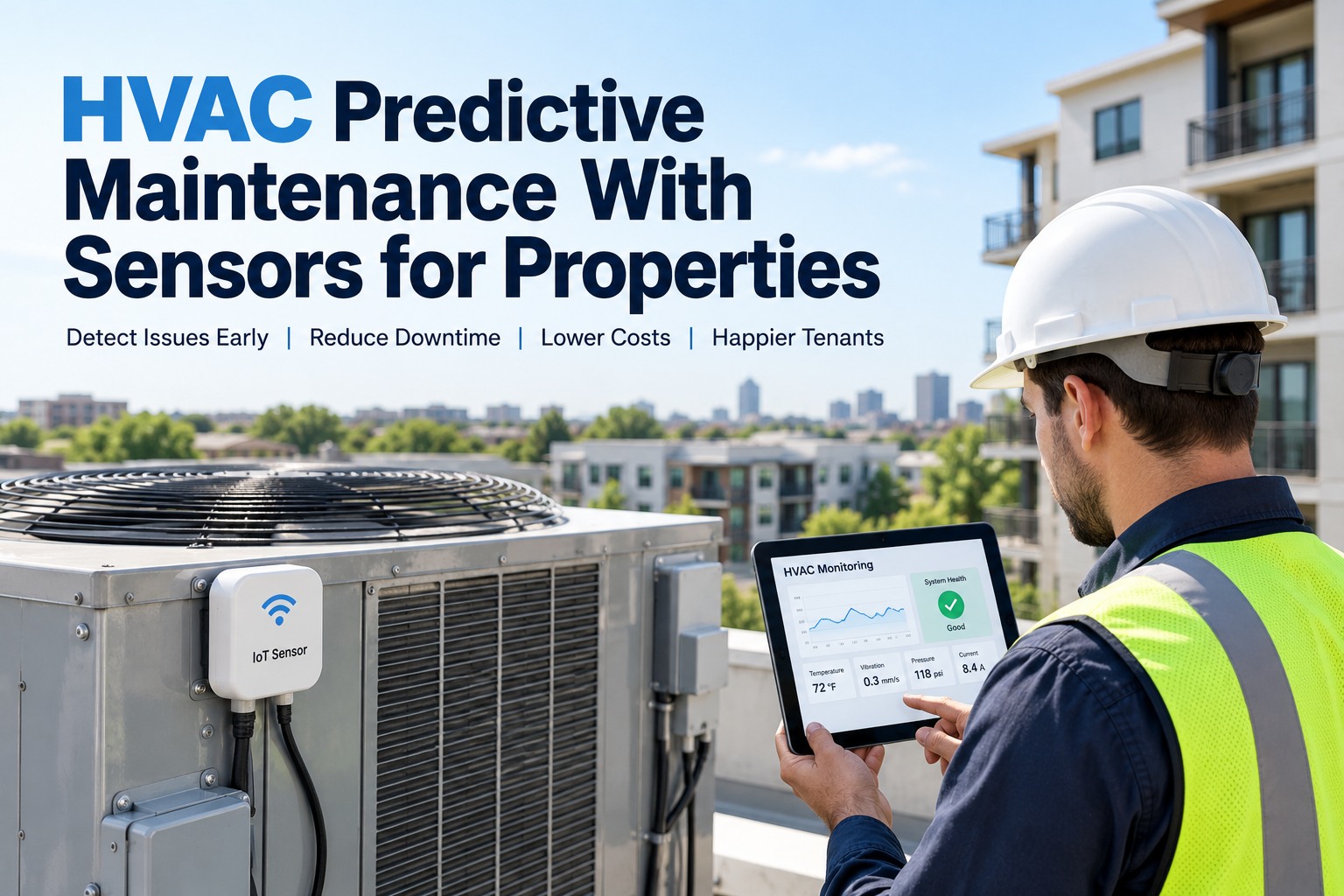
Heating, ventilation, and air conditioning systems represent the single largest category of both energy consumption and maintenance expenditure in most commercial properties. IoT sensors embedded across HVAC infrastructure — on compressors, air handling units, ductwork, and condensate pans — monitor operational parameters including supply and return air temperatures, refrigerant pressures, fan motor current draw, filter differential pressure, and airflow volumes. Deviations from baseline operating ranges indicate developing faults weeks before they cause system failure, allowing parts to be ordered and maintenance scheduled during low-demand periods rather than during peak weather events when HVAC contractors are in highest demand.
Sub-metering sensors on electrical panels, circuit breakers, and major equipment allow property managers to monitor energy consumption at granular levels — by floor, by tenant, by equipment class, or by individual circuit. This granularity transforms energy management from a passive utility-bill review process into an active operational discipline. Consumption spikes that indicate equipment malfunction, tenant behavior patterns that drive demand charges, and equipment running during unoccupied hours all become visible and addressable through real-time monitoring dashboards.
CO₂ concentration, particulate matter (PM2.5), volatile organic compounds (VOCs), and humidity levels are direct indicators of ventilation adequacy and indoor environmental quality. Continuous IAQ monitoring enables property managers to demonstrate compliance with WELL Building Standards and LEED requirements, respond rapidly to air quality incidents, and optimize HVAC operation based on actual occupancy-driven ventilation demand rather than fixed schedules — reducing energy consumption while improving occupant health outcomes.
Accelerometers and tilt sensors installed on structural elements, elevators, and heavy rotating equipment detect anomalous vibration signatures that indicate mechanical imbalance, bearing degradation, or structural movement. For elevator systems specifically, vibration profiling generates early warning of component wear that, left unaddressed, leads to regulatory shutdowns and expensive emergency repair. Parking structures, rooftop mechanical rooms, and loading docks benefit similarly from continuous structural monitoring that would be impractical to replicate through manual inspection schedules.
Passive infrared (PIR) and time-of-flight occupancy sensors provide accurate, privacy-preserving space utilization data across common areas, conference rooms, and tenant suites. This data informs lease negotiations by quantifying actual space usage against contracted square footage, guides HVAC zoning to condition occupied spaces rather than entire floors, and supports facilities rightsizing decisions for portfolios undergoing post-pandemic space rationalization. Occupancy data integrated with access control systems also enhances building security monitoring without adding operational complexity.
The IoT Predictive Maintenance Framework
Predictive maintenance — the use of continuous condition monitoring data to forecast equipment failures before they occur — represents the highest-value application of IoT sensor networks in property management. Moving beyond both reactive repair (fix it when it breaks) and preventive maintenance (replace it on a schedule), predictive maintenance uses actual equipment health data to intervene precisely when intervention is needed.
Sensor Baseline Establishment
Every predictive maintenance program begins with a defined operating baseline — the normal range of sensor readings for a given piece of equipment under typical load conditions. Baseline establishment requires a calibration period during which sensor data is collected without alerts, allowing the system to characterize seasonal variation, load-cycle patterns, and equipment-specific operating signatures. Without a reliable baseline, anomaly detection produces excessive false positives that erode staff confidence in the system and lead to alert fatigue.
Anomaly Detection and Pattern Recognition
Once baselines are established, analytics engines — ranging from simple threshold-based rules to machine learning models trained on equipment failure histories — continuously compare incoming sensor data against expected operating parameters. Anomalies are classified by severity, frequency, and trajectory. A compressor running two degrees warmer than baseline is a watch condition; the same compressor running eight degrees warmer with increasing temperature trend is an immediate maintenance trigger. Pattern recognition across multiple sensor signals simultaneously catches complex failure modes that single-parameter monitoring would miss entirely.
Automated Work Order Generation
Predictive maintenance only delivers operational value when sensor alerts translate directly into maintenance action. Integrated platforms connect anomaly detection outputs to computerized maintenance management systems (CMMS), automatically generating work orders with fault descriptions, sensor data attachments, and priority classifications. This integration eliminates the manual handoff between monitoring systems and maintenance dispatch — a gap that historically caused alert information to be lost, delayed, or misinterpreted before technicians were deployed.
Maintenance Outcome Tracking and Model Refinement
Each completed maintenance event generates feedback that refines predictive model accuracy over time. When a technician confirms a bearing failure that sensors flagged three weeks earlier, that correlation strengthens the model's confidence threshold for similar patterns in the future. When an alert proves to be a false positive caused by a sensor calibration drift, the system adjusts accordingly. This continuous feedback loop is what separates mature predictive maintenance programs from static rule-based alert systems — and it's the mechanism through which property-specific equipment performance profiles are built into institutional knowledge rather than residing solely with individual technicians.
Sensor Technology Comparison by Application
Selecting the right sensor hardware for each monitoring application requires matching sensor specifications to the physical conditions, communication requirements, and data resolution needs of each use case. The table below summarizes the primary sensor categories deployed in property management environments and their key operational characteristics. To see how these sensor types integrate within a unified operations platform, schedule a demo with our team.
| Sensor Type | Primary Application | Communication Protocol | Battery Life | Data Frequency |
|---|---|---|---|---|
| Capacitive Moisture | Water leak detection | Zigbee / Z-Wave / LoRaWAN | 3–7 years | Event-driven |
| Thermocouple / RTD | HVAC and pipe temperature | 4-20mA / Modbus / BACnet | Wired | Continuous / 1-min intervals |
| Current Transformer (CT) | Electrical energy monitoring | Modbus / Ethernet | Wired | Real-time / 15-min intervals |
| MEMS Accelerometer | Vibration and structural monitoring | Bluetooth / Wi-Fi / wired | 1–3 years | Configurable (1Hz–10kHz) |
| Electrochemical CO₂ | Indoor air quality | Zigbee / Wi-Fi / LoRaWAN | 2–5 years | 5–15 min intervals |
| PIR / Time-of-Flight | Occupancy and space utilization | Zigbee / Bluetooth / Wi-Fi | 2–5 years | Event-driven |
| Differential Pressure | Filter and airflow monitoring | 4-20mA / BACnet | Wired | Continuous / 5-min intervals |
Implementation Architecture: From Sensors to Decisions
A sensor network without a coherent data architecture is a collection of hardware, not an operational intelligence system. Successful IoT implementations in property management are built on a layered architecture that connects physical sensing to actionable operational decisions through structured data flows.
Physical sensors deployed at asset locations capture raw measurement data and transmit readings via wireless or wired communication protocols. Edge-layer sensors may include local processing capability for threshold-based alerting that does not require cloud connectivity — critical for time-sensitive events like water leak detection where response latency directly determines damage magnitude.
IoT gateways aggregate signals from multiple sensors across communication protocols (Zigbee, Z-Wave, LoRaWAN, BACnet, Modbus) and normalize data into standardized formats for cloud transmission. Gateway selection determines the building's network resilience, sensor capacity ceiling, and protocol compatibility — decisions that significantly affect platform flexibility as sensor deployments expand.
Cloud-hosted IoT platforms receive, store, and process sensor data streams, applying analytics engines that range from simple threshold rules to machine learning models. This layer hosts dashboards, generates alerts, maintains equipment history records, and integrates with downstream operational systems including CMMS, BMS, and ERP platforms. Platform selection criteria should include data retention policies, API flexibility, multi-building portfolio support, and integration ecosystem breadth.
The value of IoT data is realized when it flows into the operational systems that drive action — maintenance management platforms, energy management systems, tenant communication tools, and portfolio reporting dashboards. Integration depth determines whether IoT intelligence stays within a monitoring silo or becomes embedded in the daily workflows of maintenance teams, property managers, and asset managers making capital allocation decisions.
Building the Business Case: ROI Drivers for IoT Sensor Investment
IoT sensor deployment requires capital investment in hardware, connectivity infrastructure, platform licensing, and integration services. For property managers and asset owners evaluating implementation, the business case rests on quantifying returns across several distinct value categories that collectively exceed deployment costs — typically within 12 to 24 months for well-scoped implementations.
Avoided damage costs are the most straightforward ROI driver. A single undetected pipe leak in a commercial building can produce water damage claims exceeding $50,000 before it is discovered through visible signs or tenant complaints. A moisture sensor network capable of detecting the same event within minutes — for a hardware cost measured in hundreds of dollars — represents a return profile that requires no complex financial modeling to justify. The same logic applies to HVAC failures during extreme weather events, where emergency repair costs, tenant disruption claims, and lost rental income from uninhabitable units consistently dwarf sensor deployment costs.
Energy optimization returns are quantifiable through pre- and post-implementation utility bill comparison. Buildings with granular sub-metering and occupancy-linked HVAC control consistently achieve 15–30% reductions in energy expenditure, with payback periods on sensor hardware often under 18 months based on energy savings alone. Combined with avoided maintenance costs, extended equipment life, and reduced insurance premiums that some carriers now offer to buildings with continuous monitoring programs, the aggregate ROI case for IoT implementation is compelling across most commercial and multi-family property types. Organizations ready to build this business case can sign up free and explore portfolio-level monitoring tools built for measurable ROI.
Common Implementation Pitfalls and How to Avoid Them
IoT property management implementations that underperform their projected ROI share a recognizable set of failure patterns. Understanding these pitfalls before deployment begins is the practical foundation of a successful program.
Sensors deployed without a systematic asset inventory and criticality assessment result in coverage gaps at high-risk locations and redundant coverage at low-priority assets. Before installation begins, map every monitored asset, identify failure modes and consequence severity for each, and design sensor placement to maximize detection of high-consequence failure precursors rather than simply achieving coverage density.
Thresholds set too conservatively generate constant false-positive alerts that train maintenance teams to ignore the monitoring system entirely. Thresholds set too liberally miss genuine developing failures. Threshold calibration is an ongoing operational discipline, not a one-time commissioning task — invest in the analytics expertise and process discipline to manage thresholds continuously as equipment ages and seasonal baselines shift.
IoT sensor platforms that exist as standalone monitoring dashboards — disconnected from CMMS, BMS, and energy management systems — require manual data transfer between systems and produce insights that don't reliably reach the teams positioned to act on them. Prioritize platform integration capability during vendor selection, and allocate implementation budget for the integration work that connects sensor data to operational workflows.
Wireless sensor networks require adequate signal coverage, gateway capacity, and reliable internet connectivity throughout the building. Connectivity assessments and signal surveys should precede hardware procurement, not follow it. Buildings with thick concrete construction, extensive metal infrastructure, or complex floor plan geometry may require denser gateway deployment or alternative communication protocols to achieve reliable sensor coverage.
Scaling from Pilot to Portfolio: A Practical Roadmap
Most successful IoT property management programs begin with a focused pilot deployment — typically targeting a single high-priority building, a specific high-risk system such as HVAC or plumbing, or a clearly defined use case such as water leak detection. Pilot programs serve dual purposes: they generate the performance data needed to build internal business cases for broader deployment, and they surface implementation challenges at a scale where course correction is inexpensive.
Pilot success criteria should be defined before deployment begins, not evaluated retrospectively. Specific metrics — alert response times, false positive rates, maintenance cost deltas, energy consumption changes — provide objective grounds for expansion decisions and prevent programs from being evaluated on anecdotal impressions rather than measured outcomes. Pilots that demonstrate clear, quantified results create organizational momentum for portfolio-wide deployment that technology enthusiasm alone rarely sustains through procurement, budgeting, and change management cycles.
Portfolio scaling introduces additional challenges around data standardization, vendor contract management, and cross-building analytics. Organizations that design their data architecture for portfolio visibility from the start — using standardized sensor naming conventions, consistent gateway configurations, and centralized analytics platforms — avoid the retroactive integration work that plagues programs scaled without deliberate infrastructure planning. Teams ready to connect IoT monitoring intelligence to operational workflows can book a demo to see how integrated facility management platforms support full portfolio deployment from a single operational interface.
Connect your IoT sensor data to a platform built for property operations — from predictive maintenance alerts to portfolio-level reporting.
The Future of Connected Property Management
The IoT sensor landscape in property management is evolving rapidly across several dimensions simultaneously. Sensor hardware costs continue to decline as manufacturing volumes grow, lowering the capital barrier to comprehensive building coverage. Battery technology improvements are extending wireless sensor operating life to a decade or more in low-transmission-frequency applications, reducing the operational overhead of sensor network maintenance. AI-driven analytics platforms are moving beyond rule-based alerting toward generative fault diagnosis that not only detects anomalies but explains probable root causes and recommends specific corrective actions — dramatically reducing the diagnostic burden on technicians responding to alerts.
Digital twin technology — the creation of dynamic, sensor-fed virtual models of physical buildings — represents the logical endpoint of comprehensive IoT instrumentation. When every major building system is represented in a continuously updated digital model, property managers and engineers can simulate the effects of operational changes before implementing them in the physical building, optimize maintenance scheduling across interdependent systems, and conduct forensic analysis of past incidents with complete environmental context. The buildings that are investing in IoT sensor infrastructure today are building the data foundation on which digital twin capability will ultimately rest.
What remains constant across all technology horizons is the fundamental value proposition: visibility into building conditions that were previously invisible, delivered in time to act before problems become crises. IoT sensors do not eliminate equipment failures, water damage, or energy waste — but they extend the window between early warning and consequence, and in property management, that extended window is where operational excellence and financial performance are built. Teams ready to act on that advantage today can book a free consultation and see how connected sensor programs are implemented from day one.
Frequently Asked Questions
How many IoT sensors does a typical commercial building require?
Sensor counts vary significantly based on building size, asset complexity, and the scope of monitoring objectives. A focused water leak detection deployment in a 50,000 sq ft office building might require 30–60 moisture sensors. A comprehensive program covering HVAC monitoring, energy sub-metering, IAQ, and occupancy for the same building could involve 200–400 sensors across multiple types. Implementation planning should begin with an asset inventory and monitoring scope definition before sensor count estimates are developed.
What wireless communication protocol is best for property management IoT?
No single protocol is universally optimal. Zigbee and Z-Wave work well for dense sensor deployments in buildings with gateway infrastructure coverage. LoRaWAN is preferred for large campuses or buildings where running gateway cabling is impractical, given its long-range, low-power characteristics. BACnet and Modbus remain standard for HVAC and building automation integration where wired connections are available. Many enterprise IoT platforms support multi-protocol gateway hardware that allows mixed-protocol deployments within a single building.
How long does IoT sensor installation typically take?
Installation timelines depend heavily on building complexity, network infrastructure readiness, and the scope of sensor types being deployed. A focused water leak sensor deployment in a single building can typically be completed in one to three days. Comprehensive programs covering multiple system types across a large commercial building generally require two to six weeks from hardware delivery to operational commissioning, including gateway installation, network configuration, platform integration, and alert threshold setup.
Can IoT sensors integrate with existing building management systems?
Yes, in most cases. Modern IoT platforms support integration with BACnet and Modbus-based building management systems through protocol translation gateways. However, integration depth varies significantly between legacy BMS installations and newer systems designed with open APIs. A connectivity assessment of existing BMS infrastructure is recommended before committing to specific IoT platform vendors, as integration complexity directly affects implementation cost and timeline.
What cybersecurity considerations apply to IoT sensor networks in buildings?
Building IoT networks introduce cybersecurity exposure that requires deliberate governance. Best practices include network segmentation that isolates IoT devices from corporate IT infrastructure, firmware update policies that keep sensor and gateway software current, strong authentication requirements for platform access, and vendor security assessments that evaluate data encryption standards, access control architecture, and breach notification commitments. Properties subject to industry-specific regulatory frameworks — healthcare, financial services — face additional compliance considerations around IoT data handling.
How is IoT sensor data used to reduce property insurance premiums?
A growing number of commercial property insurers now offer premium reductions or enhanced coverage terms for buildings with continuous monitoring programs, particularly for water leak detection and fire system monitoring. Insurers recognize that early detection systems reduce both claim frequency and claim severity — actuarially favorable outcomes they are increasingly willing to price into policy terms. Property owners should disclose monitoring programs to their insurance brokers and request formal underwriting review, as premium impacts vary significantly between carriers and coverage types.