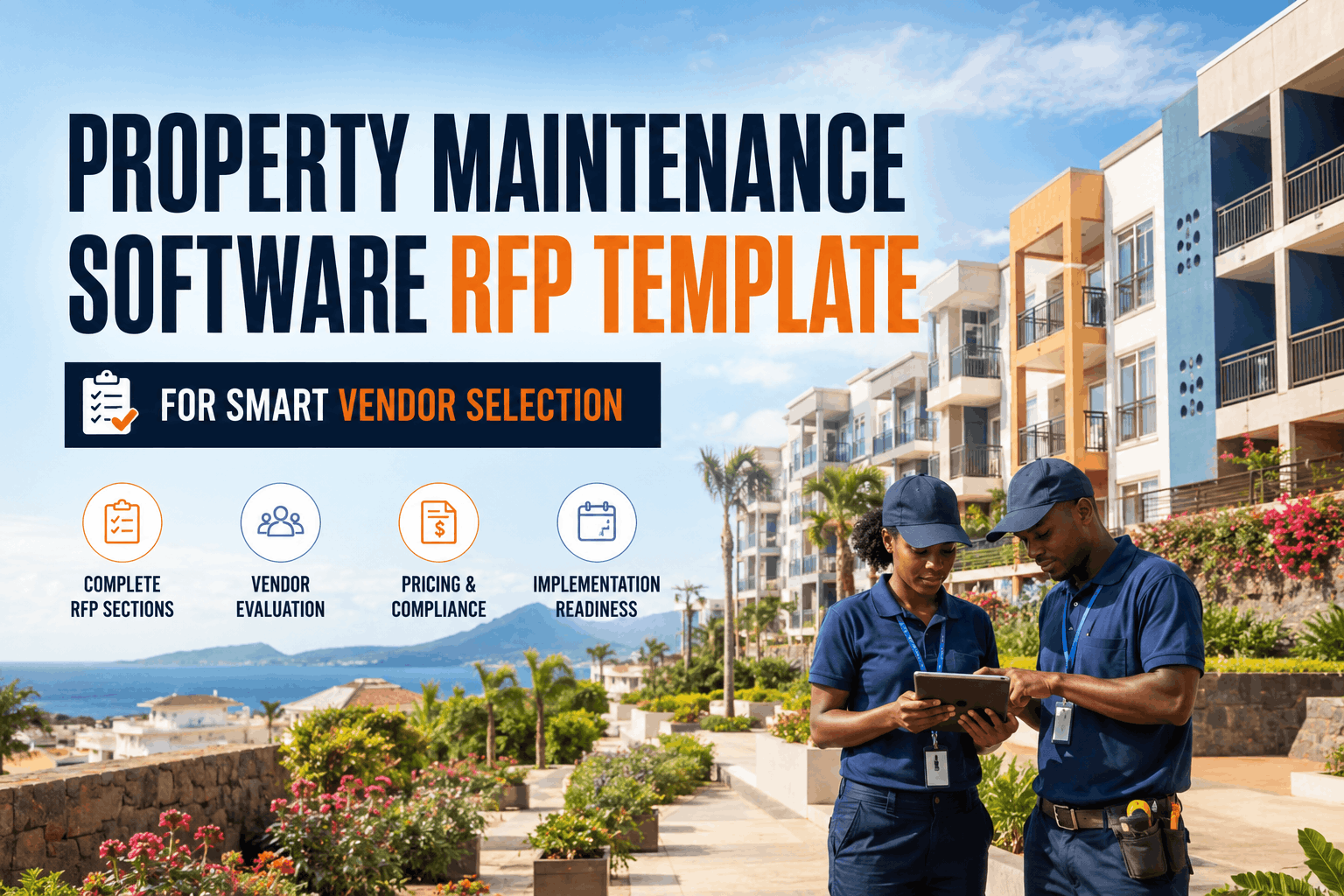
RFP Template for Property Maintenance Software Vendor Selection
By Alex Jordan on June 30, 2026
Selecting the right property maintenance software (CMMS) is one of the most consequential procurement decisions a property management organization makes. A comprehensive Request for Proposal (RFP) process—covering functionality requirements, technical architecture, integration capabilities, security, pricing, implementation, and vendor qualifications—ensures that your selection is defensible, your chosen vendor aligns with your operational strategy, and your team adopts the system successfully. Organizations that invest 4–6 weeks in a structured RFP process report 60% higher software adoption, 40% faster implementation, and 3-year ROI that exceeds budgeted expectations by 25–35%.
Evaluate Property CMMS Vendors SystematicallyComplete RFP framework with vendor evaluation matrix, demo scoring templates, reference check protocols, and TCO analysis tools to select your optimal property maintenance platform.
The RFP process begins with honest stakeholder conversations about pain points, operational priorities, budget constraints, and 3-year strategic goals. This clarity drives everything downstream: requirement specificity, vendor shortlist quality, and final selection alignment with organizational strategy.
2. Vendor Research & Shortlist Development (Weeks 2–3)
Strategic vendor research focuses on identifying platforms purpose-built for property management rather than industrial/manufacturing systems retrofitted for property use. A shortlist of 4–6 qualified vendors creates enough competition to drive value without overwhelming your evaluation capacity.
3. RFP Development & Issuance (Weeks 3–4)
A well-structured RFP eliminates ambiguity, establishes evaluation criteria upfront, and ensures vendors compete fairly on a level playing field. Your RFP serves as the baseline document for vendor negotiations and eventual contract terms.
4. Vendor Evaluation & Selection (Weeks 5–7)
Structured evaluation of vendor responses, scored demonstrations, and reference calls produces a defensible vendor selection backed by documented evidence. Multi-evaluator scoring prevents individual bias and builds consensus across your organization.
Successful RFP processes conclude with clear contract terms that protect your interests, establish vendor accountability, and define implementation success metrics and remedy procedures.
Evaluate & Select Your Property CMMS ConfidentlyOxmaint guides you through vendor evaluation, comparison, and selection with our RFP framework, scoring templates, and expert guidance on property management software capabilities.
Frequently Asked Questions — RFP Process for Property Maintenance Software
How long should the complete RFP process take?
A thorough RFP process typically takes 8–12 weeks: 2 weeks for planning and team assembly, 2–3 weeks for vendor research and shortlist development, 3–4 weeks for RFP development and issuance, 4 weeks for vendor response evaluation and vendor demos, 2–3 weeks for reference calls and final selection, and 1–2 weeks for contract negotiation. Accelerated processes can compress this to 6 weeks if you're working from pre-vetted vendor shortlist and simplified evaluation criteria.
What's the difference between Must-Have, Should-Have, and Could-Have requirements?
Must-Haves are non-negotiable (mobile app, multi-property dashboards, PM automation, integrations with your existing systems). A vendor lacking even one Must-Have should be eliminated. Should-Haves are important but not showstoppers (advanced analytics, tenant portal, predictive maintenance). Could-Haves are nice-to-have but deferrable to future phases (AI optimization, occupancy sensors, advanced data visualization).
How many vendors should we include in the RFP?
An RFP shortlist of 4–6 vendors creates sufficient competition and choice without overwhelming your evaluation team. Fewer than 4 vendors limits competitive pressure and may miss better options. More than 6 vendors multiplies evaluation effort (coordinating 6 demos, reviewing 6 detailed proposals) without proportionally better outcomes.
Should we require a proof-of-concept (POC) before final vendor selection?
POCs can be valuable but add 4–8 weeks to the selection timeline. If considering a POC, define the scope tightly: specific asset classes, 4-week duration, clear success metrics. Avoid open-ended POCs that blur the line between evaluation and actual implementation. Most property teams complete vendor evaluation through demos and reference calls without needing a separate POC.
What's the most important evaluation criterion—functionality, cost, or vendor reputation?
Functionality and vendor capability matter more than lowest cost. A 20% cheaper platform that requires extensive customization or has poor property-specific features can cost 30–40% more by year 3 when you include implementation overruns and workaround development. Quality implementations follow: (1) Does it meet my requirements? (2) Can they execute well? (3) Can I afford it reasonably? vs (1) What's the cheapest option?
How should we weight the RFP evaluation criteria if stakeholders disagree on priorities?
Have a structured weighting workshop where each stakeholder group (operations, IT, finance, leadership) nominates their top 3 priorities and rates their relative importance. Use consensus-building techniques (dot-voting, breakout group discussions) to build agreement on weighting. Document disagreements and the reasoning behind final weighting. This transparency prevents stakeholders from later claiming the vendor selection was biased.
Can we negotiate better pricing or terms after vendor selection?
Yes, contract negotiation begins after vendor selection. You have negotiating leverage post-selection because the vendor knows you're ready to proceed and has already invested time in your deal. Common negotiation areas: per-user-per-month rates, implementation hours and costs, training tier inclusions, payment terms, contract length. Be clear about "must win" items (implementation timeline, integration capabilities) vs negotiable items (pricing, contract length).

.png)
.png)