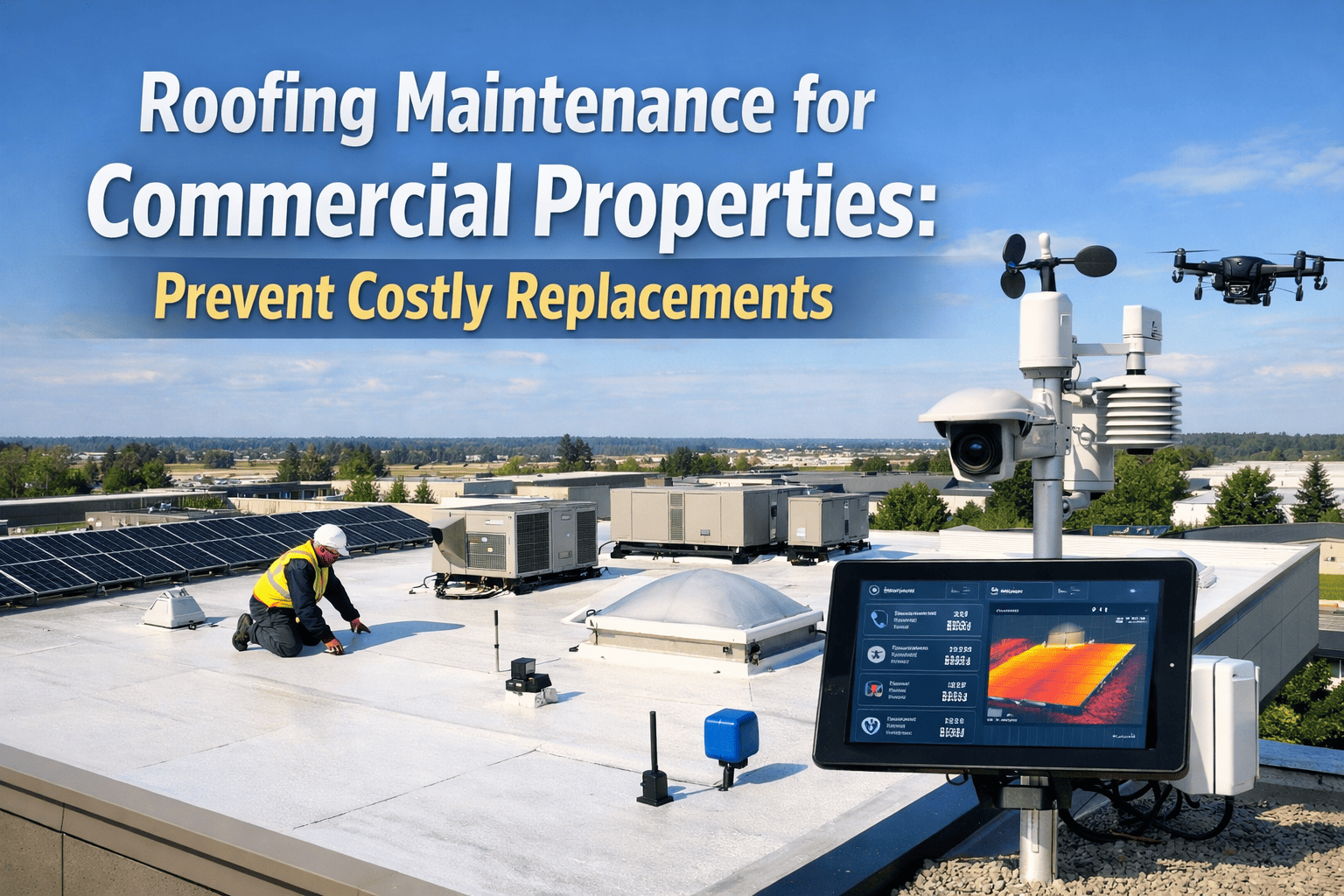
Roofing maintenance problems are among the most expensive and disruptive issues facing property managers, facility teams, and building owners. From slow leaks that silently destroy insulation and ceilings to sudden membrane failures during storm season, roof problems rarely announce themselves until damage is already underway. The root causes—UV degradation, thermal cycling, poor drainage, and deferred maintenance—are predictable and preventable when addressed through structured inspection workflows. Industry data shows that proactive roof maintenance programs reduce emergency repair costs by 60–70% while extending roof service life by 40% or more. This guide provides a complete framework for understanding roofing failure modes, recognizing symptoms early, and applying the right repair solutions before minor issues become major capital expenditures. If your roof maintenance is still reactive, it is time to sign up for OxMaint and shift to a proactive, data-driven approach.
Roofing Systems—Understanding Your Options
Different roofing materials degrade differently and require tailored maintenance strategies. Understanding your roof type is the first step toward effective inspection planning. Book a demo to see how OxMaint tailors .
Roof Maintenance Lifecycle: Complete Reference
Each phase of a roof's life demands different maintenance intensity. Early investment in inspections compounds into decades of extended service.
| Lifecycle Phase | Roof Age | Inspection Frequency | Typical Issues | Maintenance Focus |
|---|---|---|---|---|
| New Installation | 0–5 years | Annual + post-storm | Installation defects, warranty items | Punch-list verification, baseline documentation |
| Early Service | 5–10 years | Biannual | Sealant aging, minor flashing shifts | Preventive sealant renewal, drain clearing |
| Mid-Life | 10–20 years | Biannual + condition-based | Surface cracking, ponding, membrane wear | Coating applications, flashing replacement |
| Mature Asset | 20–30 years | Quarterly | Widespread degradation, structural concerns | Capital planning, overlay vs. replacement analysis |
| End of Life | 30+ years | Monthly monitoring | Systemic failure risk, insurance concerns | Replacement budgeting, emergency response planning |
Repair vs. Replace: The Decision Framework
When roof problems are discovered, teams must quickly determine whether to repair, restore, or replace. This framework guides that decision based on damage scope, roof age, and budget impact.
Get structural assessment. Compare 10-year repair cost projection against full replacement ROI. Factor in energy savings from modern materials and updated insulation.
Document the failure, repair the specific defect, update the maintenance schedule, and increase inspection frequency for the affected zone.
Top 5 Roof Failure Points & Prevention
Decades of roofing industry data reveal five consistent failure patterns. Understanding each one allows teams to concentrate inspections where they matter most.
Flashing and Edge-Metal Separation
Flashing at penetrations (chimneys, vents, skylights) and roof edges accounts for over 70% of all roof leaks. Thermal cycling loosens sealants and lifts metal, creating gaps where water enters. Prevention: Inspect all flashing joints biannually. Re-seal with compatible materials before gaps exceed 1/8 inch.
Membrane Deterioration
UV radiation and thermal stress cause surface cracking, blistering, and loss of flexibility in all membrane types. Once the surface breaks, water penetrates the substrate and damage accelerates exponentially. Prevention: Apply reflective coatings every 5–7 years. Document surface condition changes with photos at each inspection.
Drainage System Failure
Clogged gutters, blocked internal drains, and failed scuppers cause ponding water that adds 5.2 lbs per square foot per inch of depth—creating structural stress and accelerating membrane breakdown. Prevention: Clear all drainage paths monthly. Install overflow drains on flat roofs as a secondary system.
Insulation Saturation
Once water penetrates the membrane, it saturates insulation boards that lose 40% or more of their R-value. Wet insulation also adds dead load and creates conditions for mold growth and deck corrosion. Prevention: Use infrared thermography annually to detect moisture trapped beneath the surface. Replace saturated sections immediately.
Fastener Back-Out & Wind Uplift
Mechanically attached systems rely on fasteners that loosen over time from vibration and thermal movement. Loose fasteners allow wind to peel membrane sections, creating catastrophic exposure during storms. Prevention: Test fastener pull-out resistance during inspections. Re-secure or replace corroded fasteners before storm season.
Digital Infrastructure for Roof Oversight
Modern roof maintenance requires more than ladders and clipboards. A digital infrastructure layer transforms scattered observations into actionable intelligence—connecting field inspectors, maintenance planners, and budget decision-makers through a single source of truth.
Mobile Inspection App
Field teams capture photos, tag locations, rate severity, and complete checklists directly from the roof—syncing instantly to the central platform.
Condition Scoring Dashboard
Composite roof condition scores aggregate surface, flashing, drainage, and structural ratings into a single index for portfolio-level comparison.
Automated Work Orders
Critical defects automatically generate work orders with severity priority, location tags, photo attachments, and vendor assignment.
Trend Analytics & Forecasting
Historical defect data reveals degradation patterns, predicts failure timelines, and generates capital replacement schedules years in advance.
From Reactive Repairs to Verified Performance
The shift from reactive to proactive roof maintenance is measurable. Here is what changes when teams adopt structured digital workflows.
Why Roof Maintenance Fails Without Systems
The roofing industry has long operated on the assumption that roofs are "set and forget" assets—inspected only when leaks appear and repaired only when damage becomes visible. This approach consistently delivers the worst financial outcomes. Properties that invest $0.15–$0.25 per square foot annually in structured inspections avoid $2.00–$5.00 per square foot in emergency repairs and premature replacement costs.
The pattern is clear: organizations that shift to digital inspection workflows with automated scheduling, mobile documentation, and condition scoring see emergency repair ratios drop below 10% within the first year. Meanwhile, properties without systematic programs spend 60% or more of their roof budget on unplanned work—paying premium contractor rates for damage that was entirely preventable.
The most advanced facility teams are now using historical defect data to build predictive models that forecast failure timelines 3–5 years in advance, allowing capital budgets to be planned with precision rather than estimated through guesswork.
Conclusion
Roofing maintenance problems follow predictable patterns—UV degradation, flashing failure, drainage breakdown, and structural compromise—that are identifiable and treatable when caught early through systematic inspection. The difference between a $500 repair and a $50,000 emergency is not luck; it is a maintenance program that schedules inspections automatically, documents findings digitally, and converts defects into work orders before damage spreads. Every property deserves a roof management approach built on data rather than reaction.
Start building your proactive roof maintenance program today →