A veteran inspector with 30 years of experience approves a weld that fails catastrophically six months later. Another inspector rejects perfectly acceptable material because they're having a bad day. The same defect gets classified as "minor" on Monday morning and "critical" on Friday afternoon. These aren't isolated incidents—they're the inevitable consequences of human-driven quality inspection in steel manufacturing. When acceptance decisions depend on an inspector's mood, fatigue level, training quality, or personal interpretation of vague standards, consistency becomes impossible and defect escape rates remain stubbornly high despite massive quality investments. Artificial intelligence is fundamentally transforming steel quality inspection by replacing subjective human judgment with objective, data-driven analysis that detects defects with superhuman consistency, learns from every inspection, and makes decisions based on statistical patterns invisible to human eyes—delivering quality levels that were physically impossible to achieve through manual inspection alone.
AI-powered quality inspection systems combine computer vision, machine learning algorithms, and deep neural networks to analyze steel surfaces, welds, dimensions, and material properties with precision that exceeds human capabilities by orders of magnitude. These systems inspect 100% of production at line speed—detecting microscopic surface defects, measuring dimensions to micron accuracy, identifying material composition variations, and predicting failure modes based on subtle patterns that human inspectors cannot perceive. Unlike humans who fatigue after hours of repetitive inspection, AI maintains perfect consistency across millions of inspections, continuously improves accuracy through learning, and provides complete traceability with detailed defect images and classifications stored permanently. This comprehensive guide reveals how leading steel manufacturers are deploying AI inspection systems that eliminate human bias, reduce defect escape rates by 90%+, and transform quality from a cost center into a competitive advantage that enables premium pricing and customer loyalty.
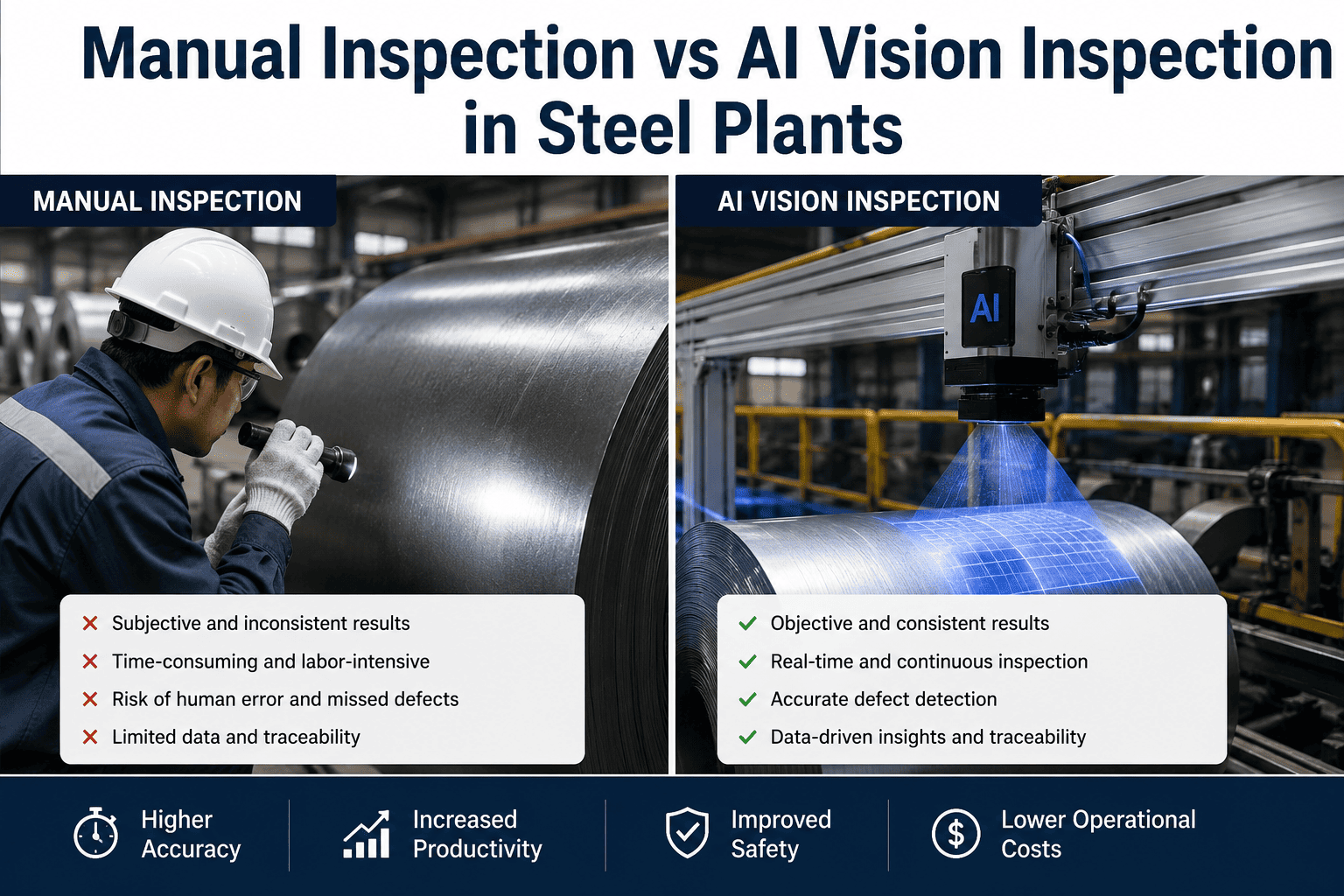
Human Visual Inspection
AI-Powered Inspection
The Hidden Costs of Human Inspection Bias
Quality managers often underestimate the financial impact of inspection inconsistency, viewing it as an acceptable tradeoff for flexibility. But quantifying the true cost of human bias reveals it's one of the most expensive hidden drains on steel mill profitability.
Inter-Inspector Variability: The Silent Profit Killer
The Problem: Studies show 40-60% disagreement rate when multiple inspectors evaluate identical defects. Inspector A accepts material that Inspector B would reject, creating arbitrary quality standards that fluctuate based on who's working each shift.
Fatigue-Induced Error Escalation
The Problem: Inspector accuracy degrades 25-40% after two hours of continuous visual inspection. End-of-shift defect detection rates are significantly worse than start-of-shift, creating time-dependent quality variation.
Training Investment and Knowledge Loss
The Problem: Developing expert visual inspectors requires 12-18 months of training and mentorship. When experienced inspectors retire or change jobs, their accumulated defect recognition knowledge leaves with them.
AI Inspection Technologies Revolutionizing Steel Quality
Modern AI quality systems deploy multiple complementary technologies, each optimized for specific defect types and inspection scenarios. Understanding these capabilities helps mills select the right combination for their production environment.
Deep Learning Surface Defect Detection
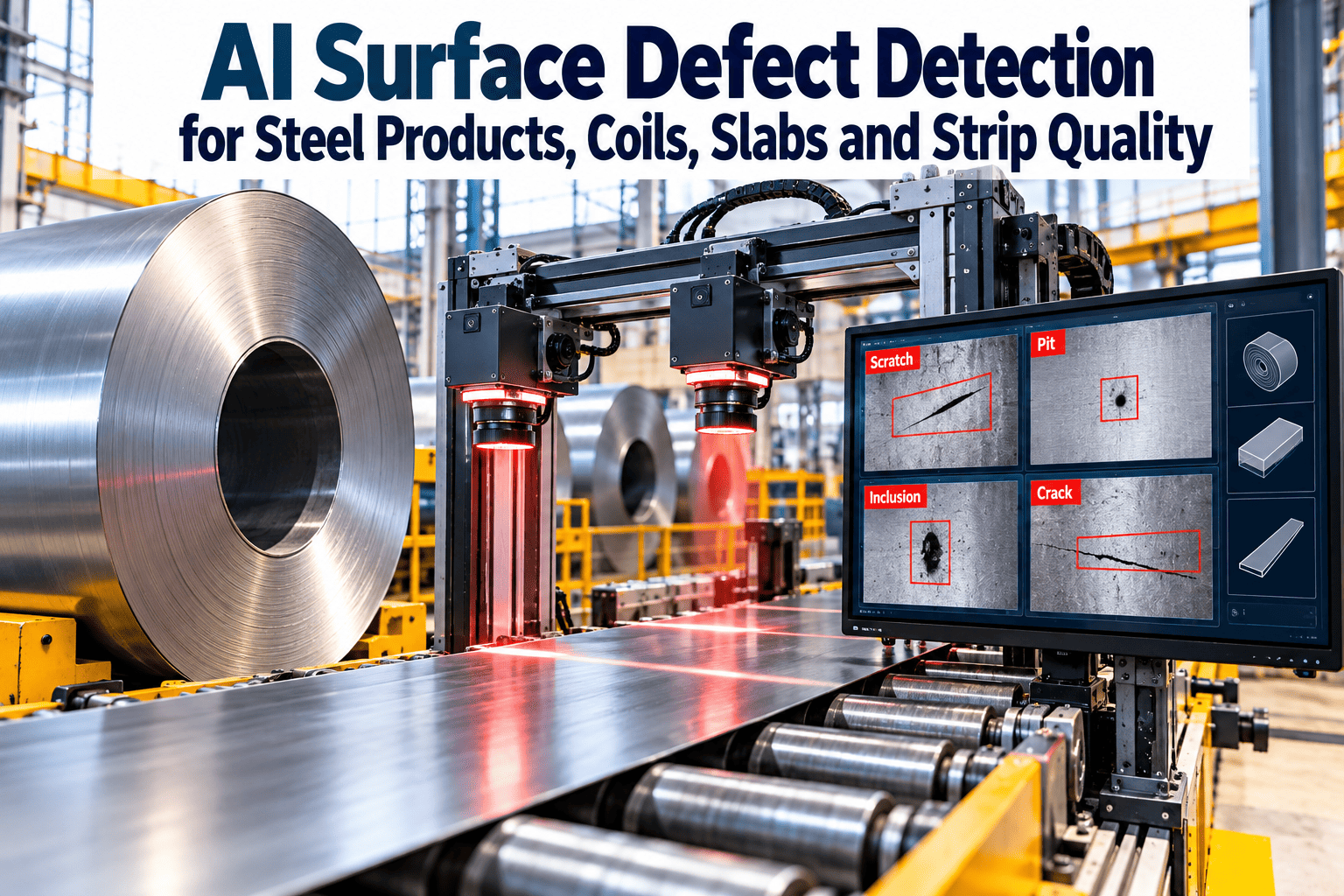
Convolutional neural networks (CNNs) analyze high-resolution images of steel surfaces to identify scratches, pits, inclusions, scale, rust, and coating defects invisible to human inspectors. Multi-camera arrays capture entire surface at line speeds up to 2000 meters/minute with sub-millimeter spatial resolution.
Dimensional Accuracy Verification
Laser triangulation sensors and structured light systems create three-dimensional point clouds measuring thickness, width, flatness, and geometric profiles to micron precision. AI algorithms compare measurements against CAD specifications and identify out-of-tolerance conditions instantly.
Material Property Characterization
Infrared thermography detects temperature variations indicating internal defects, coating thickness irregularities, or heat treatment inconsistencies. Spectroscopic sensors verify alloy composition and coating weight in real-time without destructive sampling.
Automated Weld Quality Assessment
Specialized neural networks trained on millions of weld images evaluate bead appearance, penetration depth, porosity, undercut, and other critical weld quality parameters. Combines visual inspection with ultrasonic and radiographic data for comprehensive evaluation.
Connect AI Inspection Data to Intelligent Maintenance Systems
AI inspection systems generate massive quality data streams, but this information becomes exponentially more valuable when integrated with maintenance operations. Oxmaint automatically correlates quality defect patterns with equipment maintenance records, identifying when degrading equipment (worn tooling, misaligned rolls, failing sensors) is causing quality issues before they trigger customer complaints. This closed-loop integration transforms quality data from passive reporting into active equipment health monitoring that prevents defects at the source.
Implementation Roadmap: From Concept to Production
Deploying AI inspection requires systematic approach balancing technical complexity with operational realities. This phased methodology minimizes risk while building internal expertise and stakeholder confidence.
Assessment & Proof of Concept
Pilot System Deployment
Production Transition & Validation
Scale & Optimization
Real-World Performance: AI vs Human Inspection Benchmarks
Theoretical benefits are meaningless without measured performance in actual production conditions. These benchmarks come from documented steel mill deployments across surface inspection, dimensional measurement, and weld quality applications.
| Performance Metric | Human Inspection | AI Inspection | Improvement Factor |
|---|---|---|---|
| Defect Detection Rate | 60-75% | 95-99.5% | 1.3-1.6x better |
| False Positive Rate | 8-15% | 0.5-2% | 4-30x better |
| Inspection Consistency | 40-65% | 98-99.9% | 1.5-2.5x better |
| Inspection Speed | 2-10 m/min | 100-2000 m/min | 10-1000x faster |
| Coverage | 2-10% sampling | 100% inspection | 10-50x more coverage |
| Minimum Detectable Defect | 0.5-1.0mm | 0.01-0.05mm | 10-100x smaller |
| Time to Expert Performance | 12-18 months | 2-4 weeks | 13-36x faster |
| Performance Degradation | 25-40% after 2hrs | None (24/7) | Infinite improvement |
| Cost Per Inspection | $0.50-$2.00 | $0.02-$0.10 | 5-100x lower |
| Customer Defect Escapes | 200-500 PPM | 5-20 PPM | 10-100x better |
Addressing Common Concerns About AI Inspection
Steel manufacturers often hesitate to deploy AI inspection due to misconceptions about complexity, cost, and workforce impact. Understanding the realities helps make informed decisions rather than avoiding innovation due to unfounded fears.
Concern: "AI will eliminate inspector jobs"
Reality: AI transforms inspector roles rather than eliminating them. Instead of monotonous visual scanning causing eye strain and boredom, inspectors become quality analysts investigating AI-flagged anomalies, validating edge cases, labeling new defect types for continuous learning, and conducting root cause analysis. This higher-value work is more engaging, better compensated, and leverages human judgment where it adds most value—complex decision-making rather than repetitive pattern recognition.
Concern: "AI requires massive training datasets we don't have"
Reality: Modern transfer learning techniques leverage pre-trained models that already understand general visual patterns, requiring only 500-2000 mill-specific defect examples for customization—far less than older AI approaches demanding 100K+ images. Additionally, synthetic data generation and data augmentation artificially expand small datasets. Most mills already possess sufficient historical defect images from documentation; systematic collection over 4-8 weeks fills remaining gaps.
Concern: "AI systems are 'black boxes' we can't trust or audit"
Reality: Explainable AI techniques visualize what image regions influenced decisions, providing transparency into model reasoning. Systems generate confidence scores for each classification—low confidence triggers human review. Complete audit trails capture every inspection with timestamp, defect location coordinates, classification rationale, and original images. This traceability exceeds human inspection documentation where decisions are typically unrecorded judgments. For critical applications, ensemble models combining multiple AI approaches plus mandatory human verification provide defense-in-depth.
Concern: "Initial investment too high for uncertain ROI"
Reality: Pilot deployments start at $150K-$300K for single-line surface inspection—far less than full mill automation. ROI typically achieved within 12-18 months through reduced scrap (false rejects), fewer customer returns (false accepts), elimination of overtime inspection labor, and premium pricing enabled by superior quality documentation. Many vendors offer performance-based contracts where payment depends on measured defect reduction, aligning their incentives with yours and reducing financial risk.
Frequently Asked Questions
How does AI inspection handle new defect types never seen before?
AI systems flag unknown anomalies as "unclassified" requiring human review rather than making uncertain decisions. When expert inspectors classify these novel defects, examples are added to training dataset and model is retrained—typically overnight. This continuous learning means AI improves over time rather than becoming obsolete. For truly unprecedented defects, ensemble approaches combining multiple detection algorithms provide redundancy; if any model flags abnormality, material is routed for human inspection. This hybrid human-AI approach captures benefits of automation while maintaining safety net for edge cases.
Can AI inspection systems integrate with existing quality management software?
Yes, modern AI inspection platforms provide REST APIs and standard protocols (OPC-UA, MQTT) for integration with SCADA, MES, ERP, and CMMS systems. Inspection results, defect images, and statistical data flow automatically to quality databases, production control systems, and maintenance platforms. This enables closed-loop quality control where defect patterns trigger automatic process adjustments or maintenance work orders. Pre-built connectors exist for major platforms like SAP, Oracle, and leading CMMS solutions, minimizing custom integration work.
What happens to AI inspection accuracy in harsh steel mill environments?
Industrial AI vision systems are specifically engineered for steel mill conditions. Cameras use protective enclosures with air purge systems preventing dust accumulation, water cooling for high-temperature areas, and vibration-isolated mounting. Lighting systems maintain consistent illumination despite ambient conditions. AI models trained on images from actual production include variations from steam, scale, water spray, and other environmental factors—making them robust to these conditions unlike laboratory-trained systems. Regular automatic calibration using reference standards compensates for any hardware drift over time.
Do customers accept AI inspection results for quality certification?
Acceptance depends on industry and application criticality. For general commercial steel, AI inspection providing detailed defect documentation often exceeds customer expectations versus traditional sample-based certification. For code-required applications (pressure vessels, structural steel), AI augments but may not fully replace certified human inspectors or NDT technicians depending on specific regulations. However, AI-generated quality documentation (100% inspection records, defect maps, statistical analysis) provides compelling evidence of superior quality control. Many progressive customers specifically request AI inspection data as it provides transparency impossible with manual sampling approaches.
How quickly can AI models be retrained when product specifications change?
Transfer learning enables rapid adaptation to new products or modified specifications. If steel grade changes but defect types remain similar, retraining requires only 50-200 new examples and completes in hours to 1-2 days. For entirely new product lines, collecting sufficient training data (500-1000 examples) takes 2-4 weeks of production, followed by 1-2 weeks model development and validation. This is dramatically faster than training human inspectors (6-18 months) and knowledge is retained permanently rather than being lost when inspectors change roles. Cloud-based AI platforms can leverage models from other mills producing similar products, accelerating deployment further.
Transform Quality Data Into Maintenance Intelligence
AI inspection generates millions of quality data points revealing when equipment degradation causes defects. Oxmaint automatically correlates defect patterns with equipment condition, creating predictive maintenance triggers that prevent quality issues at the source. Stop treating quality and maintenance as separate silos—integrate them for breakthrough operational performance that competitors cannot match.