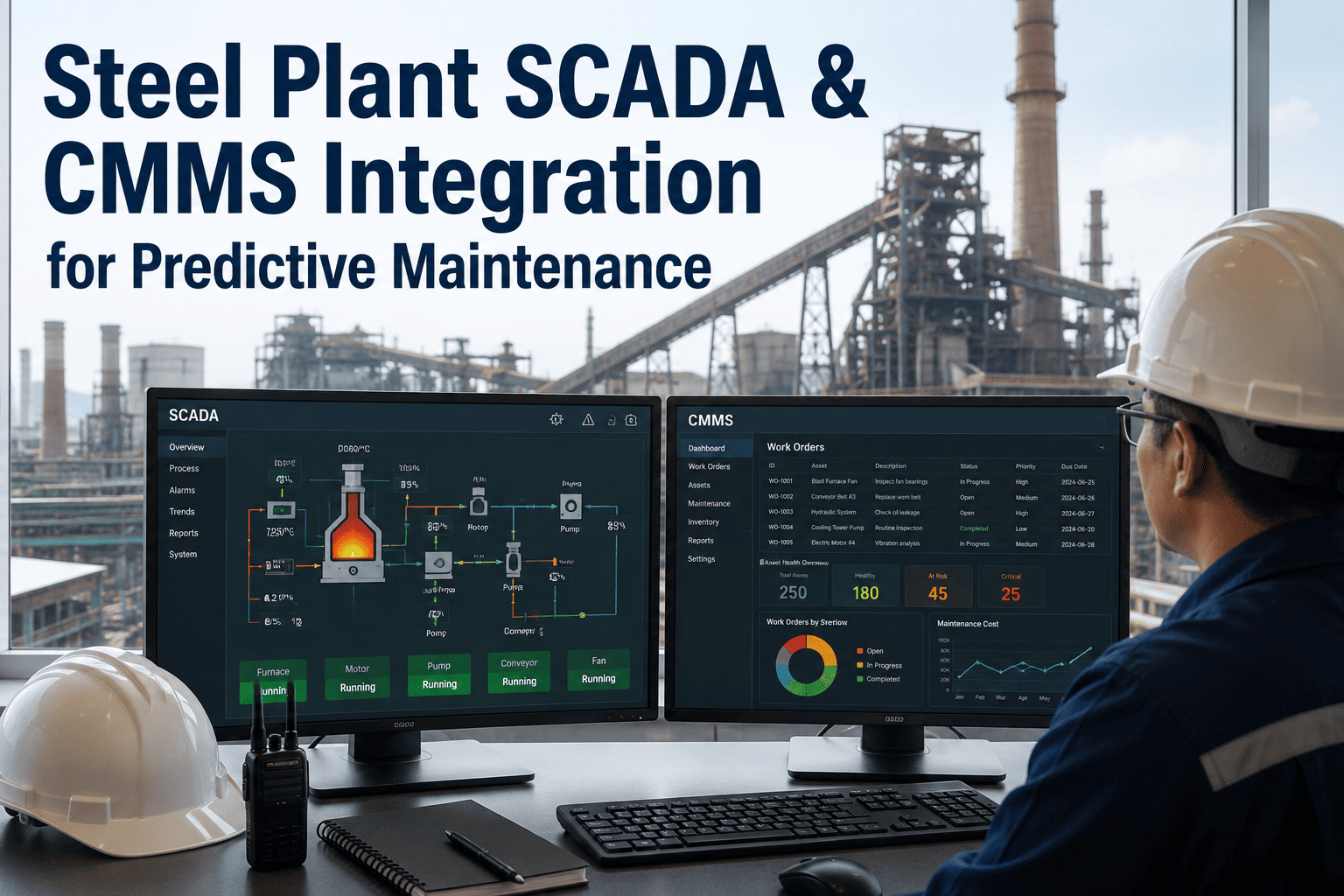
Steel plant SCADA systems generate thousands of equipment signals every shift — bearing temperatures, motor currents, vibration amplitudes, pressure deviations, and drive fault codes — each of which carries a maintenance implication that almost never reaches the CMMS automatically. The average delay between a SCADA alarm firing and a maintenance work order being created in a manual workflow is 4–8 hours. On a continuous caster or rolling mill bearing with a narrow failure window, that gap is the difference between a planned replacement and an emergency shutdown. OxMaint connects to your OPC-UA endpoint and converts SCADA alarms into structured work orders automatically — without changing a single PLC or DCS configuration. Book a demo to see your plant's OPC-UA tags mapped to OxMaint work order automation.
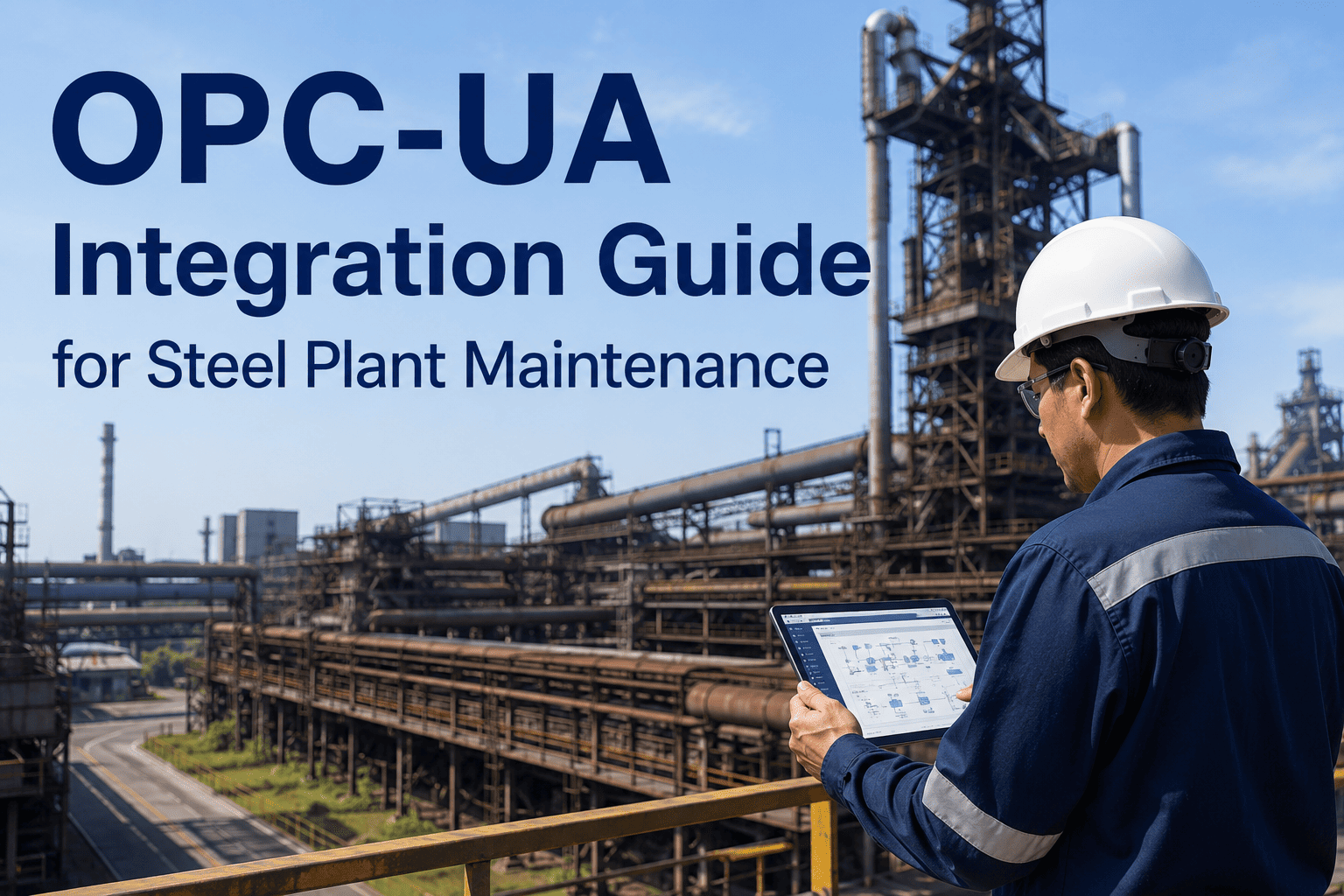
OPC-UA Integration Guide
for Steel Plant Maintenance
How OPC-UA connects your SCADA historian, DCS alarm streams, and PLC fault codes to OxMaint work order automation — converting plant-floor signals into maintenance actions in under 60 seconds.
Why OPC-UA Is the Right Protocol for Steel Plant Maintenance Integration
OPC-UA (Unified Architecture) is the Industry 4.0 standard for secure, platform-independent industrial data exchange. Unlike its predecessor OPC-DA, OPC-UA transmits not just values but structured context — what the value means, which asset it belongs to, and what alarm state it represents. Every major automation vendor supports it natively: Siemens PCS7 and TIA Portal, ABB System 800xA, Rockwell FactoryTalk, Schneider EcoStruxure, and GE iFIX all expose OPC-UA server endpoints that OxMaint connects to as a read-only subscriber — with no PLC modifications, no DCS changes, and no write-access to your OT network.
Platform-independent, encrypted, supports complex data structures. Native support in all major SCADA/DCS vendors. OxMaint connects on port 4840 as a read-only subscriber.
Lightweight publish-subscribe for high-frequency sensor data. Sub-second latency, low bandwidth. Used where OPC-UA is not natively available on edge devices.
Direct query of historian for trend data and batch event records. Supplements OPC-UA for alarm frequency analysis and remaining useful life calculations.
Register-level reading from legacy PLCs without OPC-UA capability. OPC-DA to OPC-UA wrapper available for SCADA systems predating the UA standard.
From OPC-UA Signal to Work Order — The Full Pipeline
OxMaint's lightweight collector, deployed in the plant DMZ, subscribes to configured alarm and event streams from the OPC-UA server. No inbound ports opened to OT network — outbound-only encrypted HTTPS tunnel. No PLC or DCS configuration changes required.
Not every alarm warrants a work order. OxMaint's rule engine filters nuisance alarms and transients by configuring sustain duration, asset priority, alarm frequency, and severity. A tag exceeding threshold for 3 seconds is a transient. A tag sustained above threshold for 5 minutes on a Vital-class asset creates a work order.
When an alarm passes classification, OxMaint auto-creates a work order with: asset ID and location, alarm tag and value at trigger, historian trend link (30/60/90-day view), previous alarm and WO history for the asset, and recommended action based on alarm type. One active work order per active fault — new alarms enrich the existing WO rather than creating duplicates.
Work order is assigned to on-shift technician based on skill profile and geographic zone. Mobile notification arrives in under 4 minutes from alarm trigger. Technician arrives at the asset with full sensor context — not as a blind responder to a radio call.
Alarm-to-Work-Order Mapping — Steel Plant Reference
| Process Area | Alarm Type | OxMaint WO Priority | Response Target |
|---|---|---|---|
| Continuous Caster | Mold thermocouple zone non-responsive | Critical | Before next campaign |
| Continuous Caster | Segment roller bearing temp above threshold | Critical | Same shift — 4 hrs |
| Rolling Mill | Drive motor current 8% above baseline | High | Next planned window |
| Rolling Mill | Spindle vibration amplitude +15% over 3 readings | High | Next roll change |
| Blast Furnace | Stave cooler outlet temperature deviation | Critical | Immediate — 2 hrs |
| Hydraulic System | Pressure below lower control limit sustained 5 min | Critical | Same shift — 2 hrs |
| Descaler / Water | Flow differential above threshold per header | Standard | Next planned outage |
Connect Your OPC-UA Tags to OxMaint
First alarm-to-work-order automation live within 2–4 weeks of OPC-UA connection. Starting with your highest-impact alarm sources — caster, rolling mill, blast furnace — delivers measurable downtime reduction before full plant coverage is complete.
Expert Review
"The OT and IT teams in steel plants both agree on the problem — the automation layer generates everything the maintenance team needs to be predictive, and none of it reaches them in time. The rule logic — which tags trigger work orders, which thresholds matter — is a maintenance knowledge problem, not a software problem. OxMaint's read-only OPC-UA architecture removes the OT security objection entirely. I have never seen an OT team block a read-only client on a proper DMZ."