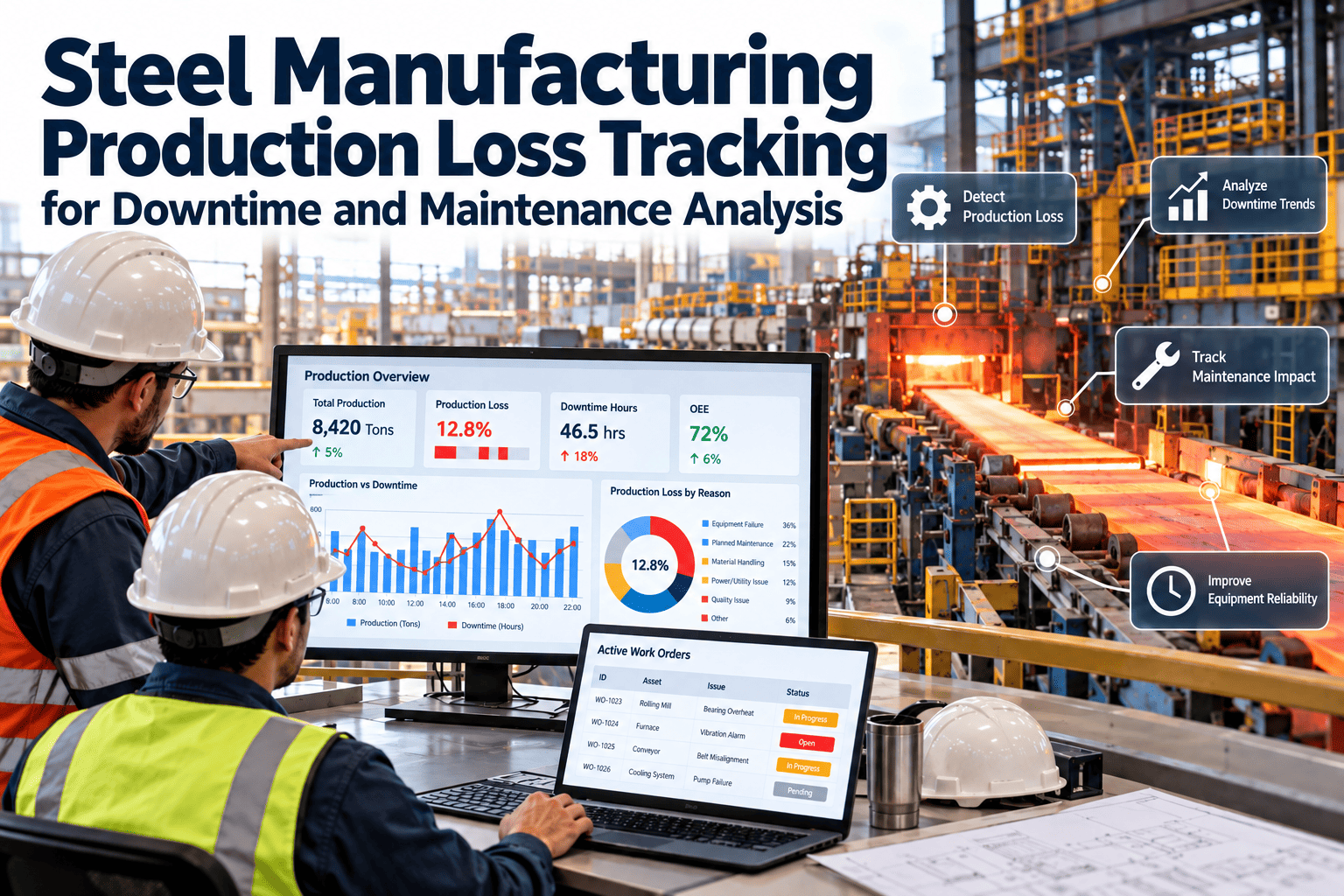
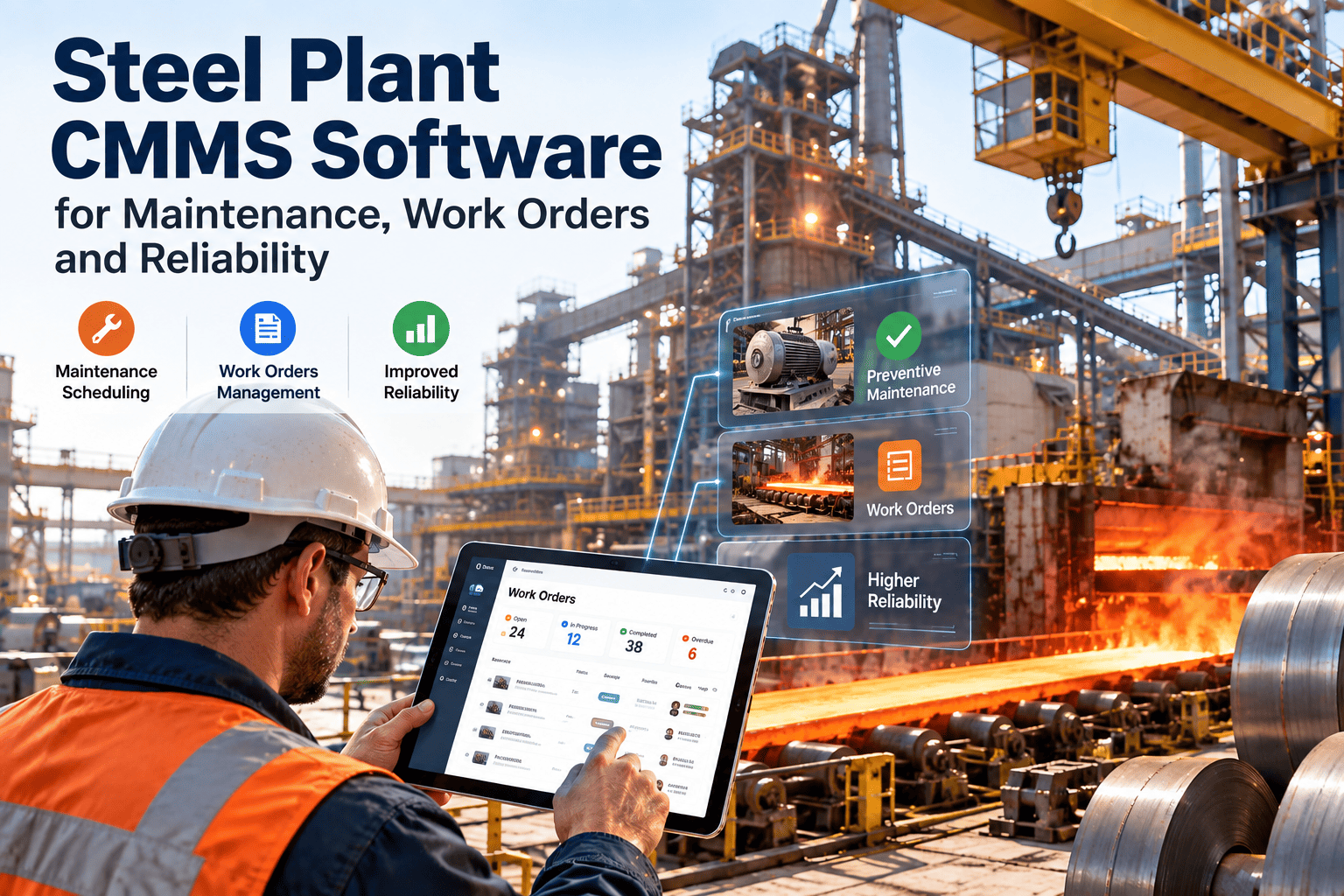
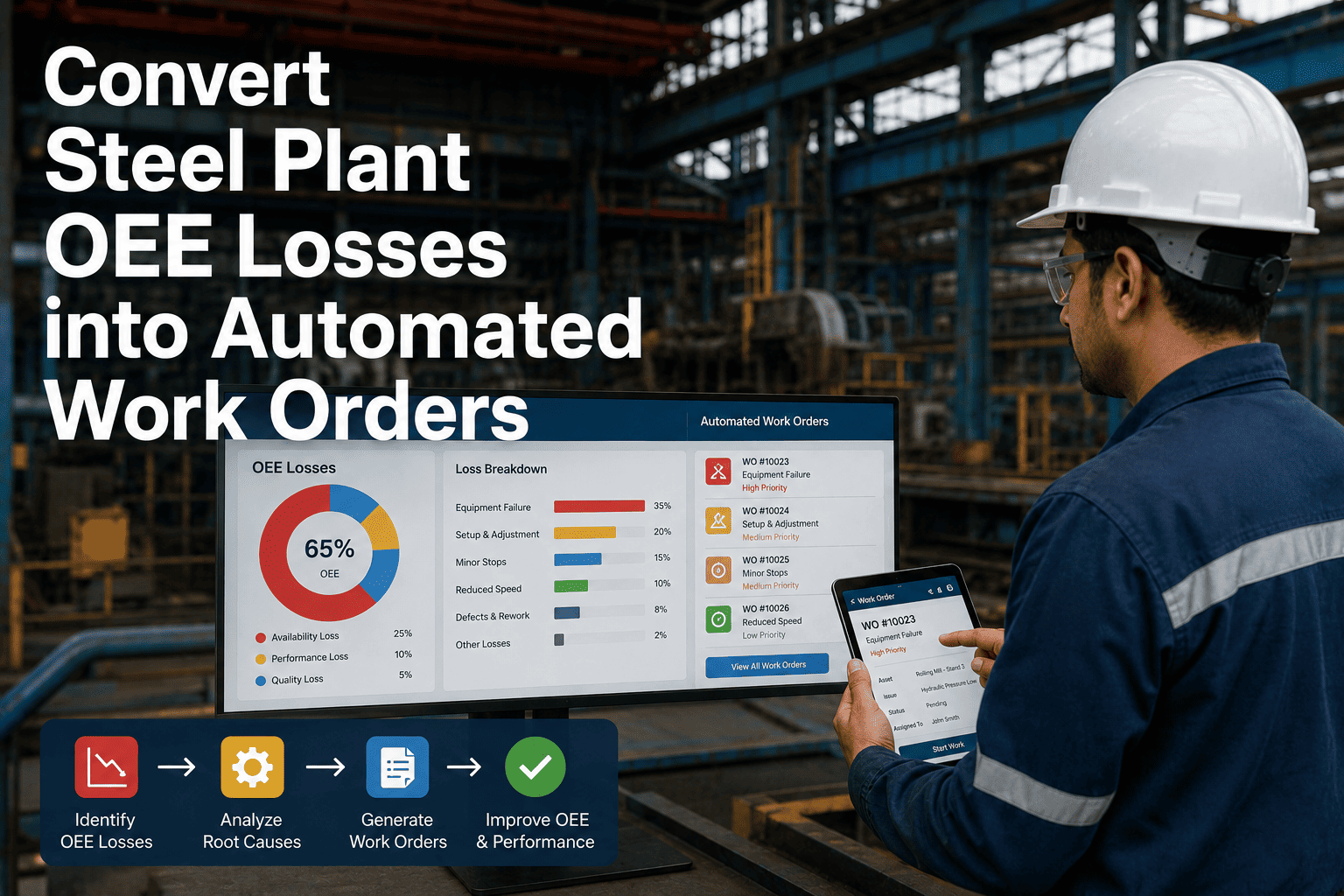
Every unplanned stop on a steel production line generates a production loss event in the MES — but without a direct connection to the CMMS, that event never informs the maintenance work order that should have prevented it. Maintenance teams prioritise by gut feel. Work orders are scheduled without knowing which assets are costing the most tonnes. OxMaint's Analytics and Reporting module connects MES production events to CMMS maintenance workflows — so work orders are prioritised by actual tonnes lost, downtime cost, and quality impact rather than by who called the maintenance manager first. Book a demo to see production-linked maintenance prioritisation built for your steel plant configuration.
MES and CMMS Integration
for Steel Production Maintenance
How connecting MES production event data to OxMaint maintenance workflows lets steel plant teams prioritise work orders by tonnes lost, downtime cost, and quality impact — not by noise.
The Data That Exists on Both Sides — and the Gap Between Them
MES systems record what happened to production: tonnes rolled, heats cast, quality rejects by code, equipment stops by asset and duration. CMMS systems record what happened in maintenance: work orders raised, parts consumed, technician hours, PM compliance rates. Both systems contain half the information needed to run a reliability programme intelligently. When the systems don't talk, the production data never informs maintenance prioritisation — and the maintenance data never explains the production loss that triggered the event.
OxMaint integration connects both data sets — so every maintenance decision is made with full visibility of production impact.
What MES-CMMS Integration Enables in OxMaint
Production-Loss Work Order Prioritisation
When an MES stop event exceeds a configurable tonnes-lost threshold — for example, any stop costing more than 100 tonnes — OxMaint automatically elevates the priority of open work orders on the responsible asset, and creates a root cause work order if none is open. Maintenance teams see production impact alongside work order queue — not two separate systems.
Meter-Based PM Triggers from Production Counters
Tonnes rolled, heats cast, and cuts completed stream from MES into OxMaint meter readings in real time. PM tasks trigger on actual production throughput — not calendar estimates. A rolling mill scheduled for segment inspection every 80,000 tonnes gets its work order when 80,000 tonnes are confirmed in the MES, regardless of calendar date.
Quality-Linked Failure Analysis
MES quality reject events — surface marks, edge defects, dimensional failures — are matched against maintenance records for the responsible equipment in OxMaint. When a descaler nozzle PM was overdue at the time of a surface quality batch rejection, the audit trail links the two events automatically for root cause analysis and PM schedule revision.
Downtime Cost Attribution per Work Order
Each corrective work order in OxMaint is tagged with the MES stop event that generated it. Labour cost, parts cost, and production loss are combined into a single total cost-of-failure figure per work order — giving reliability engineers the data to justify PM investment against avoided downtime cost in capital review cycles.
Integration Architecture — How It Works
| Data Flow | Source | OxMaint Action | Output |
|---|---|---|---|
| Equipment stop event | MES downtime log — asset ID, duration, cause code | Match to CMMS asset, create corrective WO if none open | Prioritised work order with production loss attached |
| Production counter update | MES tonnes / heats / cycles counter per asset | Update OxMaint meter reading for linked PM tasks | Meter-based PM work order at correct throughput threshold |
| Quality reject batch event | MES quality hold — batch ID, defect code, asset | Flag linked CMMS asset; append to open WO if present | Quality-maintenance audit trail for RCA and PM revision |
| Speed reduction event | MES production speed below campaign target | Trigger condition inspection WO on responsible asset | Early intervention before full stop event occurs |
Connect Your MES to OxMaint
Production-loss work order prioritisation, metre-based PM triggers, and quality-linked failure analysis — configured for your MES platform and OxMaint asset register in one integration project.
Expert Review
"Steel plants that connect their MES production event data to their CMMS maintenance workflow stop managing maintenance as a support function and start managing it as a production capability. When every work order carries the production loss cost of the failure that generated it, maintenance prioritisation becomes objective rather than political. The best reliability teams in steel operations are already running this model — and the gap between their cost-per-tonne and industry average is the financial case for every plant still managing the two systems independently."