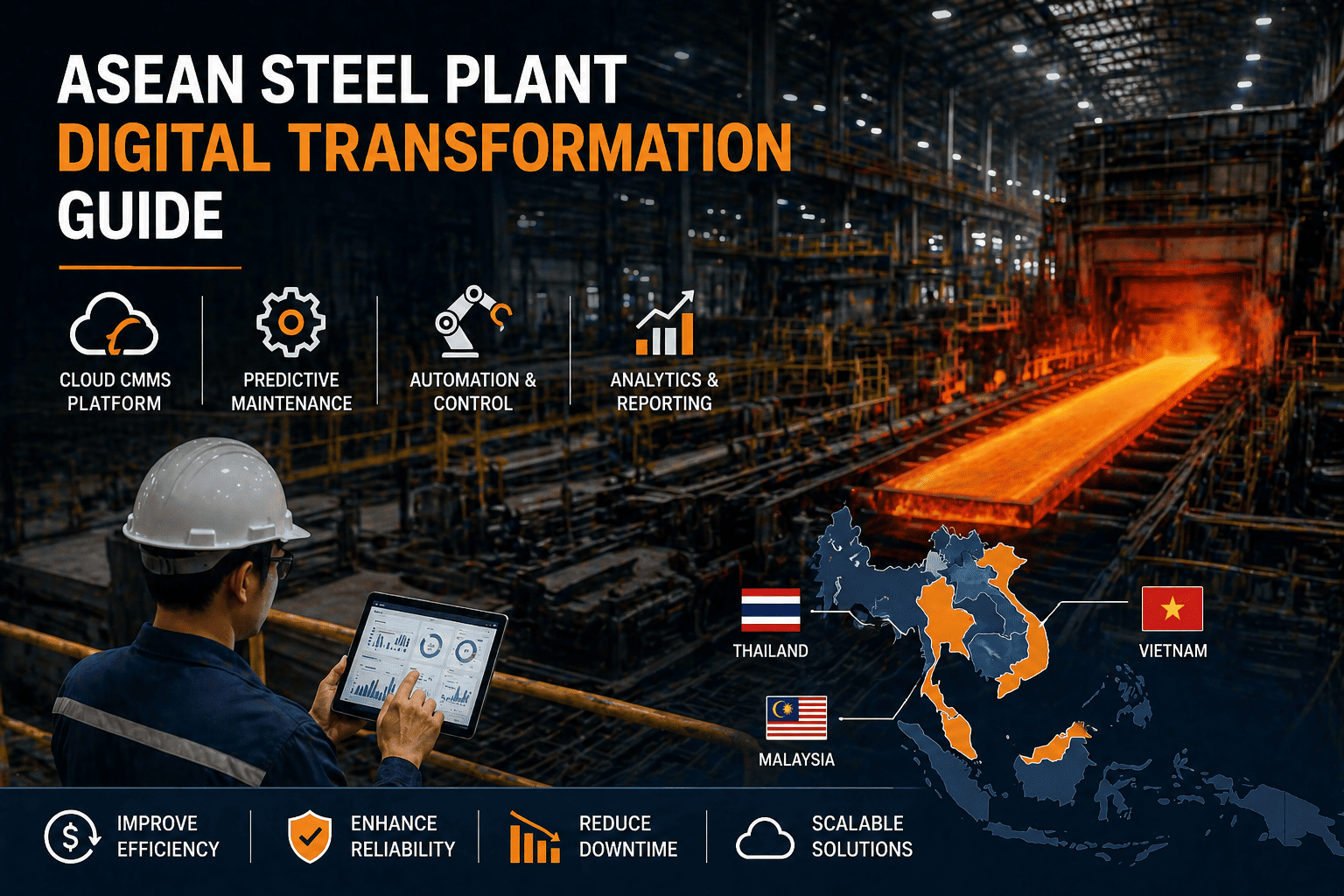
ASEAN-6 steel production capacity is on track to expand from 78 million tonnes per year in 2021 to 188 million tonnes per year by 2030 if all announced projects are realised — the most aggressive regional capacity growth anywhere in the world outside India and China. Vietnam leads at 22 Mt of annual production with a target of 48 Mt by 2030, Malaysia is positioning as a regional hub through Chinese investment partnerships, and Thailand is restructuring toward higher-value steel under cost pressure. But the operational gap is striking: World Economic Forum 4IR readiness research clusters Malaysia, Thailand, and Vietnam as the region's most advanced manufacturers — while CMMS adoption inside their steel plants still trails Korean and Japanese competitors by a decade. Book a 30-minute demo to see how a cloud CMMS deploys in 30–60 days across multi-country ASEAN steel operations, or start a free trial on a single pilot site.
Regional Snapshot
Where ASEAN Steel Stands in 2026 — And What Digital Transformation Actually Means Here
75 Mt
Combined ASEAN-6 steel consumption — 4th largest globally after China, India, USA
188 Mt
Projected 2030 capacity if all announced projects come online (from 78 Mt in 2021)
82%
Of total Chinese cross-border steel investment now flowing into ASEAN
77 Mt CO&sub2;
Combined ASEAN-6 steel emissions — exceeds 160 countries' total annual CO&sub2;
Digital transformation in ASEAN steel is not a generic Industry 4.0 conversation. It is a specific competitive question: can the region's producers operate at world-class OEE, MTBF, and energy efficiency at the moment they take delivery of new BF-BOF and EAF capacity from Chinese, Japanese, and European OEMs? The plants that arrive on day one with predictive maintenance, digital LOTO, integrated quality systems, and automated compliance reporting will operate at >85% OEE while regional competitors run at 65–72%. The plants that bolt on legacy on-premise CMMS five years after commissioning will spend the next decade catching up.
Country Profiles
Steel Industry Maturity By ASEAN Country — What Each Market Actually Needs
A digital transformation strategy that treats ASEAN as one market will fail in every market. Each country has different production technology, different cost structure, different regulatory regime, and different digital maturity. The profile below reflects the operational reality in each major steel-producing ASEAN nation.
VN
Vietnam
22 Mt/yr · Target 48 Mt by 2030
Regional production leader. 4IR Cluster 3 ranking. Hoa Phat Group exploring hydrogen-based DRI. Urbanisation target 50% by 2030 driving demand. Largest CO&sub2; emitter (32 Mt).
Digital priority: Multi-site CMMS for capacity expansion, predictive maintenance, energy reporting
MY
Malaysia
BF-BOF + NG-DRI mix · 13 Mt CO&sub2;
Beneficiary of trade diversion. Baowu joint ventures expanding. 4IR Cluster 3. GDP per capita US$13,310. Strategic regional hub position alongside Singapore. Growing NG-DRI interest.
Digital priority: JV-grade CMMS standardisation, OEM partner integration, regional rollout templates
TH
Thailand
100% EAF currently · NG-DRI planned
Highest crude steel production cost in region (above VN, ID, CN, IN, JP). 4IR Cluster 3. Established industrial structure. Reorienting toward higher-value steel grades. Carbon pricing in development.
Digital priority: Cost optimisation, quality system upgrades, compliance & carbon reporting
ID
Indonesia
Largest economy · 28 Mt CO&sub2;
PT Gunung Raja Paksi pioneering low-carbon EAF. Tsingshan integrated stainless complex. 285 million population. Outdated facilities limiting competitiveness vs Vietnam. Carbon tax in development.
Digital priority: Brownfield modernisation, asset registry rebuild, condition-based maintenance
Transformation Pillars
The Five Capabilities ASEAN Steel Plants Must Build — In Order
Digital transformation is not a single project. It is a sequenced build of five capabilities, each unlocking the next. Plants that try to deploy AI vision before they have a working asset registry will fail at AI vision; plants that try to integrate SCADA without a cloud CMMS foundation will end up with siloed data lakes that nobody queries.
1
Cloud CMMS Foundation
Asset hierarchy, PM schedules, work order workflow, digital LOTO, mobile-first technician app. The non-negotiable foundation. Deploys in 30–60 days. Without this, every higher-order capability has nowhere to land.
2
Sensor & SCADA Integration
Vibration, temperature, pressure, current sensors on critical assets. SCADA data flowing into the CMMS for condition monitoring. IoT sensor networks where wired alternatives are uneconomic. Activates predictive workflows.
3
Predictive Maintenance AI
ML models scoring asset health from sensor data. Anomaly detection on motor signatures, bearing vibration patterns, hydraulic pressure trends. Predictive workflow auto-generating work orders before failure.
4
AI Vision Quality Systems
Surface defect classification on rolling mills and finishing lines. Defect-to-asset mapping closing the loop from quality inspection to maintenance work order. Replaces manual inspection at 95–99% accuracy.
5
Energy & ESG Reporting
Automated emissions tracking, energy KPIs per tonne, CSRD/ASEAN Taxonomy disclosure templates. Critical as Indonesia, Thailand, and Vietnam phase in carbon pricing. Built on top of the operational data foundation.
Deploy a Cloud CMMS Across Your ASEAN Steel Operations in 30–60 Days
Oxmaint's cloud architecture is built for multi-country, multi-site ASEAN steel operations — with regional compliance templates, mobile-first design for distributed plants, and rollouts measured in weeks instead of the 12–24 months legacy systems demand.
Capability Matrix
What A Modern ASEAN Steel CMMS Must Cover — By Plant Type
A one-size-fits-all CMMS will not survive contact with the diversity of ASEAN steel operations. The matrix below shows which capabilities each production technology demands, and how the corporate layer aggregates analytics across the entire portfolio.
| Capability |
BF-BOF |
EAF |
NG-DRI |
Rolling Mills |
Coating Lines |
| Operating-hour PM triggers |
Critical |
Critical |
Critical |
Critical |
Yes |
| SCADA / DCS data ingestion |
Critical |
Critical |
Critical |
Yes |
Yes |
| Refractory life tracking |
Critical |
Critical |
Yes |
N/A |
N/A |
| Roll campaign management |
N/A |
N/A |
N/A |
Critical |
Yes |
| Digital LOTO + permits |
Critical |
Critical |
Critical |
Critical |
Critical |
| AI vision integration |
Optional |
Optional |
Optional |
Critical |
Critical |
| Energy KPIs per tonne |
Critical |
Critical |
Critical |
Yes |
Yes |
| Mobile + offline app |
Yes |
Yes |
Yes |
Yes |
Yes |
| Multi-language interface |
Critical |
Critical |
Critical |
Critical |
Critical |
Deployment Timeline
The 90-Day Multi-Site Rollout Path For ASEAN Steel Operations
Wave deployment beats simultaneous deployment every time. The 90-day path below mirrors successful rollouts across Vietnamese, Malaysian, and Thai steel operations — bringing one site live, capturing lessons, then expanding regionally.
Days 1–15
Foundation
Asset hierarchy locked. Standard failure code library deployed. Compliance template set selected (Vietnam, Malaysia, Thailand variants). Single sign-on configured. Multi-language activated.
Days 16–30
Wave 1: Pilot Site
First plant goes live — typically the most modern facility. Asset registry imported, SCADA integration tested, technicians trained on mobile, digital LOTO active. Live by day 30.
Days 31–60
Wave 2: Regional Expansion
Lessons from pilot applied. Additional plants added in parallel. Cross-site inventory pool activated. Regional compliance variants (NG-DRI vs BF-BOF templates) refined per country.
Days 61–90
Corporate Layer Activation
Multi-country dashboard goes live. Fleet OEE rollup, EFOR benchmarking, unified energy reporting, ESG disclosure exports. Corporate VP gets a single weekly view across the regional portfolio.
Regional Outcomes
What ASEAN Steel Plants Actually Achieve Post-Deployment
38%
Total maintenance cost reduction within 18 months
61%
Forced outage frequency drop after multi-site rollout
25–40%
Defect generation reduction once root causes are corrected
2 days
Compliance audit prep time, down from 3 weeks of manual binder assembly
85%+
OEE achievable on new ASEAN plants commissioned with day-one CMMS
12–18 mo
Typical payback period including AI vision & predictive maintenance
Expert Review
What 25 Years In ASEAN Steel Operations Teaches You About Digital Transformation
"The ASEAN steel industry's biggest digital risk is not picking the wrong technology — it is picking the wrong sequence. I have watched plants in Vietnam and Malaysia spend three years and millions of dollars on AI vision projects that produced beautiful demos and zero operational value, because the underlying CMMS was a five-year-old on-premise system that nobody outside the maintenance manager's office could query. The plants that actually transform start with the cloud CMMS foundation, get the asset registry and work order discipline correct, then layer sensor integration, then predictive maintenance, then AI vision. The order matters. The sequence is the strategy."
FAQs
Frequently Asked Questions
Why is digital transformation more urgent for ASEAN steel than for other regions?
ASEAN-6 capacity is doubling from 78 Mt to 188 Mt by 2030 — the most aggressive expansion outside India. New plants commissioning without day-one digital CMMS will operate at 65–72% OEE while neighbouring competitors with cloud-first deployments hit 85%+.
Book a demo to see day-one deployment workflow.
How does Oxmaint handle multi-country ASEAN deployments with different languages and regulations?
The platform supports multi-language interfaces (English, Vietnamese, Bahasa Malaysia, Thai), regional compliance template libraries, and country-specific reporting formats. Each plant retains local autonomy while corporate gets aggregated analytics across the regional portfolio.
What is the realistic deployment timeline for a multi-site ASEAN steel operation?
Most multi-site rollouts complete in 30–60 days per site on a wave-deployment schedule. A 4–5 site regional portfolio typically goes fully live in 90 days, including the corporate dashboard.
Start a free trial to begin with a single pilot site.
How does the platform support carbon reporting given Indonesia, Thailand, and Vietnam introducing carbon pricing?
Energy data per tonne, fuel consumption per furnace, and electricity intensity flow automatically into ESG disclosure templates aligned with ASEAN Taxonomy and CSRD requirements. The same data foundation supports operational KPIs and regulatory reporting without parallel systems.
Will the cloud CMMS work in plants with limited internet bandwidth at remote sites?
Yes — the mobile app is fully offline-capable. Technicians complete inspections, capture photos, and record measurements without a network, and everything syncs once the device reconnects. Critical for distributed operations across rural Indonesia, Vietnamese coastal plants, and Malaysian regional sites.
Stop Operating ASEAN Steel On Yesterday's Technology Stack
Oxmaint is the cloud CMMS platform built for the speed, scale, and regulatory diversity of ASEAN steel operations — with rollouts in weeks, not years, and a maintenance foundation that supports every higher-order capability you build on top of it.