Your CMMS already contains the data that could launch your digital transformation — the problem is that 76% of steel plant managers never develop a structured roadmap to guide their Industry 4.0 journey. Every sensor reading, every work order, every production record your plant has generated over the past 24 months contains the digital foundation for predictive maintenance, AI optimization, and operational intelligence. A 2026 study found that digital transformation in the steel sector is a "must-have" for achieving India's vision of a USD 5 trillion economy [citation:2]. Tata Steel's digital twin strategy generated $1.4 billion in cumulative cost savings between 2015 and 2020 through 250+ AI models and a centralized iROC command center [citation:3]. The plant that still relies on manual data entry instead of automated analytics is not suffering from a technology gap — it is suffering from a roadmap gap. That pattern is sitting in your operations data right now, invisible because nobody has built the transformation framework that surfaces it. Oxmaint's digital transformation module turns your current state assessment into a strategic roadmap — automatically identifying digitization opportunities, prioritizing high-ROI use cases, and tracking transformation progress. The data is already yours, and the analysis that charts your 5-year digital journey takes minutes to configure, not months. If your steel plant is still approaching digitalization as a set of isolated projects instead of a strategic roadmap, start a free trial or book a demo to see how Oxmaint surfaces transformation opportunities from your existing data.
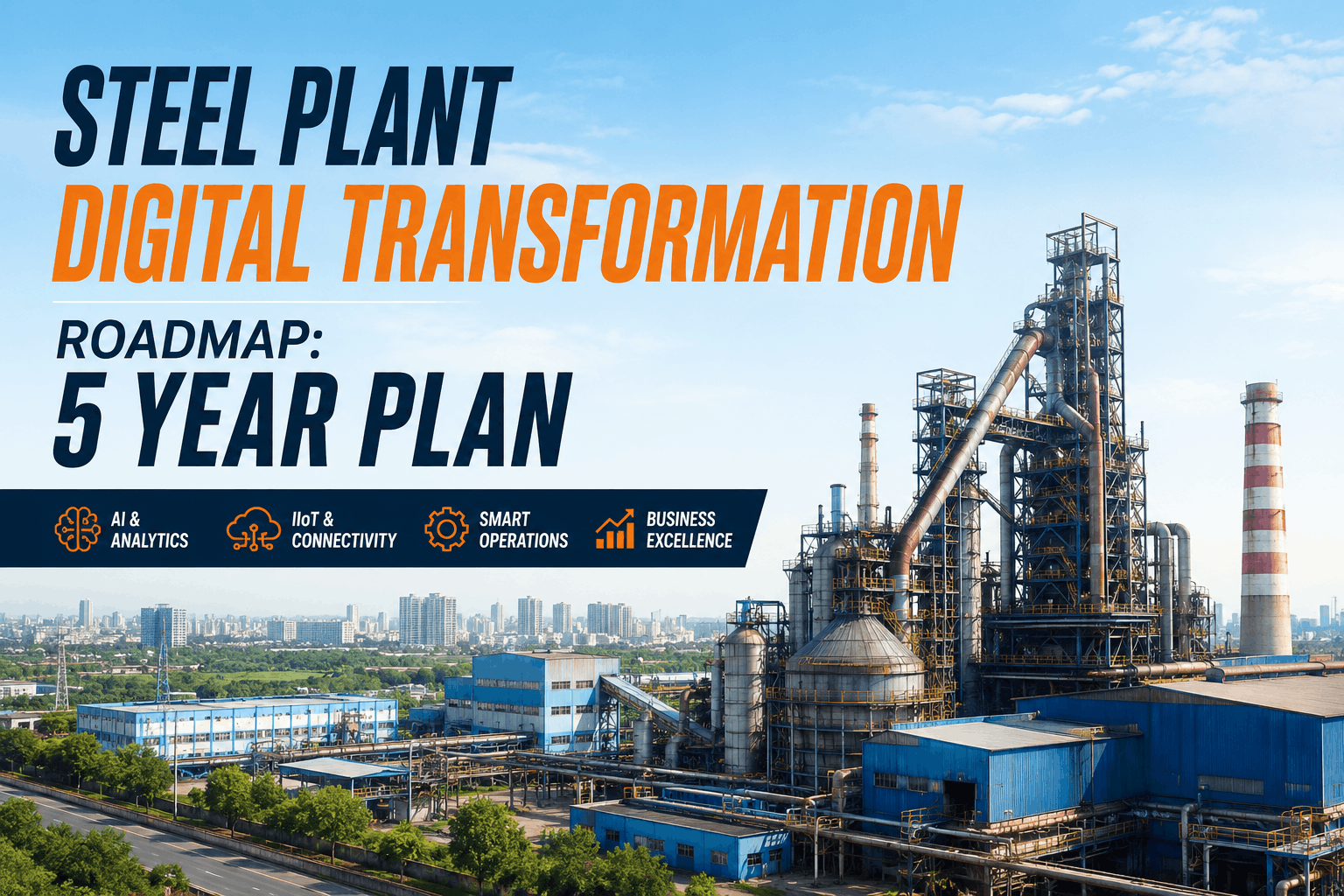
Steel Plant Digital Transformation Roadmap: 5-Year Plan
Complete 5-year digital transformation roadmap for steel plants — from digital maturity assessment to AI deployment, predictive maintenance, and Industry 4.0 implementation across the steel value chain.
You Already Have the Foundation — You Just Need the Roadmap
Every sensor, every work order, every production record in your plant is a digitalization opportunity. Oxmaint does not require new consultants or technology — it provides the structured framework to assess your current maturity, prioritize high-ROI initiatives, and track transformation progress. Steel plant leaders ready to chart a 5-year digital roadmap can start a free trial or book a demo to see how transformation planning works on your plant's actual data.
Why Digital Transformation Is a Strategic Imperative for Steel Plants
The steel sector faces unprecedented pressures: capacity expansion targets, decarbonization mandates, margin compression from global competition, and workforce transitions [citation:2][citation:7]. Digital transformation has moved from optional to essential. The Ministry of Steel has positioned AI as a strategic enabler rather than a peripheral tool, recognizing that the next phase of growth will be defined not only by expanded capacity but also by intelligent systems, predictive analytics, automation, and data-driven decision-making [citation:2][citation:6]. India's crude steel capacity is targeted to increase from approximately 200 million tonnes to 300 million tonnes by 2030-31 and further to 400 million tonnes by 2035-36 [citation:2].
Leading steel enterprises are already realizing the value. Tata Steel's digital transformation generated $1.4 billion in cumulative savings between 2015 and 2020, with 250+ digital twin models deployed across 15+ plants globally [citation:3]. JSW Steel is planning over ₹2 lakh crore ($24 billion) in investment over the next five years to add capacity, with significant allocation for digital infrastructure and AI adoption [citation:8].
Digital Transformation Models — Choosing the Right Approach
Not all digital transformation approaches are created equal. The right model depends on your enterprise structure, geographic distribution, operational autonomy requirements, and maturity level [citation:1].
5-Year Digital Transformation Roadmap — Phased Implementation
Successfully implementing Industry 4.0 across a steel plant portfolio requires a phased approach that builds momentum while minimizing disruption. The roadmap below is based on proven approaches from leading steel enterprises, combining the structured phases of the Oxmaint framework with the transformation timeline demonstrated by Tata Steel's journey from crisis to digital leadership [citation:1][citation:3].
The transformation begins by establishing where you stand today. Assess digital maturity across all plants, define enterprise data standards, select and configure unified platform, and establish governance structure. Deploy critical asset connectivity and launch pilot use cases [citation:1]. Tata Steel's first digital twin on blast furnace #7 achieved 2.5% coke rate reduction in 6 months, proving the concept and building momentum [citation:3].
With the foundation in place, the focus shifts to scaling connectivity and launching high-impact pilots. Deploy OPC servers and historians for data collection, expand digital twins to 50+ models across blast furnaces, steel melt shops, and rolling mills [citation:3]. Implement enterprise reporting and train plant teams on new processes [citation:1].
The transformation reaches full scale. Extend digital twins to global operations — Tata Steel expanded from 50 to 150+ models across UK, Netherlands, and Thailand plants by Year 3 [citation:3]. Deploy shared resource programs, implement best practice transfer, and launch continuous improvement programs [citation:1].
The transformation becomes part of the enterprise DNA. Launch iROC-style 24/7 command center monitoring global operations [citation:3]. Deploy advanced analytics and AI across the entire value chain — mining, logistics, production, quality, and sustainability [citation:2]. Regularly review performance and integrate new facilities [citation:1].
Tata Steel's Value Drivers — Where the $1.4 Billion Came From
Tata Steel's digital transformation savings breakdown reveals the six major value streams that drove the $1.4 billion cumulative savings between 2015 and 2020 [citation:3].
| Value Stream | Description | Savings |
|---|---|---|
| Raw Material Optimization | Blast furnace coke rate reduced 4-6% via AI optimization; iron ore blend optimization; digital twin simulated 1,000+ burden recipes before physical trials | $550M |
| Energy Cost Reduction | Reheating furnace fuel optimization across 25+ furnaces; power consumption reduced 8-12% in rolling mills; waste heat recovery maximized | $380M |
| Yield Improvement | Steel yield increased 1.5-2%; defect rates reduced 30-40% via quality prediction; first-time quality success rate: 90%+ | $280M |
| Predictive Maintenance | Unplanned downtime reduced 22% across plants; equipment failures predicted 2-4 weeks early; spare parts inventory optimized | $120M |
| Quality Consistency | Customer claims reduced 35%; premium product grades achieved more consistently; alloy addition precision improved | $50M |
| Supply Chain Efficiency | Production scheduling optimized; logistics routes optimized via AI; demand forecasting accuracy improved 25% | $20M |
High-Impact Digital Use Cases for Steel Plants
The Ministry of Steel's AI roadmap has identified specific high-impact use cases where AI interventions can create immediate and long-term value, including predictive maintenance, computer vision systems, supply chain optimization models, and intelligent decision support systems [citation:2][citation:6].
Predictive maintenance algorithms reduce downtime by predicting equipment failures 2-4 weeks before they occur [citation:3]. Digital twins enable virtual testing of all process changes before physical implementation, achieving 90%+ first-time success rates [citation:3]. Jianlong Beiman Special Steel deployed 56,313 data collection points across its plant, with 92% self-developed, achieving 100% automation coverage [citation:5].
Digital twins create virtual replicas of physical steel plants using real-time data from sensors to simulate, predict, and optimize performance [citation:3]. By creating a digital twin of a blast furnace, engineers can run thousands of simulations to find the exact temperature and material mix that maximizes steel quality while minimizing fuel consumption [citation:11].
AI models predict quality outcomes in real-time, enabling proactive adjustments. Jianlong Beiman deployed 453 self-developed automation modules, including a "recipe optimization module" for blast furnace burdening that significantly reduced ironmaking costs [citation:5].
AI-driven supply chain models optimize raw material blending, demand forecasting, and logistics routing. Tata Steel's supply chain efficiency improvements delivered $20M in savings through optimized production scheduling and logistics routes via AI [citation:3].
Best Practices from Leading Steel Transformations
Based on experiences from Tata Steel, Jianlong Beiman, and other successful digital transformations, these best practices guide steel plant digitalization efforts [citation:3][citation:5].
T.V. Narendran personally championed Tata Steel's digital transformation — not delegated to IT. "Crisis creates urgency. Don't wait for crisis — create urgency" [citation:3]. The transformation was announced as a ₹1,200 crore digital investment over 3 years, with CEO-level commitment driving accountability.
Tata Steel's first digital twin (Blast Furnace #7) achieved 2.5% coke reduction in 6 months — proving the concept and funding Phase 2 investments [citation:3]. Jianlong Beiman deployed 453 self-developed automation modules over 5 years, starting with foundational MES and data platform implementations before advancing to AI [citation:5].
The iROC model allows best experts to optimize all plants — knowledge centralized, applied globally [citation:3]. Jianlong Beiman's transformation followed a "top-level design, overall planning, step-by-step implementation" approach, centralizing digital governance while executing locally [citation:5].
Tata Steel's $1.4B number is specific, audited, credible — not marketing hype [citation:3]. Jianlong Beiman tracks cost in real-time, producing hourly ton-cost reports from 56,313 data collection points [citation:5]. Every initiative has clear KPIs and measurable outcomes.
"Competitors cut costs, Tata invested — emerged stronger when market recovered" [citation:3]. Digital transformation is counter-cyclical — the leaders invest when others retreat. JSW Steel's ₹2 lakh crore investment plan positions digital infrastructure and AI as core to capacity expansion [citation:8].
ROI of Digital Transformation for Steel Plants
Tata Steel's digital transformation (2015-2020) delivered $1.4 billion in savings across raw materials, energy, yield, maintenance, quality, and supply chain [citation:3]
Against ₹1,200 crore (~$160M) digital investment, Tata Steel achieved 775% ROI over 5 years [citation:3]
Predictive maintenance reduced unplanned downtime by 22% across Tata Steel's global operations [citation:3]
Tata Steel achieved project payback in under 2 years from first digital twin deployments [citation:3]
Frequently Asked Questions
What is a digital transformation roadmap for a steel plant?+
What are the key pillars of a steel plant digital transformation?+
What are digital twins and how do they benefit steel plants?+
How much should a steel plant invest in digital transformation?+
Your Digital Future Is Already in Your Data — Chart Your 5-Year Roadmap Today
Every sensor reading, work order, and production record in your steel plant contains the foundation for digital transformation. Oxmaint's digital transformation module helps you assess your current maturity, prioritize high-ROI initiatives, and track your 5-year journey — turning Industry 4.0 from a concept into a roadmap. No consultants. No guesswork. Import your data, chart your roadmap, and start your digital transformation in your first 30 days.