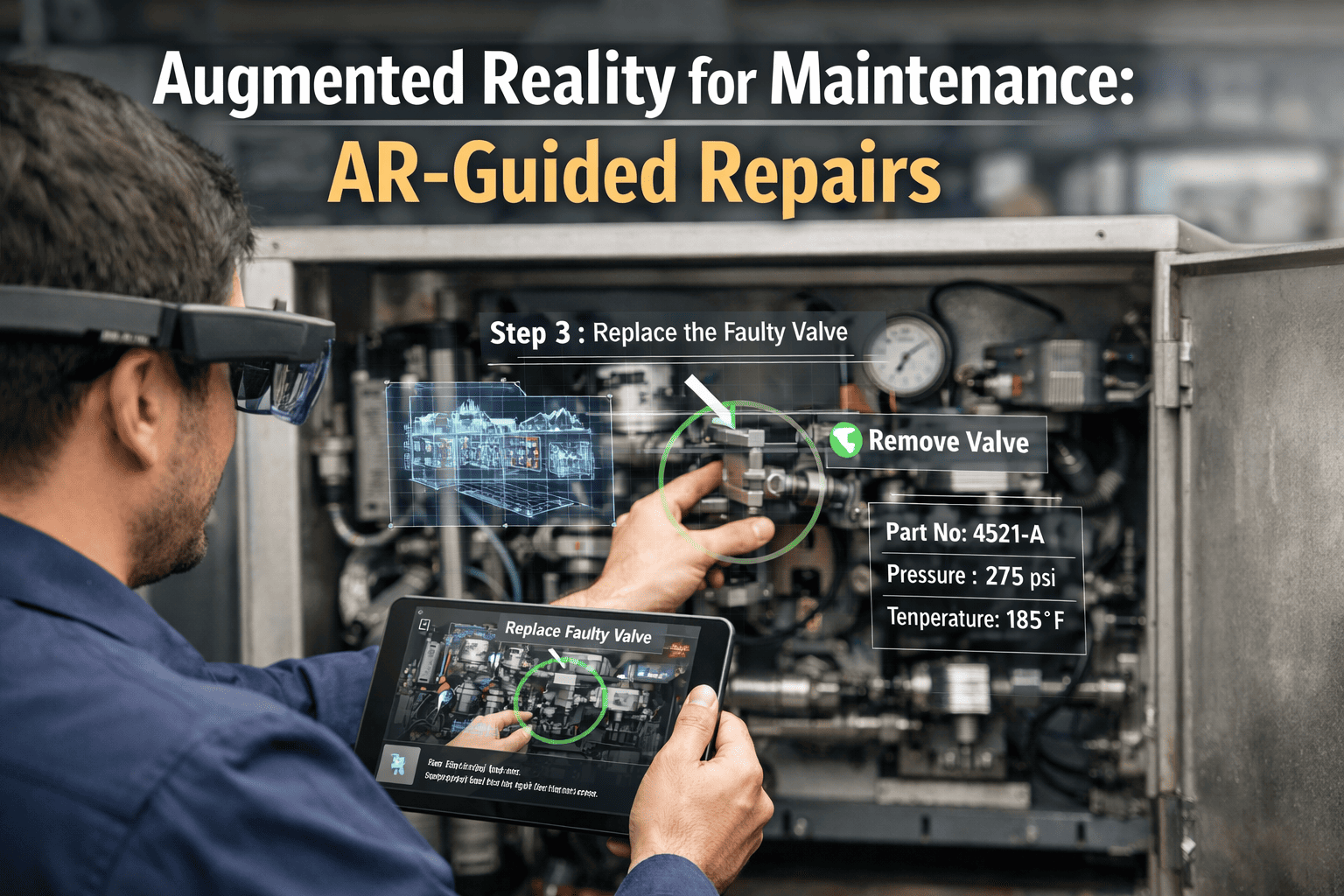
A maintenance technician in a steel plant blast furnace cooling circuit has both hands on a coupling that has never been replaced on this unit before. The procedure is in a 340-page equipment manual that is in the engineering office. The expert who has done this repair before retired eight months ago. In a conventional maintenance environment, this moment ends one of three ways: the technician stops, walks to the office, finds the manual, and returns — losing 20–40 minutes; the technician calls the engineering office and tries to follow verbal instructions while working blind; or the technician proceeds from experience and either succeeds or creates a secondary fault. Augmented reality maintenance adds a fourth option: the procedure appears overlaid on the coupling itself through smart glasses, step by step, with torque specifications and warning markers anchored to the exact bolt positions in the technician's field of view — hands stay on the equipment throughout.
Augmented Reality for Steel Plant Maintenance: Hands-Free Guided Repairs
How AR overlays, remote expert guidance, and digital work instructions delivered through smart glasses reduce repair time, improve first-time fix rates, and close the skill gap created by an ageing maintenance workforce — with OxMaint integration context for each capability.
Why Augmented Reality Solves a Steel-Specific Maintenance Problem
Steel plant maintenance has three characteristics that make it uniquely suited to AR guidance — and uniquely poorly served by conventional documentation approaches. First, the operating environment: high temperature, high noise, and physical hazard levels that make returning to an engineering office for documentation lookup not merely inconvenient but genuinely disruptive to safe working practice. Second, equipment complexity: a blast furnace, continuous caster, or rolling mill drive train has thousands of individually distinct subcomponent configurations across a plant fleet — no technician can hold the specific procedure for every variant in memory. Third, workforce demographics: with 38% of experienced steel maintenance technicians approaching retirement by 2028, the institutional knowledge those technicians carry cannot be transferred fast enough through conventional mentoring. Book a demo to see how OxMaint's AR integration connects work order context to AR guidance layers.
- Technician stops repair, walks to engineering office
- Locates correct manual section — 10–40 min average
- Attempts to hold procedure in memory while working
- Radio call to supervisor if unfamiliar fault encountered
- Expert must travel to plant floor for complex jobs
- Procedure compliance unverified — no documentation
- New technician shadows experienced one — slow transfer
- Procedure overlaid on equipment in field of view
- Step-by-step navigation — hands remain on equipment
- Torque specs, safety markers anchored to bolt positions
- Remote expert sees live feed, annotates overlay in real time
- Expert guidance from any location — zero travel required
- Each step completion logged — automatic compliance record
- New technician guided through complex job independently
Five AR Maintenance Capabilities Relevant to Steel Plant Operations
Five distinct AR capabilities address different points in the steel maintenance workflow — from procedure delivery at the point of repair through remote expert guidance to training acceleration. Each is independently deployable; the highest-impact deployments combine all five with a CMMS integration layer that connects AR guidance to structured work order records. Sign up to see OxMaint's AR integration framework — free.
Digital Work Instructions Overlaid on Physical Equipment
AR headsets anchor digital repair procedures to physical equipment markers — bolt positions, valve handles, cable bundles — using QR codes, NFC tags, or computer vision recognition. The technician sees the next required action superimposed on the exact component it applies to, with safety warnings visible before the action is taken, not in a footnote at the bottom of a page they are not holding. Torque specifications, part numbers, and sequential step logic are all delivered in field of view without requiring the technician to redirect attention away from the physical task.
For steel plants, the most immediate application is rotating equipment — gearboxes, pump assemblies, and coupling replacements where the specific variant configuration determines the procedure and where an error in torque sequence or assembly direction creates either immediate re-failure or a safety hazard. AR work instructions eliminate the configuration-lookup step that accounts for a significant share of the 20–40 minute manual search time in conventional workflows.
Remote Expert Guidance With Live Annotation
When a technician encounters a fault beyond their experience level — or when a high-value asset requires expert oversight during a complex repair — an off-site expert connects via video call and sees exactly what the technician sees through the AR headset camera. The expert can draw annotations, arrows, and highlight boxes directly onto the technician's field of view in real time, pointing to specific components and marking the sequence of actions without either party being in the same location.
In steel plant terms, this means a specialist turbine engineer in a European office can guide a technician through a first-ever main drive gearbox inspection on a hot strip mill in Southeast Asia — in real time, with visual annotations on the actual components. The 80% reduction in human exposure to hazardous environments cited in the introduction comes specifically from this capability: remote expert guidance eliminates the requirement for the specialist to be physically present in the high-temperature or high-hazard zone. Book a demo to see OxMaint's remote guidance session integration.
AR-Accelerated Technician Training and On-the-Job Certification
New maintenance technicians in steel plants typically require 18–36 months before they can confidently work independently on complex equipment — not because they lack mechanical aptitude, but because the institutional knowledge required (which specific failure modes appear on which asset variants, what the signatures of impending failure look like, which steps in a procedure have the most consequence for getting wrong) transfers only through supervised experience. AR training systems accelerate this transfer by allowing new technicians to complete guided repair simulations on virtual or actual equipment before their first supervised job, then complete real supervised jobs with procedural guidance visible throughout, with each completed step logged as a verified competency record.
AR-Assisted Fault Identification and Visual Diagnosis
AR systems equipped with thermal imaging, vibration analysis overlays, and AI-pattern recognition can surface fault indicators on equipment in the technician's visual field before they are visible to the naked eye — highlighting a bearing housing running hot relative to its normal operating temperature gradient, or marking the location of a leak path that is not yet producing visible discharge. When integrated with CMMS work order data, the AR overlay can additionally display the asset's maintenance history — when it was last serviced, what was found, what parts were replaced — directly superimposed on the equipment, giving the technician the full diagnostic context at the moment of inspection. Sign up to see how OxMaint surfaces work order history in the AR inspection context.
Automatic Compliance Documentation From AR Step Completion
Every step a technician completes in an AR-guided procedure generates a timestamped completion record — the exact moment each action was taken, by which technician, with which equipment in view (via camera verification). When this is connected to a CMMS like OxMaint, the AR step completion data automatically populates the work order's closure record: each checklist item is confirmed, each mandatory photo is captured from the AR headset camera, and the full procedure trace is stored in the asset's permanent maintenance history.
For steel plants operating under ISO 55000, regulatory inspection requirements, or manufacturer warranty maintenance schedules, this automatic documentation is the compliance record that previously required manual sign-off, supervisor countersignature, and paper filing. The AR system produces it as a byproduct of the repair itself — no additional documentation step, no end-of-shift data entry, no risk of missing documentation under production pressure. Book a demo to see OxMaint's AR compliance documentation integration.
How OxMaint Integrates With AR Maintenance Systems
OxMaint connects to AR maintenance platforms through a structured integration layer that links work order data, asset history, PM procedures, and compliance records to the AR guidance content the technician receives. The integration means the AR system does not operate as a standalone tool — it operates as the field execution interface for the maintenance management system, with every AR interaction feeding back into the structured CMMS record. Sign up to evaluate OxMaint's AR integration architecture — free.
Work Order to AR Procedure
When a work order is dispatched in OxMaint, the associated AR procedure (linked to the specific asset, fault type, and repair category) is pushed to the technician's AR device. The technician opens OxMaint on their mobile, accepts the work order, and the AR guidance loads on their headset — no separate procedure lookup step.
Asset History in AR Overlay
OxMaint's asset maintenance history — last service date, previous fault records, parts replaced, technician notes — is surfaced as an overlay layer in the AR view when the technician scans the asset's NFC tag or QR code. The technician has full diagnostic context without returning to the CMMS mobile app.
AR Step Completion to Work Order Record
Each AR procedure step confirmed by the technician creates a timestamped entry in the OxMaint work order record. At procedure completion, the work order is automatically populated with step-by-step compliance data, headset camera photos, and a completion signature — ready for supervisor review without any additional data entry.
Remote Session Logged to Work Order
Remote expert guidance sessions are logged in OxMaint as work order events — session duration, expert identity, and any procedure deviations annotated during the session. The complete guidance record is stored in the asset's history for future reference and compliance audit purposes.
Competency Records From AR Training
AR training job completions feed into OxMaint's training management module — each guided repair completion adds a verified competency record to the technician's profile, updating their skill matrix and determining which work orders they are eligible to accept independently.
PM Procedures as AR Content
OxMaint PM templates are publishable as AR-guided procedures — each PM checklist item becomes an AR step with the associated visual confirmation, measurement logging, and photo capture built in. The PM is no longer a list to check off — it is a guided visual inspection with automatic compliance documentation.
We had a gearbox replacement on our hot strip mill finishing stand that had never been done in-house before. We always used the OEM service team. With AR remote guidance, our two senior technicians guided two newer technicians through the full replacement with the OEM engineer connected from Germany — watching through the headset cameras and annotating the components in real time. The job took 6.5 hours. The same job with the OEM team on-site took 9 hours the time before, plus two days of travel logistics. The newer technicians now have verified competency records in OxMaint for that specific gearbox variant. The next replacement will not require the OEM at all.
Frequently Asked Questions
What AR hardware is suitable for steel plant maintenance environments?
How does AR maintenance guidance connect to a CMMS work order?
Can AR maintenance guidance work offline in areas with poor connectivity?
How does AR maintenance training accelerate technician certification?
AR Guided Repairs Work Best When They Feed a CMMS That Remembers Everything.
OxMaint connects AR step completions, remote guidance sessions, and training records to structured work order history — so every AR interaction builds the asset knowledge base that makes future repairs faster, safer, and better documented.