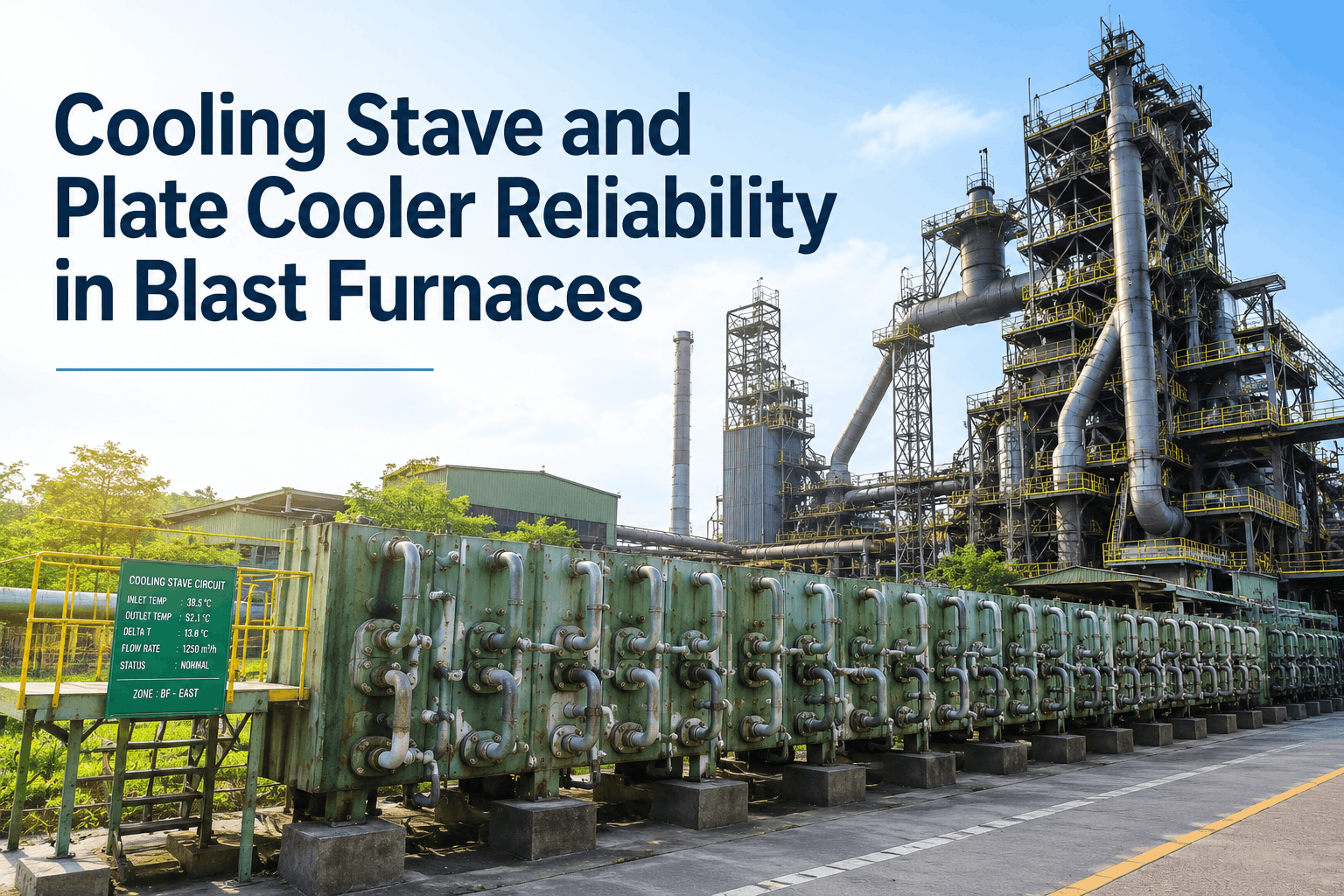
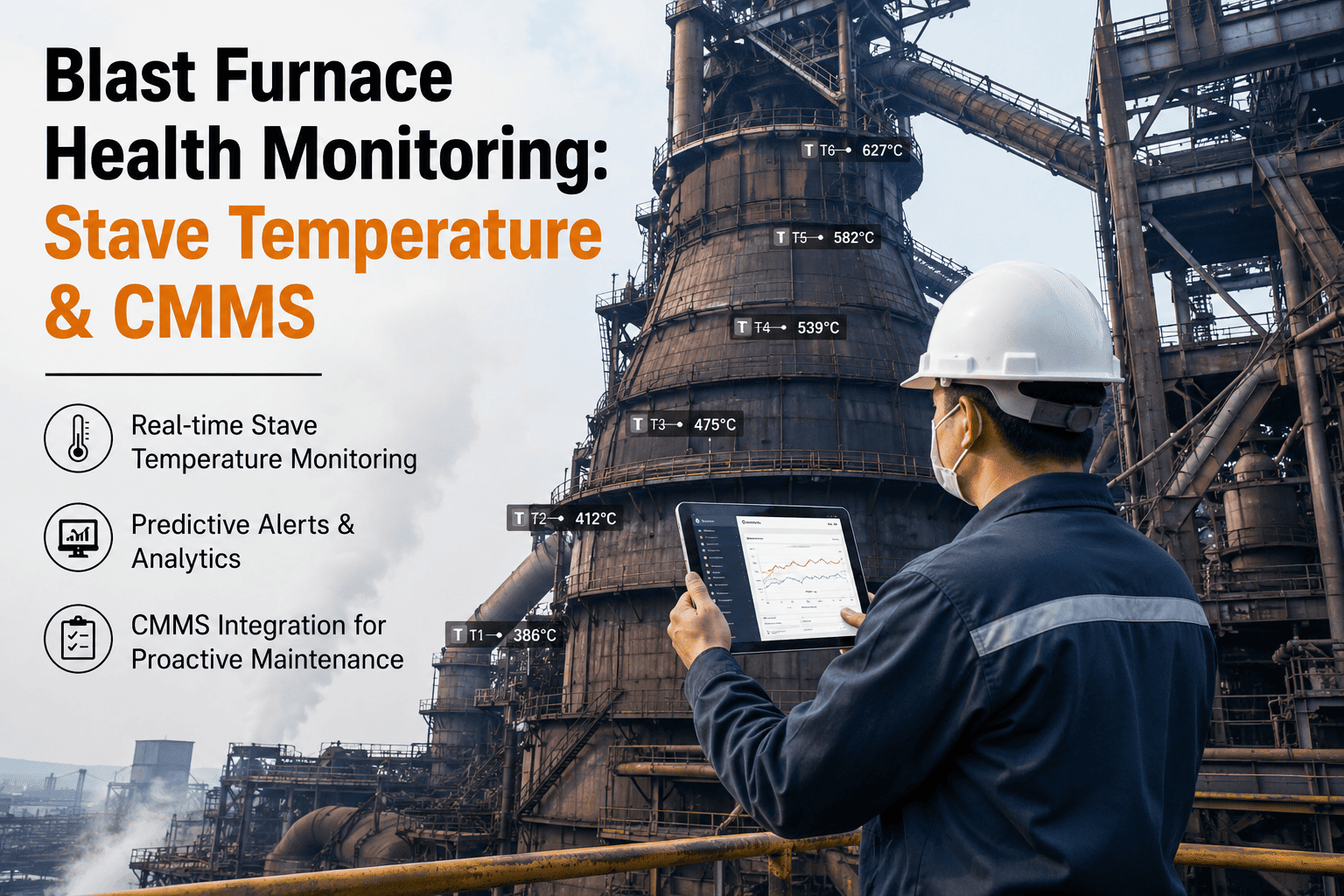
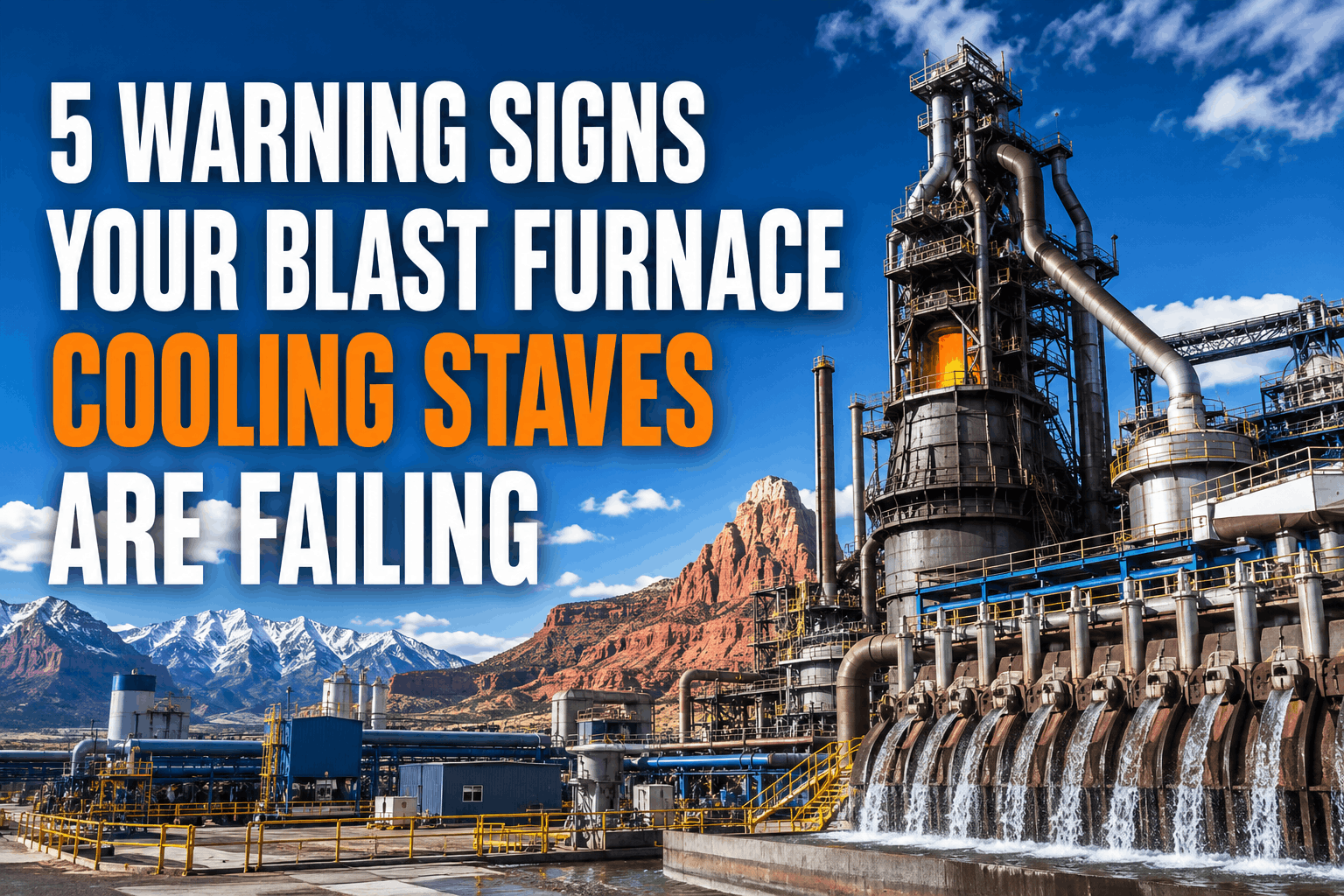
Cooling Stave and Plate Cooler Reliability in Blast Furnaces
By Alex Jordan on May 14, 2026
The blast furnace cooling system is the single most consequential maintenance domain in ironmaking. Cooling staves and plate coolers do not just regulate shell temperature — they are the physical boundary between a productive campaign and an emergency reline. When a stave fails, the progression from elevated heat flux to burnthrough can unfold in a matter of days. When cooling water contacts molten iron or slag through a burned-through stave, the result is not just production loss — it is a potential explosion event that threatens the furnace shell, the casthouse structure, and the people working inside it.
Most ironmaking teams today track stave temperatures inside a SCADA or DCS historian and manage maintenance records in a separate paper system or basic spreadsheet. That disconnection is the core reliability problem: the temperature trend that predicts a burnthrough 72 hours ahead exists in the process control layer, but the PM compliance gap that caused it — a blocked circuit that wasn't caught at the last inspection, a water chemistry excursion that wasn't actioned — lives in a binder somewhere in the maintenance office. Schedule a demo to see how Oxmaint connects stave temperature data with field inspection records in a single CMMS dashboard.
Stave Monitoring Module
Connect Your Stave Temperature Data to Maintenance Work Orders in Real Time
Oxmaint's blast furnace cooling module tracks every circuit as an individual asset record — with heat flux trending, PM scheduling, and automatic work order generation when thresholds are breached. No separate sensor dashboard. No disconnected maintenance records.
Stave burnthrough precursor signals typically visible 48–72 hours before failure with proper heat flux trending
-68%
Reduction in unplanned cooling failures reported by plants using CMMS-driven heat flux trending in the first campaign year
40+
Individual stave circuits in a modern large blast furnace, each requiring shift-level ΔT monitoring and weekly flow verification
$4M+
Value of each additional month of campaign life — emergency relining avoided through proactive stave monitoring
Core Reliability Principle
Scale accumulation in cooling circuits is the leading cause of premature stave burnout — and it is detectable weeks ahead with proper flow rate trending. A blocked circuit that reduces water flow by 30% creates a heat flux imbalance that conventional SCADA alarms will not flag until the stave face temperature reaches critical thresholds. CMMS-integrated flow trending catches it at the 15% deviation point — while there is still time to schedule a circuit flush during the next planned outage.
FAILURE MODES
Primary Failure Modes — Staves and Plate Coolers
01
Stave Burnthrough from Blocked Circuits
Scale deposits, corrosion products, and biological fouling gradually reduce bore diameter and increase pressure drop in stave cooling circuits. In severe cases, circuits reach near-zero flow — operating with no cooling protection — often undetected until the stave face temperature spikes catastrophically. This is the most common pathway to stave burnthrough in operational furnaces with inadequate circuit monitoring.
02
Cooling Water Leak Into the Furnace
A stave or plate cooler that develops an internal crack or weld failure allows cooling water to migrate into the furnace interior. Water contacting molten iron or slag generates steam explosions and produces hydrogen gas — creating explosive atmosphere conditions within the furnace shell. Even small leaks of a few litres per hour represent a critical safety and structural risk requiring immediate isolation and repair during the next planned outage window.
03
Thermal Fatigue and Mechanical Erosion
Cast iron staves in the lower shaft and belly experience aggressive thermal cycling as the burden descends and gas flow patterns shift. Over time, this produces micro-cracking in the stave body and erosion of the hot face. Copper plate coolers installed in high heat load zones are particularly susceptible to erosion from descending burden material. Both failure modes accelerate significantly when inlet water temperature exceeds design limits due to cooling tower or heat exchanger degradation.
04
Disconnected Records and Missed PM Compliance
The single largest preventable reliability failure in stave management is not a material or engineering problem — it is a records problem. When stave inspection records, water chemistry logs, circuit flow checks, and hydrostatic pressure test results live in separate systems or paper binders, PM compliance gaps are invisible until a failure occurs. A CMMS that treats each stave circuit as an individual asset record with full maintenance history eliminates this information gap entirely.
FAILURE DISTRIBUTION CHART
Stave Failure Cause Distribution — Industry Data
Understanding where stave failures originate determines which monitoring parameters deserve the highest PM frequency. Across documented blast furnace stave failure events, blocked cooling circuits and water chemistry excursions account for the majority of avoidable failures — both of which are fully detectable through CMMS-integrated trending.
Root Cause of Stave / Plate Cooler Failures (% of events)
Source: Industry operational data synthesis — ISPatGuru, CECAL engineering data, Oxmaint BF maintenance records
MONITORING PARAMETERS
Critical Monitoring Parameters by Cooling Zone
Blast furnace cooling systems divide into distinct zones — hearth, bosh, belly, lower shaft, upper shaft — each with different heat load profiles, stave materials, and failure modes. The monitoring parameters and alert thresholds must be calibrated per zone, not applied uniformly across the full furnace height. A temperature differential that is normal in the upper shaft indicates a developing problem in the bosh.
Zone
Key Parameters
Alert Threshold
CMMS Action
Bosh / Tuyere
Outlet temp, ΔT per circuit, flow rate, tuyere cooler outlet
Outlet >55°C sustained 10 min
Tuyere change WO; lube and flow check
Belly / Lower Shaft
Stave face temp, shell temp mapping, ΔT trend, heat flux
Heat flux >200 kW/m², shell >120°C
Heat flux alert WO; accretion investigation
Upper Shaft
Stave outlet temp, circuit ΔT, flow rate per circuit
Unlike generic CMMS platforms or sensor-only monitoring dashboards, Oxmaint is built around individual asset lifecycle records for each stave circuit. Every stave zone, every plate cooler, and every circuit in your blast furnace gets its own asset ID with a full maintenance history, inspection timeline, and trending dashboard — not just a tag in a sensor system that generates alerts without maintenance context.
1
Per-Circuit Asset Register
Each of your 40+ stave circuits is created as a unique asset in Oxmaint with its zone location, material type (cast iron / copper), design flow rate, design ΔT, installation date, and last hydrostatic test result. This is the foundation that makes everything else — trending, PM compliance, work order generation — traceable to the specific stave, not just a zone label.
2
Heat Flux and ΔT Trending with Auto-Alerts
Oxmaint aggregates stave outlet temperature data, heat flux readings, and flow rate measurements alongside maintenance records in a single dashboard. When flux deviation crosses your configurable thresholds, a corrective work order is generated automatically — with the stave zone location, last inspection date, and thermal trend chart attached to the work order. Book a call to see the alert threshold configuration in live demo.
3
PM Compliance Tracking Per Zone
Oxmaint schedules and tracks every shift-level ΔT check, weekly flow rate verification, monthly water chemistry test, and annual hydrostatic pressure test as individual PM work orders assigned to specific technicians. When a PM is missed or overdue, the shift manager receives a real-time notification — not a monthly compliance report that arrives after the failure has already occurred.
4
Campaign Audit Trail and Reline Planning
Every stave circuit in Oxmaint carries a complete audit trail from commissioning through campaign end: all inspection results, all work orders raised and closed, all abnormality records, and all water chemistry logs. This documentation record is the foundation for reline planning — enabling your team to identify which zones drove campaign-ending degradation and configure the next campaign's PM schedule accordingly.
Stave Monitoring Module
Connect Your Stave Temperature Data to Maintenance Work Orders in Real Time
Oxmaint's blast furnace cooling module tracks every circuit as an individual asset record — with heat flux trending, PM scheduling, and automatic work order generation when thresholds are breached. No separate sensor dashboard. No disconnected maintenance records.
Paper Records vs. CMMS-Integrated Stave Management
Disconnected / Paper System
ΔT trend access
Separate SCADA — no maintenance link
PM compliance
Manual logsheet — gaps invisible
Circuit flow history
Paper log — not trended
Leak detection
Visual observation only
Campaign audit trail
Scattered binders — incomplete
Reline planning input
Experience-based — no data
Oxmaint CMMS
ΔT trend access
Linked to asset record — auto WO on breach
PM compliance
Real-time dashboard — missed PM alerted
Circuit flow history
Full trend per circuit — deviation flagged
Leak detection
ΔT drop alert + flow discrepancy WO
Campaign audit trail
Complete per-circuit digital record
Reline planning input
Data-driven zone analysis
CUSTOMER QUOTE
"Before Oxmaint, our stave temperature alarms lived in SCADA and our inspection records were in a binder in the maintenance office. When a circuit failed, we'd go back through the logs and find the warning signs had been there for three weeks — just nobody ever connected the two. Now every ΔT deviation generates a work order with the last inspection attached. We caught a developing blockage in Circuit 14-W at 18% flow reduction. The old system would not have caught that until the stave face was already 15 degrees above normal."
RM
R. Mehta
Senior Maintenance Engineer — Integrated Steel Plant, Blast Furnace Department
FAQ
Frequently Asked Questions
What is the difference between a cooling stave and a plate cooler in a blast furnace?
Cooling staves are large, flat cooling elements (typically 1000–1600mm tall) that line the furnace wall from bosh to upper shaft. They are cast in iron or copper and contain one or more internal water channels. Plate coolers (or compact copper coolers) are smaller, thicker elements (typically 500–1000mm long, 400–800mm wide, ~75mm thick) installed in high heat load zones — particularly in European large furnaces — to provide targeted, intensive cooling in critical areas. Both protect the furnace shell from the high-temperature gas and molten burden, but plate coolers offer higher heat flux capacity in their installed zones while staves provide continuous full-wall coverage.
How often should stave circuit temperature differential (ΔT) be monitored?
In the bosh and lower shaft — the highest heat load zones — ΔT should be monitored continuously via the process control system, with CMMS-integrated shift-level manual verification as a backup check. For upper shaft circuits operating under lower thermal loads, shift-level recording (every 8–12 hours) is typically sufficient. The critical factor is not just monitoring frequency but trending — a 3°C rise in ΔT that develops over 72 hours is as significant as an acute 10°C spike, and trend-based detection requires consistent recording at known intervals to be meaningful.
How does Oxmaint detect a developing cooling water leak in a stave circuit?
Oxmaint uses two complementary signals to flag potential leaks. First, a significant drop in outlet temperature ΔT without a corresponding change in operating conditions indicates that cooling water may be bypassing the intended circuit path through a crack — effectively short-circuiting the thermal load. Second, a discrepancy between inlet flow and return flow at the circuit level flags physical water loss. When either signal crosses configurable thresholds, Oxmaint generates a high-priority work order for investigation, while simultaneously notifying the shift manager and blast furnace engineer. Contact our support team to configure your leak detection thresholds.
Can stave cooling circuits be replaced during an active campaign?
Individual stave circuits can be isolated and blocked off during an active campaign by closing the supply and return valves — essentially removing that circuit from service while the furnace continues to operate on surrounding circuits. This is a short-term mitigation, not a repair, as the unprotected stave face will continue to experience thermal loading from adjacent hot zones. Full stave replacement requires a planned outage. The goal of proactive CMMS-based monitoring is to detect developing circuit problems while they are in the "manageable" phase — allowing circuit flushing, water treatment interventions, or planned outage scope to address them before isolation becomes necessary.
What water chemistry parameters most affect stave circuit life?
The most damaging water chemistry conditions for blast furnace cooling circuits are high dissolved oxygen (above 0.1 mg/L), out-of-range pH (below 6.5 or above 9.0), high total hardness (above 150 mg/L as CaCO₃), and high chloride content (above 50 mg/L). Dissolved oxygen drives electrochemical corrosion of steel pipe walls; pH excursions outside the neutral range attack both steel and copper surfaces; hardness causes scale deposition that progressively restricts bore diameter; chloride promotes pitting corrosion. Water chemistry should be tested every 8 hours at the cooling tower and monthly per individual circuit return line — with CMMS work orders triggered automatically on any excursion outside configured ranges.
How is a hydrostatic pressure test for stave circuits managed in Oxmaint?
Annual hydrostatic pressure tests — typically conducted at 1.5× operating pressure during a planned outage — are managed in Oxmaint as recurring PM work orders assigned to the maintenance planner responsible for outage scope preparation. The work order template includes the test procedure, required test pressure, pass/fail criteria, and a mandatory photo documentation checklist. Results are recorded directly against the circuit asset record, creating a time-stamped audit trail of every test. If a circuit fails the pressure test, Oxmaint automatically escalates to a corrective work order for repair or replacement with the failed test result and last known operational data attached.
Does Oxmaint integrate with existing DCS or SCADA historian data?
Yes. Oxmaint supports data integration with DCS and SCADA historians via standard protocols (OPC-UA, REST API, CSV import). Continuous process parameters — stave outlet temperatures, flow rates, heat flux readings — from your existing process control infrastructure can be mapped to the corresponding circuit asset records in Oxmaint, enabling the correlation between process data and maintenance records that is the foundation of predictive stave management. Speak with our integration team about your specific historian platform.
How does Oxmaint support reline planning using stave condition data?
Oxmaint generates campaign performance reports that consolidate every circuit's ΔT history, work order volume, water chemistry excursions, and failure events into a zone-by-zone analysis of where campaign-limiting degradation originated. This report directly informs reline scope decisions: which stave rows require replacement vs. refurbishment, which zones had chronic PM compliance gaps, and which water chemistry conditions correlated with accelerated wear. This turns the next campaign's maintenance strategy from experience-based guesswork into a data-driven programme with quantified justification for each scope item.
FINAL CTA
Every Stave Circuit. Every ΔT Reading. Every PM Record — In One Traceable CMMS.
Oxmaint gives blast furnace teams per-circuit asset records, automated heat flux alerts, PM compliance tracking, and full campaign audit trails — closing the gap between your process control system and your maintenance team before it becomes a burnthrough event.