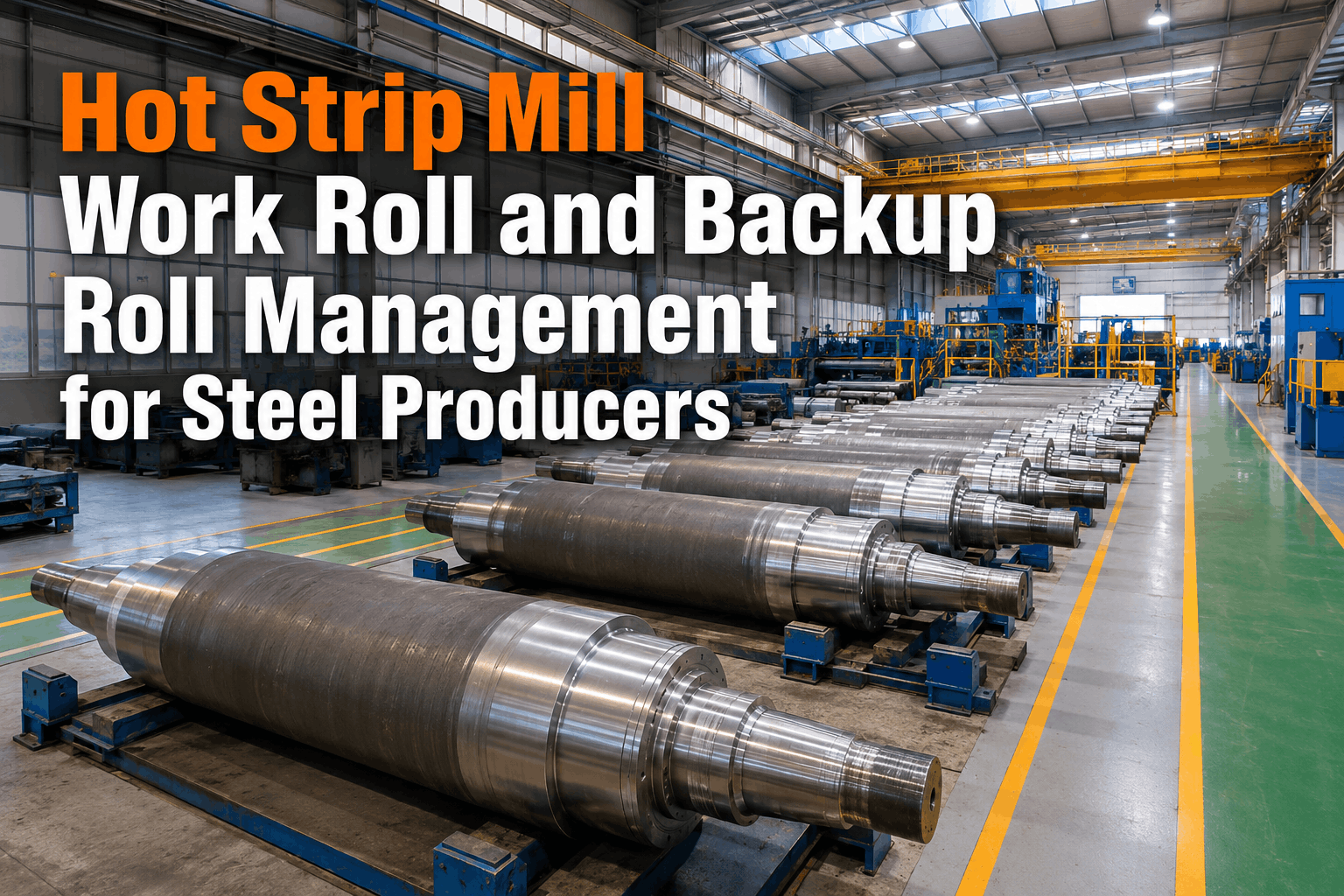
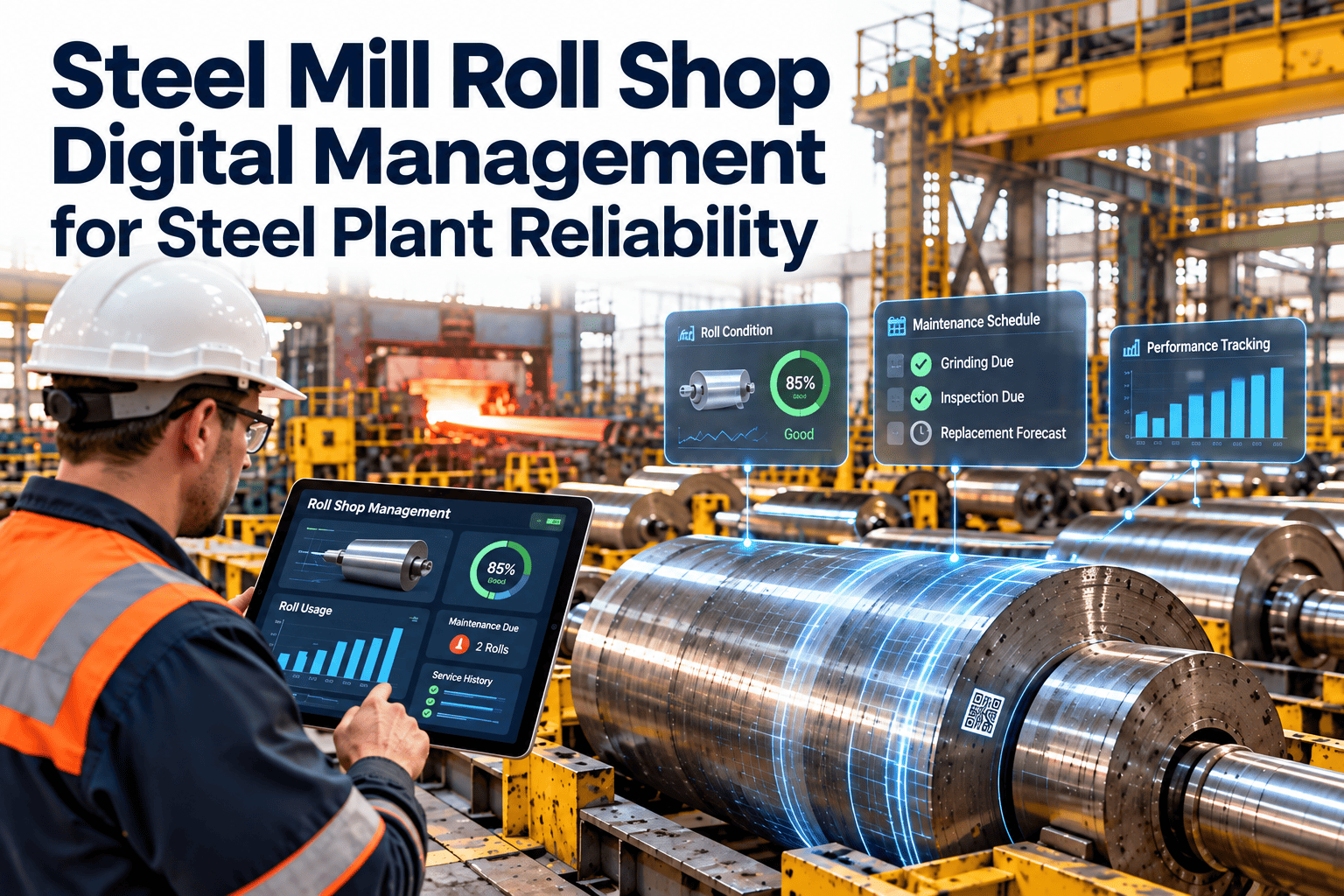
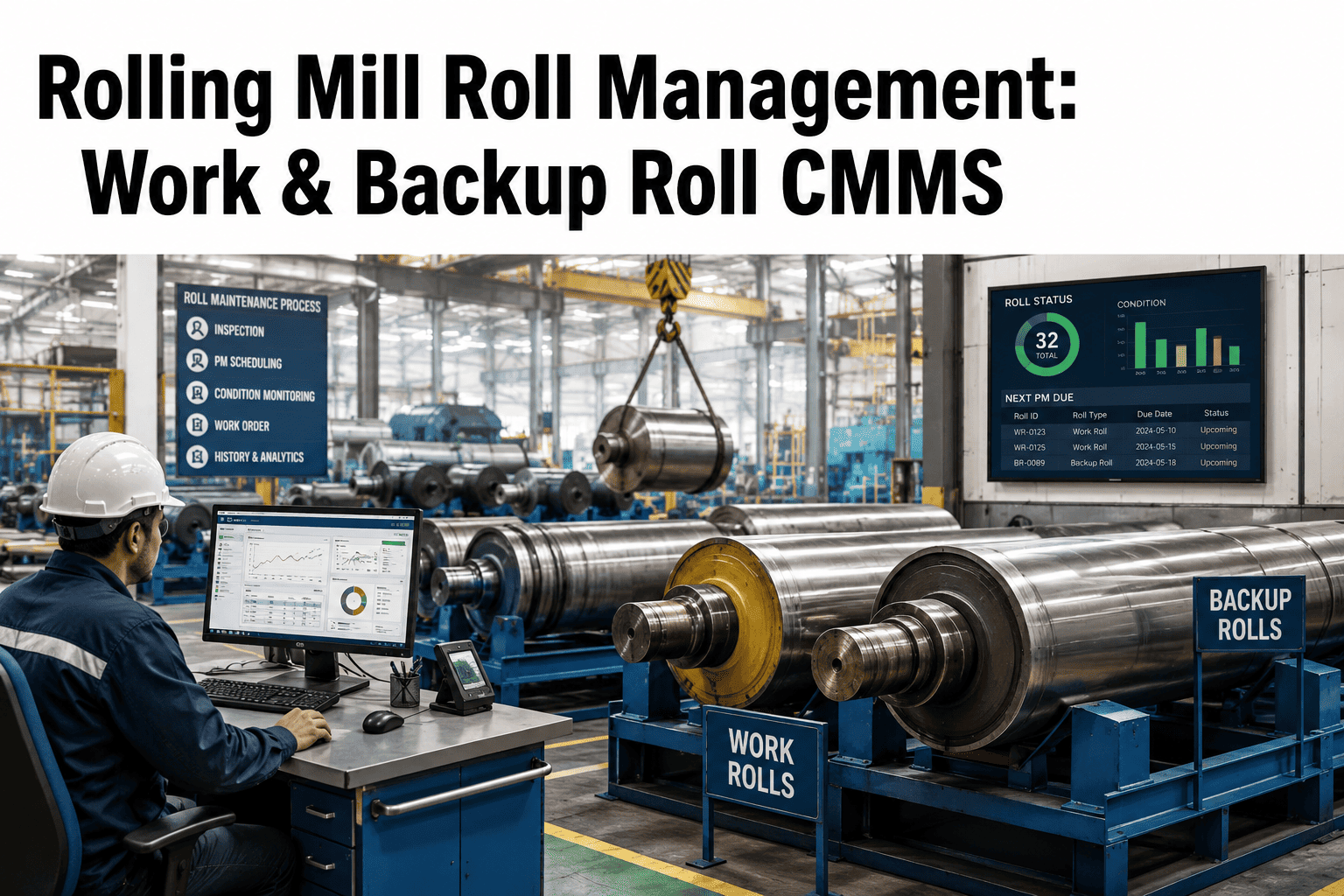
A hot strip mill runs on its rolls. Work rolls absorb thermal shock, rolling force, and surface wear across every tonne of steel produced, while backup rolls transmit those forces into the mill housing structure with loads exceeding 30,000 kN per stand. When a work roll campaign is mismanaged — the wrong roll dispatched to the wrong grade sequence, a grinding pass skipped to meet production pressure, a backup roll retained past its safe re-dressing interval — the consequences cascade from product quality failures straight through to catastrophic mill damage. Every roll in a hot strip mill finishing train deserves a permanent, traceable lifecycle record. OxMaint's CMMS gives roll shop teams, mill pulpit operators, and maintenance engineers a single platform for roll inventory management, grinding program records, campaign tracking, ROT cooling inspection, and backup roll audit history — all accessible on mobile, all updated in real time. Register your roll population in OxMaint and start tracking every campaign today.
Blog · Hot Strip Mill · Roll Shop Management
Hot Strip Mill Work Roll and Backup Roll Management for Steel Producers
Roll Shop Sequencing · Grinding Program Records · ROT Cooling PM · Backup Roll Audit · Roll Lifecycle CMMS · Campaign Tracking · RUL Monitoring · Roll Inventory Control
Roll Shop Live Status — Finishing Mill F1–F7
F1-WR
Work Roll — Stand F1
In Campaign · 420t
F3-WR
Work Roll — Stand F3
Tonnage Limit 85% — Schedule Change
F5-BR
Backup Roll — Stand F5
Grind Due — WO Open
F7-WR
Work Roll — Stand F7
In Campaign · Normal
30–90 min
Typical work roll campaign interval on a hot strip mill finishing stand — every change demands a traceable grinding and inspection record
₹18–45L
Cost per work roll on a hot strip mill finishing stand — premature condemnation from poor records wastes millions annually per mill
6–9 months
Typical backup roll campaign duration — requiring documented grinding program, hardness checks, and chock bearing condition records every cycle
3x
Higher roll-related product quality failures in mills with manual or spreadsheet-based roll tracking versus CMMS-managed roll lifecycle programs
Why Roll Records Are Not Optional — The Five Failure Modes OxMaint Prevents
01
Work Roll Spalling
Warning Signal
Surface crack detection on eddy current scan; rolled-in scale defect pattern on strip; abnormal vibration at stand during campaign
Root causes: residual stress from grinding, retained surface crack from previous campaign, operating beyond tonnage limit for grade mix
OxMaint tracks eddy current and visual inspection results per roll ID — flags rolls with crack history for restricted grade assignment and shortened campaign intervals
02
Backup Roll Chock Bearing Failure
Warning Signal
Rising chock temperature during campaign; lubricant contamination with metal particles; increased rolling force variance at constant strip thickness
Root causes: overloaded campaign, inadequate re-lubrication interval, water ingress into chock housing, misaligned roll neck fit
OxMaint schedules chock inspection and lubrication at campaign intervals — all bearing replacement records linked to the backup roll's permanent asset record
03
Crown Profile Mismatch
Warning Signal
Strip flatness deviation on width profile; edge wave or centre buckle at specific stands; gauge deviation correlated to roll change time
Root causes: wrong crown profile dispatched for grade, grinding record not linked to roll dispatch, thermal crown not accounted for in roll prep
OxMaint stores crown measurement from each grinding pass against the roll ID — ensures correct profile roll is dispatched for each grade sequence from roll shop to mill stand
04
ROT Cooling Nozzle Blockage
Warning Signal
Coiling temperature deviation at pyrometer; uneven strip cooling across width; scale pattern on strip underside in downstream inspection
Root causes: scale build-up in nozzle headers, scale debris blocking individual nozzles, pipe corrosion reducing header flow, failed isolation valves
OxMaint schedules ROT header flush and nozzle inspection on weekly/monthly intervals — each section logged with blocked nozzle count and replaced components
05
Backup Roll Diameter Limit Breach
Warning Signal
Grinding record shows incremental material removal approaching condemnation diameter; roll neck stress recalculation required at minimum diameter
Root causes: missing diameter records across grinding cycles, no systematic tracking of cumulative material removed, ad-hoc grinding without program adherence
OxMaint calculates remaining grind cycles from current diameter, removal per grind, and condemnation limit — generating RUL alerts 3–4 cycles before retirement
Hot Strip Mill Roll Shop PM Schedule — Auto-Generated by OxMaint per Roll ID
| Component |
PM Task |
Trigger Interval |
Predictive Indicator |
Risk if Missed |
| Work Roll (per campaign) |
Diameter, crown, roughness measurement at grinder — recorded against roll ID |
Every campaign change |
Crown deviation from target profile for scheduled grade mix |
HIGH — profile mismatch → flatness defects, customer rejects |
| Work Roll Surface |
Eddy current scan for sub-surface cracks — disposition recorded (fit / restricted / condemn) |
Every campaign change |
Crack depth and location vs tonnage history |
HIGH — retained crack → spalling event, catastrophic mill damage |
| Backup Roll (per campaign) |
Full dimensional survey — barrel diameter, crown profile, shoulder condition |
Every major campaign (~6 months) |
Total material removed vs condemnation limit |
HIGH — untracked wear → operating below safe minimum diameter |
| Backup Roll Chock Bearings |
Grease analysis + bearing clearance check + sealing condition |
Per campaign or quarterly |
Metal particle count in grease sample |
HIGH — bearing seizure → unplanned mill stoppage, chock damage |
| ROT Cooling Headers |
Header flush, nozzle blockage count, isolation valve function |
Weekly section inspection |
Blocked nozzle percentage per header section |
MEDIUM — coiling temperature deviation, strip property variation |
| Work Roll Coolant Nozzles (mill stand) |
Nozzle condition check, flow test, manifold integrity |
Monthly per stand |
Roll surface temperature trend during campaign |
HIGH — inadequate cooling → accelerated roll wear, thermal cracking |
| Roll Shop Grinding Machine |
Wheel dressing condition, spindle bearing vibration, coolant pH and contamination |
Weekly |
Surface finish deviation on ground rolls |
MEDIUM — poor grind quality → roll surface defect transferred to strip |
| Backup Roll Neck (eddy current) |
Fatigue crack inspection at roll neck radius — depth and location recorded |
Every 3 campaigns or annually |
Crack growth rate between successive inspections |
HIGH — neck fracture → complete stand failure, multi-week outage |
Every Work Roll and Backup Roll — One Permanent Digital Record from First Grind to Condemnation.
OxMaint registers each roll as a serialized asset with a unique Roll ID. Every grinding pass, every campaign, every surface inspection finding, and every chock bearing replacement is recorded against that ID and accessible on mobile at the roll shop, the grinder, and the mill pulpit simultaneously. Your roll shop team always knows which roll has which history — before it goes into the stand.
Start your free trial and register your roll population in OxMaint today.
Roll Campaign Lifecycle — How OxMaint Tracks Each Stage in the Roll's Service Life
Work Roll vs Backup Roll — Campaign Lifecycle Comparison
Work Roll
Backup Roll
Grind / Inspect
Work Roll (WR-0142)
Camp 1
G
Camp 2
G
Camp 3
G
Camp 4
G
Camp 5
G
Camp 6
→ Condemned
New6 months12 months18 months24 months
Backup Roll (BR-F3-S)
Campaign 1 (~6 mo)
Grind
Campaign 2 (~6 mo)
Grind
Campaign 3
→ End of Life
New12 months24 months36 months48 months
OxMaint records every campaign start/end, every grinder pass, and every inspection against each roll's unique ID — giving your roll shop full traceability from manufacture to condemnation.
What OxMaint Tracks for Each Roll — The Four Data Pillars
?
Dimensional Records
Every grinding pass produces a dimensional record: barrel diameter at multiple measurement points, crown profile, surface roughness Ra, and material removed in that pass. OxMaint stores this per grind cycle against the roll ID. From the accumulated data, the system calculates remaining grind cycles to condemnation diameter, flags when a roll is approaching its minimum barrel diameter, and prevents assignment of rolls with insufficient material for the scheduled number of campaigns ahead. This eliminates the most expensive roll loss cause — discovering a roll is at minimum diameter only when it is needed on the mill floor with no qualified replacement in the bay.
Alert: Remaining grind cycles ≤ 3 — triggers re-dressing schedule review and replacement roll procurement
?
Surface Condition and Defect History
Each work roll receives a surface inspection after removal from the stand — visual, eddy current for sub-surface crack detection, and roughness measurement. OxMaint records every finding: crack depth and location, spall size and position, bruise marks from cobble events, and hardness measurement. Disposition decisions (fit for normal campaign, restricted grades only, investigation hold, condemn) are logged against the roll record and visible to the mill pulpit team when that roll is next proposed for dispatch. A roll with a crack event in its history never gets dispatched without the roll shop supervisor reviewing the latest eddy current result in OxMaint — reducing the risk of a retained crack progressing to a spalling event on the mill.
Alert: Crack depth > 3mm on eddy current → automatic investigation hold, prevents dispatch until cleared
?
Campaign and Grade History
Every campaign a work roll serves is recorded: stand position, paired backup roll ID, campaign start and end time, total tonnage rolled, coil count, campaign end reason (tonnage limit, surface defect, schedule change, cobble), and grade families rolled during the campaign. This grade history becomes critical for rolls re-assigned across product groups. A roll with significant high-chrome grade history develops a different thermal crown response than a roll used exclusively on structural grades — and assigning it to a flatness-critical automotive grade sequence without reviewing the grade history causes profile defects that appear after the roll change, not before. OxMaint surfaces grade history at the point of roll dispatch decision.
Alert: Roll assigned to grade group outside its campaign history — requires supervisor sign-off in OxMaint
?
Chock and Bearing Records (Backup Roll)
Backup roll chocks are separate assets in OxMaint, linked to the backup roll they are currently fitted to. Every chock strip-down — bearing replacement, seal renewal, liner check, housing bore measurement — is recorded as a work order against the chock asset, with parts consumed and findings documented. When a backup roll is removed for grinding, OxMaint auto-generates a chock inspection work order as part of the campaign close workflow. Maintenance engineers can see, for any backup roll on any stand, exactly when each chock was last inspected, which bearings are fitted, their age in campaign-hours, and the last grease analysis result.
Schedule a demo to see how OxMaint manages chock records.Alert: Chock bearing age exceeds campaign limit or metal particles in grease analysis exceed threshold
Before vs After — What Structured Roll Lifecycle Management Changes
Roll shop dispatches a work roll without knowing its last eddy current result — crack history is in a paper log from three campaigns ago
Backup roll sent to grinder and operator removes extra material to be "safe" — no record of cumulative removal, roll condemned 2 campaigns early
Crown profile of dispatched roll does not match grade sequence — flatness defect discovered after coils are wound and in the cooling bay
ROT nozzle blockage found only when coiling temperature alarms — blocked nozzles have been degrading strip properties for days
Chock bearing failure on Stand F4 backup roll — no record of when last bearing was replaced, investigation takes a full shift to find service history
Roll population size cannot be optimised — rolls purchased reactively when crises arise, no lead time planning from RUL data
Every work roll dispatch goes through OxMaint — last inspection result, crack history, campaign count, and grade history visible before dispatch decision is made
Grinding program records cumulative material removed per cycle — OxMaint alerts when roll is 3 grinds from condemnation diameter, procurement planned in advance
Crown profile from last grinder pass is linked to roll dispatch — mill pulpit confirms profile before roll goes in, flatness risk eliminated at source
Weekly ROT inspection captures blocked nozzle count per section — trend visible in OxMaint, headers flushed before coiling temperature is affected
Chock bearing age and last inspection date are in OxMaint against every backup roll — investigation takes 30 seconds, not a shift
RUL data across the roll population feeds into annual procurement planning — right number of rolls procured, no emergency orders at premium prices
"Before OxMaint, our roll shop ran on a combination of whiteboard notes and an Excel sheet that only two people knew how to navigate. After a roll spalling incident on Stand F5 — caused by a roll with a previous crack history being dispatched without the latest eddy current result — we moved to OxMaint. Now every roll has a permanent digital record, every dispatch goes through a checklist that pulls the last inspection result automatically, and our backup roll chock bearing failures are down to near zero. The payback was visible within the first campaign cycle."
— Senior Maintenance Manager, Hot Strip Mill, Integrated Steel Plant, Maharashtra
Frequently Asked Questions — Hot Strip Mill Roll Management with OxMaint
How does OxMaint manage roll inventory and ensure the right roll is dispatched for each grade sequence?
Each work roll in OxMaint carries a grade history field that accumulates the product families it has been used on across its service life. When the roll shop supervisor dispatches a roll for the next campaign, OxMaint displays the roll's crown profile from its last grind, its grade history, its current surface condition status, and the number of campaigns remaining before condemnation. If the roll's grade history flags a potential profile mismatch with the scheduled grade sequence, OxMaint raises a warning at the dispatch step — preventing the decision from being made without that information on screen. The mill pulpit team can also view the dispatched roll's profile record via mobile before the roll is fitted in the stand.
Configure your roll dispatch workflow in OxMaint — free trial available.
Can OxMaint track cumulative grinding material removal and calculate remaining grind cycles to condemnation?
Yes. Each roll record in OxMaint stores the current barrel diameter, the configured condemnation diameter, the average material removed per grinding pass (calculated from the roll's own history), and the grinding records from every pass in the roll's service life. From these values, OxMaint calculates the estimated remaining grind cycles and displays this prominently on the roll's asset page. When remaining grind cycles reach the configured alert threshold — typically 3 cycles — OxMaint generates a planning notification that allows procurement of the replacement roll with sufficient lead time. This eliminates the scenario where a roll reaches condemnation diameter unexpectedly during a production campaign, forcing an unplanned roll change with no qualified replacement in the bay.
How does OxMaint handle eddy current and surface inspection records for work rolls?
Surface inspection results — including eddy current crack depth and location, visual surface condition rating, and roughness measurement — are entered against the roll's asset record in OxMaint via the mobile interface or desktop after each campaign removal. The disposition decision (fit for normal campaign, restricted grade assignment, investigation hold, or condemn) is selected by the roll shop inspector and saved against the roll's record with a timestamp and inspector identity. When that roll is next proposed for dispatch, OxMaint displays the most recent inspection result and disposition status prominently — ensuring the dispatch decision is always made with current information. Rolls on investigation hold cannot be dispatched until the hold is cleared by an authorised supervisor in OxMaint.
How are backup roll chock bearing records managed separately from the roll record?
In OxMaint, backup roll chocks are registered as separate child assets linked to the backup roll assembly. Each chock has its own work order history tracking bearing replacements, seal renewals, housing bore measurements, and grease analysis results. When a backup roll is removed from service for grinding, OxMaint automatically generates a chock inspection work order as part of the campaign close checklist — ensuring that chock condition is assessed during every backup roll grind event rather than only when a bearing failure forces investigation. The bearing age in campaign-hours is tracked against each chock, with configurable PM intervals that generate inspection work orders before the bearing reaches the end of its planned service life.
Schedule a demo to see how backup roll and chock records work in OxMaint.
Can OxMaint manage ROT cooling system inspection and maintenance records?
Yes. The Run-Out Table cooling system is registered in OxMaint as a set of assets organised by header section — typically upper and lower headers across each cooling zone from F7 exit to the coiler entry. Weekly inspection work orders are auto-generated for each section, with mobile checklists capturing blocked nozzle count, header flow condition, isolation valve function, and pipe integrity. Blocked nozzle count per section is trended over time, allowing the maintenance team to identify sections with accelerating blockage rates before coiling temperature is affected. Header flush work orders are triggered when blocked nozzle count exceeds a configured threshold — preventing the reactive situation where a coiling temperature deviation triggers an emergency ROT inspection during active rolling.
How does OxMaint differ from general CMMS platforms for hot strip mill roll management?
Generic CMMS platforms track assets, work orders, and PM schedules — but they are designed around static assets like pumps and motors, not serialized consumable assets like rolling mill rolls that accumulate dimensional and surface condition data across dozens of cycles. OxMaint is configured with hot strip mill roll shop workflows as a standard feature: roll-specific asset records with grinding data fields, campaign tracking with grade history accumulation, eddy current disposition workflows, RUL calculation from dimensional history, and chock-to-roll linkage for bearing record management. These are not custom configurations requiring an IT project — they are available to your roll shop team from the first day of your free trial. Platforms focused on IoT sensor integration and AI prediction require hardware investment before delivering value; OxMaint delivers roll record management value from the first roll registered, with zero sensor hardware required.
Can OxMaint support multiple mill stands and a large roll population across a full hot strip mill finishing train?
OxMaint scales to the full finishing mill roll population — F1 through F7 work rolls and backup rolls, all associated chocks, all grinding machines, and all ROT cooling sections — within a single plant site configuration. Each stand is a parent asset with work rolls, backup rolls, drive spindles, hydraulic cylinders, and cooling systems as child assets. The roll shop team accesses their inspection and grinding record entry workflows via mobile; the mill shift team views roll status and campaign status on desktop; the maintenance manager sees the full roll population RUL status and PM compliance on the dashboard. Multi-stand, multi-roll PM batch scheduling means a single work order can cover a full ROT section inspection rather than generating one work order per header — maintaining manageable workload without losing traceability.
What reports does OxMaint generate for hot strip mill roll management and roll shop performance?
OxMaint generates roll-level and population-level reports including: average campaign tonnage by stand position and grade family, roll condemnation analysis (premature condemnation reasons and frequency), grinding compliance rate (percentage of rolls grinding within program vs overdue), backup roll chock bearing MTBF by stand position, ROT nozzle blockage trend by cooling section, and roll-related product quality events linked to specific roll IDs. These reports give maintenance managers the data to identify which roll types are underperforming, which stand positions have the highest wear rates, and where grinding program adherence is weakest — enabling targeted improvements in roll procurement specifications, grinding intervals, and campaign management practices.
Start generating roll shop performance reports in OxMaint — free trial.
Hot Strip Mill Roll Management Should Run on Data, Not Memory. OxMaint Makes It Happen.
OxMaint gives your roll shop team, mill maintenance engineers, and shift supervisors a single platform for work roll lifecycle records, backup roll campaign tracking, grinding program management, ROT cooling inspection, and roll inventory planning — all accessible on mobile, all traceable by roll ID, and all visible without a sensor installation or an IT project.