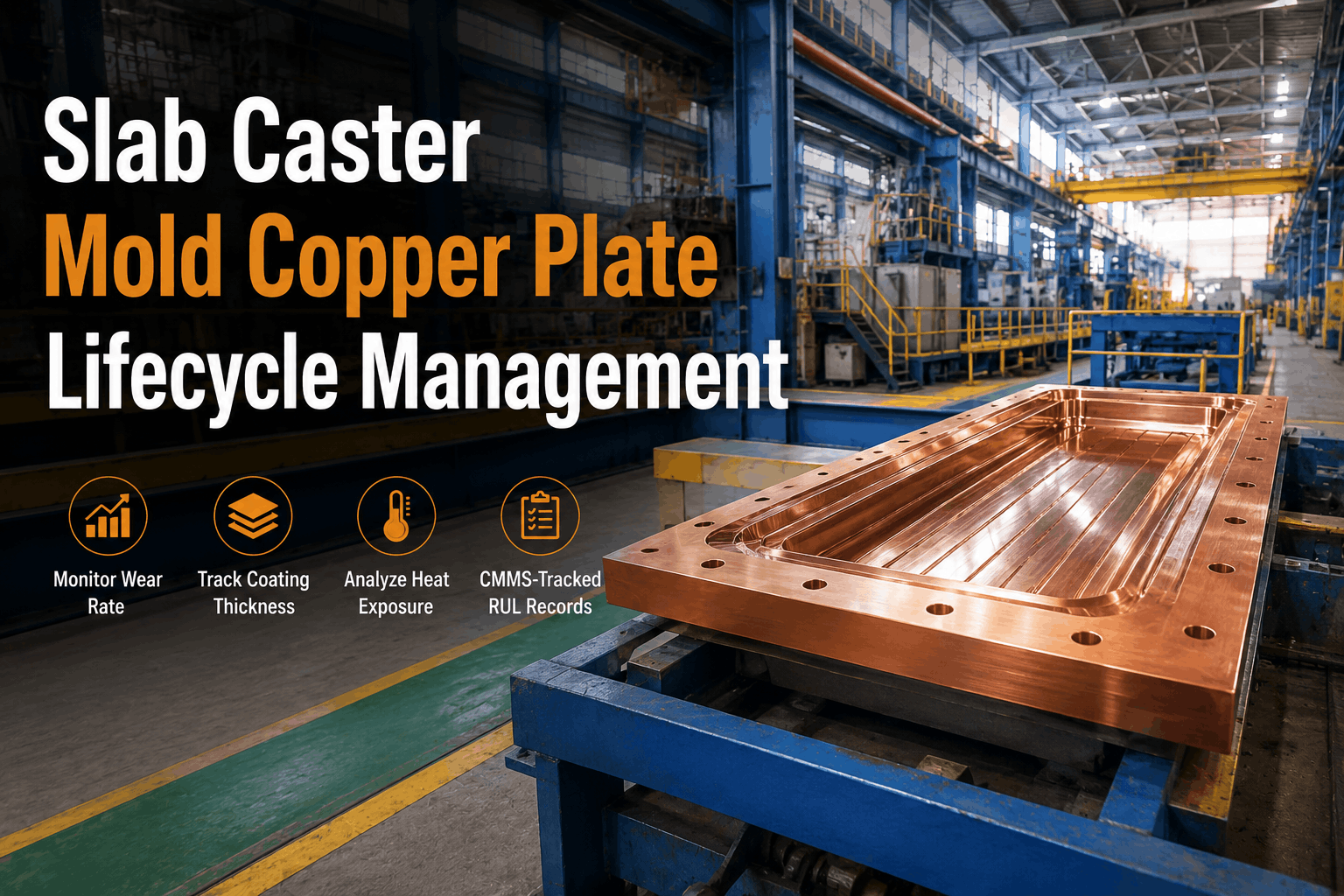
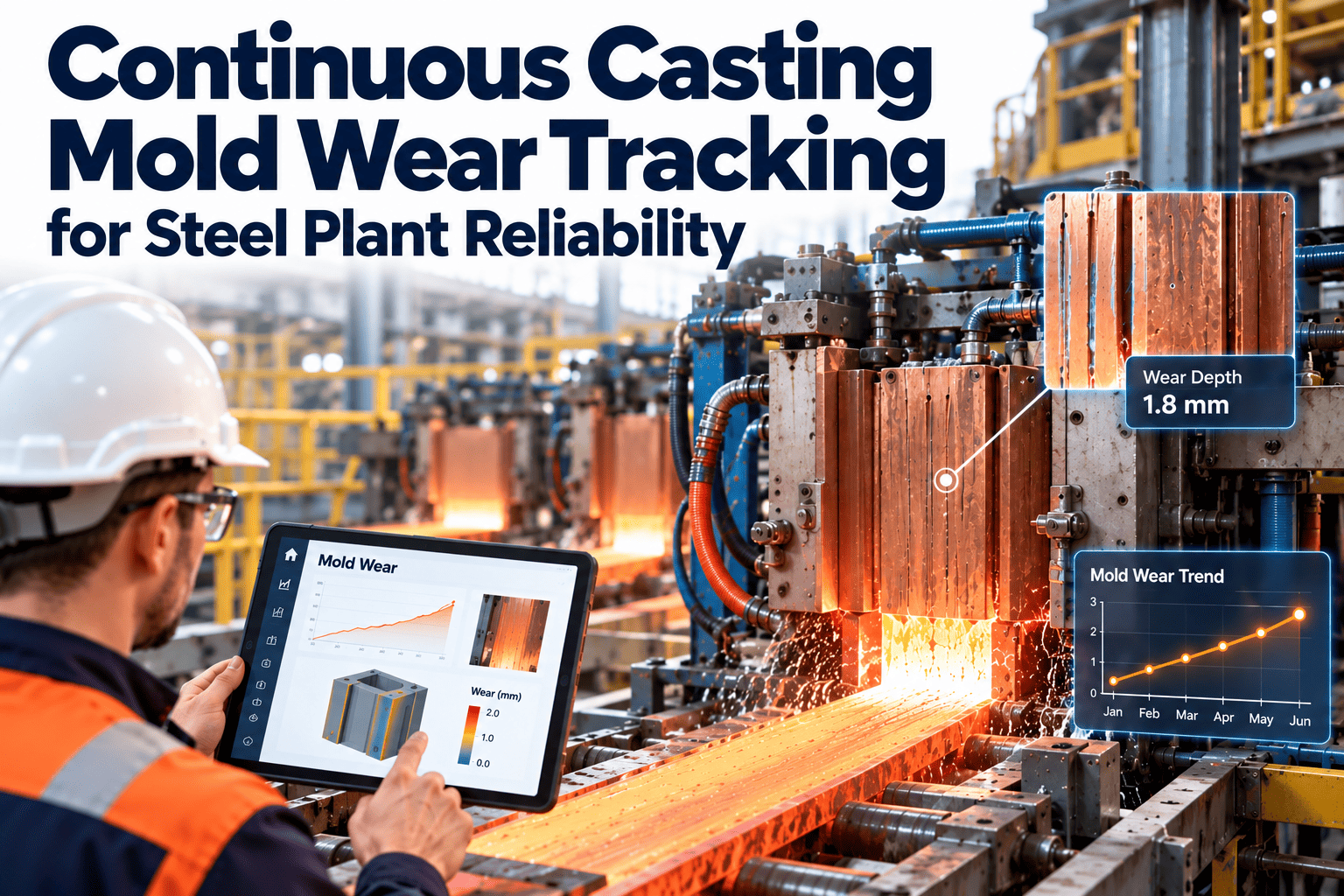
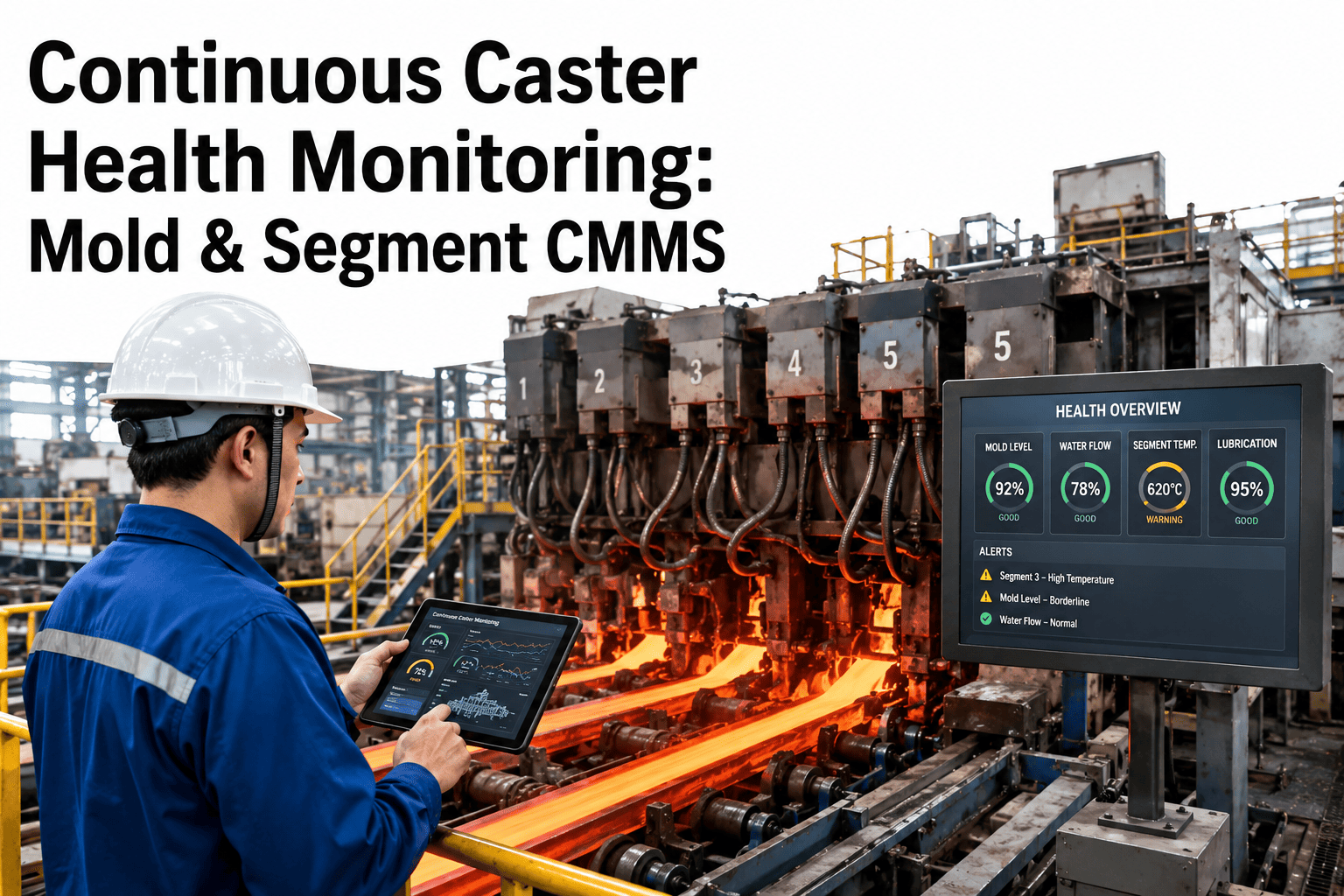
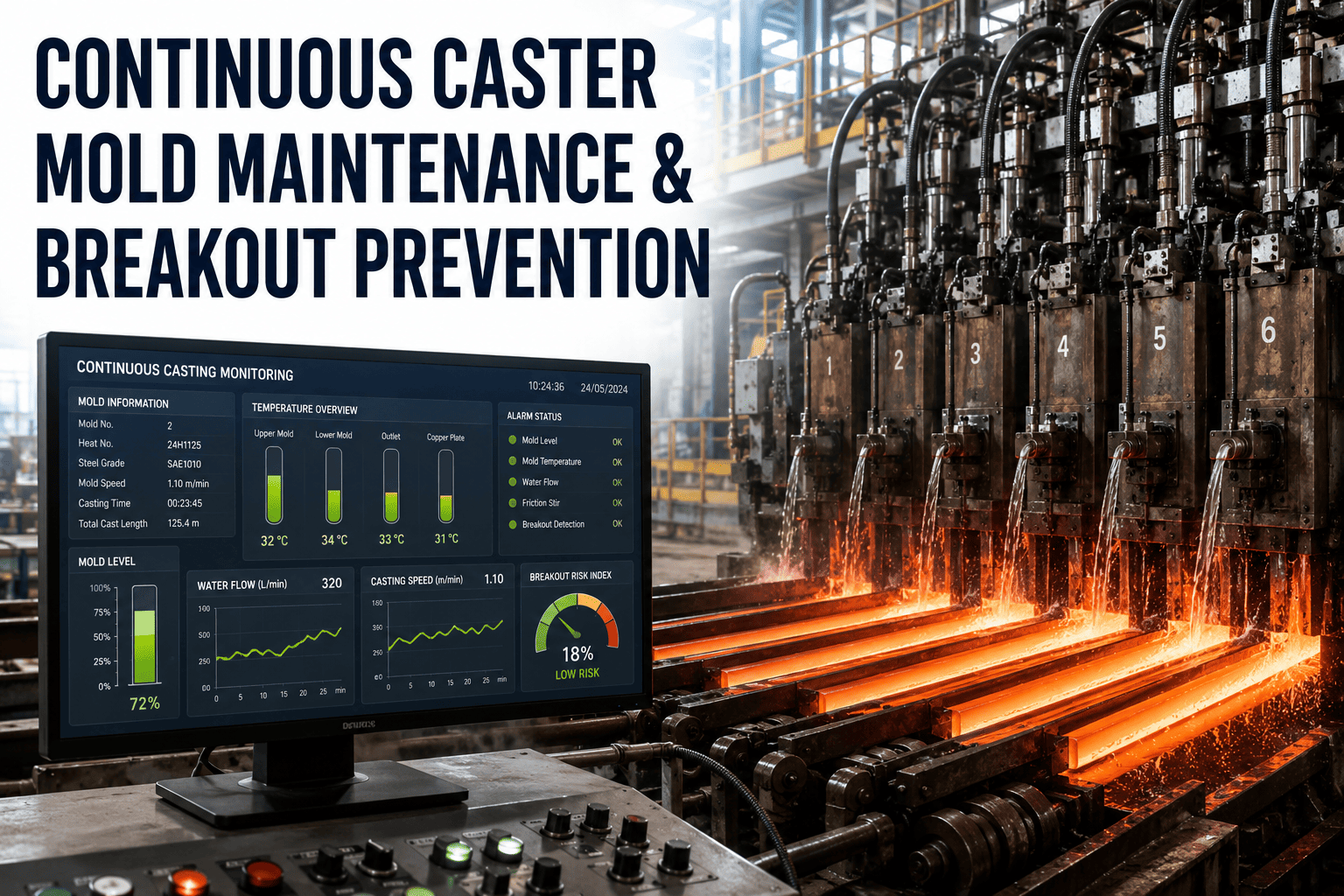
The slab caster mold copper plate is not a consumable — it is a precision reusable asset that goes through multiple refurbishment cycles across its operational life. A wide-face mold copper plate installed on a modern slab caster will support 300,000 to 500,000 tonnes of cast steel across five to eight refurbishment cycles before reaching its minimum copper thickness limit. Managing that lifecycle — tracking each heat, recording each coating application, measuring wear after every campaign, and calculating remaining useful life (RUL) with accuracy — is the difference between a mold copper budget that is predictable and one that is driven entirely by emergency replacements.
The breakout risk dimension makes this management challenge even more consequential. A mold copper plate running beyond its coating wear limit exposes the copper substrate to direct contact with the solidifying steel shell — creating star cracks in the strand surface, accelerating strand sticking, and raising breakout probability in the secondary cooling zone. Most continuous casting breakout events that originate in the mold zone are traceable to an identifiable precursor in the copper plate's wear and coating history. Schedule a demo to see how Oxmaint tracks mold copper plate lifecycle from first cast to scrap.
5–8×
Refurbishment cycles per copper plate — each cycle removes 0.5–2mm of copper; CMMS tracking prevents scrapping plates early
500K+
Tonnes per campaign achievable with UniGuard® and NanoGuard® coatings on thick slab casters with systematic wear tracking
1 mm
Coating wear at the lower mouth that signals campaign end — exceeded wear equals exposed copper, star cracks, and breakout risk
4 plates
Per mold assembly (2 wide face + 2 narrow face) — each with different wear rates requiring independent lifecycle tracking
Core Lifecycle Principle
A copper plate is not done when the coating wears out — the plate is recoated and returned to service. CMMS-tracked refurbishment history (serial number → campaign tonnage → coating type → residual thickness → machining removal → new coating → deployment) gives your procurement and maintenance teams the data to extend each plate's useful life to its designed maximum while preventing the breakout events that occur when plates run past their serviceable limits undetected.
Mold Copper Plate Lifecycle Stages
Every mold copper plate passes through a defined sequence of lifecycle stages. Oxmaint creates a per-plate asset record that tracks every transition through this sequence — with tonnage accumulated at each stage, inspection results, and calculated RUL at campaign end.
New Plate Intake
Serial no., alloy type, initial thickness, coating spec recorded
Active Campaign
Heat count accumulating; thermocouple health monitored
Refurb cycle N logged; cumulative machining removal updated
Scrap at Limit
Min. thickness reached; full lifecycle report generated
Wear Profile by Mold Zone
Coating wear on a slab caster mold copper plate is not uniform — it concentrates at specific zones driven by friction from the solidifying strand, thermal fatigue at the meniscus, and mechanical contact at the corners. Understanding which zones wear fastest determines where inspection frequency and coating thickness specification must be highest.
Wide-Face Copper Plate — Coating Wear Intensity by Zone
Thermal fatigue cracks in coating; zinc diffusion (brassing) from scrap-based heats accelerates
Mid-Body Zone
0.2–0.5mm
Moderate friction wear from strand shell; increases with higher casting speed
Upper Section
<0.1mm
Minimal wear. Structured coating in this zone reduces heat flux at meniscus
Wide-face plates develop greater total wear than narrow-face plates. Narrow-face plates additionally experience width shrinkage requiring copper edge-plating to restore dimensions.
Mold Copper Plate Coating Types and Performance
The coating applied to a mold copper plate determines its campaign life, maximum casting speed, and wear resistance. Oxmaint tracks which coating variant is applied at each refurbishment cycle — enabling your team to compare actual campaign performance (tonnes cast per mm of coating consumed) against coating type, and to optimise coating selection for your specific caster and steel grade mix.
Coating Type
Hardness (HV)
Typical Campaign Life
Key Characteristic
CMMS Track Point
Nickel Sulfamate (Ni)
180–250 HV
150,000–200,000 t
Standard — good bonding, lower wear resistance
Thickness per zone, crack inspection post-campaign
Ni-Co Alloy
300–450 HV
250,000–350,000 t
Higher hardness; step coating profile by zone
Thickness at meniscus and lower mouth
Ni-P Alloy
400–550 HV
300,000–400,000 t
Excellent thermal fatigue resistance; close CTE to copper
Lower mouth thickness; thermal crack inspection
NanoGuard® (SMS)
200–700 HV
350,000–500,000 t
Proprietary Ni-based superalloy; step or full-face
Per-zone thickness map; cycle count
UniGuard® (SMS)
>700 HV
500,000+ t
Highest wear resistance; thermal spray process
Full thickness map; spalling inspection
Ni-Cr (Ni base + Cr)
600–800 HV
180–280 HV (Cr layer)
Cr top layer prone to thermal cracking; limited use in slabs
Chrome layer integrity; peeling inspection
How Oxmaint Tracks Each Plate — The Lifecycle Record
Unlike sensor-only platforms that monitor the mold in service but provide no refurbishment lifecycle record, Oxmaint maintains a complete per-plate digital twin that persists across campaigns, refurbishments, and outages.
Example based on a 30mm wide-face copper plate with standard Ni-Co coating. Oxmaint calculates RUL automatically from cumulative removal data at each refurbishment entry.
Mold Copper Lifecycle Module
Track Every Copper Plate From First Heat to Scrap — With Automatic RUL Calculation
Oxmaint maintains per-plate serial records across every campaign, refurbishment cycle, and coating application. When a plate's calculated remaining copper approaches your configured minimum, a CMMS alert triggers procurement well ahead of the required replacement date.
Manual Tracking vs. CMMS Copper Plate Lifecycle Management
Manual / Spreadsheet
Plate identification
Position-based — no serial tracking
Wear data
Handwritten post-campaign note
Coating history
Refurb order paperwork — often lost
RUL calculation
Engineer estimate — not data-based
Procurement trigger
Emergency order when plate cracks
Breakout traceability
Cannot correlate to mold wear history
Oxmaint CMMS
Plate identification
Serial-tracked — full history per plate
Wear data
Per-zone thickness entered against asset record
Coating history
Type, thickness, supplier — per cycle
RUL calculation
Auto-calculated from cumulative removal data
Procurement trigger
CMMS alert at configurable lead-time threshold
Breakout traceability
Linked to plate record and campaign data
"We were scrapping wide-face plates after four campaigns because we had no reliable record of how much copper had been machined off. Half the time we couldn't even confirm which refurb shop had done the last two cycles. After setting up Oxmaint with serial-tracked plates, we discovered we had plates in the scrap bin that still had three campaigns left in them. We recovered about 18 plates in the first audit — at $6,000–$8,000 per plate replacement cost, that's a meaningful number in one exercise."
What is the minimum copper plate thickness before a slab caster mold plate must be scrapped?
Minimum serviceable thickness varies by caster design and plate geometry, but the industry standard reference for wide-face copper plates is typically 8–10mm of remaining copper substrate after all machining removal is accounted for. Below this thickness, the structural integrity of the plate under ferrostatic pressure loads and thermal cycling becomes insufficient to ensure reliable strand shell formation. Oxmaint calculates remaining thickness automatically by subtracting cumulative machined removal (recorded at each refurbishment cycle) and campaign wear data from the original plate thickness — displaying a real-time RUL figure against the configured minimum threshold.
How does zinc diffusion ("brassing") damage mold copper plates, and how is it tracked?
Zinc diffusion, commonly called brassing, occurs when casting scrap-based heats with high zinc content — typically from galvanized steel scrap. At mold operating temperatures (250–350°C at the hot face), zinc vapour diffuses into the copper substrate at the meniscus, forming brass alloy layers (CuZn phases) that have significantly lower thermal conductivity and different thermal expansion characteristics than pure copper. This causes accelerated thermal fatigue cracking at and above the meniscus zone. Oxmaint tracks zinc-content heats as a parameter in the heat count record — enabling correlation between high-zinc heat exposure and accelerated meniscus zone wear rate, which informs coating selection and campaign length decisions for scrap-heavy steel grade mixes. Talk to our support team about configuring heat-grade tracking in your mold record.
What is the "everlasting mold" concept and can Oxmaint support it?
The everlasting mold concept, pioneered by Evertz, uses copper-to-copper electroplating to fully compensate for copper thickness lost during machining at each refurbishment cycle — meaning the plate is restored to its original thickness rather than progressively thinning. In theory, this makes plates reusable indefinitely, with campaign life limited by coating wear rather than substrate depletion. Oxmaint supports this process by maintaining the copper balance record for each plate — distinguishing between machined removal (which is offset by copper build-up plating in the everlasting process) and wear consumption — and calculating RUL based on the net copper budget rather than a simple countdown from original thickness.
How frequently should mold copper plate wear measurements be taken?
Full dimensional gauging — including per-zone coating thickness mapping, plate profile, taper verification, and corner geometry — should be completed at every scheduled mold change, typically every 150,000–250,000 tonnes of cast steel depending on caster speed and coating type. For plates approaching their minimum thickness threshold, gauging at every mold change is mandatory. Oxmaint triggers a wear inspection work order automatically when a plate's accumulated heat count reaches the configured inspection interval — ensuring no plate re-enters service without a current wear record on file.
Does Oxmaint track thermocouple health in the mold copper plates?
Yes. Thermocouples embedded in mold copper plates are the primary data source for breakout prediction systems (BPS). A degraded or failed thermocouple does not just produce a gap in the temperature map — it causes the BPS to either generate false alarms (triggering unnecessary casting speed reductions) or miss real breakout precursor signals. Oxmaint maintains thermocouple health records per mold position, tracking last-verified response time, signal drift, and replacement date — with a PM work order triggered when a thermocouple's last verification exceeds the configured interval.
How does Oxmaint handle narrow-face plate tracking differently from wide-face?
Narrow-face copper plates experience a different primary wear mode from wide-face plates. Where wide-face plates wear predominantly from friction at the lower mouth and thermal fatigue at the meniscus, narrow-face plates shrink in width direction due to differential thermal expansion and mechanical compression from wide-face clamping force. Oxmaint tracks narrow-face plate width at each inspection — triggering a refurbishment work order when width has reduced beyond the configurable limit, and recording copper edge-plating restoration of width dimensions as a distinct lifecycle event. This prevents the narrow-face gap problems that cause longitudinal corner cracking and eventual strand quality failures.
Can Oxmaint generate a mold copper plate lifecycle cost report for budget justification?
Yes. Oxmaint generates per-plate cost reports that consolidate coating costs per refurbishment cycle, machining costs, procurement cost of the original plate, and total tonnes cast over the plate's lifecycle — producing a cost-per-tonne figure for each plate and for your mold copper fleet as a whole. This report is the primary tool for justifying premium coating investments (showing the per-tonne cost advantage of NanoGuard® vs. standard nickel over five refurbishment cycles) and for benchmarking refurbishment shop performance. Contact our team to see a sample lifecycle cost report for slab caster copper plates.
What cooling water gap uniformity checks does Oxmaint track for mold copper plates?
Water seam uniformity — the evenness of the cooling water gap between the copper plate hot face and the support plate — directly affects heat extraction uniformity. Non-uniform gaps create hotspots in the copper that accelerate localised thermal fatigue cracking. Oxmaint records water gap measurements at defined positions (typically 5–7 measurement points per plate) at each mold change and assembly, with configurable tolerance limits that trigger a rejection or adjustment work order when gap deviation exceeds specification. This prevents assembly errors that create systemic localised wear even on freshly refurbished plates.
Every Copper Plate. Every Campaign. Every Refurbishment Cycle — Tracked With Full RUL Visibility.
Oxmaint gives continuous casting teams serial-tracked mold copper plate records, automatic wear inspection work orders, coating history across all refurbishment cycles, and calculated remaining useful life — eliminating the early scrapping and emergency procurement that drives mold copper cost overruns.