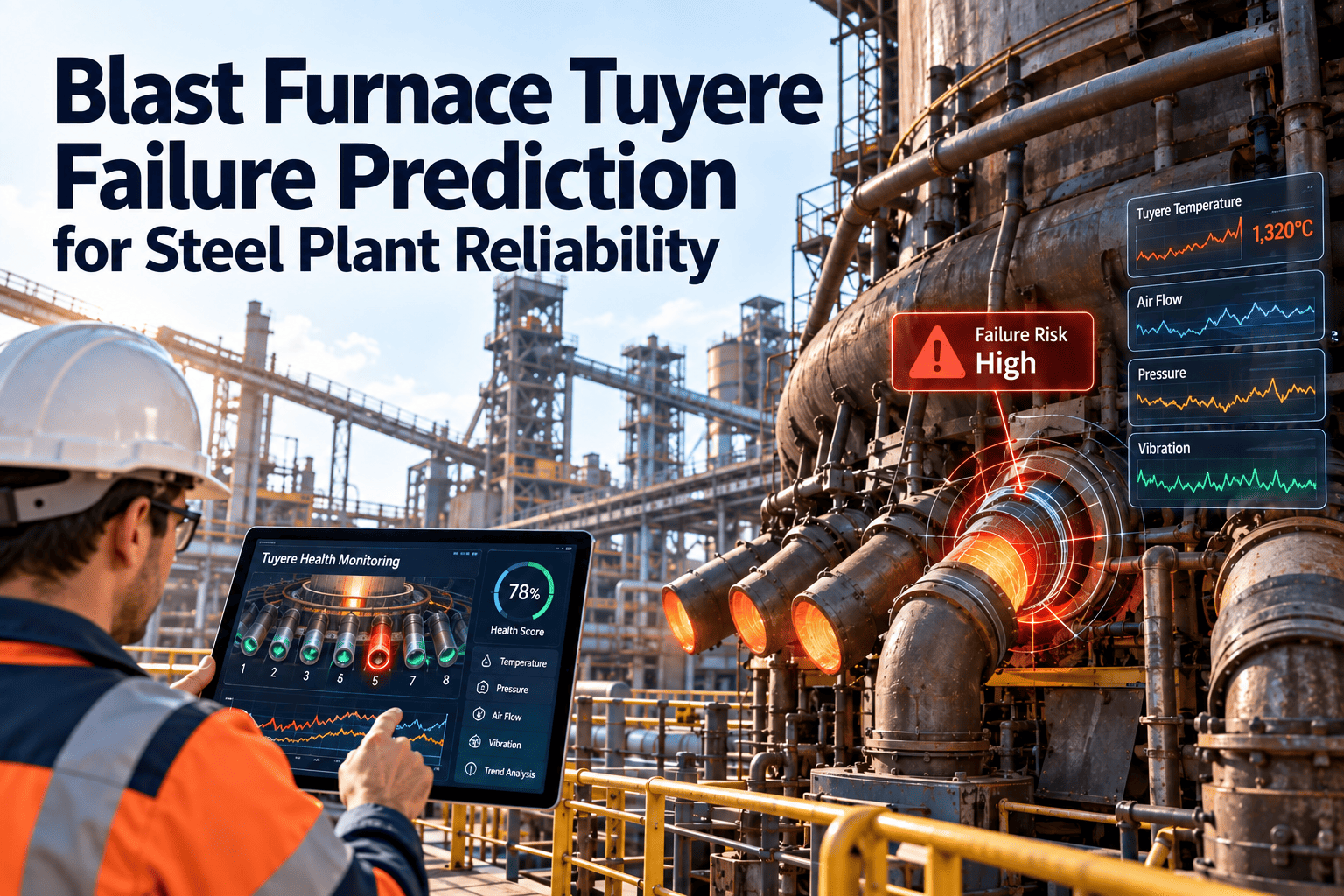
Tuyere Replacement Campaign Programs for Blast Furnaces
By Alex Jordan on May 14, 2026
A tuyere blowout — water from a failed copper casting contacting the molten iron bath — is one of the most serious safety incidents in blast furnace operation. Beyond the immediate hazard, it forces an unplanned furnace wind-down, disrupts the thermal regime, and requires emergency relines that cost days of production. Most blast furnace plants still manage their tuyere replacement programs through calendar-based schedules that ignore the individual condition of each copper casting. A CMMS with individual tuyere serial number tracking, wall thickness history, and water flow trend monitoring shifts your program from time-based guessing to condition-based precision — and keeps your furnace and your people safer.
Tuyere Replacement Campaign Programs: Individual RUL Tracking, Water Flow Monitoring, and CMMS-Managed Schedules for Blast Furnaces
Every tuyere in your furnace has a different wear history, a different water flow characteristic, and a different remaining useful life. OxMaint tracks each one individually — by serial number, installation date, operating hours, wall thickness measurements, and water flow readings — so your replacement decisions are driven by real condition data, not blanket calendar schedules that replace good tuyeres too early and miss deteriorating ones entirely.
Reduction in premature tuyere replacement events with RUL-based scheduling
Zero
Undetected water flow anomalies with automated threshold alerts
14mo
Average tuyere service life achieved with condition-based programs vs 9 months calendar-based
The Fleet Management Gap
How Calendar-Based Tuyere Programs Create Risk — and Waste
A blast furnace with 28 tuyeres is running 28 parallel wear processes simultaneously, each at a different rate. A single replacement schedule applied to all of them creates two simultaneous problems: over-replacement of tuyeres still in serviceable condition, and under-detection of tuyeres approaching failure ahead of schedule. Here is what that looks like in practice.
No Individual Tuyere Records
When replacement decisions are based on fleet-wide age rather than individual tuyere condition, there is no record of each casting's actual wall thickness progression, water flow history, or cumulative heat load. A tuyere installed in a high-burden-movement zone degrades 40–70% faster than one in a stable zone of the same furnace — but without individual records, this variation is invisible.
Result: Simultaneous replacement of tuyeres across a wide range of actual remaining life
Water Flow Anomalies Missed Between Rounds
Water flow monitoring in many plants is performed only during formal inspections at 4–6 week intervals. A tuyere developing internal wall erosion or a micro-crack will show a progressively declining water flow rate — but this decline can move through the early warning band and into the critical zone between scheduled checks if the data is not being continuously trended. The first sign of a problem becomes the failure itself.
Safety risk: Undetected micro-crack progresses to blowout during production
No Supplier and Batch Quality Correlation
Tuyere copper castings from different foundry batches or different suppliers can show significantly different wear resistance characteristics under identical operating conditions. Without tracking which tuyere came from which batch and correlating that to actual service life achieved, procurement decisions default to price rather than performance. Plants routinely over-specify or under-specify copper grade without supporting evidence from their own operating experience.
Cost: Sub-optimal procurement decisions worth hundreds of thousands annually
28 – 42 Tuyeres
per blast furnace — each with an independent wear profile, water flow characteristic, and remaining life. Without individual CMMS records, you are managing all of them blind.
OxMaint Capabilities
What OxMaint Delivers for Blast Furnace Tuyere Programs
OxMaint treats each tuyere as an individual tracked asset with its own serial number, installation record, measurement history, water flow log, and calculated remaining useful life. Book a walkthrough to see a live tuyere fleet configuration from an integrated steel plant.
Individual Tracking
Per-Tuyere Serial Number and Installation Records
Every tuyere in the furnace has its own asset record in OxMaint, identified by serial number, foundry batch code, copper grade, furnace position (tuyere number 1 through 28 or more), installation date, and operating hours at installation. The complete service history — every measurement, water flow reading, and visual inspection — is attached to that serial number and is preserved even after the tuyere is removed from service, building a plant-specific performance database for procurement decisions.
Wall Thickness
Ultrasonic Wall Thickness Measurement History
Periodic ultrasonic wall thickness measurements are entered against each tuyere's asset record in OxMaint — at each measurement point defined in your inspection protocol (typically front face centre, front face edge, side wall, and nose) along with the measurement date and operating hours accumulated to that date. OxMaint calculates the wear rate (mm per 1,000 operating hours) between consecutive measurements and projects the remaining operating hours to minimum wall thickness — your tuyere's individual RUL. When projected RUL falls below your configured alert threshold, OxMaint automatically schedules the replacement work order.
Water Flow
Cooling Water Flow Rate Trending and Alerting
Water flow readings — measured manually during rounds or imported from plant instrumentation via CSV or API — are logged against each individual tuyere position. OxMaint plots flow rate history per tuyere, calculates the rate of change between readings, and generates alerts when flow drops more than 10% from baseline (configurable) or when the absolute value falls below your minimum safe flow threshold. Early flow decline is the most reliable early warning indicator available for internal tuyere wall deterioration — OxMaint makes it impossible to miss. Try it free.
Leak Detection
Inlet-Outlet Flow Differential Monitoring
A developing leak in a tuyere copper casting manifests as a discrepancy between the inlet water flow rate and the outlet water flow rate — water is being lost into the furnace. OxMaint supports inlet/outlet differential logging per tuyere position with configurable alarm thresholds. Any differential reading above your defined tolerance generates an immediate work order assigned to the inspection team, with priority automatically set to urgent. The digital alert trail creates an auditable safety record of every anomaly detected and the response taken.
Campaign Planning
Condition-Based vs Fixed-Schedule Campaign Modes
OxMaint supports both fixed-schedule (replace all tuyeres at every planned outage) and condition-based (replace only those tuyeres whose RUL projection places them below the next planned outage window) campaign modes. Hybrid programs — condition-based individual scheduling with a maximum service age override — are also fully supported. The campaign planner dashboard shows each tuyere's projected RUL against the next five outage windows, so your maintenance planner can optimise parts procurement and outage scope months in advance. Request a campaign demo.
Supplier Performance
Batch and Supplier Wear Rate Benchmarking
Because every tuyere service record in OxMaint is tagged with supplier and foundry batch, your maintenance engineers can run cross-batch comparisons — average service life achieved, average wall wear rate, water flow decline rate, leak incidence — against any date range and any furnace position zone. This creates an evidence base for procurement decisions that most plants have never had before: actual plant-specific performance data proving which copper grade from which supplier lasts longest in your specific furnace operating conditions.
Safety-Critical Asset Management
Every Tuyere in Your Furnace Has Its Own Story — OxMaint Tracks All of Them
Water flow trending, wall thickness history, RUL projection, and leak detection alerts — all tied to individual tuyere serial numbers, accessible from mobile at the furnace or from desktop in the control room. OxMaint runs fully offline in areas with no network coverage and syncs automatically when connectivity is restored. No missed readings. No missed alerts.
Tuyere Fleet Condition at a Glance — The OxMaint Campaign Dashboard
The OxMaint tuyere fleet dashboard gives maintenance planners a real-time status snapshot of every tuyere in the furnace. Here is what a typical 28-tuyere blast furnace fleet dashboard looks like — with three key condition metrics shown as live progress indicators.
Fleet Health Score
Tuyeres rated Good or Acceptable condition
Good condition — 14 tuyeres
Acceptable — 8 tuyeres
Due for replacement — 4 tuyeres
Urgent — 2 tuyeres
Water Flow Compliance
Tuyeres with flow within normal operating range
Normal flow (5–9 m³/hr) — 24
Slightly low (4–5 m³/hr) — 2
Alert — flow declining — 1
Critical — inspect immediately — 1
RUL Coverage
Tuyeres with active RUL projection records
2+ measurements — active RUL — 24
1 measurement — pending 2nd — 3
No measurement — newly installed — 1
Dashboard data is updated in real-time as technicians log readings and close work orders in OxMaint mobile or desktop. All threshold values are configurable by your maintenance engineering team. Request a live dashboard walkthrough.
Field Operations
Tuyere Monitoring Round with OxMaint: From Alert to Work Order
This is how an OxMaint-equipped blast furnace maintenance team manages tuyere monitoring rounds — from automated alert generation to corrective action closure — entirely from the field.
06:00
Water Flow Round Assigned Automatically
The morning water flow monitoring round is automatically dispatched to the furnace technician's mobile app at the start of shift. The work order lists all 28 tuyere positions with their last recorded flow value alongside, so the technician immediately knows which positions showed declining trends in the previous round — no verbal briefing required, no paper checklists to prepare.
07:30
Flow Reading — Tuyere 17 Flags Automatically
As the technician enters flow readings tuyere-by-tuyere on their mobile device, Tuyere 17 shows 3.8 m³/hr against a previous reading of 4.9 m³/hr six hours ago. OxMaint immediately flags this as a 22% decline — above the 15% alert threshold configured for this furnace. A high-priority corrective action work order is automatically generated and pushed to the shift supervisor's device while the technician continues the round. The inlet-outlet differential inspection checklist for Tuyere 17 is also auto-triggered.
08:15
Tuyere 17 Differential Inspection
The OxMaint differential inspection checklist for Tuyere 17 guides the technician through the inlet flow reading, outlet flow reading, differential calculation, and visual observation fields. The inlet-outlet differential measured is 0.3 m³/hr — within the alert limit of 0.5 m³/hr. The inspection finding is documented in OxMaint with two photos of the flow gauge readings. The corrective action classification is updated to "Monitor — re-check in 2 hours" and the system auto-schedules the follow-up check.
The 2-hour follow-up check shows Tuyere 17 at 3.6 m³/hr — continuing to decline. OxMaint displays the two-reading trend on the technician's mobile screen. The decline rate now exceeds the threshold for an expedited ultrasonic wall thickness inspection. An urgent inspection work order is raised within OxMaint, assigned to the NDT technician, with Tuyere 17's full service history — installation date, operating hours, previous thickness measurements, and supplier batch — pre-loaded in the work order for context before the inspector reaches the furnace floor.
13:00
NDT Results Logged — RUL Updated
Ultrasonic wall thickness measurements are entered for Tuyere 17 across all four measurement points. Front face centre shows 14.2mm against an installation thickness of 20mm. OxMaint recalculates the wear rate from all three historical measurements and projects remaining life at current rate: 340 operating hours to minimum safe wall thickness of 8mm. The next planned outage window is 280 hours away. Tuyere 17 is automatically placed on the next outage replacement schedule with a critical priority flag.
14:30
Outage Scope Updated — Parts Ordered
The maintenance planner reviews the updated outage scope in OxMaint desktop. Tuyere 17 is added to the confirmed replacement list alongside three others already scheduled. The spare parts request for a 4-tuyere outage set is raised directly in OxMaint's inventory module, checked against stock on hand, and a purchase order request generated for the shortfall quantity. All decisions made, documented, and actioned without a single email, phone call, or paper form.
Measurable Impact
What Blast Furnace Plants Report After OxMaint Tuyere Program Deployment
63%
Fewer Premature Replacements
RUL-based scheduling replaces only tuyeres whose condition data indicates replacement is actually required — eliminating the blanket replacement waste inherent in calendar-based programs.
+5mo
Average Service Life Extension
Condition-based replacement decisions, supported by individual thickness and water flow trend data, consistently extend average tuyere service life from 9 months to 13–15 months across documented plant deployments.
100%
Water Flow Anomaly Detection
Automated threshold-based alerts in OxMaint ensure every water flow decline above the configured trigger is captured and actioned — regardless of which technician is on round, which shift it is, or how busy the plant is running.
4×
More Data Per Tuyere Per Campaign
Structured mobile data capture drives 4x more measurement records per tuyere compared to paper-based rounds — creating the measurement density needed for reliable RUL projection rather than single-point guesses.
Zero
Lost Tuyere Service Records
All historical thickness measurements, water flow readings, and replacement records are permanently stored in OxMaint against each tuyere serial number — building a plant-specific performance database that survives staff changes and software migrations.
28hr
Saved Per Outage Scope Preparation
The outage replacement scope — previously assembled manually from multiple Excel sheets and physical inspection reports — is generated directly from OxMaint's RUL dashboard in under one hour, with parts requirements calculated automatically.
Customer Experience
From the Field
Before OxMaint, our tuyere program was entirely schedule-driven — every planned outage, we replaced the full set regardless of condition because we had no reliable individual condition data to justify keeping any of them in service. At approximately US$1,800 per copper tuyere set, this was extremely costly, and the 6-hour outage window to do a full replacement was a significant production hit. Since we deployed OxMaint's individual RUL tracking, our last outage replaced eight tuyeres out of thirty-two — the ones with water flow data and thickness measurements that actually warranted replacement. We saved twenty-four tuyere sets plus the labour and outage time for those positions. The OxMaint dashboard made it easy to justify the condition-based decision to plant management with real trend data from each tuyere.
Blast Furnace Maintenance Superintendent
Fully integrated steel plant, South Asia — 3.8 Mtpa capacity, two blast furnaces
What causes tuyere copper wear in blast furnace operation?
Tuyere wall wear in blast furnaces is caused by three primary mechanisms operating simultaneously. Abrasive wear occurs when furnace burden materials — coke, sinter, pellets, and ore fragments — make physical contact with the tuyere nose and side walls during burden descent, particularly in areas where burden movement is vigorous. Thermal fatigue develops from the cyclic thermal stress imposed by variations in blast temperature, blast rate, and hot metal tapping cycles — each cycle inducing microscopic crack propagation in the copper crystal structure over time. Chemical attack occurs from the alkaline and sulphurous components of the blast furnace environment, which can cause surface pitting and intergranular corrosion on copper and copper-alloy castings. The relative contribution of each mechanism varies by furnace type, operating practice, burden composition, and tuyere position within the furnace circumference.
How is tuyere remaining useful life (RUL) calculated?
RUL calculation in OxMaint is based on linear wear rate projection from sequential ultrasonic wall thickness measurements. The wear rate is calculated as: (Thickness at Measurement 1 − Thickness at Measurement 2) ÷ (Operating Hours between Measurement 1 and Measurement 2) = mm per operating hour. Remaining useful life is then calculated as: (Current Thickness − Minimum Safe Wall Thickness) ÷ Wear Rate = projected remaining operating hours. OxMaint uses the most recent measurement interval to calculate wear rate, with an option to use a rolling average of the last three intervals for more stable projection in tuyeres with variable wear patterns. The minimum safe wall thickness is set by your metallurgical engineering team and configured in OxMaint as a per-position or per-furnace parameter.
How frequently should tuyere water flow be measured?
For a blast furnace operating at standard production rates, a minimum of two water flow monitoring rounds per 24-hour period is generally considered best practice — one per shift where two shifts cover the monitoring period, or three per day in a 3-shift operation. During periods of elevated concern — elevated burden moisture, known tuyere wear, or following any unusual operating event — increased monitoring frequency of up to hourly readings for suspect tuyeres is warranted. OxMaint supports any monitoring frequency and can be configured to escalate round frequency automatically when a tuyere's flow reading falls into an alert band — shifting that position from standard monitoring to enhanced monitoring without manual schedule changes.
Can OxMaint integrate with our existing DCS or process historian for tuyere water flow data?
Yes. OxMaint supports CSV import of time-series data from DCS, SCADA, and process historians for automatic logging of water flow readings against individual tuyere asset records. This eliminates manual data entry for plants that already have flow instrumentation per tuyere position. For plants without per-tuyere instrumentation, manual round-based data entry via the OxMaint mobile app is the standard approach. Our implementation team works with your process engineering group to configure the data import format and frequency during the onboarding process. Schedule a technical integration discussion.
What is the safety protocol when a tuyere water flow alert is triggered in OxMaint?
OxMaint generates an immediately-actionable work order when a tuyere flow reading breaches a configured alert threshold. The work order is pushed to the designated response team members' mobile devices as a push notification and includes: the tuyere position number, the recorded flow value, the threshold that was breached, the previous two flow readings for immediate context, and the tuyere's current RUL status. The response protocol embedded in the work order checklist — your plant's own procedure for tuyere water flow alerts — guides the responding technician through the mandatory steps. Each step completion is timestamped, creating a complete safety response audit record. Your actual safety procedures for blast furnace tuyere emergencies are defined by your plant's operational team and should be reviewed by your safety management system independently of the CMMS configuration.
How does OxMaint handle tuyere positions with different operating conditions across the furnace circumference?
Different tuyere positions around the blast furnace circumference can experience significantly different wear rates due to variations in local burden movement, proximity to taphole positions, and blast distribution characteristics. OxMaint supports position-specific alert thresholds — meaning Tuyere Position 14 (near a taphole) can have a shorter maximum service age and a lower flow alert threshold than Tuyere Position 6 in a stable zone. These position-specific parameters are configured during setup and can be updated by your maintenance engineering team at any time as operating experience accumulates. OxMaint also surfaces wear rate comparison data by position group, making it straightforward to identify systematically high-wear zones and feed this back into operational practice or furnace design decisions.
Does OxMaint support spare tuyere stock management?
Yes. OxMaint's inventory module tracks tuyere stock by copper grade, supplier, batch code, and quantity on hand. When a replacement work order is raised — whether triggered by RUL projection or an emergency inspection finding — the inventory module checks current stock against the replacement requirement and generates a purchase order request for any shortfall. The parts consumption record is automatically linked to the replacement work order, so your tuyere spend is tracked against individual furnace positions and campaign periods. Over time, this creates a clear picture of parts consumption by furnace position, copper grade, and supplier — directly supporting procurement optimisation.
How long does it take to set up OxMaint for a blast furnace tuyere tracking program?
A standard tuyere tracking deployment for a single blast furnace with 28–36 tuyere positions can be configured and live within 2–3 working days. This includes: creating the furnace and tuyere asset hierarchy, configuring position-specific alert thresholds, setting up the water flow monitoring PM schedule, importing historical thickness data from existing records (if available), and training the field team on mobile app data capture. OxMaint's onboarding team provides dedicated configuration support included in the subscription. If historical data is minimal, the program starts collecting real data from day one and generates the first RUL projections after the second set of thickness measurements is entered — typically within 4–8 weeks of initial deployment.
Condition-Based Tuyere Management
Replace Tuyeres When the Data Says Replace Them — Not When the Calendar Does
OxMaint gives your blast furnace maintenance team individual tuyere RUL tracking, automated water flow alerting, inlet-outlet differential monitoring, and supplier performance benchmarking — all accessible from mobile at the furnace and from desktop in the planning office. Full offline capability for areas with poor network coverage. Start your free trial today or book a 30-minute demo with our blast furnace maintenance specialist.