Best Mobile CMMS for Steel Plant Floor Crews in 2026
By Alex Jordan on May 19, 2026
Steel plant floor crews work in environments that destroy standard mobile software in under two weeks. Casthouse ambient temperatures reaching 65°C. EAF bays where WiFi signal never reaches. Blast furnace platforms where a technician in cut-resistant gloves cannot operate a standard touchscreen interface. Rolling mill pits where the combination of vibration, particulate, and humidity kills consumer-grade electronics within a season. When U.S. steel operators evaluate the best mobile CMMS for steel plant floor crews in 2026, the list of qualifying platforms shrinks fast — because most CMMS vendors built their mobile apps for office environments and retrofitted them for industrial settings, and that retrofit fails the moment your crew walks onto the plant floor. Oxmaint is purpose-built for steel: offline-first architecture, IP67/IP68 rugged device certification, glove-mode minimum-tap interaction design, and QR-tagged asset lookup that works in every signal-dead zone from the blast furnace hearth to the underground rolling mill pit. This guide ranks the best mobile CMMS platforms for steel plant floor crews in 2026, evaluates what actually separates them in extreme industrial conditions, and tells U.S. steel operations managers exactly what to demand during platform evaluation. Pair your mobile CMMS selection with a structured steel plant maintenance schedule to maximize wrench time from day one.
Oxmaint · Best Mobile CMMS · Steel Plant Floor Crews · 2026 Rankings
Best Mobile CMMS for Steel Plant Floor Crews in 2026 — Rugged, Offline, QR-Ready.
Offline-first architecture, IP67 rugged device support, glove-mode minimum-tap design, QR asset scanning, OSHA crane inspection exports — tested in blast furnace casthouses, EAF bays, and rolling mill pits across U.S. steel operations.
Casthouse ambient — Oxmaint certified on IP67 rugged devices rated for this environment
100%
Work order functions available offline in signal-dead zones on Oxmaint
<3 taps
To accept and begin executing a work order — glove-mode minimum-tap design
85%
Day-30 active usage rate at Oxmaint steel deployments vs 30% for consumer-grade apps
Why Standard Mobile CMMS Apps Fail on the Steel Plant Floor
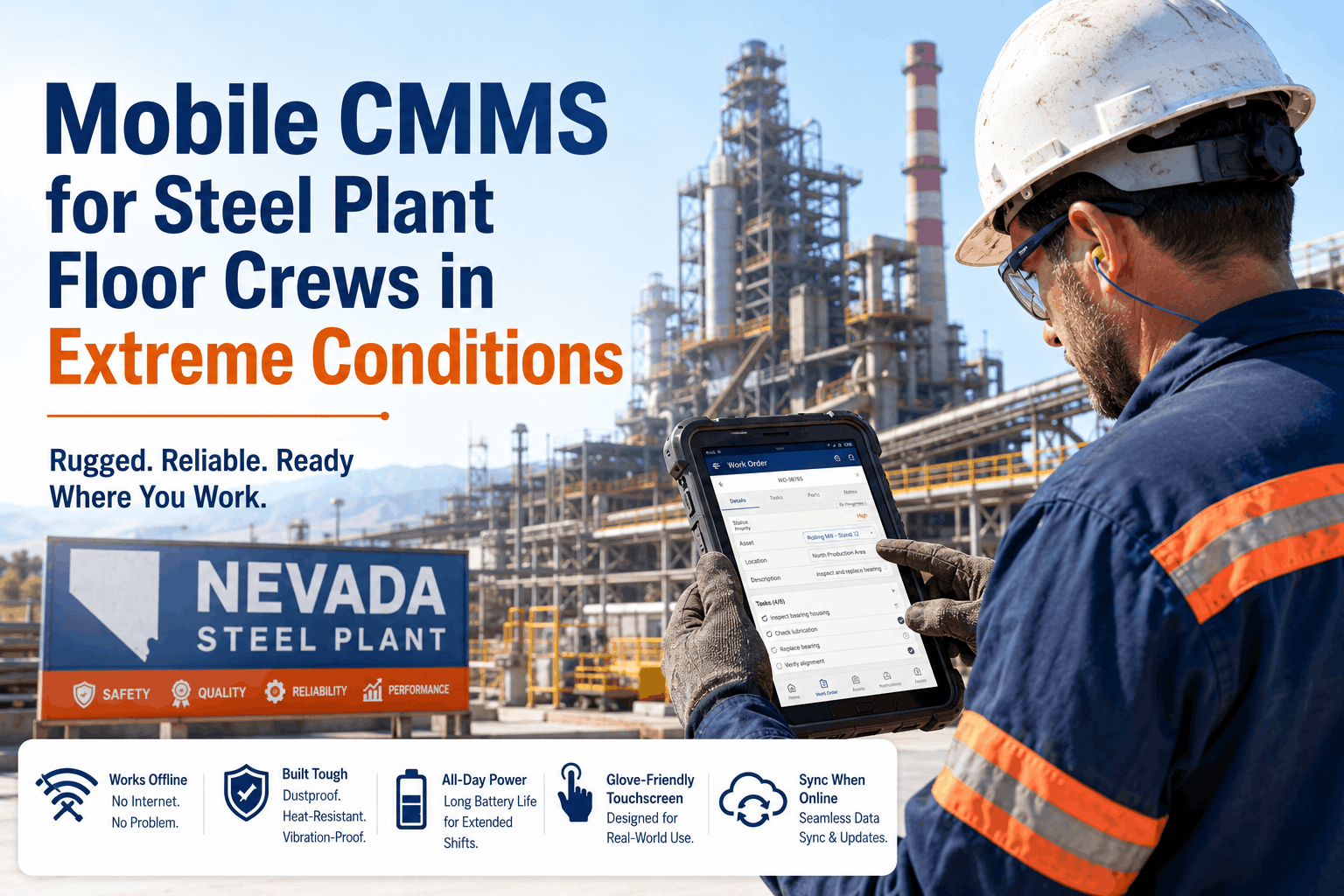
The steel plant floor presents three physical constraints that eliminate most mobile CMMS options before the evaluation even begins. First: connectivity. Signal-dead zones are not edge cases in steel plants — they are the dominant operating environment. Shielded structural steel eliminates WiFi in underground pits, below-grade electrical rooms, and blast furnace platforms. Second: interface usability. A technician in heat-resistant gloves cannot operate a standard capacitive touchscreen, cannot pinch-and-zoom through asset histories, and cannot type work order notes into a keyboard. Third: device survivability. Consumer smartphones die within weeks in casthouse environments. IP67/IP68 rating, MIL-STD-810H drop certification, and high-brightness displays (1,000+ nit for outdoor readability in direct sunlight near furnaces) are baseline requirements, not premium features.
According to 2026 steel plant maintenance research, the average U.S. steel plant technician loses 50+ minutes per shift to information retrieval trips — walking to the maintenance office to print work orders, look up asset history, or confirm parts availability — because their mobile CMMS app doesn't work reliably on the floor. At 8–12 technicians per shift across three shifts, that's 1,200–1,800 lost wrench-hours annually per plant. Multiply by 22 planned and unplanned shutdown hours per year for a major integrated mill and you begin to understand the true cost of choosing the wrong mobile CMMS platform.
STEEL PLANT ZONE REQUIREMENTS — MOBILE CMMS SURVIVABILITY MAP
Plant Zone
Temp Range
Connectivity
Interface Constraint
Oxmaint Status
BF Casthouse
45–65°C ambient
Zero WiFi / No Signal
Full heat-resistant gloves
Certified — Zebra TC57/TC77
EAF Bay
30–55°C ambient
Intermittent / Dead zones
Gloves + protective eyewear
Certified — Full offline mode
Rolling Mill Pit
25–45°C, high vibration
Below-grade, no signal
Gloves, limited visibility
Certified — 1000nit display
Ladle Turret Area
35–60°C radiant
Intermittent coverage
Full PPE — limited dexterity
Certified — Glove-mode UX
Raw Materials Yard
-20°C to +40°C seasonal
Outdoor — partial LTE
Winter gloves, outdoor lighting
Certified — IP67 + cold op.
Electrical Substation
Controlled 20–35°C
Partial WiFi available
Standard — LOTO procedures
Full function — Permit-to-work
2026 Mobile CMMS Rankings for Steel Plant Floor Crews
The ranking below evaluates platforms specifically against steel plant floor crew requirements — not office-based property management or light manufacturing features. Every platform was assessed on offline architecture depth, rugged device support, glove-mode usability, QR asset scanning performance, crane inspection export capability, OSHA compliance documentation, and U.S. steel deployment track record. This is not a general CMMS comparison. It is a steel-specific evaluation built for reliability engineers and plant maintenance directors choosing a platform that must work on a 60°C casthouse floor.
#1
Oxmaint
Best Overall for U.S. Steel Plant Floor Crews
Oxmaint is the strongest purpose-built mobile CMMS for U.S. steel plant floor crews in 2026 — deploying in 3–5 days with no implementation fee, native offline-first architecture, certified support for Zebra TC-series, Honeywell EDA-series, and Samsung XCover rugged devices, and a minimum-tap glove-mode interaction design built specifically for steel environments. Every work order function — receive, start, log parts, photograph, sign off, close — operates with full offline capability. QR scanning pulls complete asset history, open work orders, and maintenance procedures in under 2 seconds. OSHA crane inspection records and permit-to-work digital workflows export audit-ready documentation instantly. Pre-built templates for blast furnace, continuous caster, rolling mill, and crane fleet compress deployment from months to days. Starts free with no per-user gating at scale.
Offline Architecture
10/10
Rugged Device Support
10/10
Glove-Mode Usability
10/10
QR Asset Scanning
10/10
OSHA Crane Exports
10/10
Deployment Speed
9.6/10
Best for: All U.S. steel plant types — integrated BF-BOF, EAF mini-mills, and rolling operations. Free to start. Live in days.
IBM Maximo Application Suite has deep industrial asset management capability and is deployed at several major U.S. integrated steel producers. Its asset hierarchy modelling and compliance record management are enterprise-grade. The limiting factors for most U.S. steel plants are implementation cost ($500K–$2M+), deployment timeline (12–24 months), dedicated Maximo administrator requirements, and a mobile UX that was designed for desktop-first workflows and retrofitted for mobile — meaning technicians in gloves on the EAF floor encounter usability friction that drives low adoption rates. Maximo mobile exists but lacks the steel-native offline depth and minimum-tap design that Oxmaint delivers out of the box.
Offline Architecture
6.0/10
Rugged Device Support
6.5/10
Glove-Mode Usability
5.0/10
Deployment Speed
2.0/10
Best for: Largest U.S. integrated mills with dedicated IT/Maximo teams and multi-year implementation budgets.
#3
UpKeep
Accessible pricing — light industrial grade
UpKeep delivers strong mobile usability for light manufacturing and facilities management environments. For steel plant floor crews, its limitations become critical: offline mode is a limited cache (not full database sync), the interaction model was designed for standard touchscreens rather than gloved operation, and it lacks pre-built steel-specific templates for blast furnace, caster, or crane fleet inspection workflows. U.S. steel plants running UpKeep frequently report technician abandonment in dead-zone environments because work order completion requires connectivity to fully save and submit. Adequate for maintenance offices and lower-temperature utility areas; insufficient for primary production zone crews.
Offline Architecture
4.0/10
Rugged Device Support
4.5/10
Steel-Specific Templates
2.0/10
Deployment Speed
8.0/10
Best for: Auxiliary and utility areas of steel plants — not primary production zone floor crews.
The 6 Non-Negotiable Mobile CMMS Features for Steel Plant Crews
Steel plant floor crew mobile CMMS evaluation must go beyond feature checklists. Every feature below is a deal-breaker — not a nice-to-have — if inadequate for primary production zone operations. U.S. steel reliability engineers and plant maintenance directors should use this framework as their RFP baseline when evaluating any mobile CMMS platform for floor crew deployment.
6 DEAL-BREAKER FEATURES — STEEL PLANT MOBILE CMMS EVALUATION
Offline-First Architecture
Full work order lifecycle — receive, log, photo, close — operates with zero network connectivity. Conflict-free auto-sync when signal returns. Not "view only" offline. Full database sync to device before entering dead zones.
Oxmaint: 100% offline capability — all zones certified
Rugged Device Certification
IP67/IP68 rated, MIL-STD-810H drop certified, 1,000+ nit display, -20°C to 55°C operating range. Tested on Zebra TC-series, Honeywell EDA-series, and Samsung XCover for primary production zone deployment.
Oxmaint: Certified on all three major rugged device families
Minimum-Tap Glove-Mode UX
Accept a work order: 2 taps. Log parts used: 3 taps. Close with photo: 4 taps. No pinch-zoom, no keyboard required for core workflow. Designed for heat-resistant, cut-resistant, and cryogenic gloves — not bare fingers.
Oxmaint: Under 3 taps for all primary work order functions
QR Asset Scanning
Scan QR-tagged equipment and see full maintenance history, open work orders, and attached procedures in under 2 seconds — even offline. Metallic/high-temperature QR tags survive casthouse and EAF environments. Eliminates manual lookup trips to the maintenance office.
Oxmaint: Sub-2-second QR scan to full asset history — offline capable
OSHA Crane Inspection Exports
Digital crane inspection checklists — overhead cranes, ladle cranes, gantry cranes — with OSHA-compliant format exports per 29 CFR 1910.179. Timestamped, technician-signed, and immediately exportable as audit-ready PDF for MSHA or OSHA inspection.
Lockout/Tagout (LOTO) workflows, confined space permits, hot-work permits, and height access authorizations — digitally issued, acknowledged, and closed on mobile with full photo evidence. Mandatory field enforcement prevents work order access until safety steps are signed off.
Oxmaint: Full permit-to-work digital workflows — LOTO + confined space + hot work
"Our technicians work in a steel processing plant in Pittsburgh with no WiFi in 70% of the building. We tried two other mobile CMMS apps that required a connection — nobody used them after the first week. Oxmaint's offline mode changed everything. Every work order now gets closed in the field. Our PM compliance went from 61% to 94% in four months, and we cut emergency repair costs by $340,000 in the first year."
Maintenance Supervisor
Steel Processing Facility, Pittsburgh, PA — 22 Technicians, 4-Month Result
Frequently Asked Questions
Q1 What is the best mobile CMMS for steel plant floor crews in 2026?
Oxmaint is the top-ranked mobile CMMS for U.S. steel plant floor crews in 2026 — the only platform with certified offline-first architecture, IP67 rugged device support for Zebra TC-series, minimum-tap glove-mode UX, and pre-built steel-specific inspection templates that deploy in 3–5 days without an implementation fee.
Q2 Does Oxmaint mobile work in WiFi dead zones on the blast furnace and EAF bay floors?
Yes — Oxmaint uses a local-first data architecture where all assigned work orders, asset records, and checklists cache to the device before entry into dead zones. Completions, photos, and signatures sync automatically when signal is restored with zero data loss and full timestamp integrity.
Q3 Which rugged devices does Oxmaint support for steel plant environments?
Oxmaint is tested and certified on Zebra TC52, TC57, TC72, TC77 (recommended for casthouse and EAF bay hot zones), Honeywell EDA51/EDA52, and Samsung Galaxy XCover Pro/XCover 6 Pro — all IP67/IP68 rated with MIL-STD-810H drop certification and glove-mode touch.
Q4 How does Oxmaint handle OSHA crane inspection documentation for steel plants?
Oxmaint includes pre-built OSHA-compliant crane inspection checklists per 29 CFR 1910.179 for overhead cranes, ladle cranes, and gantry cranes — completed on mobile with photo evidence and instantly exportable as audit-ready PDFs for MSHA or OSHA regulatory review.
Q5 What is the typical PM compliance improvement after deploying Oxmaint at a U.S. steel plant?
U.S. steel plant deployments consistently report PM compliance improvements from the 55–65% range (paper/spreadsheet baseline) to 90–94% within 90–120 days of Oxmaint mobile deployment, driven by offline-capable work order execution and QR-triggered asset access on the floor.
Q6 How does Oxmaint's glove-mode interface work for steel plant technicians?
Oxmaint's interaction model was designed around a maximum of 3 taps to complete any primary work order function — accept, log parts, photo-close — with no pinch-zoom, no keyboard required, and large-target touch elements that operate reliably through heat-resistant and cut-resistant industrial gloves.
Q7 Can Oxmaint manage permit-to-work and LOTO workflows on the steel plant floor?
Yes — Oxmaint's digital permit-to-work module covers Lockout/Tagout, confined space permits, hot-work authorizations, and height access — with mandatory sign-off before work order access, photo evidence capture, and complete permit audit trails exportable for OSHA compliance review.
Q8 How long does Oxmaint take to deploy across a U.S. steel plant floor crew?
A standard steel plant deployment with pre-built blast furnace, caster, rolling mill, and crane fleet templates goes live in 3–5 days — with technicians completing their first work orders on mobile within the first shift and full crew adoption (80%+ active usage) typically reached within 30 days.
Start Oxmaint Free — Built for Your Steel Plant Floor Crew
Offline-first. Rugged-device certified. Glove-mode UX. OSHA crane exports. Live in 3–5 days with no implementation fee across your U.S. steel operation.


.png)
