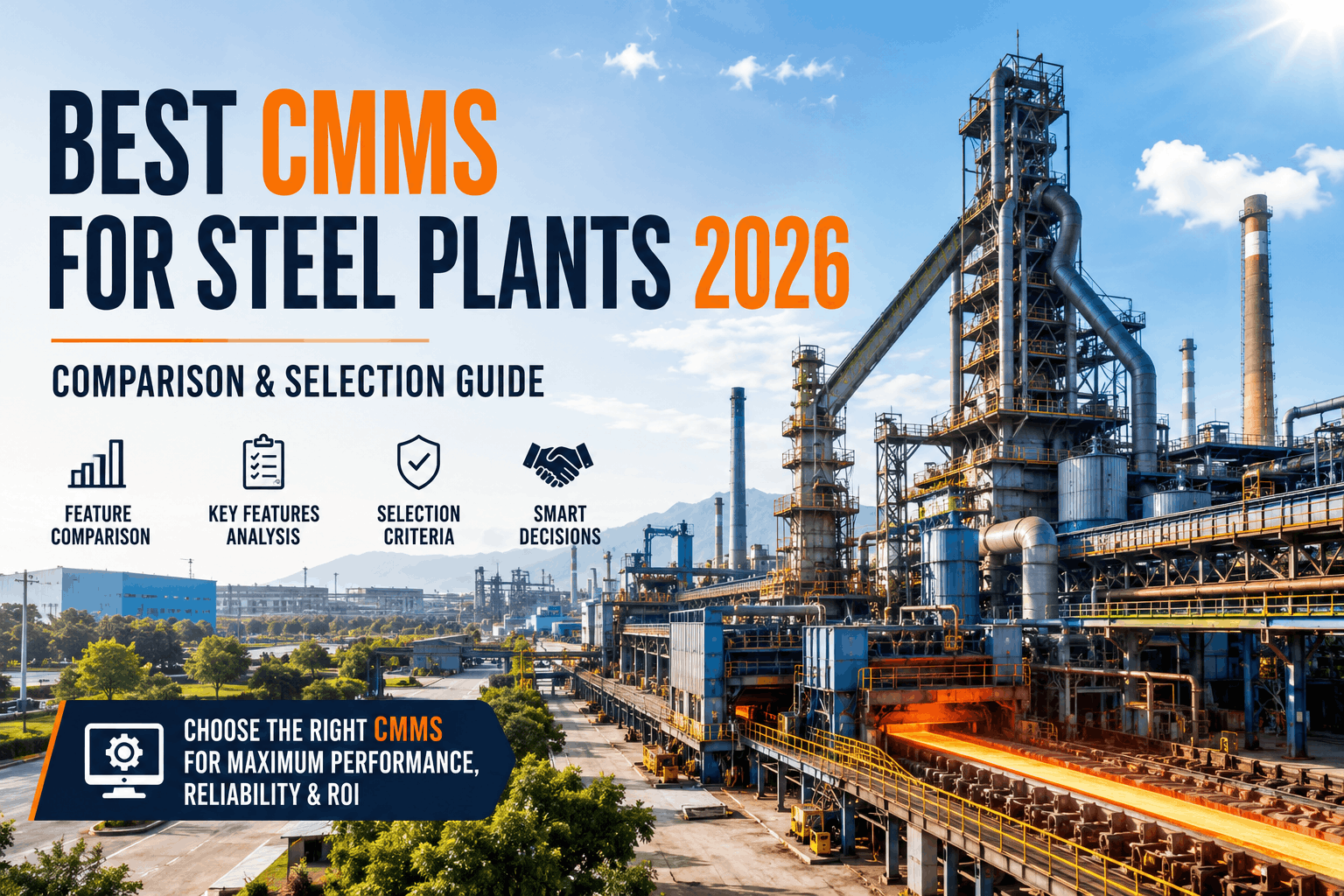
Choosing a CMMS (Computerized Maintenance Management System) for steel plant operations is one of the most critical technology decisions maintenance leaders face in 2026. With hundreds of critical assets operating under extreme thermal stress, complex maintenance workflows spanning blast furnaces to rolling mills, and compliance requirements from OSHA and EPA, the wrong platform choice costs millions in unplanned downtime. Start a free trial to compare Oxmaint's steel-specific CMMS capabilities against the competition, or book a demo to see real-time work order management and AI-powered predictive maintenance designed specifically for integrated mills, mini-mills, and EAF operations.
Best CMMS for Steel Plants 2026: Comparison & Selection Guide
Compare steel-specific CMMS platforms for campaign tracking, heat-count triggers, tuyere sub-assets, caster segment PM, and roll management. Mobile-first design with offline capability for extreme environments.
Why Steel Plant CMMS Is Different from General Manufacturing Software
A CMMS built for food processing plants, hospitals, or discrete electronics manufacturing does not understand the refractory asset classes, heat-count triggers, campaign life cycles, or extreme-environment mobile requirements unique to steel production. A 4 million tonne-per-year integrated blast furnace and BOF mill has fundamentally different software requirements than a 500,000 tonne EAF mini-mill or a standalone rolling operation. The asset classes are different—refractory, rolls, tundishes, ladle linings—and most general CMMS platforms have no native concept of any of them. The integration requirements are different, requiring real-time connection to Level 2 historians, MES production schedules, and ERP cost centers. When a continuous caster breakout costs $150,000 minimum, a blast furnace unplanned stop costs $1.2M–$2.8M per day, the CMMS must be designed with those cost stakes in mind. Oxmaint's platform is purpose-built for these exact requirements—every component from asset class definition to mobile field execution reflects steel industry operational reality.
Steel Plant Facility Types: Choosing the Right CMMS Architecture
A 4 million tonne-per-year integrated steelworks operating a blast furnace, BOF, continuous caster, hot rolling mill, and finishing lines requires a CMMS capable of managing refractory lifecycle, multi-stage production dependencies, and the highest-consequence asset failures in manufacturing. An EAF mini-mill has fundamentally different requirements—electrode and refractory consumable management is the primary asset class, faster heat cycles mean higher maintenance frequency, and electrical energy intensity requires meter-based PM triggers that most general CMMS platforms cannot support. A standalone rolling operation requires roll wear curve management and campaign-length optimization. When you book a demo with Oxmaint, our steel team walks through your specific facility type and maps the critical requirements that differentiate your operation from the competition. Every facility class has unique asset hierarchies, trigger logic, and workflow patterns—and Oxmaint's pre-built models for integrated mills, mini-mills, and rolling operations cut configuration time by 60% versus generic platforms.
Campaign-Based & Heat-Count PM: Replacing Calendar Intervals in Steel
The single most impactful change a steel plant can make in 2026 is abandoning calendar-based PM intervals and replacing them with campaign-count and heat-count triggers. A blast furnace campaign lasting 1,500–2,000 heats does not align to a calendar date—it aligns to refractory condition, accumulated thermal stress, and production intensity. A ladle operating at 1,600°C for 8 hours experiences wear patterns that a generic CMMS cannot capture because wear rate varies significantly with steel grade, holding time, and flux practice. The result of calendar-based replacement: tundishes replaced too early (wasting $50,000–$100,000 per replacement cycle) or too late (risking $1.5M–$3M breakout). Oxmaint's condition-based refractory tracking measures thickness after each campaign—so your tundishes get replaced when wear actually requires it, not when a calendar suggests. For casters, the logic is similar: segment life should be measured in mold sequences and casts, not months. For rolling mills, roll wear should be tracked by pass count and tonnage, not fixed intervals. Every meter-based trigger you implement reduces unnecessary component replacement and extends asset life by 25–40%.
Mobile-First CMMS for Extreme Environments: Offline, Glove-Compatible, Ruggedized
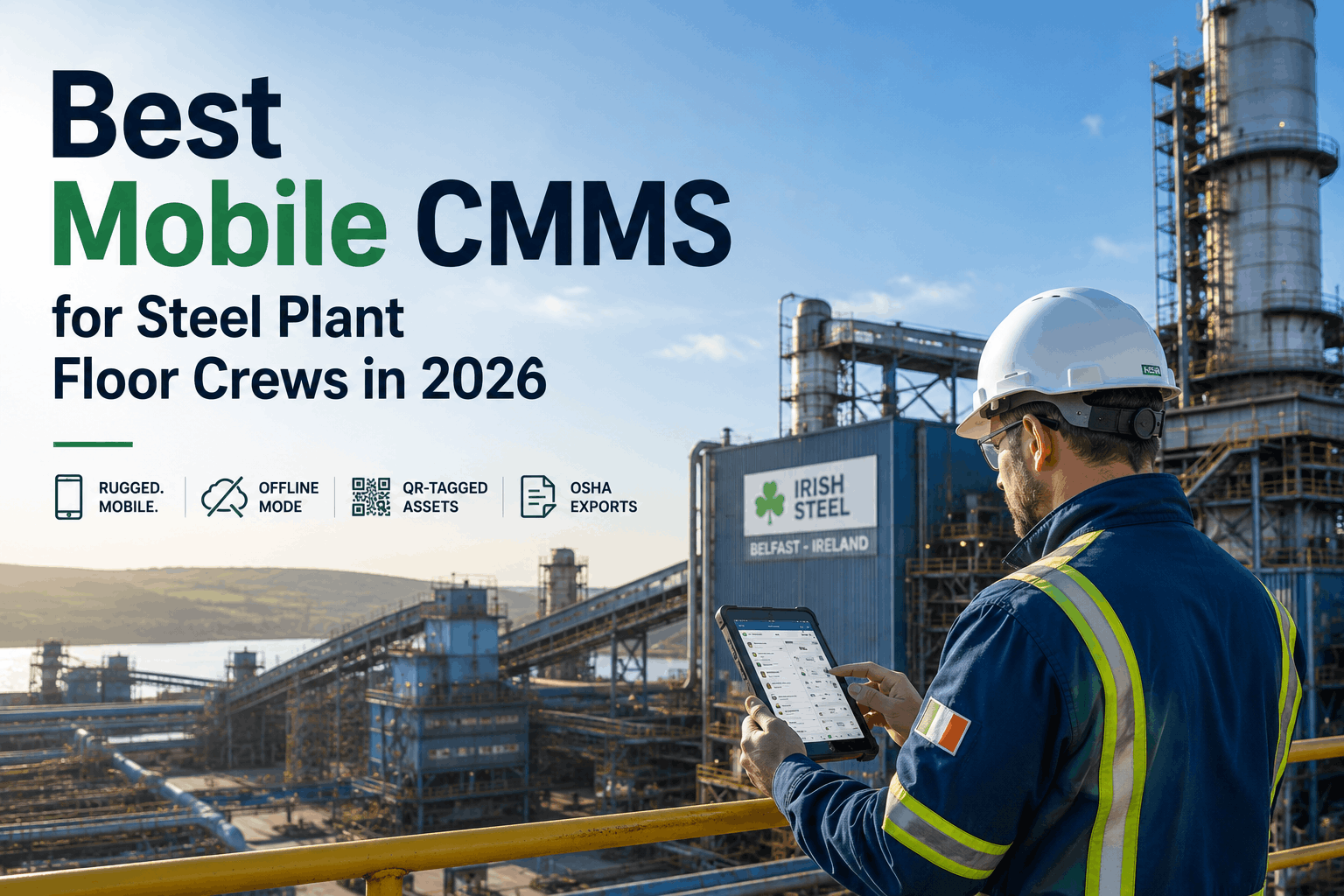
Steel plant maintenance happens in environments where a standard consumer mobile app was not designed to survive. Blast furnace casthouse floors reach ambient temperatures of 50–65°C. Rolling mill pits accumulate scale dust that blocks phone cameras within one shift. A maintenance technician in these environments faces three constraints that no desktop CMMS addresses: they are wearing heat-resistant gloves that make touchscreen operation unreliable; they are in areas where cellular and WiFi coverage is intermittent or absent; and they are performing physical work where both hands are frequently occupied. A CMMS that requires WiFi connection, multi-step form fields, or ungloved operation will be abandoned within two weeks. The difference between a mobile CMMS that steel plant technicians actually use and one they reject comes down to three engineering decisions: ruggedised device support (IP67 rating, thermal tolerance to 55°C), offline-first architecture (full work order lifecycle available without connectivity), and minimum-tap interaction model (QR scan, two-tap acceptance, one-tap photo capture, three-tap closure). Oxmaint's mobile platform is engineered specifically for these constraints—every interaction was tested with Level D cut-resistant gloves in 50°C environments using industrial maintenance technicians, not office-based UX designers.
Multi-Plant Standardization: Unified Visibility Across 14+ Facilities
A diversified global steel group operating 14 production facilities across North America, Europe, and Asia—ranging from small rebar mills to large integrated steelworks producing specialty products—deployed Oxmaint across all 14 facilities within 26 weeks. The fragmentation before implementation: each facility used different CMMS software (three different vendors), paper-based processes at two older mills, and spreadsheet-based planning at smaller operations. This fragmentation created blind spots for corporate management, prevented best-practice sharing, and blocked standardization of spare parts and maintenance procedures across the group. By implementing Oxmaint's unified platform across all 14 facilities, the group achieved: unified maintenance visibility, enabled cross-plant benchmarking, implemented standardized PM procedures for like equipment types, and created a centralized KPI dashboard visible to plant directors and corporate executives. First-year operational cost recovery: $1.8 million. Maintenance cost per tonne declined from $4.20/tonne to $2.80/tonne. Most importantly, critical failure patterns discovered at one mill were immediately standardized across all locations—preventing future incidents before they occurred.
We evaluated Oxmaint against three enterprise CMMS platforms. The timeline sealed the decision—we went live across our integrated mill and mini-mill in 6 weeks. Within that first month, our planned maintenance ratio jumped from 42% to 68%, and our technicians actually use the mobile app because it works with their gloves in the mill pit. We identified 23 recurring fault patterns that we standardized across both facilities. The system is paying for itself in reduced emergency repairs—we're running leaner, more predictively. For a USA integrated mill with tight margins, this is the difference between reactive firefighting and strategic maintenance planning.
AI-Powered Predictive Maintenance: From Reactive to Condition-Based
The average steel plant experiences 25–40 major unplanned failures per month across blast furnaces, steelmaking shops, casters, and rolling mills—each one costing $50,000 to $1.6 million depending on the asset class and duration. Most of these failures are not random; they are preceded by detectable patterns: vibration anomalies, thermal drift, pressure deviations, or acoustic changes that indicate degradation weeks or months before catastrophic failure. A CMMS without AI pattern detection leaves these signals invisible until failure occurs. Oxmaint's AI engine ingests every work order, parts consumption record, asset runtime, and maintenance observation—detecting recurring fault patterns automatically. When a bearing exhibits thermal drift for three consecutive weeks without intervention, the system flags it and queues a predictive work order before the failure cascades. When a specific caster nozzle clogging pattern emerges, it correlates the pattern with steel grade, flux practice, and argon flow—identifying the root cause, not just the symptom. Over a 12-month period, USA integrated mills deploying Oxmaint's predictive analytics report 22–28% reduction in unplanned downtime and 18–24% reduction in emergency repair spending.
CMMS Implementation Timeline: Why Oxmaint Deploys in 6–8 Weeks vs 6–12 Months
Enterprise CMMS implementations at steel plants typically follow a 6–12 month timeline: months 1–2 for vendor selection and contract negotiation, months 2–4 for infrastructure setup and custom configuration, months 4–8 for data migration and testing, and months 8–12 for training and go-live. The result: deployment costs exceeding $150,000, extended IT project teams, and delayed ROI. Oxmaint's steel-specific CMMS deploys in 6–8 weeks because the platform was purpose-built for steel operations—not customized from a generic template. Week 1: Asset register migration and steel-specific asset class configuration (tundishes, ladles, rolls, casters, refractory). Week 2–3: Mobile deployment to maintenance supervisors and leads. Week 4: Establish baseline KPIs and identify first cost reduction opportunities. By week 6, your team is running digital work orders and seeing measurable improvements in planned maintenance ratio. ROI is visible within 6–8 weeks—not 18 months.
Frequently Asked Questions: CMMS Selection for Steel Plants
Compare Oxmaint Against Your Current CMMS
Deploy a purpose-built steel CMMS in 6–8 weeks. See campaign-based PM triggers, heat-count automation, mobile offline capability, and AI predictive maintenance live in your environment.
.png)