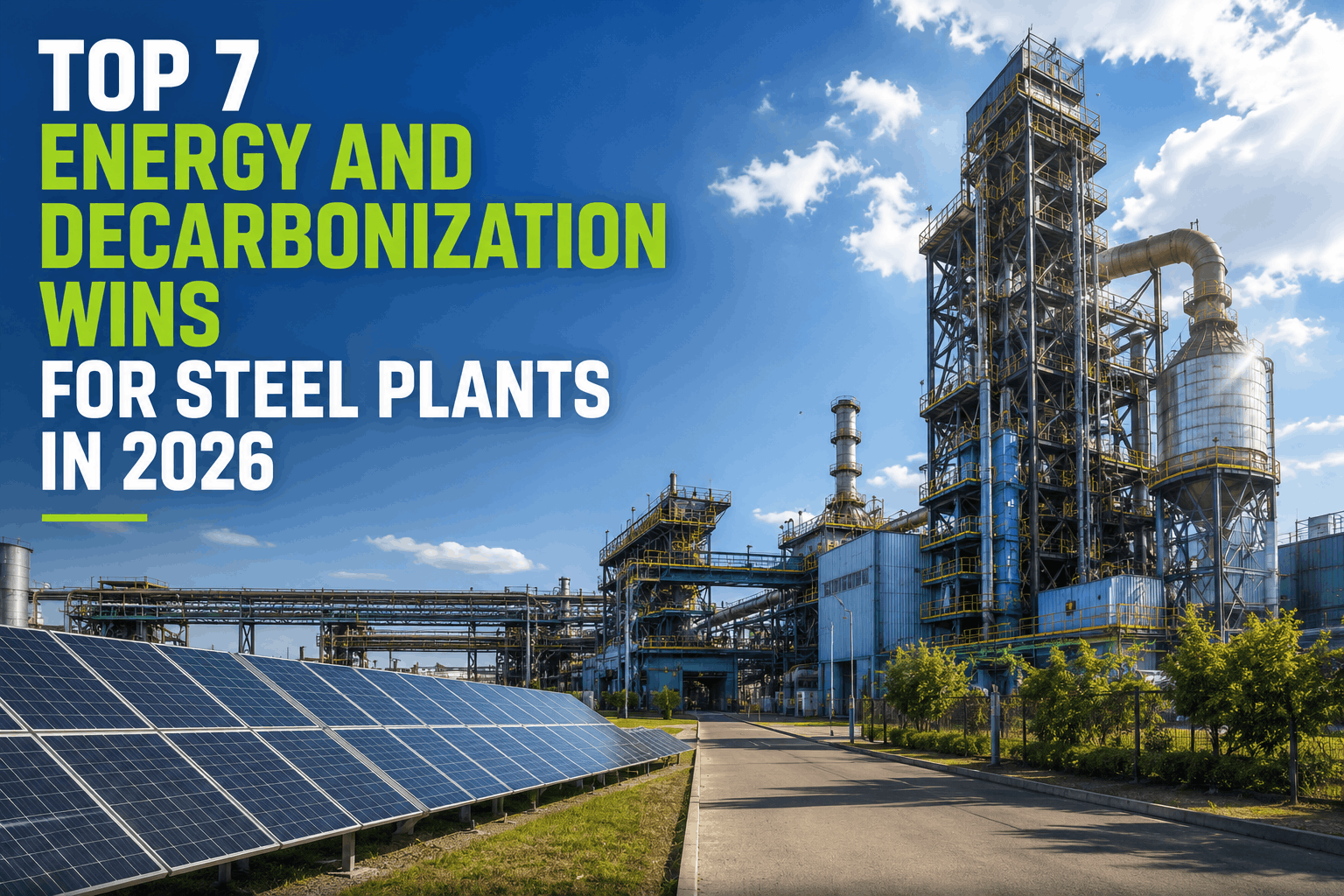
Steel production accounts for approximately 7-9% of global CO2 emissions, making decarbonization an urgent priority for the industry. AI-powered carbon emission tracking transforms environmental compliance from manual calculations into real-time intelligence, monitoring emissions across every process stage from blast furnaces to finishing lines while identifying reduction opportunities invisible to traditional methods. Schedule a consultation to explore how AI-powered emission tracking can support your steel plant's decarbonization journey.
Why AI-Powered Carbon Tracking for Steel
Steel plants face unprecedented pressure from carbon pricing mechanisms, ESG reporting requirements, and customer demands for low-carbon steel. Manual emission calculations based on production factors miss the real-time variations and optimization opportunities that AI analytics can capture.
AI Carbon Tracking Platform Architecture
Modern carbon tracking platforms for steel plants combine continuous emission monitoring systems (CEMS), process data integration, and machine learning models to deliver auditable, real-time emission intelligence across the entire steelmaking value chain.
Emission Sources in Steel Production
Steel plants have multiple emission sources across integrated and EAF routes. AI tracking systems monitor each source independently while providing consolidated plant-level and product-level carbon accounting.
Carbon Intensity Metrics & KPIs
Effective carbon management requires tracking the right metrics at the right granularity. AI systems calculate and monitor multiple carbon intensity indicators to support operational optimization and regulatory compliance.
| Metric | Unit | Typical Range | Optimization Target |
|---|---|---|---|
| Overall Carbon Intensity | tCO2/t crude steel | 1.4-2.2 (integrated), 0.4-0.6 (EAF) | Industry benchmark minus 10-15% |
| Blast Furnace CO2 | tCO2/t hot metal | 1.5-1.8 | Optimize coke rate, increase PCI, hydrogen injection |
| BOF Carbon Efficiency | tCO2/t liquid steel | 0.08-0.15 | Maximize scrap ratio, optimize blowing practice |
| EAF Specific Emission | kgCO2/t liquid steel | 150-400 (depends on grid) | Green energy procurement, electrode optimization |
| Reheating Energy Intensity | GJ/t rolled product | 1.0-1.8 | Hot charging, furnace efficiency, scheduling |
| Scope 3 Upstream | tCO2e/t steel | 0.3-0.8 | Supplier selection, scrap sourcing, logistics |
Traditional vs. AI-Powered Carbon Tracking
Understanding the capabilities difference between traditional emission reporting and AI-powered tracking reveals why leading steel producers are transitioning to intelligent carbon management systems.
- Monthly calculations from production factors
- Spreadsheet-based emission estimates
- No product-level carbon attribution
- Limited visibility into process variations
- Reactive compliance reporting only
- Real-time continuous emission monitoring
- Automated mass balance verification
- Product-level carbon footprint tracking
- AI-optimized process recommendations
- Predictive compliance and credit optimization
Regulatory Compliance & Reporting
Steel plants must navigate an increasingly complex landscape of carbon regulations, trading schemes, and disclosure requirements. AI systems automate compliance across multiple frameworks while maintaining audit-ready documentation.
| Regulation/Standard | Coverage | Key Requirements | AI Automation |
|---|---|---|---|
| EU ETS | European Union | Annual verified emissions, free allocation, carbon leakage | Real-time allowance tracking, benchmark monitoring, MRV reports |
| CBAM | EU imports | Embedded carbon reporting, third-party verification | Product-level carbon calculation, supplier data integration |
| EPA GHGRP | United States | Subpart AA (iron & steel), annual reporting | Automated data collection, calculation verification, e-GGRT filing |
| China ETS | China | Allowance management, MRV compliance | Provincial reporting, benchmark tracking, allocation optimization |
| ResponsibleSteel | Global certification | GHG intensity thresholds, site certification | Continuous benchmark monitoring, certification documentation |
| SBTi | Science-based targets | Scope 1, 2, 3 reduction pathways | Progress tracking, scenario modeling, target achievement forecasting |
Green Steel & Product Carbon Footprint
Customer demand for low-carbon steel requires accurate product-level carbon tracking. AI systems calculate the embedded carbon in each coil, plate, or beam, enabling premium pricing for certified green steel products.
ROI of AI Carbon Tracking
AI carbon tracking investments deliver returns through regulatory compliance optimization, carbon credit management, operational efficiency gains, and premium pricing for certified low-carbon products.
Technical Specifications
AI carbon tracking platforms for steel plants must meet demanding specifications for data accuracy, regulatory compliance, and system reliability to support audit requirements and operational decision-making.
Implementation Approach
Successful AI carbon tracking deployment in steel plants requires careful planning across instrumentation, data integration, and organizational change management. A phased approach delivers quick compliance wins while building toward comprehensive optimization.
Integration Capabilities
AI carbon tracking platforms integrate with existing steel plant systems to enable comprehensive emission monitoring, process optimization, and automated regulatory compliance.
| System | Integration Type | Data Exchange |
|---|---|---|
| Level 2 Automation | Real-time bidirectional | Process parameters, setpoints, production data, optimization recommendations |
| CEMS/Analyzers | Continuous data feed | Stack emissions, gas compositions, flow rates, calibration status |
| MES/Production | Transaction-based | Heat tracking, grade information, raw material consumption, yield data |
| ERP/Financial | Scheduled batch | Carbon cost allocation, credit management, procurement data, customer orders |
| Energy Management | Real-time | Electricity consumption, fuel usage, steam flows, grid carbon intensity |
Common Challenges & Solutions
Steel plant carbon tracking deployments face unique challenges from measurement complexity, data quality, and regulatory variation. Understanding these challenges and proven solutions accelerates successful implementation.
| Challenge | Impact | Solution |
|---|---|---|
| Multiple emission sources | Complex attribution, data integration burden | Unified data platform with source-level tracking and automatic aggregation |
| Legacy instrumentation | Insufficient measurement accuracy | Phased CEMS upgrades, calculation-based estimation with verification |
| Process gas complexity | Variable composition affects calculations | Real-time gas analysis integration, AI-based composition estimation |
| Multi-jurisdictional compliance | Different methodologies, reporting formats | Regulatory framework library with automatic report generation |
| Product-level attribution | Allocation methodology disputes | Mass balance tracking, heat-level carbon accounting, audit documentation |