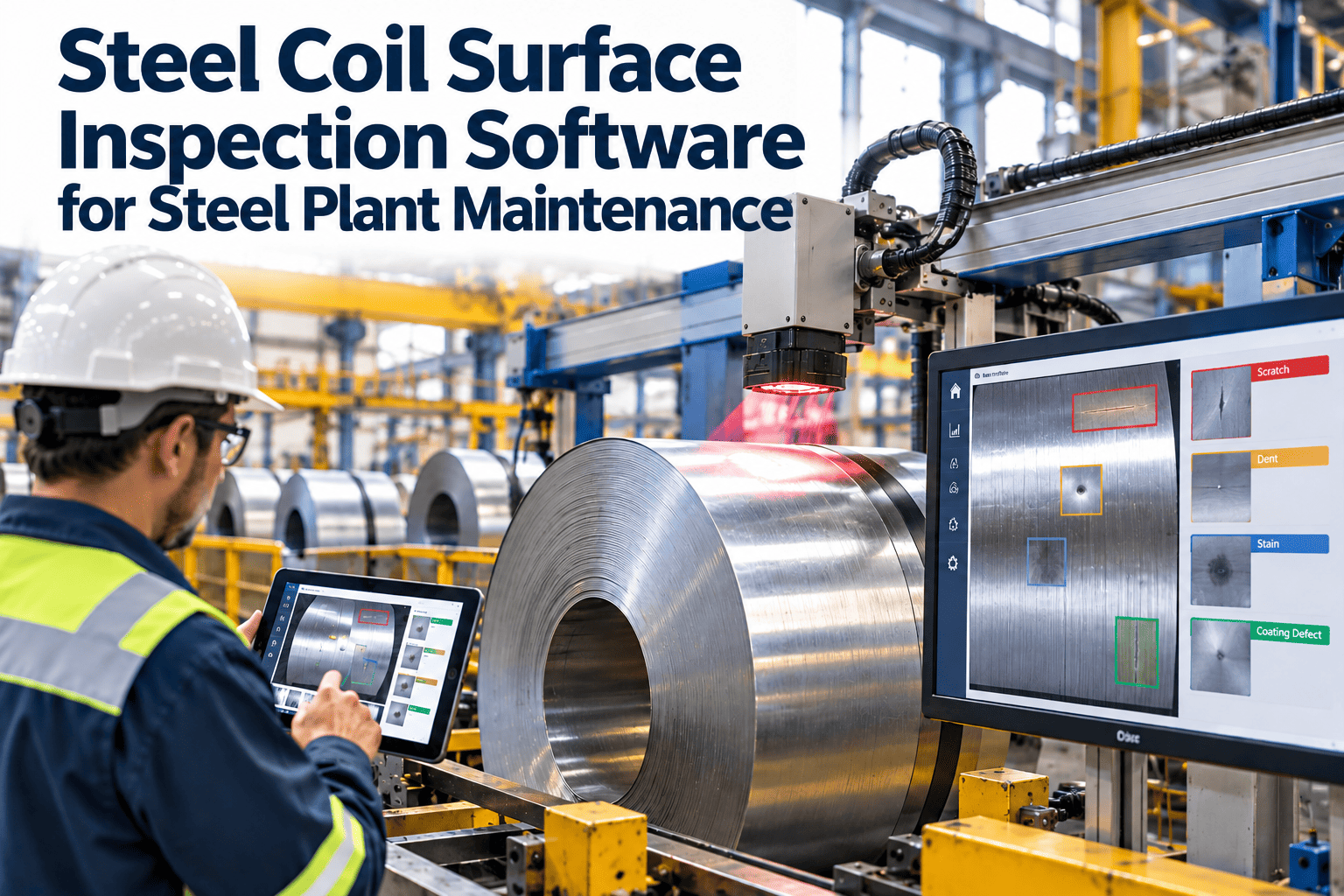
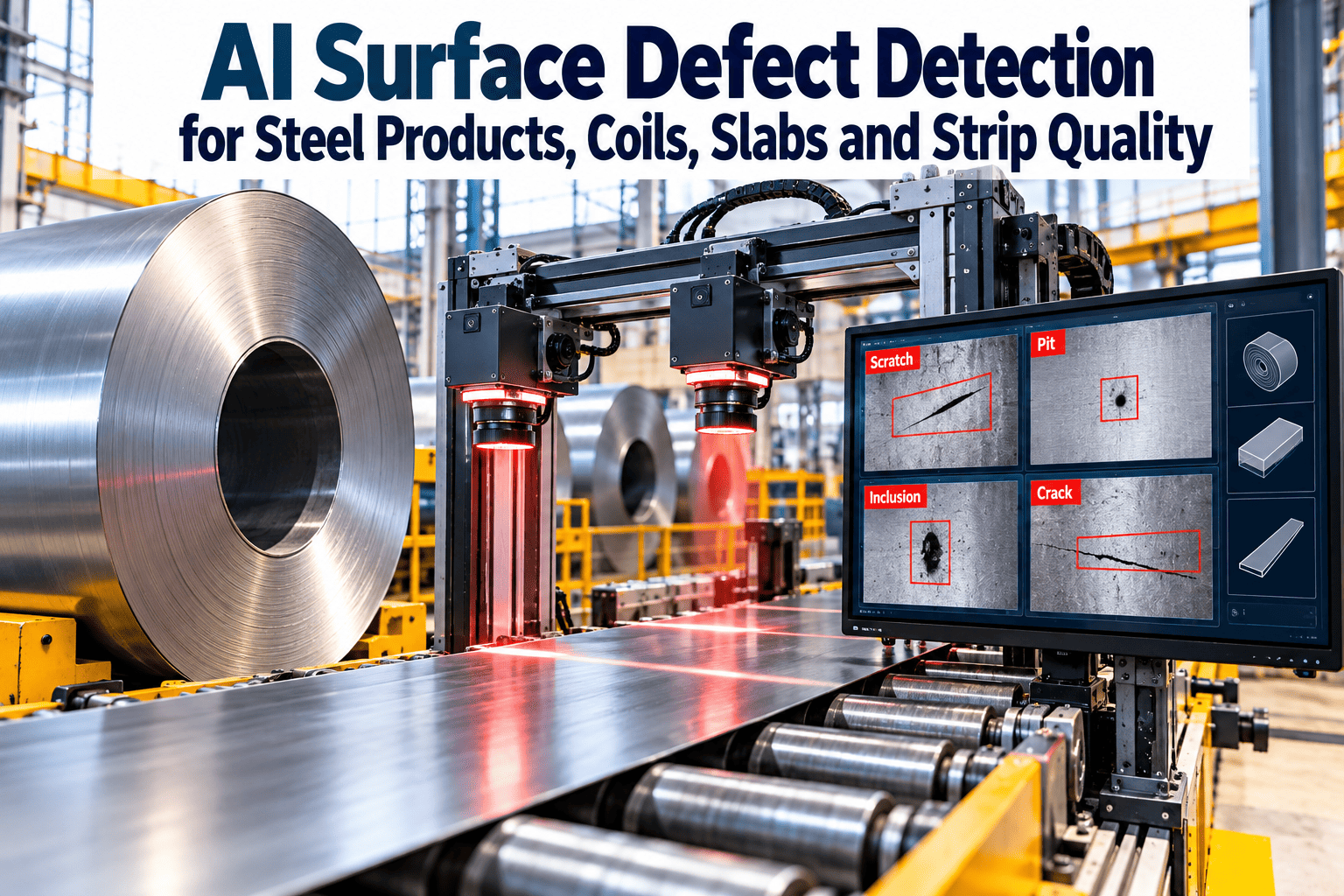
Steel Coil Quality Inspection with Vision AI | Defect Detection Automation
By James smith on April 17, 2026
A human inspector at a hot strip mill exit catches 60-70% of surface defects on a good shift. After eight hours on night watch under the glare of 900°C steel, that number drops to 40-50%. The 30-40% that slip through travel downstream as slivers, inclusions, and roll marks — showing up six months later at an automotive stamper's press line as a million-dollar claim. AI vision systems now inspect 100% of the strip surface at line speeds above 2000 m/min, detect defects as small as 0.1mm, and classify 200+ defect types with 95-99% accuracy. Oxmaint turns every AI-detected defect into a maintenance work order against the upstream asset that caused it — or book a 30-minute demo to see the closed loop on your own coil data.
Vision AI Quality Inspection
30-40% of Surface Defects Leave Your Mill Undetected. The Stamper Finds Them First.
Manual inspection has a ceiling that a human cannot cross — fatigue at hour six, sub-millimeter defects invisible above 300 m/min, and subjective grading that varies between inspectors on the same coil. AI vision breaks that ceiling. Here is how automated coil inspection actually works, from photon capture to closed-loop maintenance action.
0.1mm
Minimum defect detected by AI
2000
m/min line speed coverage
200+
Defect types classified
99%
Peak detection accuracy
Quick Definition
AI coil quality inspection uses line-scan cameras, specialized lighting, and deep learning models to capture every square millimeter of steel surface at full production speed. Convolutional neural networks classify each anomaly by type, severity, size, and exact coil position — then trigger automatic quality disposition, customer-specific grading, and upstream maintenance work orders through the CMMS.
Why Human Inspection Has a Hard Ceiling
The job of scanning a moving hot strip under sodium lights, at line speeds where a single blink skips four meters of surface, is a job that exceeds human capability. The ceiling is not effort. It is physics, neurology, and eight-hour fatigue curves.
01
Resolution Limit at Line Speed
The human eye cannot resolve defects below 0.5mm at line speeds above 300 m/min. Modern cold rolling runs at 1,200-2,000 m/min. Sub-millimeter scratches, pinholes, and fine inclusions pass through invisibly.
02
Fatigue Degradation Curve
Inspector accuracy drops 15-25% after two hours of continuous scanning. Miss rates peak in the last two hours of every shift — the same hours where line speed and product complexity tend to be highest.
03
Subjective Grading Variance
The same coil inspected by three qualified graders produces three different dispositions. Acceptance criteria written on paper cannot compensate for what one person calls cosmetic and another calls structural.
04
Cascade Blindness
A developing roll mark propagates across 200-400 tonnes before an inspector notices the pattern. By the time it is flagged, the defective coils are already on trucks to the customer.
The 8 Defect Families AI Must Classify
Steel surface defects are not one problem — they are eight visually distinct families, each with its own root cause in the production line. A defect caught at the hot strip mill exit but traced to a caster problem is worth more than the coil itself, because the fix prevents the next thousand coils.
Scratches & Scuffs
Origin: rolling, coiling, handling
Linear marks parallel to rolling direction. Caused by guide contact, roll table issues, or coiler damage.
Inclusions & Slivers
Origin: steelmaking, casting
Non-metallic particles trapped during solidification. Appear as reddish-brown or light yellow streaks.
Rolled-In Scale
Origin: reheat furnace, descaling
Oxide scale pressed into the surface during rolling. Creates pits when scale detaches during pickling.
Pitted Surface
Origin: oxidation, roll wear
Small, non-periodic depressions from scale detachment, corrosion, or roll surface degradation.
Roll Marks & Imprints
Origin: work roll degradation
Periodic marks repeating at exact roll circumference intervals. A direct fingerprint of roll surface damage.
Edge Cracks & Tears
Origin: casting, hot rolling
Longitudinal cracks at strip edges. Thinner strips are more susceptible. Often penetrate inward with continued rolling.
Lamination & Seams
Origin: caster defects
Subsurface delamination that appears on the surface during downstream forming. Often reveals internal inclusions.
Coating Defects
Origin: galvanizing, painting
Bare spots, zinc dust, pinholes, and uneven coating thickness. Critical for automotive and packaging grades.
Detection Accuracy: Where AI Beats the Human Eye
The accuracy gap between manual and AI inspection is not uniform. It is widest on the defects that matter most to customers — inclusions, lamination, and coating issues that do not reveal themselves until the coil reaches the stamping press or paint line.
Defect Category
Human Eye
Detection Gap
AI Vision
Scratches & Scuffs
60%
+37
97%
Rolled-In Scale
55%
+40
95%
Roll Marks
70%
+28
98%
Inclusions & Slivers
48%
+46
94%
Edge Cracks
75%
+22
97%
Lamination & Seams
42%
+50
92%
Pitted Surface
58%
+38
96%
Coating Defects
65%
+31
96%
Rows marked with amber border show the widest accuracy gaps — these are the defects that most often escape to customers as quality claims.
Vision AI plus CMMS in one closed loop
When the Camera Sees a Roll Mark, Oxmaint Opens the Roll Change Work Order
Detection alone does not fix the caster. Oxmaint links every AI-classified defect to the upstream asset responsible — descaler, work roll, tundish nozzle, guide — and generates the maintenance action before the next 200 tonnes roll through.
The AI Vision Pipeline — From Photon to Work Order
A complete AI coil inspection system runs as a 5-stage pipeline, from light reflecting off the strip to a work order sitting in the electrical foreman's queue. Each stage must complete before the strip section leaves the inspection zone — typically 50 milliseconds end-to-end.
01
Image Capture
Line-scan cameras at 16,000–32,000 pixels per line. Both surfaces captured simultaneously at 0.1–0.5mm per pixel. Specialized LED lighting geometries — dark-field for scratches, bright-field for inclusions.
02
GPU Edge Processing
500-2,000 frames per second processed at line-side. Image normalization, background subtraction, feature extraction in under 10ms per frame. Redundant architecture prevents data loss.
03
Deep Learning Classification
CNNs trained on 5–10 million labeled defect images. Classifies 200+ defect types by category, severity, and size. Transfer learning adapts to plant-specific products and grades.
04
Spatial Defect Mapping
Every defect tagged with exact coil position, top or bottom surface, dimensions, and classification. Complete digital quality record generated per coil — no paper, no subjective notes.
05
Disposition & Work Order
Automatic coil grading against customer-specific acceptance rules. Defect patterns indicating roll degradation or descaler issues generate CMMS work orders before the next coil rolls.
The Cost Arithmetic of a Missed Defect
A defective coil caught at the mill costs you the downgrade margin. The same coil caught at the customer's stamping plant costs 10-50x more. The arithmetic compounds with every hand-off between mill and customer — and compounds again when the defect is systematic rather than isolated.
Caught at Mill Exit
$20-60/ton
Downgrade from prime to secondary. Coil diverted before it ships. Loss contained to margin erosion.
Line shutdown, emergency sort, tooling damage claim, and the possibility of losing the OEM contract at next bid.
Aggregate Annual Impact on a 2.5 MTPA Mill
$3M-$12M
Downgrade losses from secondary-grade ship-outs
$1.2M-$4M
Customer claims, returns, and emergency sort fees
$800K-$3M
Scrap and rework on material unsalvageable at any grade
2-5%
Percentage of annual production lost to surface quality issues
What Changes When Vision AI Goes Live on Your Line
The operational shift is not about replacing inspectors. It is about moving them from the physically punishing task of scanning a moving strip to the higher-value work of investigating patterns and driving upstream fixes — the work that actually lowers defect rates.
Before AI Vision
Sample-based inspection — 2-3 checks per minute, leaving 95% of surface uninspected
Subjective grading varies between inspectors on the same coil
Defect records live in paper logs, scattered between shifts
Root cause analysis is manual and typically weeks behind the event
Customer claims arrive before the mill knows the defect occurred
Roll degradation detected through coil inspection, not equipment data
With AI Vision + Oxmaint
100% surface coverage at full line speed — every coil, every millimeter, both sides
Objective, repeatable grading against customer-specific acceptance rules
Digital defect map per coil with full searchable history
Defect patterns correlated to process parameters in real time
Quality holds placed before the coil leaves the finishing line
Roll mark patterns trigger work orders against specific roll campaigns
How Oxmaint Closes the Loop Between Detection and Maintenance
A defect caught at the inspection camera but not linked to its upstream root cause is a defect that repeats. Oxmaint is the CMMS layer that turns AI-detected defect data into targeted maintenance action on the asset that produced the defect.
01
Defect-to-Asset Correlation
Periodic roll marks matched to specific work roll circumference. Scale density spikes matched to descaler nozzle patterns. Edge damage matched to guide alignment. Every AI classification points back to the asset that needs attention.
02
Automatic Work Order Generation
Defect thresholds trigger CMMS work orders without operator input. Roll change orders, descaler inspections, guide alignment tasks, and tundish nozzle checks all generate automatically when the pattern appears.
03
Roll Campaign Tracking
Each roll campaign linked to the coils it produced and the defects those coils carried. When a roll exceeds acceptable defect density, the system flags it for change — turning reactive roll swaps into data-driven scheduling.
04
Customer-Specific Quality Rules
Automotive exposed-panel grade rejects defects that structural grade accepts. Oxmaint enforces the right rule set per order automatically — no operator judgment, no inspection error, no post-ship surprises.
05
Digital Quality Certificates
Every shipped coil carries a digital certificate with its complete defect map, AI classification confidence, and disposition history. Customer audits get structured data instead of paper inspection sheets.
06
Process Parameter Linking
Defect patterns correlated with casting speed, mold level, descaler pressure, rolling reduction, temperature, and roll campaign age. Root cause analysis in minutes, not weeks.
Deployment Path — Phase 1 to Closed Loop
Vision AI is not a forklift upgrade. It is a phased deployment that starts with non-disruptive camera installation, moves through model training on plant-specific defect data, and ends with the CMMS closed loop. Most plants reach full ROI in 8-14 months.
Phase 1
Imaging Infrastructure
Line-scan camera installation, lighting array setup, and GPU edge server commissioning. Non-production hours only. No line stoppage beyond existing maintenance windows.
Weeks 1-4
Phase 2
Model Training & Validation
Baseline deep learning model deployed. Plant-specific defect data collected from production coils. Detection accuracy validated against known sample coils with documented defects.
Weeks 5-12
Phase 3
Promotion to Primary Detection
AI promoted from advisory to primary detection layer. Human inspectors transition to verification and root cause analysis. Quality disposition now automated per coil.
Weeks 13-20
Phase 4
CMMS Closed Loop
Defect patterns integrated with Oxmaint work order engine. Roll changes, descaler maintenance, and guide alignment all triggered by AI data. Full audit trail per asset and per coil.
Weeks 20+
From detection to fix in one system
The Camera Catches It. The CMMS Fixes It. Your Customers Never See It.
Oxmaint is the system of record that turns your vision AI from an inspection tool into a closed-loop quality program. Set up your account in minutes, or book a call to walk through your defect taxonomy together.
No. Camera arrays and lighting installs happen in existing maintenance windows. The GPU edge servers run line-side without tapping into Level 1 controls.
Will AI replace our quality inspectors?
Inspectors shift from visual scanning to pattern analysis and root cause investigation. The AI handles 100% coverage. Humans handle the interpretation that leads to real process improvement.
How accurate is AI on defects under 0.5mm?
Current systems detect defects down to 0.1mm with 95-99% accuracy at full production speed. Human eyes cannot resolve below 0.5mm above 300 m/min — the gap widens at every speed increase.
What is the typical ROI payback period?
Most deployments pay back in 8-14 months. Returns come from reduced customer claims, lower secondary-grade volume, and early detection of upstream equipment degradation.
Steel coil quality, inspection-first
Every Missed Defect Is a Claim You Have Not Received Yet. Catch It at the Camera.
Oxmaint connects your AI vision system to the assets that produce your defects — rolls, descalers, casters, guides — so detection becomes correction in the same shift. Start with your existing inspection line. No forklift upgrade required.