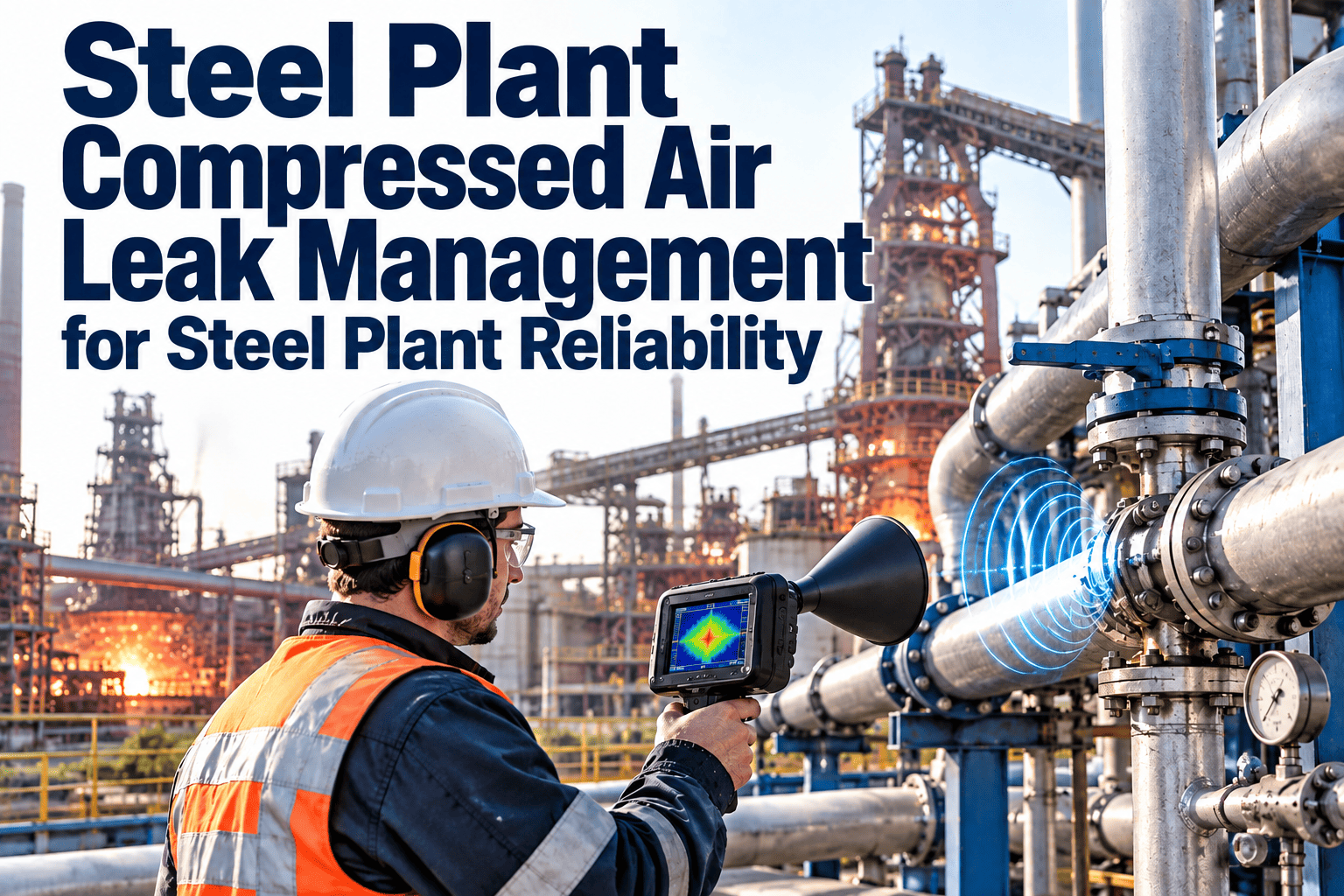
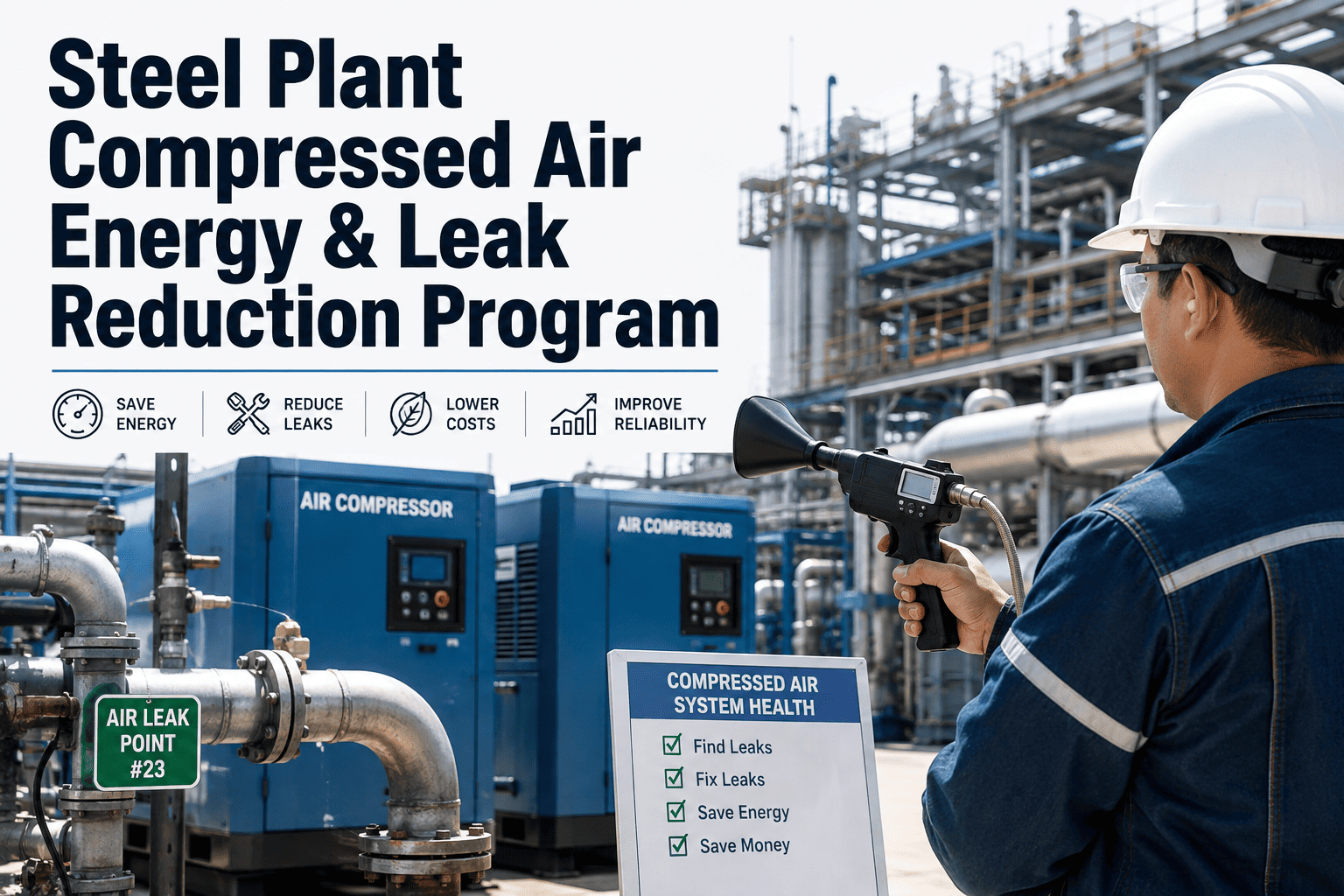
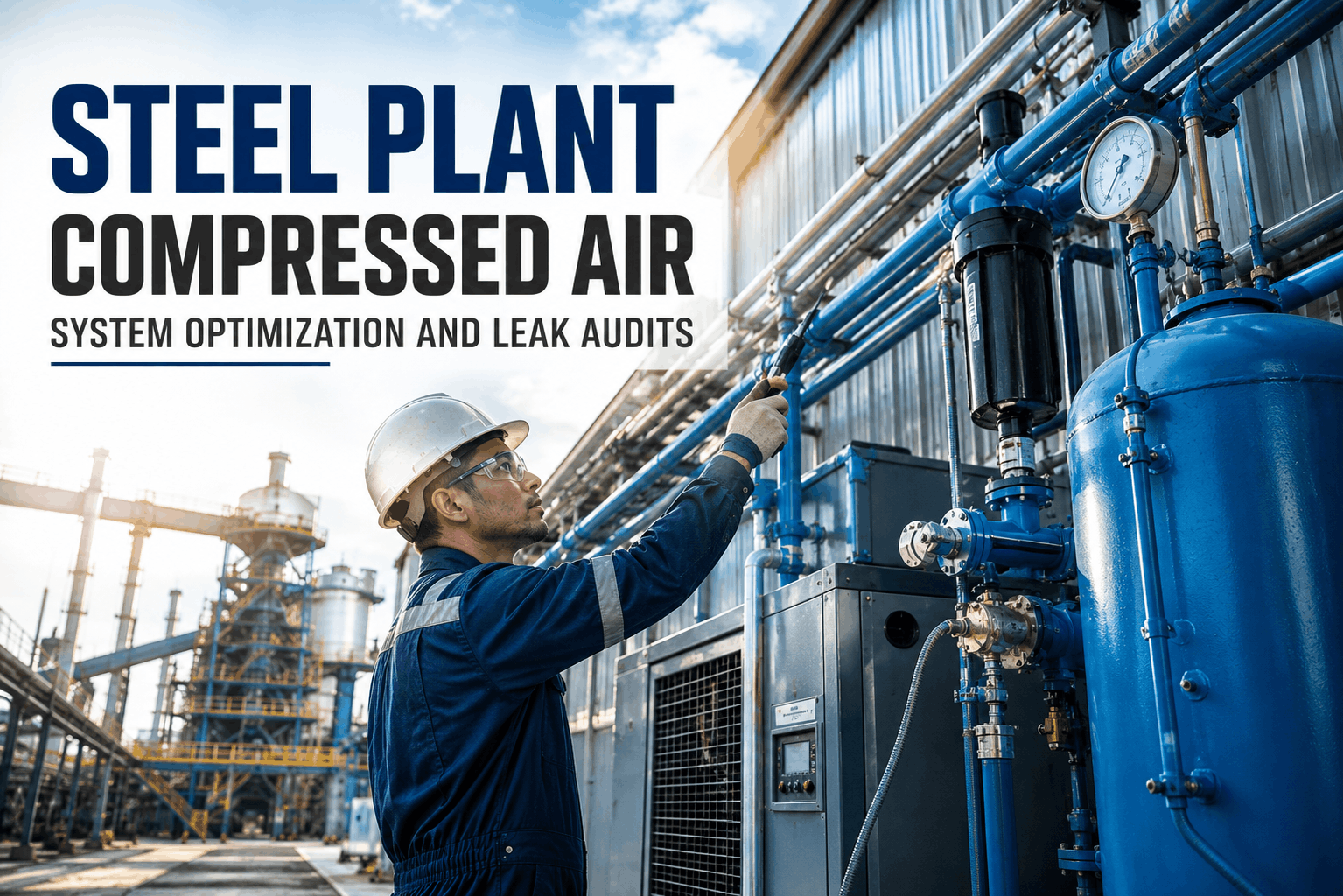
Compressed air is one of the most expensive utilities in a steel plant — and one of the least managed. A typical integrated mill running four to six large rotary screw or centrifugal compressors consumes 15–20% of its total electricity bill to produce compressed air, yet industry surveys consistently find that 25–40% of that compressed air is lost to leaks, pressure drops, and artificial demand before it reaches a productive end use. When you combine that waste with the energy penalty of running poorly maintained compressors — dirty inlet filters, worn inter-stage cooling, degraded intercooler performance — the true efficiency gap between a poorly maintained compressed air system and a well-maintained one commonly reaches 30–35%. Sign up for Oxmaint to connect your compressor runtime, energy consumption, and maintenance records in a single asset management dashboard.
A compressed air system failure is rarely just an energy event. It is typically a production stop, sometimes a safety event, and always an expensive emergency. Systematic preventive maintenance on compressors, dryers, receivers, and distribution is the only reliable way to prevent it. Book a demo to see how Oxmaint tracks compressed air system KPIs alongside your broader maintenance program.
20%
Of total electricity consumed by compressed air systems in a typical integrated steel plant
30%
Average compressed air lost to leaks and artificial demand in poorly maintained systems
35%
Energy savings achievable with systematic maintenance and leak elimination — documented industry average
Where Compressed Air Energy Is Being Wasted
Most steel plant energy managers know compressed air is expensive. Fewer have a precise breakdown of where the waste is occurring — which means improvement efforts get directed at the most visible problem rather than the highest-value opportunity. The five loss categories below represent the real structure of compressed air energy waste in steel plants, ranked by their typical contribution to total system inefficiency. Sign in to Oxmaint to start tracking your compressor specific power trend — the single most important metric for identifying maintenance-driven energy waste.
Loss 1
8–12% of system energy
Air Leaks in Distribution
Leaks are the largest single source of compressed air energy waste in steel plants. A 3 mm leak at 7 bar generates approximately 3 kW of continuous compressor load — invisible, silent, and running 24 hours a day. A large steel plant with 200+ pneumatic connections, aging pipe joints, and rubber hose connections typically sustains a leak rate of 25–35% of total compressed air production. Ultrasonic leak detection surveys, conducted by Oxmaint-scheduled maintenance teams, identify and quantify every leak point across the distribution system with work orders generated automatically for each finding.
0%Share of total system energy lossHighest
Loss 2
5–8% of system energy
Compressor Maintenance Deficit
A rotary screw compressor with a dirty inlet air filter and degraded inter-stage cooling uses 10–15% more electricity to produce the same volume of compressed air as the same machine in clean condition. Specific power — kW per cubic meter per minute — drifts upward continuously between maintenance interventions. Oxmaint tracks specific power trend per compressor from integrated energy meter data and alerts when the trend indicates filter or cooler degradation requiring maintenance — before the energy cost accumulates for another quarter.
0%Share of total system energy lossHighest
Loss 3
4–6% of system energy
Pressure Set Point Creep
Every 1 bar of unnecessary system pressure adds approximately 7% to compressor energy consumption. Steel plants frequently allow system pressure to creep upward over years — first to overcome leak losses that should be repaired, then as successive maintenance supervisors inherit higher set points and raise them further to address new complaints. A disciplined pressure management program starts with documenting the minimum pressure actually required at each critical end use and works backward to the lowest compressor discharge pressure that satisfies the entire system. Oxmaint's pressure monitoring module tracks system pressure at multiple points with configurable alert thresholds for both high-pressure waste and low-pressure risk.
0%Share of total system energy lossHighest
Loss 4
3–5% of system energy
Dryer and Air Treatment Performance
Refrigeration dryers with degraded refrigerant charge or fouled heat exchangers fail to maintain design dew point — delivering wet air to instrument systems that require clean, dry supply. The consequence is not visible on the energy bill but is visible in instrument air valve corrosion, positioner failures, and pneumatic control system faults that generate maintenance work orders at five to ten times the cost of the dryer maintenance that would have prevented them. Desiccant dryers with exhausted media deliver similar wet air quality degradation. Oxmaint tracks dryer outlet dew point against specification and schedules media replacement at heat count intervals, not calendar time.
0%Share of total system energy lossHighest
Your compressed air system's energy waste has a number. Oxmaint's energy monitoring module calculates it from your compressor runtime and power meter data — showing exactly which loss category is largest and generating maintenance work orders to address it.
Equipment-Specific Maintenance Requirements
Compressed air system maintenance spans four distinct equipment categories, each with its own failure modes, inspection parameters, and PM intervals. The following zone panels cover the critical maintenance requirements for each — structured around the inspection points that determine both reliability and energy performance.
Inlet filter condition: Replace at differential pressure limit, not calendar interval. Dirty inlet filter raises specific power immediately — a clogged filter at 7 bar adds 3–5% energy penalty per bar of differential drop.
Intercooler and aftercooler effectiveness: Measure approach temperature — the difference between cooling water inlet and compressed air outlet. Rising approach temperature signals fouling that reduces heat transfer and raises discharge temperature, increasing specific power.
Oil quality for oil-injected screws: Sample and analyze every 2,000 hours or per OEM recommendation. Degraded oil reduces separation efficiency, increasing oil carryover into the downstream air quality — contaminating instrument air filters and dryer media.
Vibration and bearing condition: Monthly vibration measurement on all compressor bearings. Bearing failure is the primary cause of emergency compressor shutdown — a single unplanned compressor outage at a large steel plant typically costs $40,000–$120,000 in lost production and emergency repair.
Specific power tracking: Calculate and record kW/(m³/min) weekly. A rising specific power trend is the earliest indicator of any maintenance deficiency — filter fouling, cooler degradation, or internal wear — before any single parameter has crossed its individual alarm threshold.
Refrigeration dryer outlet dew point: Verify continuously against specification — typically +3°C pressure dew point for instrument air. Dew point creep above +10°C signals refrigerant charge loss or heat exchanger fouling requiring service.
Desiccant media replacement: Track total volume throughput and moisture loading, not calendar time. Oxmaint's sequence-count trigger schedules media replacement based on actual operating hours and inlet air conditions — preventing the condition where exhausted desiccant delivers wet air for weeks before anyone notices.
Coalescing filter differential pressure: Replace filter elements at the OEM differential pressure limit. Saturated coalescing filters with high differential pressure are a pressure drop energy loss and an oil carryover risk simultaneously.
Automatic drain function: Test all auto-drains weekly. A failed auto-drain that allows liquid accumulation in a filter housing delivers liquid water directly into the instrument air system — a single event that can damage dozens of downstream instruments before the source is identified.
Receiver internal inspection: Pressure vessels require inspection per jurisdictional regulations — typically every 2 years internal and annually external. Corrosion in the receiver base from accumulated condensate is the primary failure mode; ensure auto-drains are functional before each inspection interval ends.
Pressure relief valve testing: Annual function test at operating pressure. A seized PRV that fails to open on over-pressure is a pressure vessel safety risk. A PRV that chatters open at normal operating pressure indicates system pressure set too high and wastes compressed air continuously.
Leak detection surveys: Quarterly ultrasonic surveys of the full distribution system. Assign Oxmaint work orders to every identified leak point with leak rate estimate and repair priority — high-flow leaks repaired within 48 hours, minor leaks scheduled within two weeks.
System pressure profile measurement: Measure pressure at compressor outlet, receiver, and three to five critical end-use points simultaneously. Excessive pressure drop between compressor and end use indicates undersized or corroded distribution pipe that is wasting energy through elevated system pressure set points.
Dew point at critical instrument panels: Measure pressure dew point at blast furnace, BOF, and caster instrument air headers monthly. Dew point above specification at end-use points identifies condensation forming in distribution — the source of positioner failures, valve corrosion, and control system faults.
Particle contamination sampling: ISO 8573-1 Class 1 particle count test annually at instrument air headers. Failed particle counts indicate coalescing filter media degradation requiring immediate element replacement before instrument failures accumulate.
Oil content measurement: Test residual oil at instrument headers annually. Oil carryover above 0.01 mg/m³ (ISO Class 1 oil) indicates oil-injected compressor separator degradation or coalescing filter failure — both of which contaminate and shorten positioner and valve life.
Critical instrument air pressure: Verify minimum pressure at each instrument header under peak demand conditions. Instrument air pressure below the minimum threshold for pneumatic positioners (typically 5.5 bar) causes valve positioning errors that affect production quality and safety system function.
Five Actions That Deliver the Fastest Energy Return
Not every compressed air maintenance action produces equal energy savings per dollar spent. The following five actions are ranked by documented energy return and are the starting point for any structured compressed air improvement program. All five are supported directly by Oxmaint's asset management and energy monitoring modules. Sign in to Oxmaint to configure energy monitoring and maintenance scheduling for all five actions simultaneously.
1
Ultrasonic Leak Survey and Elimination
Commission a full-plant ultrasonic survey. Prioritize leaks by flow rate. Repair the 20% of leak points that account for 80% of total leak volume. Verified payback: 6–14 weeks for survey cost plus repair labor.
2
Inlet Filter Replacement on Differential Pressure Trigger
Install differential pressure gauges on all compressor inlet filters. Replace on pressure drop limit — not calendar date. Eliminates both the energy penalty of restricted airflow and the risk of filter collapse under differential pressure.
3
Intercooler Cleaning Schedule
Clean intercoolers and aftercoolers at the OEM-recommended approach temperature rise trigger. A 5°C approach temperature rise from a fouled cooler adds 3–6% to compressor specific power — cleaning typically takes 4 hours and costs less than one day of added energy waste.
4
System Pressure Audit and Reduction
Map actual minimum pressure requirements at each critical end use. Reduce system set point to minimum viable pressure plus 0.5 bar safety margin. Every 1 bar reduction saves approximately 7% of compressor energy — the fastest energy return available without capital investment.
5
Compressor Sequencing Optimization
For multi-compressor systems, review sequencing logic annually against actual demand profile. Centrifugal compressors operating below 60% capacity surge region — and screw compressors unloading more than 30% of runtime — indicate over-capacity that should be absorbed by sequencing, not running a machine at part load. Oxmaint's runtime tracking identifies candidates for sequencing adjustment automatically.
$420K
Annual energy cost reduction at a 3 MTPA integrated mill after systematic leak elimination, filter PM program, and pressure set point reduction — 14-week payback on total program cost
31%
Reduction in compressed air energy consumption within 12 months at a North American flat-rolled producer after deploying Oxmaint's specific power trending and maintenance scheduling
Zero
Instrument air-related production stops in the 18 months following a full dryer and filter PM program implementation — compared to 4 stops in the previous 18-month period
Frequently Asked Questions
QHow does Oxmaint track compressor specific power automatically?
Oxmaint integrates with energy metering systems and the compressor control panel to record kW draw and m³/min output simultaneously. Specific power (kW per m³/min) is calculated and trended per compressor, with configurable alert thresholds that generate a maintenance work order when the trend rises above the baseline established after the last service. This converts a metric that most plants only review at quarterly energy audits into a real-time maintenance trigger.
Sign up for Oxmaint to configure specific power monitoring for your compressor fleet.
QWhat compressed air quality standard applies to steel plant instrument air?
ISO 8573-1 Class 1 is the standard applied to instrument air in steel plant critical applications — blast furnace controls, BOF lance positioning, caster mold level control. This requires particle size below 0.1 micron, pressure dew point of −70°C or better, and residual oil below 0.01 mg/m³. General purpose pneumatic air (tool circuits, conveyor actuators) typically operates to Class 3 or 4 — less stringent and served from a lower-quality header downstream of the instrument air treatment train. Maintaining the separation between these systems and preventing cross-contamination during maintenance is an important aspect of instrument air quality management.
Book a demo to see how Oxmaint separates instrument air and plant air asset records.
QHow often should a steel plant conduct an ultrasonic compressed air leak survey?
Quarterly surveys are the best-practice standard for steel plants with active pneumatic systems. Leak rates in steel plant environments re-accumulate quickly — vibration, thermal cycling, and mechanical impacts on pipe joints and hose connections regenerate leaks at a rate that makes annual surveys insufficient for controlling energy waste. Oxmaint schedules quarterly leak survey work orders automatically and maintains the cumulative leak repair log, which allows the program to track whether repaired leaks are recurring (indicating a pipe joint or fitting design issue) or are genuinely new (indicating random deterioration).
Connect Your Compressed Air Maintenance to Real Energy Outcomes
Oxmaint links compressor specific power trending, filter PM triggers, leak survey work orders, and dew point monitoring in a single asset management platform — so your compressed air maintenance program produces measurable energy savings, not just completed work orders.