Compressed air is the "fourth utility" in steel plants—as essential as electricity, water, and natural gas. A typical integrated steel mill operates 15–30 air compressors delivering 5,000–20,000 cubic feet per minute (CFM) at 80–120 PSI to power pneumatic equipment: blast furnace hot blast controls, BOF oxygen lance actuators, EAF electrode height controls, continuous caster mold oscillators, and thousands of manual pneumatic tools on the plant floor. Yet compressed air is notoriously wasteful: the U.S. Department of Energy estimates that 20–30% of compressed air produced in manufacturing is lost to leaks before reaching end-use equipment. For a steel plant, a 25% loss rate translates to $500,000–$2 million annually in wasted electricity (compressors run 24/7 to maintain pressure despite leaks). A single 1/8-inch orifice leak in a 100 PSI system wastes approximately 65 CFM—equivalent to running a 1 HP electric motor continuously just to replace lost air. Most steel plants discover compressed air inefficiency only during emergency shutdowns when production pressure drops and operations grind to a halt. A systematic compressed air optimization program—combining leak auditing, dew point control, dryer maintenance, and filter replacement—coupled with CMMS-tracked preventive maintenance and ROI measurement, can recover 10–25% of compressed air energy annually, saving $100,000–$500,000 per facility. Oxmaint's compressed air module automates leak detection scheduling, logs dew point readings, tracks dryer cartridge life cycles, and calculates kWh savings from each maintenance intervention—translating maintenance work into quantified financial and environmental benefits visible to plant management and corporate sustainability teams.
Optimize Your Compressed Air System.
Download our complete compressed air audit checklist, leak detection protocol, dew point monitoring guide, and CMMS ROI calculator. Get energy savings estimates and preventive maintenance schedules instantly.
Why Compressed Air Leaks Cost Steel Plants $500K+ Annually
Compressed air energy cost is calculated as: (kW input) × (24 hours) × (365 days) × (electricity rate $/kWh). A typical 75 HP rotary screw compressor consumes 56 kW of electrical input and operates at 40% capacity during normal steel plant operations (roughly 22 kW average). At an industrial electricity rate of $0.10/kWh, this compressor costs approximately $19,300 annually to run. If 25% of output is lost to leaks (undetected), the plant is burning $4,825 per year in electricity just to replace wasted air. Multiply this across a facility with 10 compressors and the annual waste reaches $48,250—and this assumes detected leaks. Most steel plants lack systematic leak detection, so actual losses are often 30–40%, pushing annual costs to $70,000–$100,000+ per facility. The compounding challenge: as leaks accumulate, system pressure drops, forcing compressors to run longer (increased kW consumption) and more frequently (more energy). A compressor operating at 95 PSI (due to leaks) instead of 100 PSI consumes approximately 8% more electricity to maintain lower pressure. A CMMS-scheduled quarterly ultrasonic leak audit detects leaks early (often before pressure drops noticeably), enabling rapid repair and preventing the cascading energy penalty.
Understanding Compressed Air Energy Loss Mechanisms
COMPRESSED AIR ENERGY LOSS BY SOURCE (% of total system)
Leaks (Hose, Fittings, Equipment)
25%
Inappropriate End-Use (Blow-Off vs. Actuator)
18%
Heat Loss in Compressor Discharge
15%
Moisture Carryover (Inadequate Dryer)
20%
Filter Pressure Drop (Blocked Filters)
12%
Compressor Control Inefficiency
10%
Compressed Air Leak Detection & Repair
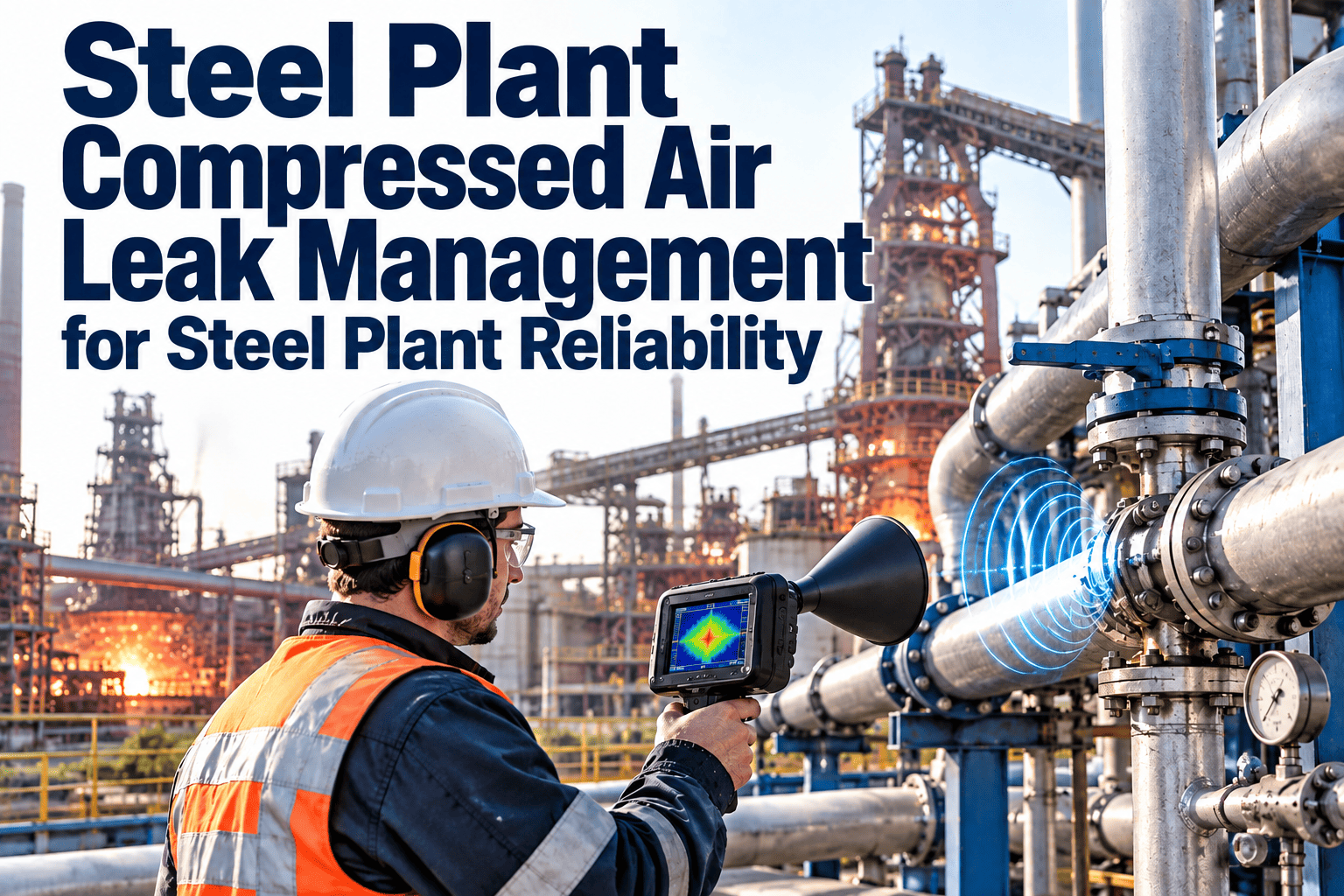
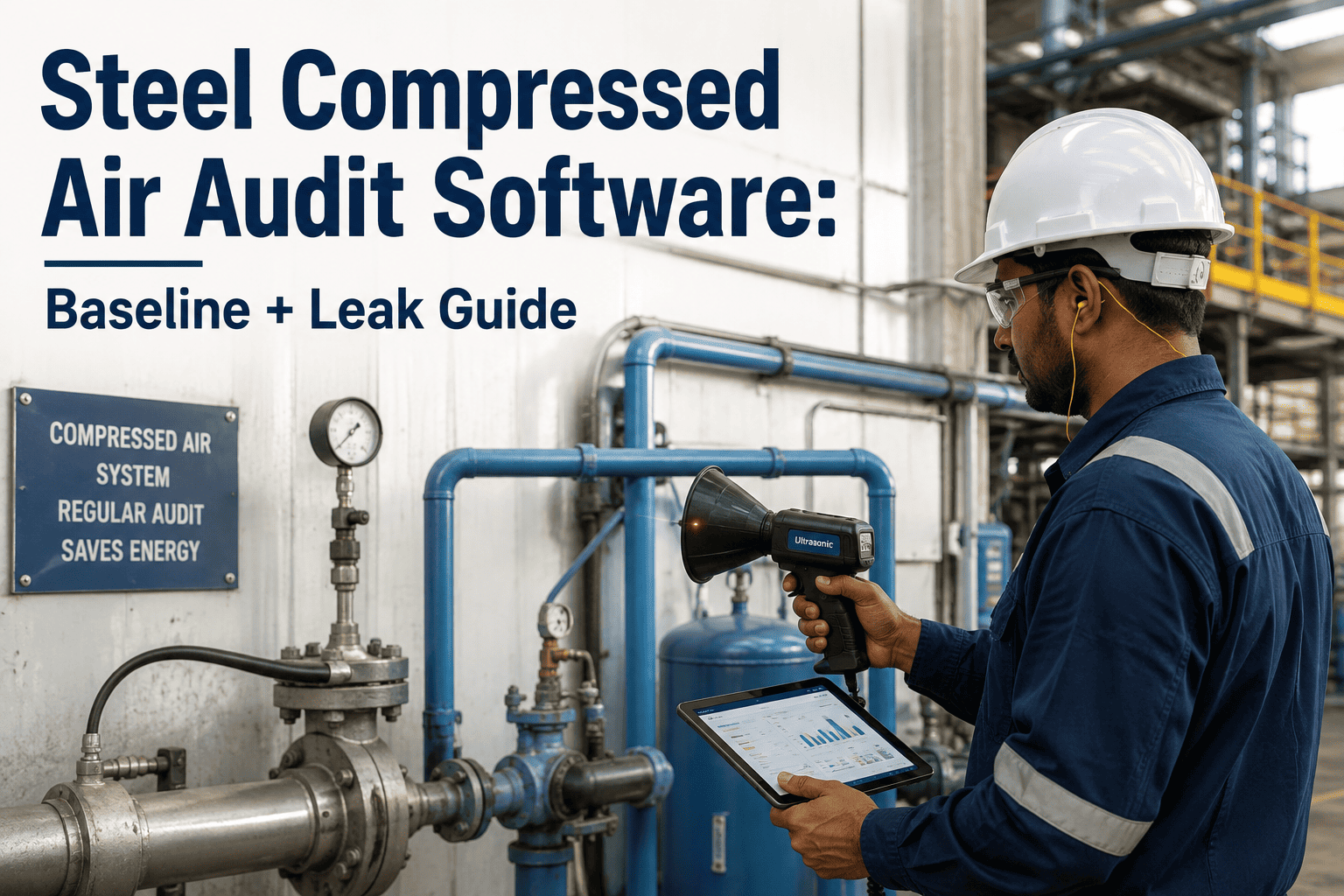
A compressed air leak is any unintended escape of pressurized air from the system: pinhole holes in hoses, loose fittings, failed quick-disconnect couplers, leaking pneumatic tool seals, and cracked rigid pipe connections. Leaks range from barely audible (0.5 CFM loss) to catastrophic (>50 CFM), but even tiny leaks compound rapidly. A 1/16-inch hole at 100 PSI wastes approximately 10 CFM; a 1/8-inch hole wastes 65 CFM; a 1/4-inch hole wastes 230 CFM. Most facilities lack systematic leak detection because leaks are difficult to find: a technician walking the plant with their ear is unreliable (they miss leaks in loud environments, miss leaks inside walls or underground). An ultrasonic leak detector ($2,000–$5,000 one-time equipment cost) uses high-frequency sound waves to pinpoint leaks. Compressed air at high pressure generates ultrasonic frequencies (20–100 kHz) that are inaudible to human ears but clearly detectable with specialized equipment. A CMMS-scheduled quarterly ultrasonic leak audit ensures every square foot of the compressed air system is surveyed systematically. The technician maps leak locations, estimates CFM loss (based on hole size and pressure), and logs repairs in the CMMS with timestamp, location, and CFM recovered. Over a year, this generates a leak trend: if leak frequency increases year-over-year, it signals aging hoses or systemic pressure issues requiring capital investment (system rebuild).
Leak Quantification Method
Estimating CFM Loss from Hole Size & Pressure
CFM loss correlates to orifice size (diameter) and system pressure. At 100 PSI: 1/16-inch hole ≈ 10 CFM, 1/8-inch hole ≈ 65 CFM, 1/4-inch hole ≈ 230 CFM, 1/2-inch hole ≈ 900 CFM. At 80 PSI (lower pressure), losses are approximately 20% less. A technician using an ultrasonic detector visually identifies leak location, estimates hole size by comparing to reference charts, and logs CFM estimate in CMMS. The system calculates: (CFM lost) × (24 hrs) × (365 days) × (8 CFM per kWh typical efficiency) × ($0.10/kWh) = annual cost of leak. A single 1/8-inch leak costs approximately $570/year. A facility with 20 undetected 1/8-inch leaks wastes $11,400 annually—trivial to find and repair, but invisible without systematic auditing.
Dew Point Control: Moisture Management in Compressed Air
Compressed air naturally contains moisture: atmospheric air at 50% relative humidity contains approximately 10 grams of water per cubic meter. When air is compressed to 100 PSI, the moisture concentration increases proportionally (same water in smaller volume). If that compressed air cools, water condenses into liquid, forming rust in metal pipes and corroding pneumatic equipment. Dew point is the temperature at which water begins to condense; air dryers lower dew point to prevent condensation. A typical industrial compressed air dryer targets -40°F dew point (ISO Class 4 cleanliness per ISO 8573-1 standard)—cold enough that water won't condense even in cold outdoor environments. Refrigerated dryers (most common in steel plants) cool compressed air to 35–40°F, removing 75–90% of moisture. Desiccant dryers (using silica gel or molecular sieve cartridges) remove 95–99% of moisture and achieve -40°F to -60°F dew points. A CMMS monitors dew point continuously: each dryer has a dew point sensor logged hourly into the system. If dew point rises above -20°F, the CMMS alerts maintenance—indicating dryer cartridge saturation (needs replacement) or cooler blockage (needs cleaning). This automated monitoring prevents the silent failure mode: a technician assumes the dryer is working because it's running, but dew point creeps upward, corrosion accelerates in downstream equipment, and rust eventually clogs precision pneumatic controls (blast furnace temperature control solenoids, BOF oxygen lance actuators) forcing emergency shutdowns.
Dew Point Monitoring Schedule
Preventive Maintenance for Compressed Air Dryers
CMMS-scheduled dryer maintenance: (1) Daily: Check dew point reading (target -40°F or lower for ISO 4). If dew point >-20°F, alert maintenance. (2) Monthly: Visual inspection of dryer cooler for ice blockage (in cold climates) or scale buildup. Clean cooler fins with compressed air. (3) Quarterly: Replace or regenerate desiccant cartridge (depends on humidity load—high-humidity seasons may require monthly replacement). Check cartridge bypass valve for stiction (failure to open when cartridge saturates). (4) Semi-annually: Test cooler performance via temperature differential measurement—incoming air temperature should drop 15–25°F across the cooler. Low temperature drop indicates fouling. (5) Annually: Inspect all air dryer seals and gaskets; replace if weeping (small fluid leaks indicate seal degradation). A CMMS-scheduled program tracks every maintenance action, dew point trending, and correlates dryer maintenance to downstream equipment reliability (fewer corrosion-related failures = dryer maintenance ROI).
Compressed Air Filter Maintenance & Pressure Drop
Compressed air filters remove particulates, oil aerosols, and water droplets from the air stream before it reaches end-use equipment. A typical compressed air system has 3–5 stages of filtration: (1) Aftercooler filter (immediately after compressor discharge, removes large particulates and bulk moisture), (2) Moisture separator (removes water droplets), (3) Desiccant or refrigerated dryer (removes water vapor), (4) Fine particulate filter (1–5 micron filtration for precision equipment), and (5) Oil mist filter (if pneumatic tools are oil-lubricated). As filters load with contaminants, pressure drop increases—the compressor must work harder to push air through the blocked filter, consuming more electricity. A clean final filter might have 0.5 PSI pressure drop; a saturated filter can reach 3–5 PSI drop. This translates to 5–10% additional compressor power consumption. A CMMS-automated filter maintenance program monitors pressure drop via differential pressure switches (mechanical gauges or electronic sensors on each filter stage). When pressure drop exceeds threshold (typically 3–5 PSI depending on filter design), the CMMS auto-generates a work order to replace the filter element. Technicians document replacement timestamp, filter element part number, and note any visible saturation (black, oily, or water-laden elements indicate upstream problems—dryer failure, oil carryover from compressor). Tracking filter replacement frequency trending reveals systemic issues: if filters need replacement every 2 weeks instead of expected 6 weeks, it signals compressor oil carryover or downstream contamination source requiring investigation.
Month 1: Baseline Assessment & Audit
Conduct comprehensive compressed air system audit: map compressor locations, measure kW input and CFM output, document system pressure, perform ultrasonic leak scan. Identify all leaks >5 CFM and estimate annual cost impact.
Schedule air system assessment with specialist.
→
Month 2-3: Leak Repair & Quick Wins
Repair all identified leaks (hose replacement, fitting tightening, seal replacement). Verify repair effectiveness by re-scanning with ultrasonic detector. Log each repair in CMMS with before/after CFM recovery and kWh savings calculation.
→
Month 4-6: CMMS PM Scheduling Deployment
Configure CMMS quarterly ultrasonic leak audits, monthly dew point monitoring, monthly filter pressure drop checks, and semi-annual dryer cooler inspections. Deploy automated alerts when thresholds are breached (dew point, pressure drop).
→
Month 7-12: Continuous Monitoring & ROI Tracking
Execute preventive maintenance schedule. Track all leaks repaired, filters replaced, dryer cartridges changed. Monthly CMMS dashboard shows cumulative CFM recovered, kWh saved, and financial ROI. Present results to plant management showing compressed air system optimization impact on operating costs.
Compressed Air System ROI Calculation in CMMS
A CMMS quantifies compressed air maintenance ROI by linking each maintenance intervention to energy savings. When a technician repairs a 1/8-inch leak, the CMMS calculates: Leak CFM loss (65 CFM) × Compressor runtime (hours/year) × Specific power (8 kWh per 1000 CFM—standard assumption for rotary screw compressor efficiency) ÷ 1000 = annual kWh saved. At $0.10/kWh, that single leak repair saves $52 annually. Multiply across a facility with 100+ annual leak repairs, and the savings reach $5,000–$10,000. Add filter replacements (reducing pressure drop saves 2–3% compressor power = 10–15 kWh/month), dryer optimization (controlling moisture reduces downstream corrosion repairs), and the cumulative savings compound. A typical steel plant compressed air optimization program (combining leak detection, dryer maintenance, and filter management) delivers 15–20% energy savings with payback period of 6–18 months. The CMMS dashboard should display: Total leaks repaired YTD, CFM recovered, kWh saved, estimated annual savings, and comparison to baseline electricity cost. This business case justifies continued investment in preventive maintenance—when plant managers see "$150,000 annual compressed air energy savings driven by $30,000 PM investment," they approve additional funding and staffing.
✓ Best Practice
Ultrasonic Leak Detection Quarterly
Schedule systematic quarterly ultrasonic audits of entire compressed air system: main compressor room, distribution piping (above-ground and underground), all branch lines, and tool connections. Map leaks geographically in CMMS, allowing technicians to batch repairs by location (reducing downtime).
✓ Best Practice
Real-Time Dew Point Monitoring
Install dew point sensors on main air supply line (post-dryer) and log readings hourly to CMMS. Set alert threshold (-30°F for steel plant applications). Auto-generate work orders when threshold is breached, triggering dryer maintenance before corrosion occurs.
✗ Mistake to Avoid
Ignoring Underground Air Piping
Many facilities route compressed air lines underground to distributed work areas. These hidden lines corrode (external rust) or develop pin-hole leaks that are invisible until pressure drops. Ultrasonic detection can identify underground leaks before they cause system failures—don't skip scanning buried piping during audits.
✓ Best Practice
Filter Element Lifecycle Tracking
Log filter replacement timestamp, element part number, and observed condition (clean, black, oily, wet) in CMMS. Trending filter life (actual replacement interval vs. manufacturer recommendation) reveals upstream problems. If filters clog 50% faster than expected, investigate compressor oil carryover or moisture separator failure.
✗ Mistake to Avoid
Replacing High-Pressure Regulators Without Testing
A leaking regulator is often the culprit in mystery low-pressure situations. Before replacing, confirm the regulator is actually leaking (apply soapy water to outlet port; bubbles indicate leak). A faulty regulator vent can mimic a system leak—testing prevents unnecessary replacement.
✓ Best Practice
Validate Dryer Desiccant Cartridge Saturation
Before replacing a desiccant cartridge, measure dew point pre- and post-dryer to confirm the cartridge is actually saturated (post-dryer dew point >-20°F indicates saturation). A good cartridge doesn't need replacement yet; early replacement wastes consumables. Use CMMS historical dew point trending to predict cartridge life (enables just-in-time inventory ordering).
Steel Plant Compressed Air Use Cases & Equipment-Specific Optimization
Blast Furnace Hot Blast System
Pneumatic Solenoid Valves & Actuators
The hot blast main air line (140+ PSI at 2,000+ CFM) feeds pneumatic solenoids controlling furnace temperature and oxygen enrichment. Any leak in this high-volume line is catastrophic: a 1/8-inch pinhole leak in the main line represents 65 CFM loss at 100+ PSI (~$600+/year waste). CMMS schedules monthly hot blast line ultrasonic inspection. Valve seat leakage (solenoid internal leak) causes slow furnace temperature drift—detected via temperature trend analysis in CMMS. Corroded valve internals (from moisture) cause stiction (valves stick open/closed instead of responding to control signals), risking thermal runaway. Dryer dew point monitoring prevents corrosion that clogs these precision solenoids.
Basic Oxygen Furnace (BOF) Oxygen Lance
High-Pressure Pneumatic Actuators & Control Valves
BOF oxygen lance height is controlled by pneumatic cylinders (200+ PSI, rapid response required). Any leak or stiction in control lines delays lance positioning, resulting in poor scrap melting rates or tundish temperature excursions. A CMMS monitors lag time: time between solenoid signal and actuator response. Increasing lag indicates valve seat leakage or actuator seal degradation. Preventive valve inspection and seal replacement on CMMS schedule prevents mid-heat lance failures (forced shutdowns costing $50K+/hour in lost production).
Continuous Caster Mold Oscillation
High-Frequency Pneumatic Servos
Caster mold oscillation (1–3 Hz frequency) requires clean, dry, leak-free air at precise pressures. Moisture in air causes corrosion in servo valve internals; leaks cause pressure ripple affecting mold movement uniformity. Dew point monitoring and quarterly leak audits ensure casting quality. A CMMS dashboard correlates casting surface defects (detectable via post-caster inspection cameras) to compressed air system quality (dew point, leak frequency), enabling root-cause analysis: surface defect spike might indicate recent dryer failure or undetected leak that requires investigation.
Frequently Asked Questions: Compressed Air Optimization
Q1 How often should compressed air systems be audited for leaks?
Quarterly minimum (4 times/year) for plants with mature systems. High-humidity or corrosive environments should audit monthly. A CMMS automatically schedules and alerts technicians to conduct ultrasonic scans on calendar schedule.
Q2 What dew point should a steel plant target for compressed air?
Target -40°F dew point for general plant operations (ISO Class 4 cleanliness). For precision pneumatic controls (blast furnace solenoids, BOF oxygen lance servos), -50°F to -60°F is preferred to eliminate all moisture risk.
Q3 How much does a compressed air leak cost annually?
A single 1/8-inch leak at 100 PSI costs approximately $570/year. A 1/4-inch leak costs approximately $2,000/year. A facility with 50 undetected 1/8-inch leaks wastes $28,500 annually—detectable and fixable in a single afternoon audit.
Q4 Can ultrasonic leak detection miss small leaks?
No. Ultrasonic detectors are extremely sensitive and can detect leaks <1 CFM. The limitation is human: technician must scan systematically (can miss leaks behind equipment or in wall cavities). CMMS checklists ensure technicians document all scanned locations.
Q5 How often should desiccant dryer cartridges be replaced?
Depends on humidity load and compressor runtime. In typical applications: every 6–12 months. In high-humidity environments: every 3–6 months. CMMS dew point trending alerts when cartridge is approaching saturation, enabling just-in-time replacement (avoids premature cartridge waste).
Q6 What's the difference between refrigerated and desiccant air dryers?
Refrigerated dryers are energy-efficient (lower cost per day) but achieve -35°F to -40°F dew point. Desiccant dryers achieve -40°F to -60°F dew point but consume more energy. For steel plants with moisture-sensitive equipment, desiccant dryers are preferred despite higher cost.
Q7 Can compressed air filter pressure drop be reduced without replacement?
Yes. Some filters allow reverse-flow cleaning (using compressed air to blow debris backward through the element, restoring some flow). Check manufacturer guidance. If reverse cleaning doesn't restore pressure drop to acceptable levels, replacement is needed—continued operation at high pressure drop wastes energy.
Q8 How much energy savings can a steel plant expect from compressed air optimization?
Typical program (leak detection/repair, dryer optimization, filter management) recovers 15–25% of compressed air system energy. For a facility losing 25% to waste, a well-executed program recovers 4–6% of total plant electricity consumption—$100K–$400K annual savings depending on facility size.
Launch Your Compressed Air Efficiency Program.
Download the complete leak audit checklist, dew point monitoring guide, dryer maintenance schedule, and CMMS ROI calculator. Get energy savings roadmap for your steel plant compressed air system.