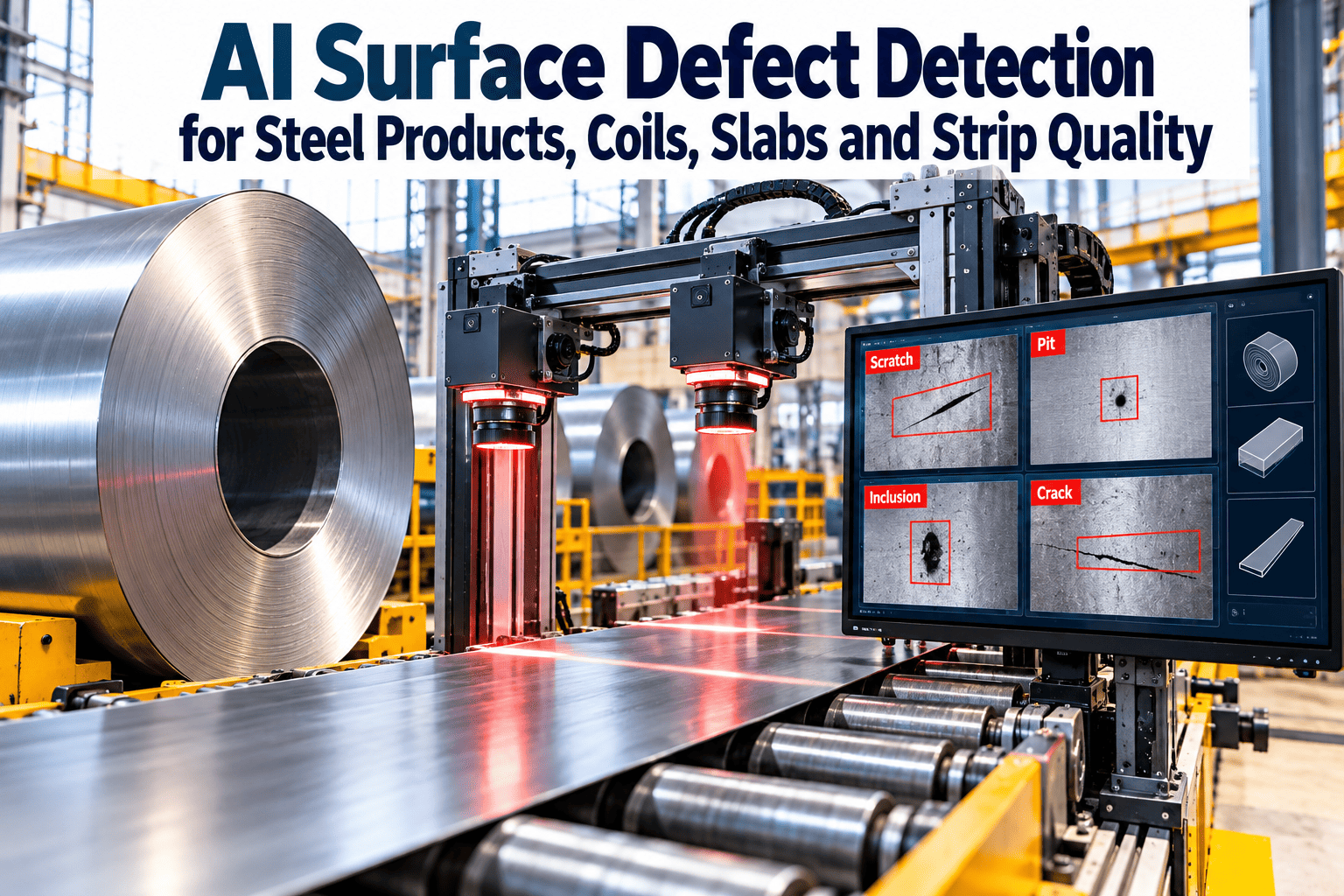
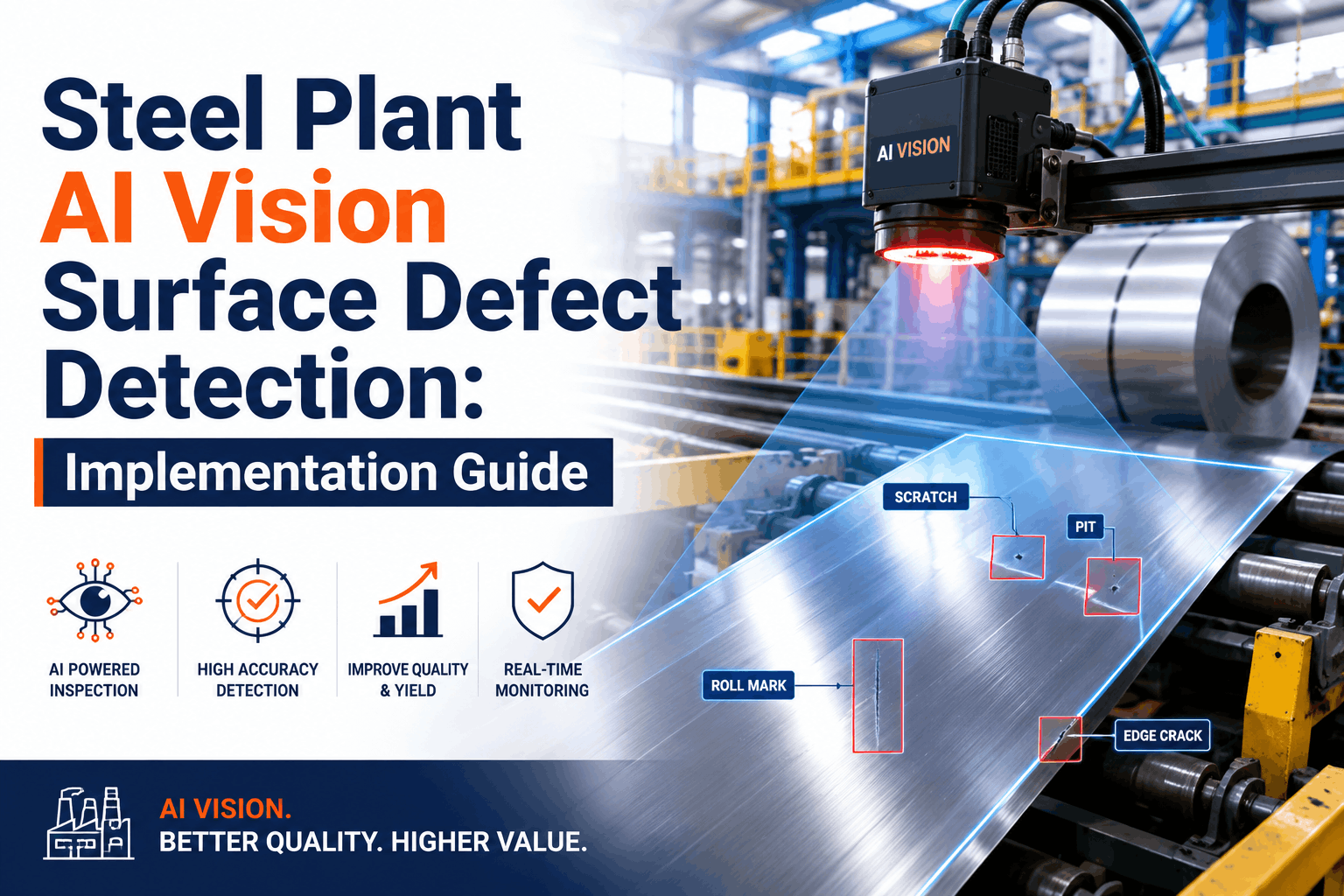
A single surface defect on a hot-rolled coil—a sliver, a scab, a rolled-in scale patch measuring 3mm across—can downgrade a $900/ton prime coil to a $600/ton secondary in the time it takes to miss one frame on a production line running at 3,000 feet per minute. Human inspectors standing at the end of a rolling mill catch 60–70% of surface defects on a good day. On a night shift after eight hours of staring at glowing steel under harsh lighting, that number drops to 40–50%. And the defects they miss don't just cost you the price differential on that coil. They cost you the customer complaint, the quality claim, the emergency sort at the service center, and the reputation damage that turns a long-term automotive or appliance OEM contract into a rebid opportunity for your competitor. The math across an integrated steel mill is staggering: surface quality defects drive 2–5% of total production to secondary or reject status, costing $3M–$12M annually in downgrade losses alone—before accounting for customer claims, sorting costs, and lost business. Computer vision systems using deep learning AI now inspect 100% of the steel surface at full production speed, detecting defects as small as 0.1mm with 95–99% accuracy, classifying them by type and severity in milliseconds, and making automated disposition decisions that remove human subjectivity from quality control entirely. This isn't incremental improvement over manual inspection. It's a fundamentally different capability that sees what humans cannot, operates without fatigue or distraction, and generates the defect data that drives upstream process improvement.
60–70%
Maximum human detection rate for surface defects under optimal conditions
0.1mm
Minimum defect size AI vision systems detect—invisible to the human eye at line speed
$3–12M
Annual cost of surface defect downgrades at a typical integrated steel mill
95–99%
AI detection accuracy—consistent across every shift, every hour, every coil
Why Human Inspection Cannot Meet Modern Quality Demands
Automotive OEMs, appliance manufacturers, and construction product companies are tightening surface quality specifications every year. Class A exposed surface requirements now demand defect-free zones that human inspectors physically cannot verify at production speed. The gap between what customers require and what manual inspection can deliver is widening—and steel producers that don't close it with technology will lose the contracts that carry the highest margins. Facilities that sign up to digitize their quality and maintenance workflows are building the data infrastructure that connects inspection findings to upstream process corrections.
Limitation
Fatigue-Driven Detection Decline
Human visual acuity degrades 20–30% over an 8-hour shift. Night shifts, overtime, and repetitive inspection tasks compound the decline. Detection rates for subtle defects like light scratches and surface texture variations drop below 40% in the final hours of extended shifts.
Limitation
Speed vs. Coverage Trade-Off
Hot strip mills run at 2,000–4,000 ft/min. Cold mills at 3,000–6,000 ft/min. At these speeds, a human inspector sees each surface area for 50–200 milliseconds. Detailed inspection of the full strip width at full speed is physically impossible for the human visual system.
Limitation
Subjective Classification
Two inspectors looking at the same defect will classify it differently 25–40% of the time. Severity grading is even less consistent. This subjectivity creates unreliable quality data that cannot support systematic process improvement or consistent customer quality commitments.
Limitation
No Data Trail for Process Improvement
Manual inspection generates no structured data about defect location, frequency, severity trends, or correlation with process parameters. Without this data, upstream process corrections are based on anecdote rather than evidence—and recurring defect sources persist for months or years.
How AI Surface Inspection Works
Modern computer vision systems for steel surface inspection combine high-speed imaging hardware with deep learning neural networks trained on millions of defect examples. The system captures, analyzes, and classifies every square millimeter of the steel surface at full production speed—generating a complete digital quality record for every coil produced.
1
High-Speed Image Capture
Line-scan cameras operating at 16,000–32,000 pixels per line capture both top and bottom surfaces at resolutions of 0.1–0.5mm per pixel. Specialized LED lighting arrays provide uniform illumination that reveals surface texture, topography, and reflectivity variations invisible under ambient conditions.
2
Real-Time Image Processing
GPU-accelerated edge computing processes 500–2,000 frames per second, applying image normalization, background subtraction, and feature extraction in under 10 milliseconds per frame. The processing pipeline handles the full strip width simultaneously with zero blind spots.
3
Deep Learning Classification
Convolutional neural networks trained on 10M+ labeled defect images classify each detected anomaly by type (crack, inclusion, scale, scratch, dent, stain, edge defect) and severity (light, moderate, severe). Models achieve 95–99% classification accuracy across 20–40 defect categories.
4
Defect Mapping & Grading
Every detected defect is plotted on a spatial defect map showing exact location (length position × width position), dimensions, classification, and severity. Coil-level quality grades are calculated automatically based on customer-specific acceptance criteria and defect density thresholds.
5
Automated Disposition & Routing
AI makes instant pass/fail/downgrade decisions against order-specific quality specifications. Prime-quality coils route to the customer order. Defective sections are flagged for trimming or diversion. Quality reports generate automatically—no manual grading, no subjective judgment, no paperwork delay.
Defect Types: What Computer Vision Detects in Steel
Deep learning models trained specifically on steel surface defects recognize the complete taxonomy of quality issues that occur across hot rolling, cold rolling, coating, and finishing operations. Each defect type has characteristic visual signatures that the AI learns to distinguish even when defects overlap, occur at varying sizes, or appear under different surface conditions.
Hot Rolling Defects
Rolled-In Scale
Detection: 97% | Size: 0.3mm+
Oxide scale pressed into the surface during rolling. Appears as dark, irregular patches with rough texture. Primary cause: descaler malfunction or insufficient water pressure.
Slivers & Seams
Detection: 96% | Size: 0.2mm+
Thin, elongated surface tears from upstream casting or rolling defects folded into the surface. Critical rejection criterion for automotive exposed applications.
Shell & Scab
Detection: 98% | Size: 0.5mm+
Loose or partially detached surface material from mold-related casting defects. Creates raised, irregular patches that cause downstream coating and forming failures.
Edge Cracks & Damage
Detection: 99% | Size: 0.1mm+
Transverse or longitudinal cracks at strip edges from excessive reduction, improper crown, or thermal stress. Width-critical for customers with tight trim tolerances.
Cold Rolling & Finishing Defects
Scratches & Rub Marks
Detection: 94% | Size: 0.1mm+
Linear surface marks from contact with guide equipment, bridle rolls, or threading hardware. Often cosmetic but critical for Class A exposed surface applications.
Roll Marks & Impressions
Detection: 96% | Size: 0.2mm+
Periodic patterns transferred from work roll or backup roll surface defects. Repeating defects at roll circumference intervals that AI identifies through periodicity analysis.
Staining & Discoloration
Detection: 93% | Size: 1.0mm+
Chemical or moisture-related surface contamination from emulsion residue, cooling water, or storage conditions. Affects coating adhesion and paint appearance.
Coating Defects
Detection: 97% | Size: 0.3mm+
Bare spots, uneven coating, dross inclusions, and zinc flower irregularities on galvanized and coated products. Corrosion protection and appearance critical.
Connect Defect Detection to Process Correction
When the vision system finds defects, OxMaint turns those findings into maintenance actions—roll change triggers, descaler inspections, guide alignment work orders. Close the loop between quality detection and root cause elimination.
Manual Inspection vs. AI Vision: Complete Comparison
Scroll horizontally on mobile
From Detection to Prevention: The Quality Feedback Loop
The most valuable output of an AI vision system isn't the defect it catches on the current coil—it's the upstream process correction that prevents the same defect on the next thousand coils. Computer vision generates the structured defect data that makes systematic quality improvement possible for the first time in most steel operations.
Real-Time Defect Identification
AI identifies and classifies every defect on every coil with exact spatial coordinates, dimensions, and severity. Defect density maps reveal patterns—edge-concentrated, center-line, periodic, random—that point directly to root cause categories.
Process Parameter Linkage
Defect data is correlated with upstream process parameters—casting speed, mold level, descaler pressure, rolling reduction, temperature, roll campaign age—to identify the specific process conditions that generate each defect type.
Automated Process Alarms
When defect rates exceed thresholds, automated alerts notify operations and maintenance—descaler pressure dropping triggers an immediate inspection work order, periodic roll marks trigger a roll change, increasing edge cracks flag a width reduction or crown adjustment.
Targeted Maintenance & Process Correction
CMMS work orders generated from vision system alerts ensure every quality issue triggers a tracked corrective action. Roll changes, descaler repairs, guide adjustments, and process parameter corrections are documented and verified against subsequent defect data.
Closed-Loop Confirmation
Post-correction defect rates are automatically compared to pre-correction baselines to verify effectiveness. If the defect persists after the correction, the system re-escalates—ensuring root causes are actually eliminated, not just papered over.
This closed-loop quality feedback system is what separates steel producers that continuously improve from those that fight the same defects year after year. Facilities that sign up to connect vision system alerts with automated maintenance work orders ensure that every detected quality issue generates a tracked, verified corrective action.
ROI Analysis: AI Vision System Investment vs. Return
$4.8M
Reduced Quality Downgrades
Early detection prevents prime-to-secondary downgrades—capturing $200–$400/ton price differential
$1.6M
Customer Claim Reduction
Eliminating defective coils before shipment reduces claims by 70–85%
$1.2M
Process Yield Improvement
Defect-to-process correlation drives upstream corrections that reduce defect generation rates by 25–40%
$680K
Inspection Labor Redeployment
Redeploy 8–12 inspectors to higher-value quality engineering and process improvement roles
$450K
Sorting & Logistics Savings
Automated disposition eliminates manual sorting, reduces warehouse holding time, and optimizes coil routing
Expert Perspective: Deploying AI Vision in Steel Quality Control
"
The steel mills that extract the most value from AI vision systems are the ones that treat defect data as process intelligence, not just quality control. Yes, you'll catch more defects and reduce downgrades—that's the baseline ROI. But the real transformation happens when you start correlating defect patterns with process parameters and feeding that intelligence back upstream. When your vision system tells you that rolled-in scale defects spike every time descaler pressure drops below 2,800 PSI, you've just identified a maintenance trigger that prevents thousands of tons of downgrades. When periodic roll marks appear at exactly 47.3-inch intervals, you know which roll needs changing before the next coil. The mills that connect their vision system to their CMMS and process control system create a quality feedback loop that continuously improves—and that's worth 3–5x more than the inspection capability alone.
Use defect data for process improvement—catching defects is baseline; preventing them is the real ROI
Connect vision alerts to your CMMS—every defect pattern should trigger a tracked maintenance action
Invest in lighting engineering—the camera sees only what the lights reveal
Plan for continuous model retraining—new products and process changes create new defect signatures
The quality control transformation from manual to AI-powered inspection is one of the highest-ROI technology investments in steel production. If you're evaluating computer vision for your mill, book a free demo to see how defect detection data integrates with maintenance workflows and process improvement tracking.
See Every Defect. Fix Every Root Cause. Ship Prime Steel.
OxMaint connects AI vision system alerts to a complete maintenance and quality platform—every defect pattern triggers a work order, every correction is tracked, every result is verified. Transform quality data into continuous process improvement.
Frequently Asked Questions
Can AI vision systems operate reliably in the harsh environment of a hot strip mill?
Yes—industrial vision systems designed for steel mills are engineered specifically for these conditions. Camera housings are water-cooled and air-purged to withstand the radiant heat near the runout table and coiler area. Protective enclosures are rated IP67 or higher to resist steam, water spray, scale dust, and oil mist. Optical windows use sapphire or hardened glass with automatic air-knife cleaning to prevent contamination buildup. LED lighting arrays are sealed and thermally managed for continuous operation in ambient temperatures exceeding 60°C. The systems are designed for 95%+ uptime with scheduled maintenance intervals aligned to mill turnaround schedules. Redundant camera configurations ensure that a single camera failure doesn't create inspection blind spots. Most hot mill installations operate continuously for 6–12 months between maintenance interventions on the vision hardware itself.
How does the AI learn to recognize new defect types it hasn't seen before?
The initial AI model is trained on a large baseline dataset of steel surface defect images—typically 5–10 million labeled examples covering the major defect categories. During deployment, the system uses a combination of supervised and semi-supervised learning approaches. New or unusual defects that the model cannot classify with high confidence are flagged for human review. Quality engineers label these images, and they're added to the training dataset for periodic model retraining—typically quarterly. Over 12–18 months, the model becomes highly specialized to your specific products, processes, and defect signatures. Transfer learning techniques allow models trained on one mill's data to be adapted to similar mills with significantly less site-specific training data. The system also employs anomaly detection algorithms that flag any unusual surface condition even if it doesn't match a known defect category—ensuring truly novel defects are not silently passed.
What happens when the vision system detects a defect mid-coil during production?
The response depends on defect severity and the downstream application. For critical defects that exceed order-specific rejection thresholds, the system can trigger immediate operator alerts, automatic marking of the defective section for downstream identification, and real-time quality disposition updates that reclassify the coil from prime to secondary before it reaches the shipping bay. For trending defect increases that suggest a developing process issue—like rising scale inclusion rates or emerging roll marks—the system sends alerts to both quality and maintenance teams while production continues. The defect map is stored with the coil record, so downstream processing stations (pickling, cold rolling, coating, slitting) know exactly where defects are located and can optimize their own processing accordingly. Some mills implement automatic diversion at the coiler or downcoiler to separate defective coils from prime product without manual intervention.
How does AI vision integrate with our existing quality management and Level 2 systems?
AI vision systems integrate at multiple levels. With Level 2 process automation, the vision system receives slab/coil tracking data (grade, dimensions, target specs, order requirements) to apply the correct inspection criteria automatically—different customers have different acceptance standards. Defect data flows back to Level 2 for real-time quality disposition. With quality management systems, detailed defect reports including spatial maps, defect images, classification statistics, and grading results are exported via standard APIs for permanent quality record storage and customer documentation. With CMMS platforms like OxMaint, defect patterns trigger automated maintenance work orders—roll change alerts when periodic marks are detected, descaler inspection orders when scale inclusion rates rise, guide alignment tasks when edge damage patterns appear. Integration with process historians enables the defect-to-process correlation analysis that drives upstream improvement.
What does an AI surface inspection system cost for a steel mill?
Total investment for a comprehensive AI surface inspection deployment covering hot strip mill, cold mill, and coating line runs $2M–$5M. Individual inspection point costs range from $500K–$1.5M depending on strip width, line speed, resolution requirements, and environmental protection needs. This includes high-speed cameras and lighting ($200K–$500K per inspection point), computing hardware and edge processing ($100K–$250K per point), AI software platform and trained models ($200K–$500K), integration with Level 2, QMS, and CMMS systems ($100K–$300K), and installation, commissioning, and model fine-tuning ($200K–$400K). Annual operating costs of $200K–$400K cover software licensing, model retraining, hardware maintenance, and system support. With annual returns of $6M–$10M from downgrade reduction, claim elimination, yield improvement, and labor redeployment, payback periods of 6–12 months are standard for mills with meaningful quality downgrade costs.