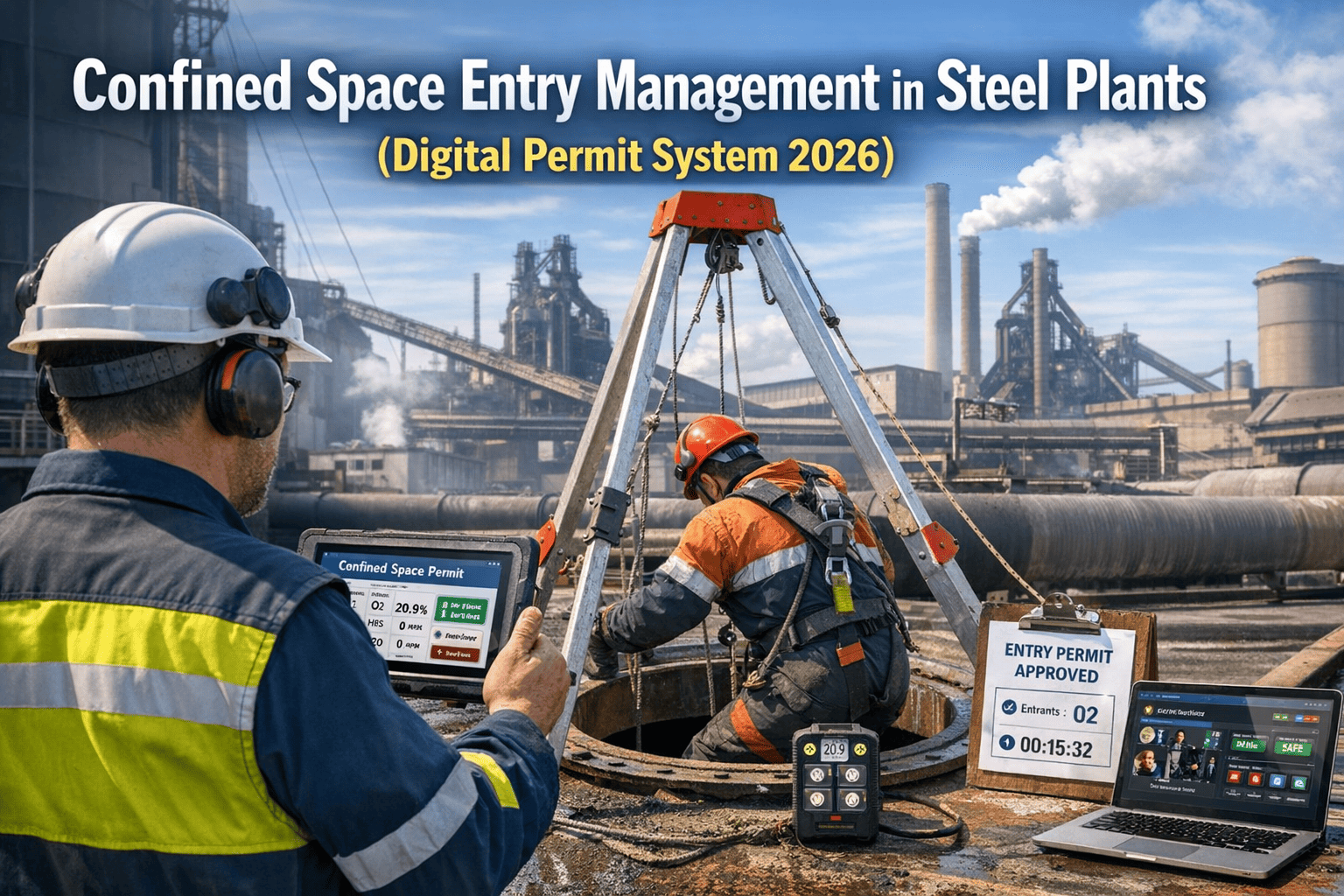
Confined space fatalities in integrated steel operations are disproportionately caused not by the work itself but by the failure of the safety system surrounding it — an incomplete gas test, a permit issued without rescue confirmation, a second worker entering to help a collapsed colleague without atmospheric verification. OSHA data shows that 60% of confined space fatalities are rescuers, not the initial entrant. In a steel plant where blast furnace gas (containing 20–27% CO), coke oven gas (5–7% CO plus H2S), and process nitrogen purge systems can simultaneously be present in any given vessel or duct, the margin for procedural failure is effectively zero. OxMaint's Compliance Tracking module digitises the entire confined space entry workflow — gas reading records, entrant tracking, rescue team confirmation, and permit closure — into a mobile-accessible system that closes the gaps that paper permits consistently leave open. This guide covers how steel plants are combining digital permits, continuous gas monitoring, and mobile checklists to operate confined space entries at a standard that survives OSHA inspection and protects workers who enter the most hazardous spaces in industrial manufacturing.
Confined Space Safety Monitoring for Steel Plants
Atmospheric testing protocols, digital permit workflows, continuous gas monitoring, rescue confirmation, and mobile safety checklists — the complete confined space safety framework for blast furnace, coke oven, and process vessel entry in integrated steel facilities.
Confined Space Hazard Classification — Steel Plant Locations
Not all confined spaces in a steel plant carry equal risk. OSHA 29 CFR 1910.146 classifies permit-required confined spaces as those with one or more serious hazard: hazardous atmosphere, material that could engulf an entrant, an internal configuration that could trap a person, or any other serious safety or health hazard. In an integrated steel facility, the vast majority of vessels, furnaces, tanks, and ducts that require periodic maintenance entry qualify as permit-required. The table below maps the primary confined space locations to their atmospheric hazards and required monitoring parameters.
| Confined Space Location | Primary Atmospheric Hazard | Gas Monitoring Parameters | OSHA Classification | Additional Hazards |
|---|---|---|---|---|
| Blast Furnace Hearth / Tuyere Area | CO up to 27,000 ppm (BFG content), O2 deficiency from N2 purge | O2, CO, LEL — continuous | Permit-Required | Extreme radiant heat, solidified iron bridging |
| Coke Oven Gas Main (Underfiring) | COG: CO 5–7%, H2S 0.5–1%, LEL combustible mix | O2, CO, H2S, LEL — continuous | Permit-Required | Residual tar deposits, ignition risk from static |
| BOF Gas Recovery Hood | CO up to 60% vol during vessel rocking; N2 purge creates O2 deficiency | O2, CO, LEL — continuous + pre-entry | Permit-Required | Molten splash residue, vessel movement risk |
| Ladle Preheating Station Interior | Combustion products: CO, NO2; O2 deficiency post-preheat | O2, CO, NO2 — pre-entry test | Permit-Required | Refractory at 300–500°C, confined geometry |
| Scrubber Tower / Wet Gas Cleaning Vessel | H2S from BFG scrubbing; CO residual; O2 deficiency possible | O2, CO, H2S, LEL — pre-entry + periodic | Permit-Required | Corrosive deposits, entrapment in sludge |
| Rolling Mill Pit / Scale Pit | O2 deficiency from steam accumulation; H2S from organic scale breakdown | O2, H2S — pre-entry test | Permit-Required | Engulfment in hydraulic scale, steam burns |
Every confined space entry in a steel plant carries a legal obligation to demonstrate that the entry was authorised, the atmosphere was tested, the rescue team was confirmed, and each entrant was tracked. OxMaint generates this evidence trail automatically — from permit issue to permit closure — so your safety records are ready for an OSHA inspector the moment they walk in. Book a demo to see the live permit workflow.
Gas Testing Protocols — Atmospheric Verification Before Every Entry
OSHA 29 CFR 1910.146(c)(5)(ii) requires testing of the confined space atmosphere for oxygen content, flammable gases and vapours, and potential toxic air contaminants before any authorised entrant enters the space. In a steel plant, the sequence of testing matters: testing for oxygen first (because LEL sensors require at least 10% O2 to function accurately), then LEL, then specific toxics. A gas detector that reads LEL accurately in a 21% O2 environment will give a false-low LEL reading in an O2-deficient space — a fact that has contributed to multiple fatalities where combustible gas presence was missed due to O2 depletion.
Digital Permit Workflow — From Request to Entry Authorisation
A confined space permit is a live operational document — not a form completed before the job and filed after. Every step from entry request to permit closure generates a timestamped, signed record that must be retrievable for OSHA inspection. In steel plants where a single confined space maintenance shutdown can involve 10–15 permit-required entries across multiple vessels, the paper permit system creates record management failures that only surface during an incident investigation.
Maintenance supervisor creates confined space entry work order in OxMaint, selecting the confined space asset from the register. System retrieves the space classification, required monitoring parameters, and applicable rescue procedure automatically. Entry request routed to safety officer for permit issuance authorisation.
Safety officer performs atmospheric testing using calibrated multi-gas detector. All readings (O2, CO, H2S, LEL) entered into OxMaint mobile form with instrument serial number and calibration date. System validates readings against configured safe-entry thresholds. Any reading outside limits automatically locks permit from proceeding.
OxMaint requires confirmation of rescue team availability as a mandatory permit gate — the permit cannot proceed to entrant sign-in without rescue team name, location, and equipment confirmed. This single requirement prevents the most common confined space fatality scenario: entry proceeding without an available rescue capability.
Each entrant signs in via mobile OxMaint app — name, entry time, and assigned personal gas monitor serial number recorded. Attendant identity confirmed and communications tested. Space entry count visible to safety supervisor in real time from command dashboard.
OxMaint generates re-test reminder alerts at configured intervals (default: every 60 minutes). Continuous gas monitor data, where IoT-connected, feeds live to the permit dashboard. Any exceedance of configured abort conditions auto-generates an evacuation alert to the attendant and safety officer simultaneously.
Permit cannot be closed until all signed-in entrants have signed out. Headcount mismatch at permit closure generates an immediate alert. Closed permit with all gas readings, entrant records, and attendant sign-offs archived against the confined space asset record — retrievable for OSHA inspection in under 5 minutes.
Before vs After — Confined Space Safety Programme Outcomes
A 2.4 MTPA integrated steel plant in eastern India operating blast furnace, coke oven battery, BOF steelmaking, and hot strip mill implemented OxMaint digital confined space permits across 48 permit-required spaces. Results measured over 12 months versus the prior paper-based permit system baseline.
Every Entry. Every Gas Reading. Every Entrant. One Audit Trail.
OxMaint enforces every confined space safety requirement as a digital workflow gate — gas tests, rescue confirmation, entrant sign-in, re-test alerts, and headcount closure — producing OSHA-ready records automatically. Most steel plants are live within one week.
Compliance Documentation Requirements — Confined Space Entry
OSHA 1910.146(e) defines the specific information each confined space permit must contain. An incomplete permit — missing any of the 16 required elements — is itself a violation regardless of whether an incident occurred. ISO 45001 Clause 8.1.3 adds additional requirements for documented management-of-change controls when confined space conditions change during a maintenance shutdown.
| Required Record Element | OSHA Reference | Retention | OxMaint Feature |
|---|---|---|---|
| Pre-entry atmospheric test results (all parameters) | 1910.146(e)(7) | 1 year minimum | Mandatory permit field — instrument ID required |
| Rescue and emergency services identified | 1910.146(e)(9) | 1 year minimum | Mandatory gate — permit locked without rescue confirm |
| Entrant names and sign-in/out times | 1910.146(e)(12) | 1 year minimum | Mobile entrant tracking — headcount enforced at closure |
| Attendant name and communications confirmed | 1910.146(e)(11) | 1 year minimum | Attendant assignment field with comms test confirmation |
| Hazard identification and isolation measures | 1910.146(e)(6) | 1 year minimum | Linked to LOTO permit and asset hazard register |
| Periodic atmospheric re-test records | 1910.146(d)(5)(iii) | 1 year minimum | Re-test alert + mandatory entry at configured interval |
Expert Review
The rescue confirmation requirement is the most frequently absent element in paper-based confined space permits I have reviewed in steel operations — present on the form as a checkbox, absent in practice as a verified action. In most cases, the rescue team has not been notified, is not at the location, and would not arrive within the physiologically critical timeframe if an entrant collapsed from CO exposure. The OSHA statistic that 60% of confined space deaths are rescuers exists precisely because untrained bystanders enter to help without atmospheric verification when no formal rescue plan was activated at permit issue. Digital permit systems like OxMaint prevent this by making rescue confirmation a technical lock — the workflow does not proceed without it. That single feature is worth the entire investment in every steel plant I have worked with that has implemented it.
Frequently Asked Questions
Digital Permits. Mandatory Gas Test Gates. Rescue Confirmation. Live Entrant Tracking.
OxMaint replaces paper confined space permits with a digital workflow that enforces every OSHA 1910.146 requirement — from pre-entry atmospheric testing to headcount closure — and stores every record for instant audit retrieval. Most steel plant safety teams are live within 5 days.