Confined Space Entry Permit Management for Steel Plants
By John Mark on March 13, 2026
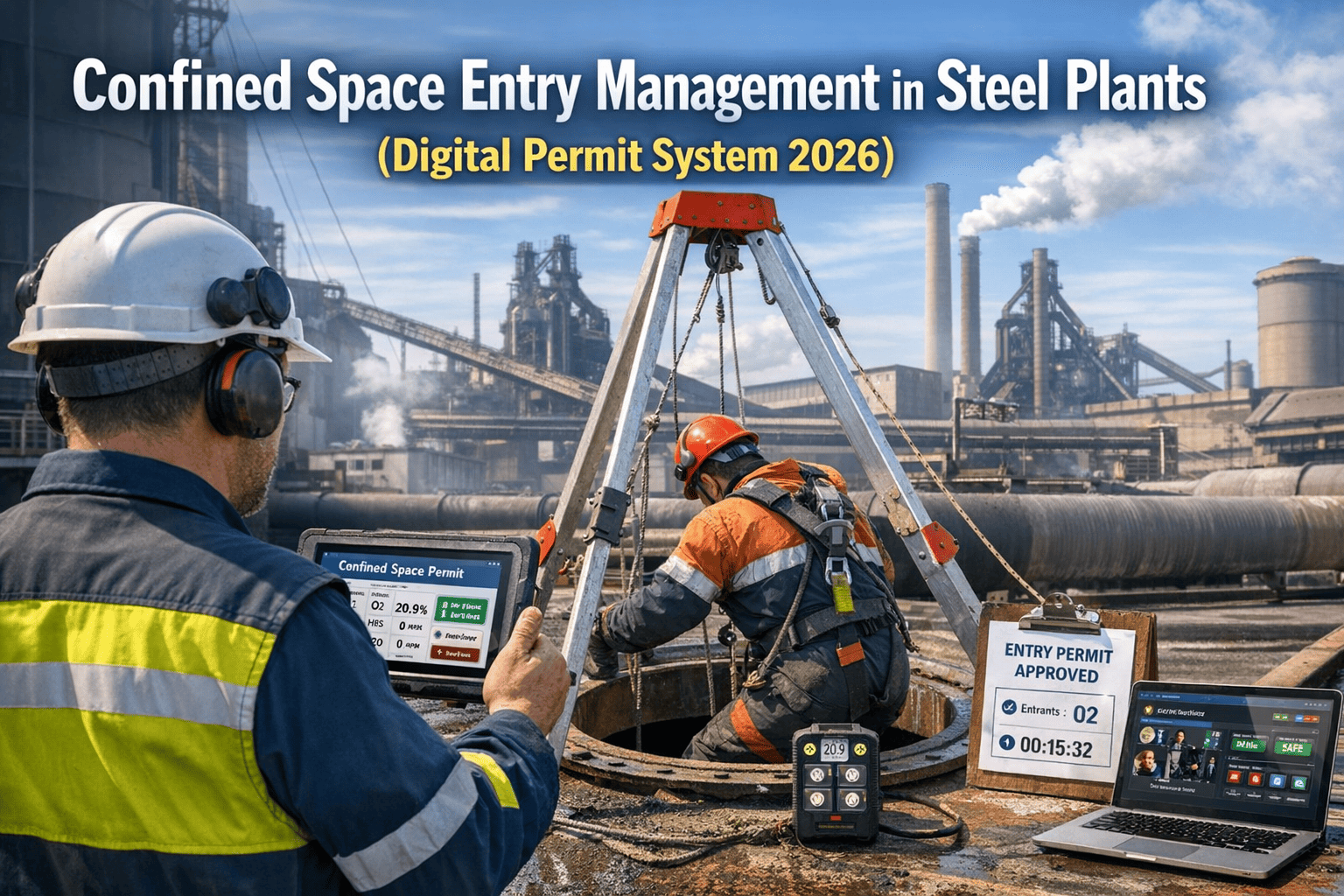
Steel plants contain some of the most hazardous confined spaces in any industrial sector—blast furnace interiors, ladle pits, underground cable tunnels, dust collector hoppers, water treatment vessels, and hundreds of other enclosed areas where oxygen deficiency, toxic gases, extreme heat, and engulfment risks can kill within seconds. A failed confined space entry permit process does not result in a near-miss report. It results in fatalities. Yet across the industry, permit-to-work systems are still managed on paper forms, shared clipboards, and verbal handoffs that leave no audit trail and create dangerous gaps in hazard control. Schedule a free permit management review with our team and find out where your current system leaves workers exposed—and how to close those gaps before an incident occurs.
Why Confined Space Entry Is the Highest-Risk Maintenance Activity in Steel Plants
Confined space fatalities are disproportionately common in heavy manufacturing, and steel plants concentrate nearly every confined space hazard in a single facility. What makes these incidents uniquely devastating is that they frequently claim multiple lives—would-be rescuers who enter without proper equipment account for more than half of all confined space fatalities in industrial settings. A permit management system that fails at any single point in the entry sequence can trigger a cascade of deaths within minutes.
54%
Of confined space fatalities involve would-be rescuers entering without proper permits or equipment
92%
Of confined space incidents are preventable with complete hazard identification and proper permit compliance
$2.5M+
Average total cost of a single confined space fatality including penalties, legal costs, and remediation
67%
Of confined space incidents involve permit non-compliance, incomplete atmospheric testing, or missing isolations
The 7 Critical Elements Every Steel Plant Confined Space Permit Must Include
A confined space entry permit is not a bureaucratic checkbox—it is a legally binding safety contract between the authorizing manager, the entrant, and the attendant. Missing or incomplete elements in any of these seven categories have directly contributed to industrial fatalities. Each element must be verified, documented, and signed off by the appropriate authority before any entry begins.
01
Atmospheric Testing and Monitoring
Pre-entry atmospheric testing for oxygen levels (19.5%–23.5% acceptable range), flammable gases (below 10% LEL), carbon monoxide, hydrogen sulfide, and any process-specific contaminants. Continuous monitoring required for all permit-required entries.
Safety Critical
02
Energy Isolation and Lockout/Tagout
Complete isolation of all energy sources—electrical, mechanical, hydraulic, pneumatic, thermal, and chemical—with verified lockout/tagout applied to each isolation point. Blanking or blinding of all process lines connected to the confined space.
Safety Critical
03
Roles and Responsibilities Assignment
Named and competent individuals assigned to each required role: Permit Authorizing Authority, Entry Supervisor, Confined Space Entrant(s), Attendant (hole watch), and Rescue Team. Each person must sign the permit confirming their role and awareness of hazards.
Required
04
Hazard Identification and Control Measures
Documented identification of all physical, chemical, and atmospheric hazards specific to the confined space and the planned work activity. For each hazard, corresponding control measures must be listed, verified as in place, and signed off before entry authorization.
Required
05
Personal Protective Equipment Requirements
Specific PPE requirements listed and confirmed as issued for each entrant: respiratory protection type and fit-tested status, chemical-resistant clothing, harness and retrieval system, communication equipment, and any space-specific protective equipment.
Required
06
Emergency and Rescue Procedures
Pre-planned rescue procedures documented on the permit, including non-entry retrieval method, emergency contact numbers, nearest emergency equipment location, and hospital route. Rescue team must be briefed and on standby or immediately available before entry begins.
Safety Critical
07
Permit Duration, Validity, and Closure
Defined start and end time for the permit with maximum duration limits (typically one shift). Conditions under which the permit is immediately cancelled. Formal permit closure process confirming all entrants have exited, isolations remain in place, and the space is secured.
Required
Digital Permit Management
Replace paper permits with a digital system that enforces every checkpoint before entry is authorized.
Oxmaint's permit-to-work module ensures no confined space entry proceeds without complete documentation, verified atmospheric data, and authorized signatures.
Confined Space Classification in Steel Plant Environments
Not every confined space in a steel plant carries the same level of risk, and applying the same permit requirements to all of them wastes resources and creates permit fatigue that reduces compliance. A proper classification system assigns the correct level of control to each space based on its actual hazard profile—keeping workers safe without burying your team in paperwork for low-risk spaces.
Permit-Required
Class A — Highest Risk
Blast furnace interiorsLadle and torpedo car pitsCoke oven chambersConverter vesselsFull permit + rescue standby required
Reassess annually
Permit-Required
Class B — Moderate Risk
Water treatment vesselsDust collector hoppersCable and pipe tunnelsCoolant system tanksFull permit + attendant required
Reassess on change
Non-Permit Required
Class C — Lower Risk
Ventilated enclosuresShallow inspection pitsLarge access manholesOpen-topped vesselsSafe work procedure only
Digital vs. Paper Permit Systems: Why Steel Plants Must Modernize
Paper-based confined space permit systems have been the industry standard for decades, but they carry structural weaknesses that digital management eliminates entirely. As steel plants operate across multiple shifts, zones, and contractors simultaneously, the volume and complexity of permit management outpaces what paper systems can reliably track.
Capability
Paper Permit System
Digital Permit System
Risk Impact
Permit Authorization
Physical signature, can be bypassed or forged
Multi-factor digital sign-off with role verification
High reduction
Active Permit Tracking
No real-time visibility of open permits across site
Live dashboard of all active entries by location
High reduction
Atmospheric Test Records
Handwritten readings, no instrument linkage
Direct instrument data entry with out-of-range alerts
Critical reduction
Permit Cancellation
Verbal cancellation—no audit trail created
Timestamped digital cancellation with reason logged
Medium reduction
Regulatory Audit Access
Manual retrieval of paper files, risk of loss
Instant searchable audit trail, years of records
Compliance secured
Contractor Permit Control
Separate paper systems, no site-wide visibility
Unified platform with contractor credential verification
High reduction
Built for Steel Plants
See how Oxmaint's digital permit system eliminates every gap that paper-based permits leave open.
Live walkthrough of confined space permit workflows—from hazard identification to permit closure and audit reporting.
Enforce every checkpoint before entry is authorized
Real-time dashboard of all active permits across the plant
Automatic alerts when atmospheric readings exceed safe limits
Link permits directly to work orders and maintenance records
Verify contractor certifications before permit authorization
Instant audit-ready records for regulatory inspections
Implementation Roadmap: Building a Robust Confined Space Permit Program
A world-class confined space permit management program is not built overnight. It requires systematic development across four phases that build on each other—starting with space identification and ending with a continuous improvement culture that drives compliance rates toward 100% across every shift and every contractor team on site.
Phase 1 — Weeks 1–6
Confined Space Inventory and Classification
Conduct a comprehensive walk-down of the entire facility to identify and document every confined space. For each space, record its physical characteristics, potential atmospheric hazards, energy isolation points, access and egress routes, and historical incident or near-miss data. Assign preliminary classifications and build the confined space register that will serve as the master reference for all permit activity. This register must be kept current and reviewed whenever physical changes are made to the plant.
Space identificationHazard assessmentClassification matrixSpace register creation
Phase 2 — Weeks 7–14
Permit System Design and Digital Deployment
Design permit templates for each classification level, incorporating all mandatory elements and space-specific hazard controls. Implement digital permit management to replace paper forms, establishing role-based access for authorizing authorities, entry supervisors, and attendants. Configure automated alerts for permit expiry, atmospheric threshold breaches, and missing sign-offs. Integrate the permit system with your CMMS so that confined space entries are linked directly to the maintenance work orders that require them.
Deliver role-specific training for all personnel involved in confined space entry—authorizing authorities, entry supervisors, entrants, and attendants. Training must cover hazard recognition, atmospheric monitoring procedures, emergency response, and the digital permit workflow. Verify competency through practical assessment before granting system access. Extend the training program to all contractors who regularly perform work requiring confined space entry on your site, and link contractor competency records to permit authorization controls.
Role-specific trainingPractical assessmentContractor onboardingCompetency records
Phase 4 — Month 6 Onward
Audit, Review, and Continuous Improvement
Establish a regular permit audit program—both planned and unannounced—to verify that permit conditions are being followed in practice, not just on paper. Review all permit cancellations, near-misses, and incidents for systemic gaps in the permit process. Conduct annual reviews of confined space classifications, particularly after any plant modifications. Use digital permit data to identify patterns: which spaces generate the most permits, which hazards are most frequently identified, and where compliance rates fall below target thresholds.
Permit Compliance KPIs Every Steel Plant Safety Manager Must Track
Measuring confined space permit performance with data transforms safety management from reactive incident reporting to proactive risk reduction. These key performance indicators give safety managers and operations leaders the visibility they need to intervene before a non-compliance event becomes an incident.
Permit Compliance Rate
Target: 100%
Percentage of confined space entries conducted with a valid, fully completed permit in place. Any figure below 100% indicates unauthorized entries are occurring and must be treated as a critical safety failure requiring immediate investigation.
Atmospheric Test Completion Rate
Target: 100%
Percentage of permits with all required atmospheric tests recorded before entry authorization. Missing test records are one of the most common compliance failures identified in confined space incident investigations.
Permit Cancellation Rate
Target: track trends
Percentage of issued permits cancelled before entry is completed. A rising cancellation rate may indicate improving hazard awareness—or it may reveal that permits are being issued before conditions are ready. Both interpretations require investigation.
Isolation Verification Rate
Target: 100%
Percentage of permits with documented verification of all energy isolations before entry. Isolation failures—where a process line is thought to be isolated but is not—account for a significant proportion of confined space fatalities in heavy manufacturing.
Near-Miss Reporting Rate
Target: increasing trend
Number of near-miss events reported relative to the number of confined space entries conducted. A rising near-miss rate combined with good permit compliance indicates a healthy reporting culture. A flat or falling rate despite active entries suggests under-reporting.
Contractor Permit Compliance Rate
Target: equal to direct staff
Separate tracking of contractor-conducted confined space entries versus direct employee entries. Compliance gaps between the two groups indicate that contractor management controls—induction, supervision, and credential verification—require strengthening.
Common Confined Space Permit Failures in Steel Plants
These failures appear consistently in post-incident investigations and regulatory enforcement actions across the steel manufacturing industry. Each one represents a systemic gap—not a one-time human error—that only structured permit management can reliably prevent.
01
Skipping Re-testing After Work Break
Atmospheric conditions inside a confined space can change rapidly during work breaks—particularly in steel plant environments where adjacent process activity can introduce gases. Permits that do not mandate re-testing before re-entry after any break expose workers to conditions that may have become immediately dangerous.
02
Unqualified or Absent Attendants
The attendant (hole watch) role is frequently treated as a low-priority assignment filled by whoever is available. An attendant who is not trained in emergency procedures, who leaves their post, or who attempts a rescue instead of summoning help, transforms a survivable incident into a fatality.
03
Incomplete Energy Isolation
Partial isolation—where most but not all energy sources are locked out—is more dangerous than no isolation because it creates false confidence. Isolation point registers that are not kept current, particularly after plant modifications, are a root cause of incomplete isolation failures in steel plant confined space incidents.
04
Permit Scope Creep During Work
A permit issued for one task is used to cover additional work that was not assessed when the permit was authorized. If the additional work introduces new hazards—hot work near the entry point, additional personnel, or chemical use—the original permit controls no longer apply and a new assessment is required.
05
Expired Permits Still in Use
Without a real-time permit tracking system, expired permits continue to be referenced as authorization for ongoing work. Paper-based systems have no mechanism to flag expiry or automatically cancel access when a permit period ends, creating invisible authorization gaps across multi-shift operations.
06
No Formal Permit Closure Process
Permits that are never formally closed leave the system without confirmation that all entrants have exited, tools and materials have been removed, and the space has been secured. Informal closures—verbal confirmations or permits left to expire—create risks for subsequent workers who may assume the space is safe because a permit was previously issued.
Frequently Asked Questions
What defines a permit-required confined space in a steel plant?
A permit-required confined space is any confined space that contains or has the potential to contain a serious hazard. In steel plants, this includes: spaces with atmospheric hazards (oxygen deficiency, toxic or flammable gases), spaces with engulfment hazards (materials that could trap or bury an entrant), spaces with internal configuration hazards (converging walls, sloping floors that could trap a person), and spaces connected to systems that contain hazardous energy. The vast majority of confined spaces in steel plants qualify as permit-required due to the proximity of blast furnace gases, process chemicals, and high-temperature systems.
How long must confined space entry permits be retained?
Regulatory requirements vary by jurisdiction, but most industrial safety frameworks require confined space entry permits to be retained for a minimum of one year from the date of cancellation or closure. Where a permit-related incident occurred, records must typically be retained for the duration of any investigation or legal proceeding. Best practice for steel plants is to retain all permit records digitally for a minimum of five years, as this covers both routine regulatory audit cycles and the longer timeframes associated with occupational illness or latent injury claims.
Can contractors manage their own confined space permits on our site?
Contractors may use their own permit systems only if those systems meet or exceed your facility's requirements and have been formally approved by your site safety authority. In practice, most steel plants require all confined space entries—including contractor entries—to be authorized through the host facility's permit system, with the site's authorizing authority signing off on every permit. This ensures a single, unified view of all active entries across the facility regardless of who is performing the work. Contractor permit compliance must be audited separately and held to the same standard as direct employee entries.
What atmospheric levels are considered immediately dangerous to life or health (IDLH) in steel plant confined spaces?
Immediately dangerous to life or health conditions in steel plant confined spaces include: oxygen concentration below 16% or above 23.5%, carbon monoxide above 1,200 ppm (IDLH threshold), hydrogen sulfide above 50 ppm, and any flammable gas or vapor above 10% of the lower explosive limit. Steel plants have additional specific hazards: blast furnace gas containing high concentrations of carbon monoxide, coke oven gas with hydrogen and benzene, and converter gases with carbon monoxide and carbon dioxide. Atmospheric monitoring equipment must be calibrated for the specific gas profiles present in each identified space—generic four-gas monitors may not detect all relevant hazards in steel plant environments.
How does a digital permit system integrate with maintenance work order management?
A properly integrated digital permit system links each confined space entry permit directly to the maintenance work order that requires the entry. When a work order is created for a task requiring confined space access, the CMMS automatically flags the permit requirement and prevents the work order from being assigned to a technician until a valid permit is in place. On permit closure, the completion record is attached to the work order and asset history. This bidirectional integration creates a complete audit trail connecting maintenance activity, safety authorization, atmospheric data, and personnel records—providing the documentation baseline required for both incident investigation and regulatory compliance.
Start Today
Every Confined Space Entry Deserves a Permit System That Cannot Fail.
Oxmaint gives your steel plant a digital confined space permit platform that enforces every checkpoint, tracks every active entry, links to every work order, and generates the audit trail your safety team and regulators require—from day one.