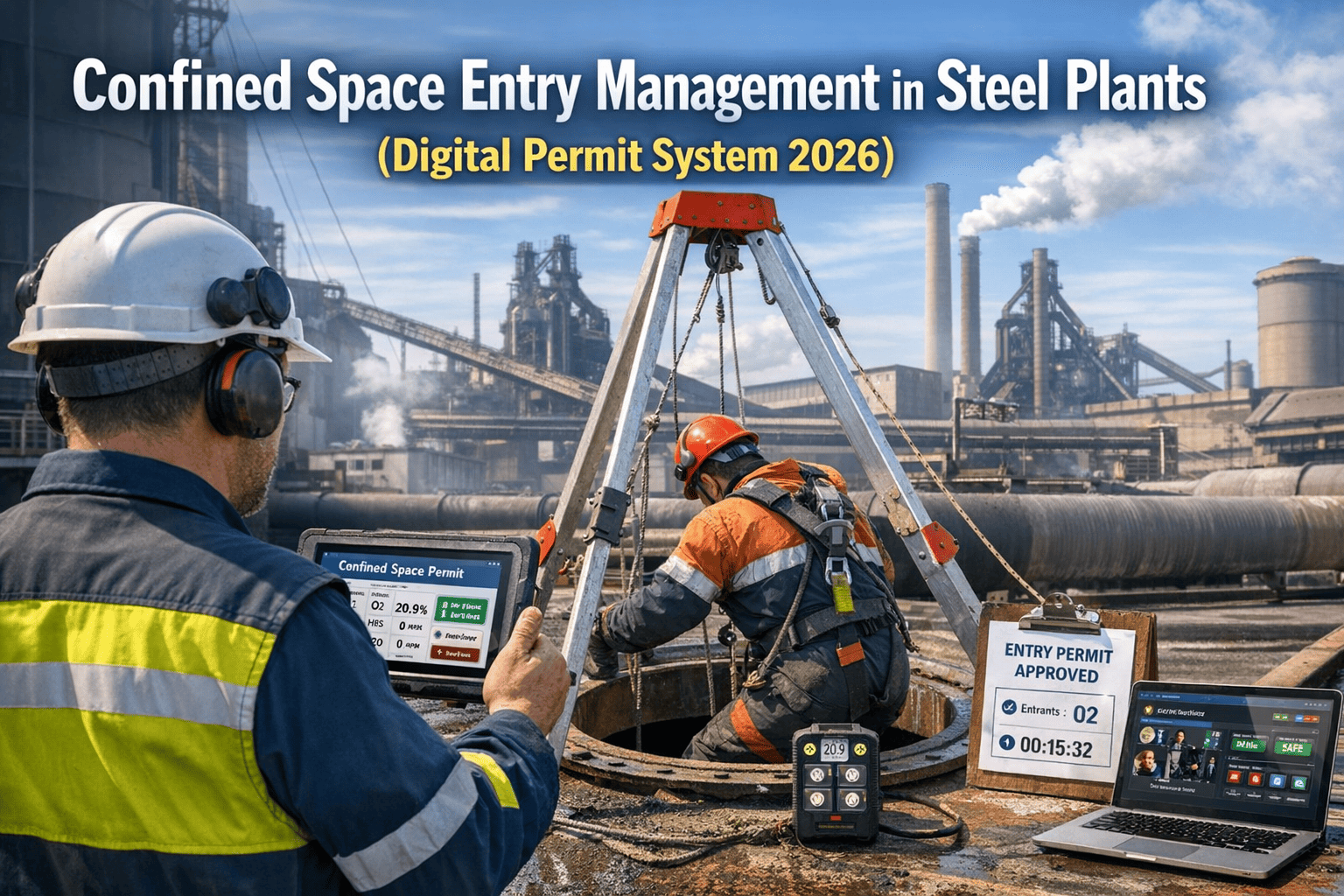
Digital confined space entry management enhances safety in steel plants by streamlining permit-to-work processes and real-time monitoring. With features like atmospheric gas detection, entrant tracking, and structured rescue planning, risks are significantly reduced. OxMaint enables end-to-end visibility and compliance, ensuring safer operations in high-risk confined environments.OxMaint — Digital Safety for Permit Management for Heavy Industry
Confined Space Entry Management
Digital Permit-to-Work + Real-Time Safety Monitoring for Steel Plants
Why Steel Plants Face the Highest Confined Space Risk
Steel plants contain dozens of permit-required confined spaces — blast furnace pits, ladle pits, tundish areas, dust collectors, underground cable tunnels — all operating under extreme heat, toxic gas exposure, and low oxygen conditions.
Toxic Gas Buildup
Carbon monoxide, sulfur dioxide, and nitrogen oxides accumulate rapidly in enclosed steel plant spaces with no warning.
Oxygen Deficiency
Oxygen levels drop below safe thresholds silently. Workers lose consciousness before they can self-rescue.
Paper-Based Permits
Manual permits get lost, go unsigned, or miss critical atmospheric checks — creating invisible compliance gaps.
No Real-Time Tracking
Without digital entrant tracking, supervisors don't know who is inside, for how long, or when conditions changed.
Is your team still managing confined space permits on paper?
Start Free Book a DemoHow OxMaint Digitizes Your Entire CSE Process
From hazard identification to permit closure, every step is tracked, verified, and audit-ready in real time.
Space Identification & Classification
Log all confined spaces in your plant with GPS tagging, hazard type, and PRCS classification. Always up to date.
Digital Permit Issuance
Entry supervisors issue permits on mobile. Pre-entry checklists, atmospheric readings, and isolations all logged digitally.
Live Atmospheric Monitoring
Connect gas detectors to OxMaint. Get real-time O2, CO, H2S, and LEL readings with automated alerts on exceedance.
Entrant Check-In / Check-Out
Every worker scans in and out. The attendant dashboard shows who is inside, since when, and how long is remaining.
Rescue Plan Activation
One-tap emergency escalation. Rescue team notified instantly with the space location, last known entrant count, and atmospheric data.
Permit Closure & Audit Log
Permits auto-close after shift. Full tamper-proof audit trail stored for OSHA 1910.146 compliance review.
Paper Permits vs. OxMaint Digital Permits
Pre-Entry Confined Space Checklist for Steel Plants
Use this checklist before every confined space entry. OxMaint makes every item a verified digital record.
- Entry permit issued and signed by Entry Supervisor
- All energy sources isolated and LOTO applied
- Atmospheric test sequence completed (O2 → Flammable → Toxic)
- Ventilation equipment installed and running
- Authorized entrants briefed on hazards
- Attendant (standby person) posted outside
- Rescue team on standby and notified
- Retrieval system (harness + lifeline) in place
- Communication system tested between entrant and attendant
- Continuous atmospheric monitoring active
- Entrant check-in logged with entry time
- Emergency evacuation signal agreed upon
- All entrants checked out and accounted for
- Equipment removed from space
- Space restored to normal operating condition
- Permit cancelled and filed for 12-month retention
- Post-entry debrief completed and documented
Built for Steel Plant Safety Teams
Digital Permit-to-Work
Structured, role-based permit workflows. Entry Supervisor, Attendant, and Entrant roles enforced digitally with e-signatures.
Atmospheric Monitoring Integration
Real-time gas readings from connected detectors. Automatic alerts when O2, CO, H2S, or LEL cross safe thresholds.
Live Entrant Dashboard
Know exactly who is inside every confined space, their entry time, and how long they have left on the permit.
Rescue Plan on Mobile
Emergency escalation with one tap. Rescue team gets space location, atmospheric data, and entrant count instantly.
OSHA Audit-Ready Records
All permits, atmospheric logs, and entrant records stored digitally. Export any time for OSHA 1910.146 compliance review.
Multi-Site Management
Manage confined space permits across all plant sections and multiple facilities from one centralized platform.
Stop Managing Confined Space Safety on Paper
OxMaint gives your safety team real-time visibility, digital permits, and automatic OSHA compliance records — from any device, on the plant floor.