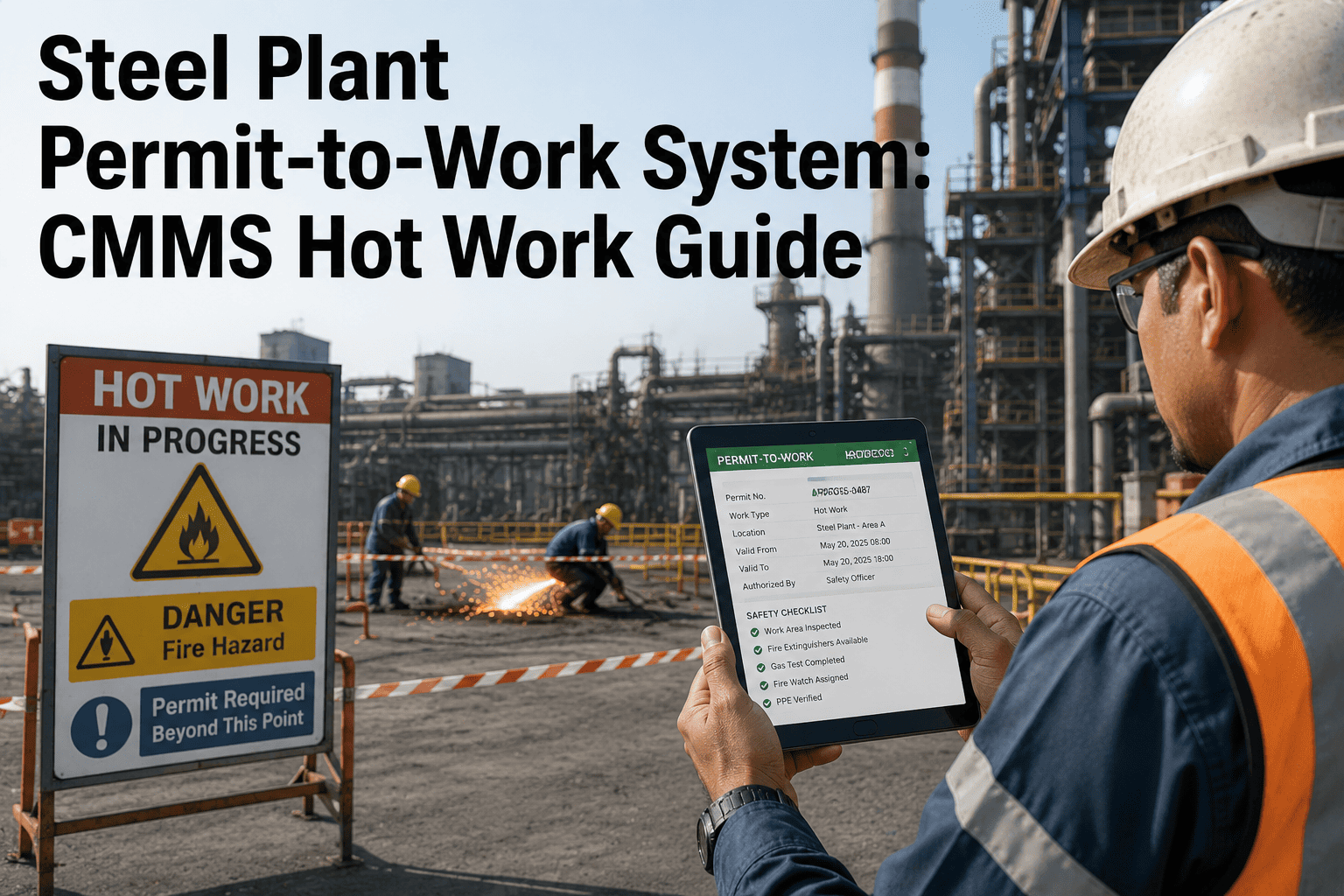
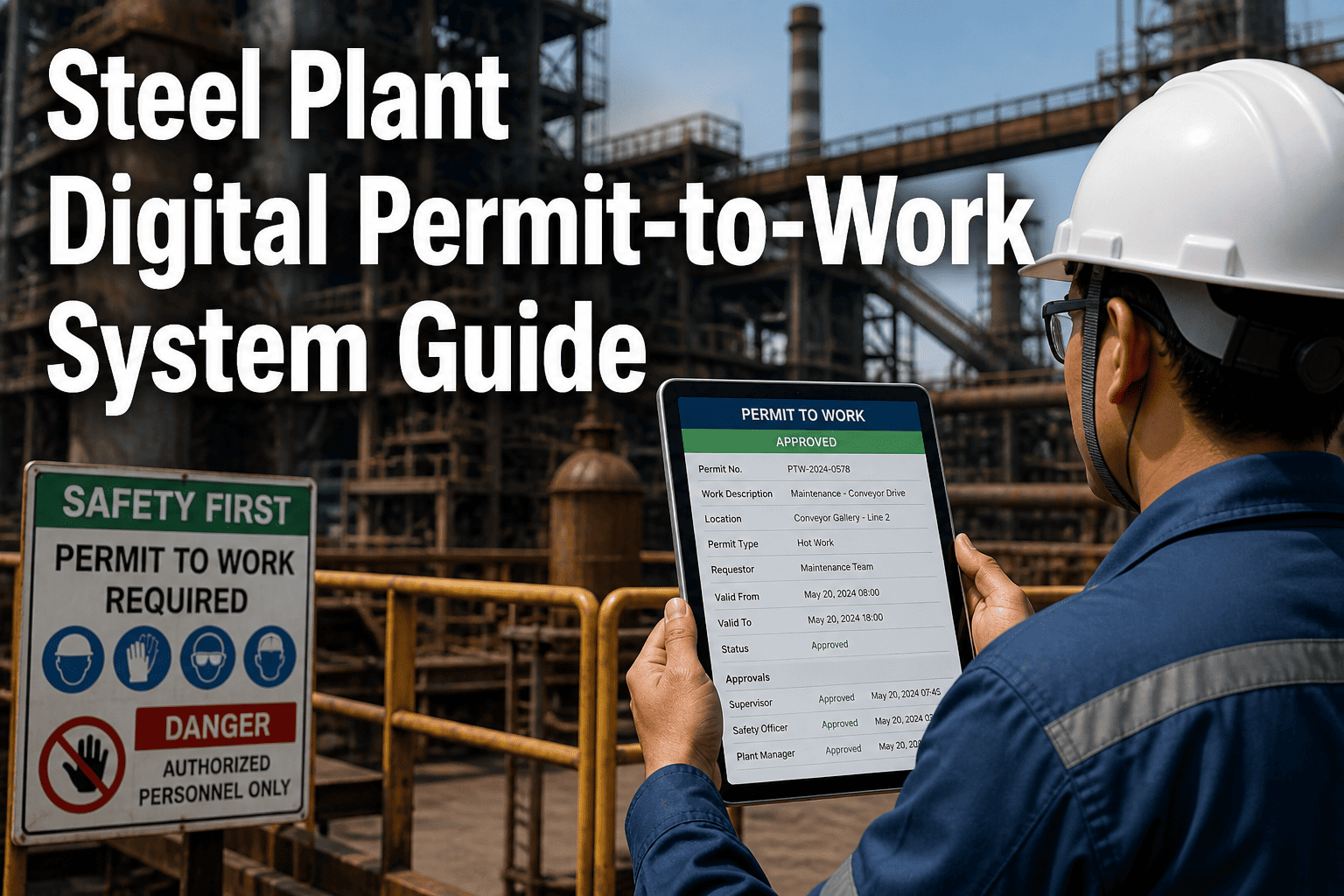
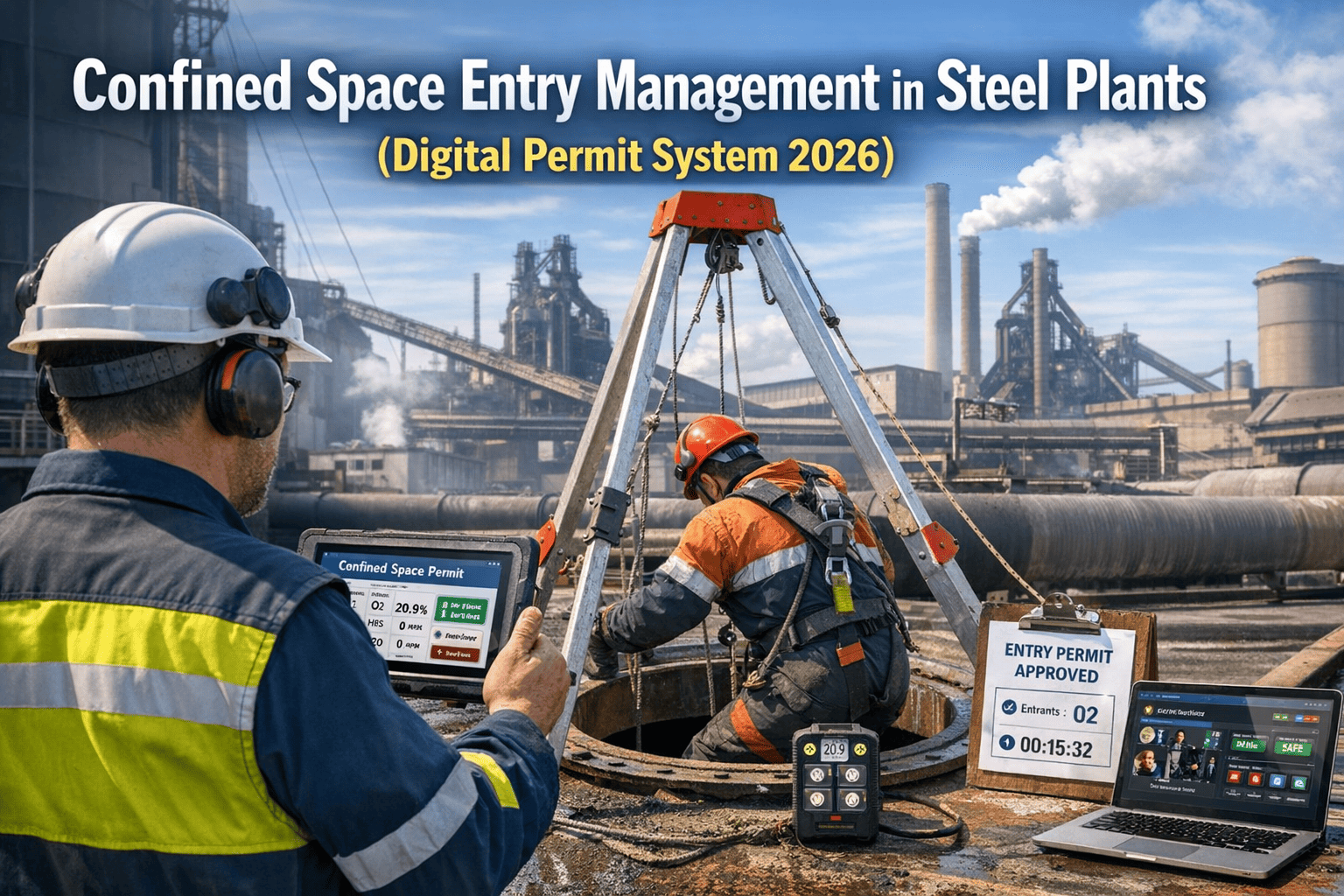
In 2023, a steelworker in a European integrated steel plant was fatally injured when equipment was energised while he was still performing maintenance inside a confined space — a process root anlysis failure traced directly to a paper permit that had been signed but not effectively communicated to the control room operator returning from break. Paper permit-to-work systems in steel plants fail not because people are negligent, but because paper has no enforcement layer: it cannot prevent a permit from being signed without a physical check, cannot alert a supervisor when a crew is still in a hazardous zone, and cannot stop an operator from re-energising equipment that has a live permit against it. OxMaint's digital permit-to-work system replaces paper permits with a real-time, auditable, mobile-accessible workflow that enforces every isolation checkpoint, requires digital signatures at every handover stage, and makes the live permit state of every piece of equipment visible to control room operators, supervisors, and maintenance teams simultaneously.
Digital Permit-to-Work for Steel Plants
Eliminate paper permit failures with a digital PTW system that enforces isolation verification, captures digital signatures at every handover, maintains complete audit trails, and makes live permit status visible plant-wide — on any device, in real time.
How Paper PTW Fails in Steel Plant Operations
The failure modes of paper permit-to-work systems in steel plants are well-documented in incident investigation reports — and they are almost always systemic, not individual. Understanding precisely where paper fails is the starting point for understanding what a digital system must enforce.
OxMaint Digital PTW: The Complete Workflow
OxMaint structures the permit-to-work process as a sequential, enforced digital workflow — each stage requires specific actions, verifications, and signatures before the next stage can begin. No stage can be skipped. No signature can be backdated.
Paper Permits Cannot Enforce What Digital Permits Can.
OxMaint's digital PTW system enforces every isolation checkpoint, requires photo evidence, captures digital signatures at every stage, and maintains a complete immutable audit trail — replacing the paper-based trust model with a verified, timestamped record of every action.
Permit Types Covered — Steel Plant Operations
Steel plant operations require multiple distinct permit types, each with different isolation requirements, hazard checklists, and authorisation levels. OxMaint manages all permit types on a single platform with type-specific workflows — preventing the common error of applying a standard Hot Work checklist to a Confined Space entry.
| Permit Type | Typical Steel Plant Application | Key Isolation Requirements | Authorisation Level | OxMaint Enforcement |
|---|---|---|---|---|
| Hot Work | Welding, grinding, cutting near process areas, BF platforms | Fire watch, gas testing, flammable material removal radius | Area Supervisor | Gas test result upload + fire watch named |
| Confined Space Entry | Vessel cleaning, ladle/tundish inspection, gas duct access | Atmosphere testing (O₂, CO, H₂S), rescue plan confirmed | Safety Officer + Area Supervisor | Atmosphere reading upload + standby attendant signed |
| Electrical Isolation | Drive maintenance, switchgear work, instrumentation, MCC access | LOTO on all energy sources, voltage test, inter-lock confirmation | Authorised Electrician + Supervisor | Per-point LOTO photo + voltage test result required |
| Line Breaking | Process pipe isolation, hydraulic system, cooling water, gas lines | Pressure bleed-down confirmed, double-block and bleed, fluid ID | Process Engineer + Area Supervisor | Pressure gauge photo at zero + bleed valve position confirmed |
| Working at Height | Crane maintenance, conveyor structure, BF top platform, stack access | Edge protection verified, harness inspection, weather clearance | Area Supervisor | Equipment inspection checklist + weather condition log |
| Radiography / NDT | Weld inspection, thickness testing, structural assessment | Exclusion zone established, dosimetry issued, area cleared | Radiation Safety Officer | RSO digital sign-off + exclusion zone boundary confirmed |
PTW Compliance Metrics — What Steel Plant Safety Teams Track
OxMaint generates the PTW compliance reports required by HSE audit teams, ISO 45001 management reviews, and internal safety governance — automatically, from live permit data, with no manual compilation.
Permit Audit Trail Completeness
Percentage of closed permits with complete digital records — all signatures, timestamps, isolation confirmations, and closure sign-offs captured. Required for ISO 45001 and HSE compliance. Paper PTW systems typically achieve 60–75% completeness on post-incident audit.
Concurrent Permit Conflicts
Number of instances where two active permits covered the same equipment or adjacent isolation zones without a documented conflict resolution. OxMaint detects and blocks concurrent conflicts before permit issue — a leading indicator rather than a lagging one.
Shift Handover Sign-Over Time
Time required for incoming supervisor to acknowledge and accept all active permits at shift change. OxMaint presents all live permits on a single screen for incoming supervisor acknowledgement — replacing physical permit board walk-arounds that take 15–25 minutes.
Isolation Verification Rate
Percentage of permits where every isolation point was confirmed with timestamped evidence before permit issue. Below 95% is a serious compliance exposure — it means some permits were issued without full physical verification, which is the leading cause of emergency physical response incidents.
Permit Overruns Without Extension
Number of permits that ran beyond their authorised duration without a formal extension. OxMaint automatically escalates permits approaching expiry — preventing the common scenario where a job overruns and the permit is silently treated as still valid without re-authorisation.
Permit Issue Cycle Time
End-to-end time from permit request submission to permit issued and crew acknowledged. Steel plants using OxMaint digital PTW report average issue times of 6–9 minutes vs. 25–45 minutes for paper-based systems — recovering over 30 minutes of productive maintenance time per job.
Every major permit-to-work failure investigation I have been involved in over 23 years comes back to the same two root causes. The first is an assumption that was not verified — somebody believed an isolation was in place without physically confirming it. The second is a communication gap — somebody who needed to know about a live permit did not know. Paper permits are structurally incapable of addressing either of these root causes, because paper cannot enforce verification and paper cannot communicate automatically. A digital PTW system does not eliminate human error — nothing does — but it eliminates the paper system's structural inability to enforce the steps that prevent the most serious errors. When I ask a plant if they can show me the isolation point photograph for the third energy source on the permit from 14 months ago, I want to hear 'yes, here it is' in under 30 seconds. In 23 years, I have never heard that answer from a paper PTW system. In plants running OxMaint, I hear it routinely.
Frequently Asked Questions
How does OxMaint prevent a permit from being issued before all isolation points are physically confirmed?
OxMaint enforces a hard gate between the Hazard Assessment and Issued states — the permit cannot progress until every isolation point on the pre-defined LOTO register has been confirmed with a timestamped mobile entry and photo upload. There is no way to override this gate, bypass it with a supervisor password, or proceed with partial confirmation. If one isolation point on a 12-point LOTO register is unconfirmed, the permit stays locked at the Isolation stage and the system displays which specific point is outstanding. This is the single enforcement mechanism that most directly addresses the most common isolation-related incident cause in steel plants. Sign in to configure your equipment LOTO registers in OxMaint.
How does the shift handover process work for active permits in OxMaint?
At shift change, the incoming area supervisor receives an automatic notification listing all active permits in their area. They must open each permit, review the current state (isolation status, crew in-area count, remaining duration), and provide a digital signature acknowledging receipt of responsibility. The outgoing supervisor's session remains open until the incoming supervisor has acknowledged all permits — preventing the common scenario where permits are verbally handed over without the incoming supervisor having read the actual permit conditions. Book a demo to see the shift handover workflow in action.
What does an OxMaint PTW audit trail contain, and how long is it retained?
Every OxMaint permit generates an immutable audit record containing: every digital signature with identity, timestamp, and device location; every isolation point confirmation with photo, timestamp, and confirming officer identity; all hazard assessment responses; permit extension records; shift handover acknowledgements; crew sign-in and sign-out log with timestamps; and closure declaration. Audit records are retained for a minimum of 7 years and can be exported as a tamper-evident PDF for HSE audit, insurance investigation, or legal proceedings. Records cannot be edited, deleted, or backdated by any user at any permission level. Sign in to review the OxMaint audit trail architecture.
Can OxMaint's PTW system integrate with our maintenance work order system and SCADA plant?
Yes — OxMaint's PTW module is natively integrated with the work order engine, so permits are always linked to a work order and inherit the asset ID, equipment class, and job scope automatically. When a planned work order is scheduled, the system prompts the planner to initiate the associated permit request at the defined lead time. Integration with SCADA systems allows OxMaint to receive equipment status from the Level 2 historian and flag any active permits against equipment that shows unexpected process activity — an early warning for control room operators that an isolated system may have a process anomaly requiring attention. Book a demo to see the full work order and SCADA integration.
How does OxMaint handle permits in areas with no mobile network coverage?
OxMaint's mobile app operates in full offline mode — isolation confirmations, photo uploads, and digital signatures are all captured locally on the device and synchronised automatically when network connectivity is restored. Offline permits cannot be approved or extended (those actions require supervisor connectivity), but isolation walkdowns and crew sign-in can proceed fully offline, which covers the most common no-coverage scenario in steel plant confined spaces, BF platforms, and basement areas. If network restoration is delayed, supervisors can use a designated offline bridge device in the control room to trigger approval actions. Start a free trial to test the offline mode in your plant environment.
Every Permit. Every Isolation. Every Signature. Every Time.
OxMaint's digital permit-to-work system enforces the physical verification steps, digital signatures, and real-time visibility that steel plant operations demand — so the next shift change, isolation removal, or confined space entry is backed by a complete, auditable, tamper-evident record of every action taken.