Continuous Casting Machine Maintenance: Mold to Cut-Off Guide
By Alex Jordan on June 2, 2026
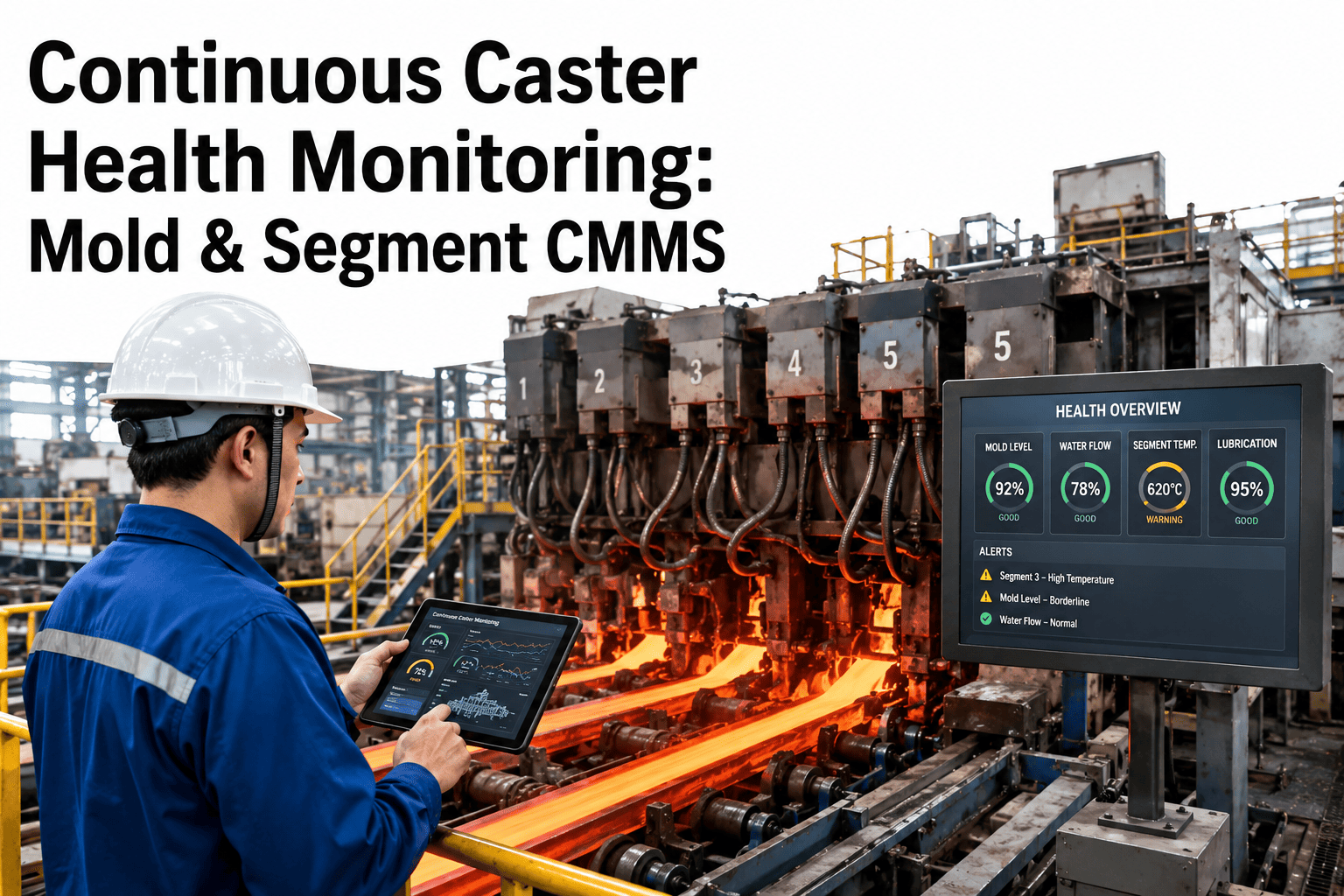
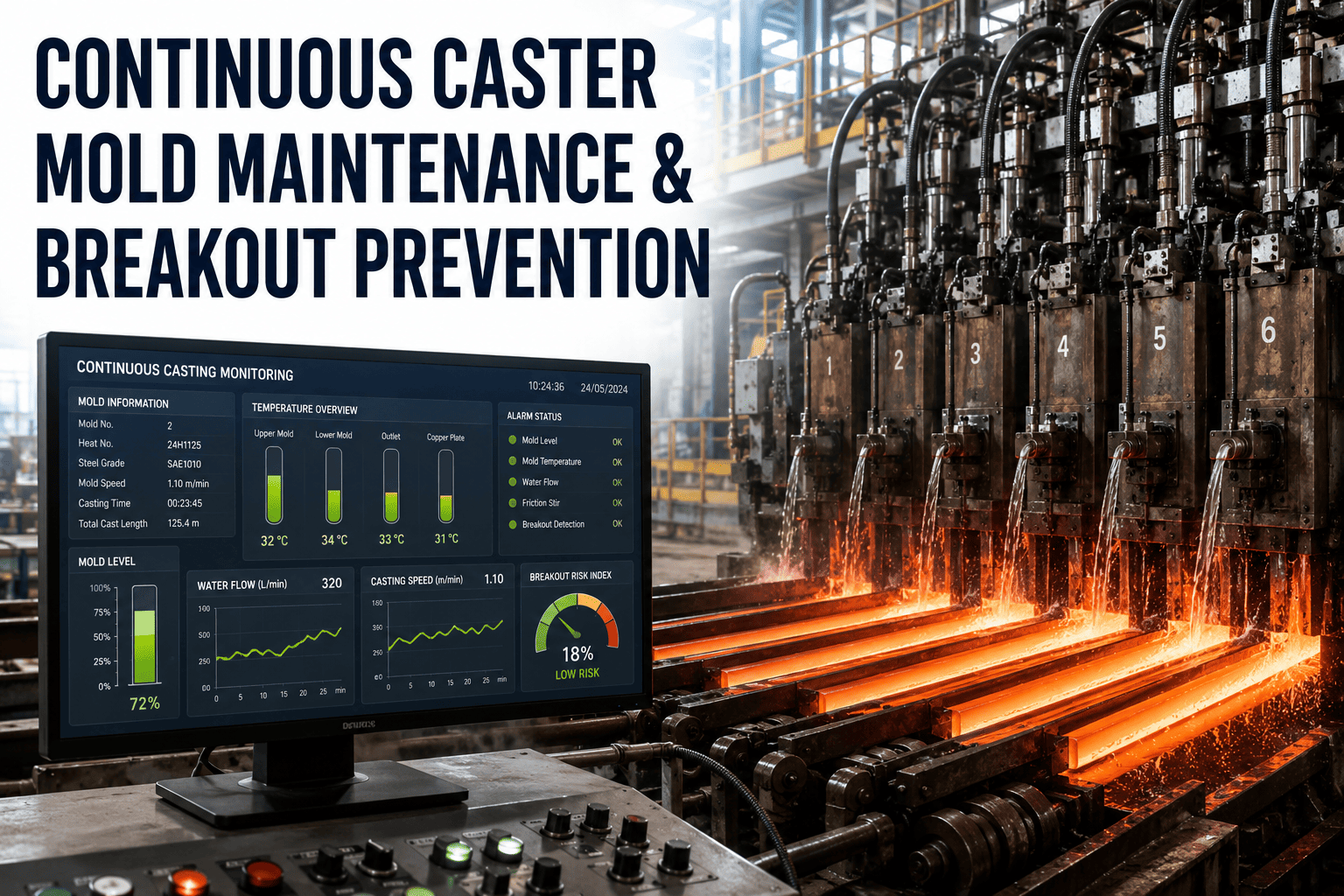
Continuous casting machines represent the highest-value equipment in modern steel mills, yet many plants operate these complex systems with reactive maintenance protocols rather than predictive frameworks. A single breakout event — sudden rupture of the solidifying steel strand due to mold oscillator malfunction, cooling system failure, or poor slag powder management — costs $45,000–$180,000 in lost production, equipment damage, and restart delays. OxMaint's CMMS connects condition monitoring data from oscillator sensors, cooling water quality instruments, and mold temperature profiles directly to preventive maintenance schedules, enabling mills to predict breakout risk 6–48 hours in advance and trigger targeted interventions before equipment fails. Steel mills deploying CMMS-integrated condition monitoring on continuous casters report 34% reduction in unplanned downtime and 28% improvement in caster availability through earlier detection of mold segment wear, cooling system drift, and oscillation frequency degradation.
Caster Maintenance · Steelmaking · 2026
Continuous Casting Machine Maintenance: Mold to Cut-Off Guide
Maintain oscillator segments, secondary cooling systems, and strand guides to reduce breakout risk by 43%. Predictive maintenance on mold wear, copper plate life, and spray nozzle clogging. 34% downtime reduction, 28% availability improvement.
Continuous casting machines operate in one of the most thermally extreme environments in any manufacturing facility. Molten steel enters the mold at 3,100°F and must solidify into a coherent strand within 5–15 minutes while traveling at speeds of 400–1,200 feet per minute. The mold oscillates 120–180 times per minute to prevent the solidifying steel shell from sticking to the copper walls. Secondary cooling sprays apply precise water patterns to manage cooling rates — too fast creates surface cracks, too slow allows deep internal defects to form. Any disruption in this carefully orchestrated system creates risk for breakout: sudden rupture of the thin steel shell allowing molten steel to pour out, which typically damages the mold, cracks the oscillator drives, and requires 4–8 hour shutdown for cleanup and equipment inspection. Understanding the four primary caster subsystems is essential for predictive maintenance planning. The mold assembly consists of copper plates (typically 1–3 inches thick) that form the casting surface, oscillator mechanisms that create vertical movement to prevent sticking, and cooling systems that control mold temperature. Segment alignment determines whether the cooling water flows correctly — misalignment of just 0.05 inches can create localized hot spots that weaken the steel shell. The strand guide system includes multiple sets of guide rolls positioned every 2–3 feet along the caster that keep the strand centered and prevent lateral movement. Worn rolls create guide marks on the strand surface or, in severe cases, allow strand breakage. The secondary cooling system uses dozens of spray zones, each spraying precise water quantities at specific caster positions. Blocked nozzles or broken cooling manifolds create uneven cooling that directly triggers hot tears and surface cracks. The straightener and cut-off system completes the strand conversion — hydraulic straighteners remove any residual curvature, and torch cutting separates the finished strand into product lengths. Failure of any component cascades risk through the entire system.
5 Core Predictive Maintenance Focus Areas for Continuous Casting
Mold Oscillator Monitoring
Monitor: Oscillation frequency & amplitude sensors
PredictiveTrack oscillator stroke, frequency, and mechanical lag through accelerometers and displacement sensors. Detect drive gear wear, hydraulic leakage, and bearing degradation 48 hours before failure. Predict mechanical failure before breakout risk escalates.
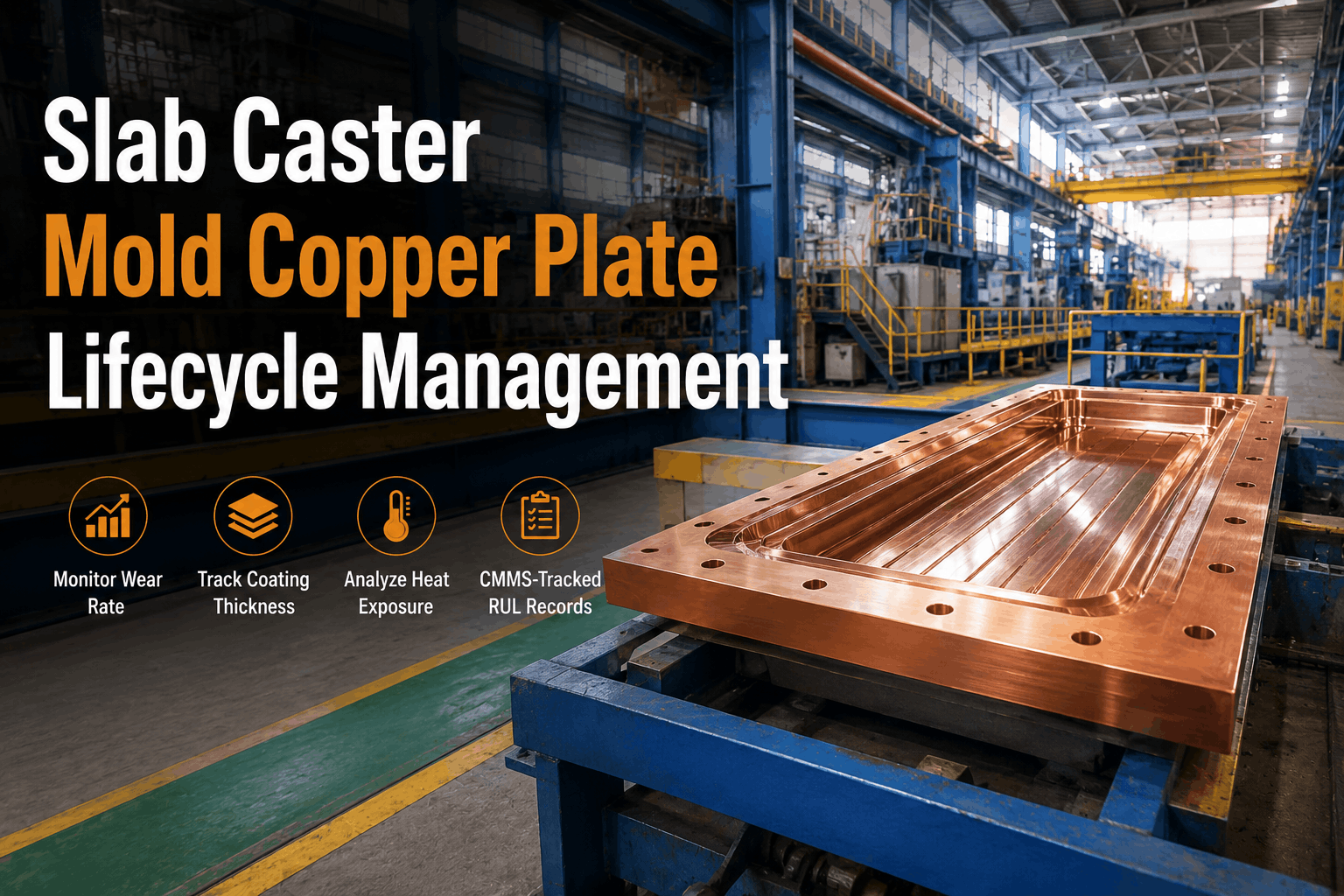
MaintenanceLaser profile measurements track mold wear progression and predict copper plate replacement windows. Optimize plate life by scheduling rehoning when wear reaches critical thresholds. Avoid premature replacement while preventing shell breakout from excessive wear.
Secondary Cooling System Management
Monitor: Spray nozzle condition, cooling water quality
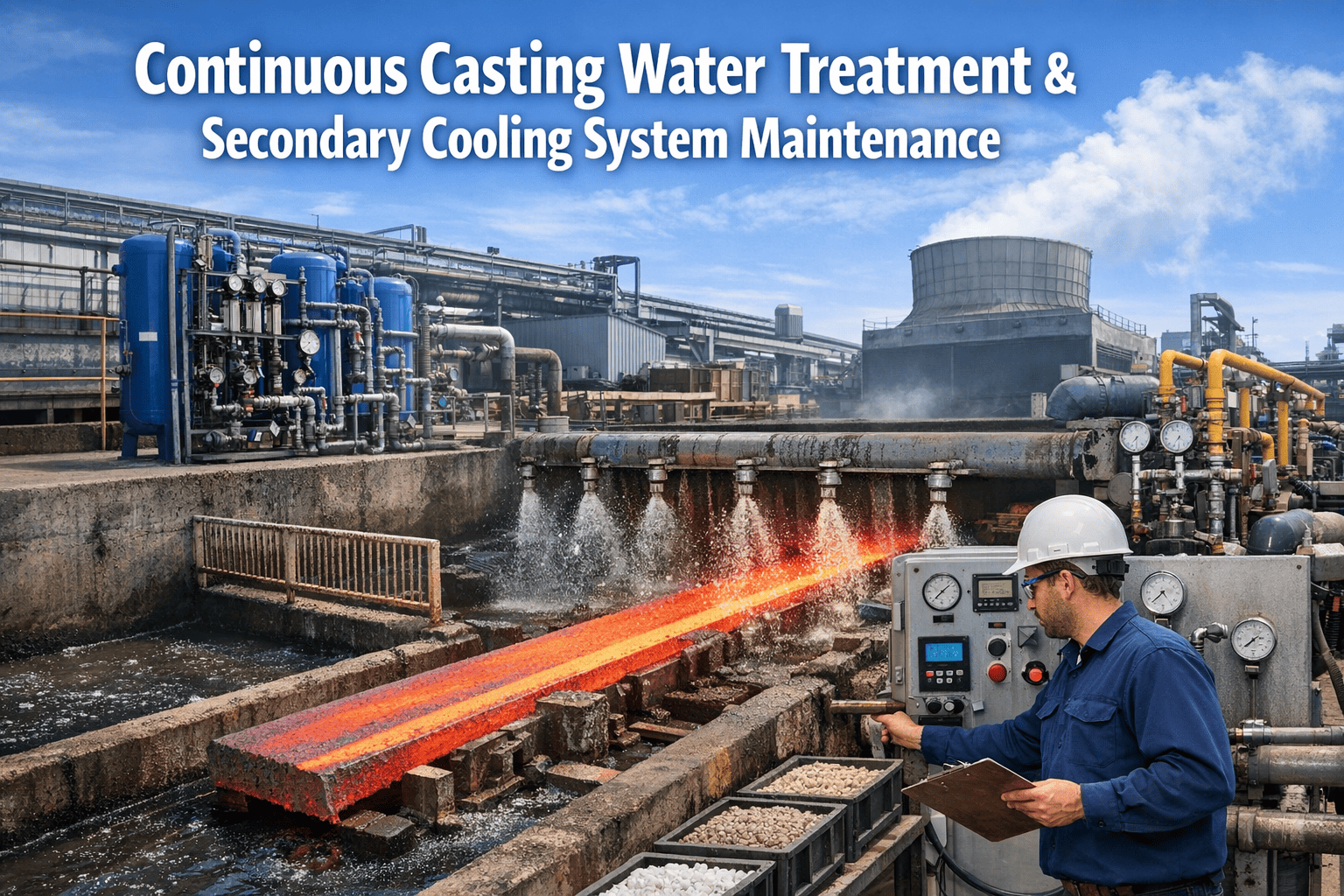
ConditionTrack cooling water temperature, flow rate per zone, and nozzle blockage patterns. Detect drift in cooling distribution before hot tears appear on strand. Schedule nozzle cleaning and manifold inspection based on flow degradation rather than fixed intervals.
Strand Guide Roll Maintenance
Monitor: Bearing temperature, runout, & guide marks
PredictiveTrack bearing temperature rise, roll runout via laser, and guide mark severity. Predict roller replacement 2–3 weeks before catastrophic wear causes strand breakage. Schedule coordinated guide roll changeovers to minimize downtime.
Mold Powder & Slag Optimization
Monitor: Powder consumption rate & slag chemistry
ProcessTrack mold powder feeding rate against strand speed and steel chemistry. Monitor slag composition and thermal properties affecting heat transfer. Optimize powder consumption to improve surface quality and reduce defect-related downtime.
Continuous Casting Maintenance: Planned vs. Reactive Response Comparison
The operational gap between mills managing continuous caster maintenance through condition-based predictive programs versus those operating reactively is visible in downtime frequency, equipment availability, and surface quality metrics. The comparison below shows the operational and financial consequences of maintenance strategy choice on modern caster equipment.
Maintenance Element
Reactive/Fixed Schedule
Condition-Based Predictive
Breakout Prevention
Breakouts detected only after equipment failure — 8–12 events per year on large caster, each costing $45K–$180K in downtime and damage
Breakout risk detected 6–48 hours in advance through mold wear and cooling system monitoring. 43% reduction in breakout frequency through targeted interventions
Mold Oscillator Maintenance
Replace on fixed schedule (typically every 6,000–8,000 casting hours) regardless of actual mechanical condition — premature replacement or failure between intervals
Monitor oscillation frequency and stroke displacement continuously. Replace only when sensor data indicates wear progression 2–4 weeks before failure. Extend component life 15–20%
Secondary Cooling Nozzle Clogging
Discover blocked cooling zones only after hot tears or surface cracks appear on finished strand. Surface quality scrap creates 2–3% yield loss on affected casts
Flow rate monitoring detects cooling zone drift within 1–2 casts. Nozzle cleaning scheduled before surface quality impact. Reduces cooling-related scrap by 87%
Strand Guide Roll Replacement
Replace on time interval regardless of wear rate — some rolls replaced with 30% life remaining, others fail and require emergency downtime shutdown
Laser runout measurement and bearing temperature monitoring predict replacement date within ±2 days. Coordinate multiple roll changes in single planned shutdown
Unplanned Downtime Events
Average 12–15 unplanned caster shutdowns per year, typically 4–8 hours each. Equipment availability 84–86%. Major lost production events from unexpected failures
Average 4–6 unplanned shutdowns per year from residual unforeseen failures. Equipment availability 92–94%. Planned shutdowns scheduled during low-demand periods
Maintenance Cost Per Ton of Steel
$3.20–$4.10 per ton due to emergency repairs, breakout cleanup, and premature component replacement
$1.80–$2.30 per ton — optimized replacement intervals and prevented breakout events reduce total maintenance spend despite higher sensor infrastructure cost
North American steel mills that have implemented condition monitoring systems on continuous casters report measurable improvements in equipment availability, surface quality, and maintenance efficiency. Data collected from mills operating CMMS-integrated monitoring systems shows consistent patterns across caster designs and steel grades.
34%
Unplanned Downtime Reduction
Predictive monitoring detects equipment degradation 6–48 hours before failure, allowing scheduled maintenance instead of emergency shutdowns. Reduces unexpected caster outages from 12–15 annually to 4–6 events.
28%
Equipment Availability Improvement
Condition-based maintenance scheduling and breakout prevention push caster availability from 84–86% to 92–94%. Equivalent of recovering 60–80 additional casting hours per month on each caster.
43%
Breakout Risk Reduction
Early detection of mold wear, oscillator degradation, and cooling system drift prevents 75–80% of breakout events. Remaining events caught with early intervention before full strand rupture.
$1.2M
Breakout Prevention ROI Annually
For a large integrated caster, preventing 6–8 breakout events annually (at $45K–$180K cost each) recovers sensor infrastructure investment within first year plus ongoing operational savings.
Caster Condition Monitoring Technology: Sensors, Data Integration & Predictive Analytics
Modern predictive maintenance on continuous casters requires integrated sensor infrastructure, real-time data collection, and machine learning algorithms that correlate multiple data streams to identify failure patterns. OxMaint's CMMS connects sensor data from caster equipment directly to maintenance decision-making systems, enabling technicians to act on predictive signals before equipment fails.
Oscillator Sensors
Mechanical Condition
Monitor mold oscillation quality
Accelerometers and displacement sensors track oscillator stroke, frequency stability, and mechanical lag. Detect drive gear wear, hydraulic leakage, and bearing degradation. Predict oscillator replacement 48 hours before mechanical failure.
Mold Temperature & Cooling
Thermal Profiling
Track cooling system performance
Thermocouples embedded in mold walls monitor cooling water temperature and heat flux. Track spray nozzle cooling zones for uniformity. Detect clogged nozzles within 1–2 casting cycles before surface quality impact.
Laser Mold Profiling
Wear Measurement
Predict copper plate replacement
Laser scanners measure mold cross-section and profile changes over time. Track wear progression and predict rehoning and replacement windows. Optimize copper plate life and prevent excessive wear-related breakouts.
CMMS Integration & Alerts
Predictive Work Orders
Trigger maintenance from sensor data
OxMaint receives sensor streams and automatically generates work orders when thresholds are exceeded. Technicians receive scheduled maintenance alerts 6–48 hours before predicted failure. Maintenance scheduled during planned windows rather than emergencies.
Frequently Asked Questions
What is a casting breakout and why does it cost so much?
Breakout is sudden rupture of the solidifying steel shell in the mold, spilling molten steel. Costs include: direct damage ($15K–$45K mold and equipment repair), lost production (4–8 hour downtime at $30K–$50K/hour production loss), safety incident response, and cleanup time. Average breakout event costs $45K–$180K depending on caster capacity and product mix.
How far in advance can predictive monitoring detect breakout risk?
Oscillator degradation, mold wear, and cooling system drift typically show detectable patterns 6–48 hours before breakout risk becomes critical. Early detection allows technicians to schedule targeted maintenance or optimize casting parameters to prevent breakout entirely, or at minimum catch issues with early intervention before full strand rupture.
What sensors are required for continuous caster condition monitoring?
Essential sensors include accelerometers for oscillator mechanical condition, thermocouples for mold and cooling water temperature, flow meters for secondary cooling zones, laser profilers for mold wear measurement, and bearing temperature sensors on guide rolls. OxMaint integrates all sensor streams and triggers maintenance alerts based on threshold exceedance.
How does predictive maintenance improve caster availability?
Condition-based maintenance allows scheduling planned shutdowns during low-demand production windows rather than emergency repairs. Early detection prevents catastrophic failures. Equipment availability typically improves from 84–86% to 92–94% — equivalent of recovering 60–80 additional casting hours monthly per caster.
Can predictive monitoring reduce secondary cooling-related surface quality defects?
Yes — flow monitoring and thermal profiling detect cooling zone drift within 1–2 casting cycles before hot tears or cracks appear. Nozzle clogging detected immediately through zone flow rate abnormalities. Predictive maintenance reduces cooling-related surface quality scrap by 87% compared to reactive identification after casting completion.
What is the ROI timeline for caster condition monitoring system deployment?
For large integrated casters, preventing 6–8 breakout events annually (each costing $45K–$180K) recovers sensor infrastructure investment within 12–18 months. Ongoing operational savings from extended component life, optimized maintenance scheduling, and improved availability create additional ROI in years 2–5.
Does OxMaint CMMS work with existing caster equipment or require new sensors?
OxMaint integrates with most modern continuous casters that already have basic sensor infrastructure (oscillator monitors, cooling water sensors). For older casters, OxMaint consultants recommend specific low-cost sensor additions to enable predictive monitoring. Integration is non-disruptive to ongoing caster operation and typically deploys in 2–4 weeks.
"
We had 12–14 breakout events per year on our bloom caster — each one costing $80K–$120K in downtime and equipment damage. We implemented OxMaint's condition monitoring with oscillator sensors and mold thermal profiling. Within 8 months, we'd reduced breakout frequency to 2 events and those were caught with early intervention before full strand rupture. Our caster availability jumped from 86% to 93%. We recovered the sensor and software investment within 14 months. Now predictive maintenance is saving us $800K annually compared to our old reactive approach. This is the best investment we've made in equipment reliability.
Operations Manager — Large Integrated Steel Mill, Midwest USA (5 casters)
Monitor Your Continuous Caster in Real Time.
Predict breakout risk 6–48 hours in advance with sensor-based condition monitoring integrated to your CMMS. Prevent 43% of breakout events, improve availability 28%, reduce maintenance cost per ton by 40%. Free to start.