A vacuum degasser snorkel refractory fails at heat 487 of 600-heat campaign — the vessel is then pulled from service for 5–7 days for cold repair and refractory relining. The failure was not a surprise. The snorkel showed 15% refractory loss at heat 420. Nobody was tracking it. When the vessel finally failed, $280k in lost production (at 1.2M tonne/day) compounded the $85k maintenance cost. The vacuum degasser is the most process-critical equipment in secondary metallurgy — when it fails unplanned, the entire steelmaking sequence from BOF to caster collapses. Yet most steel plants manage RH/VTD degassers with manual logbooks and tribal knowledge: "The snorkel usually lasts 550–600 heats." No refractory tracking. No vacuum system leak detection. No predictive campaign life estimates. OxMaint's degasser module tracks snorkel refractory consumption heat-by-heat, vacuum system parameters shift-by-shift, and alloying equipment condition continuously — predicting refractory campaign remaining life and alerting planners when replacement is imminent. The result: planned refractory changes scheduled during planned maintenance windows, not emergency outages during peak production.
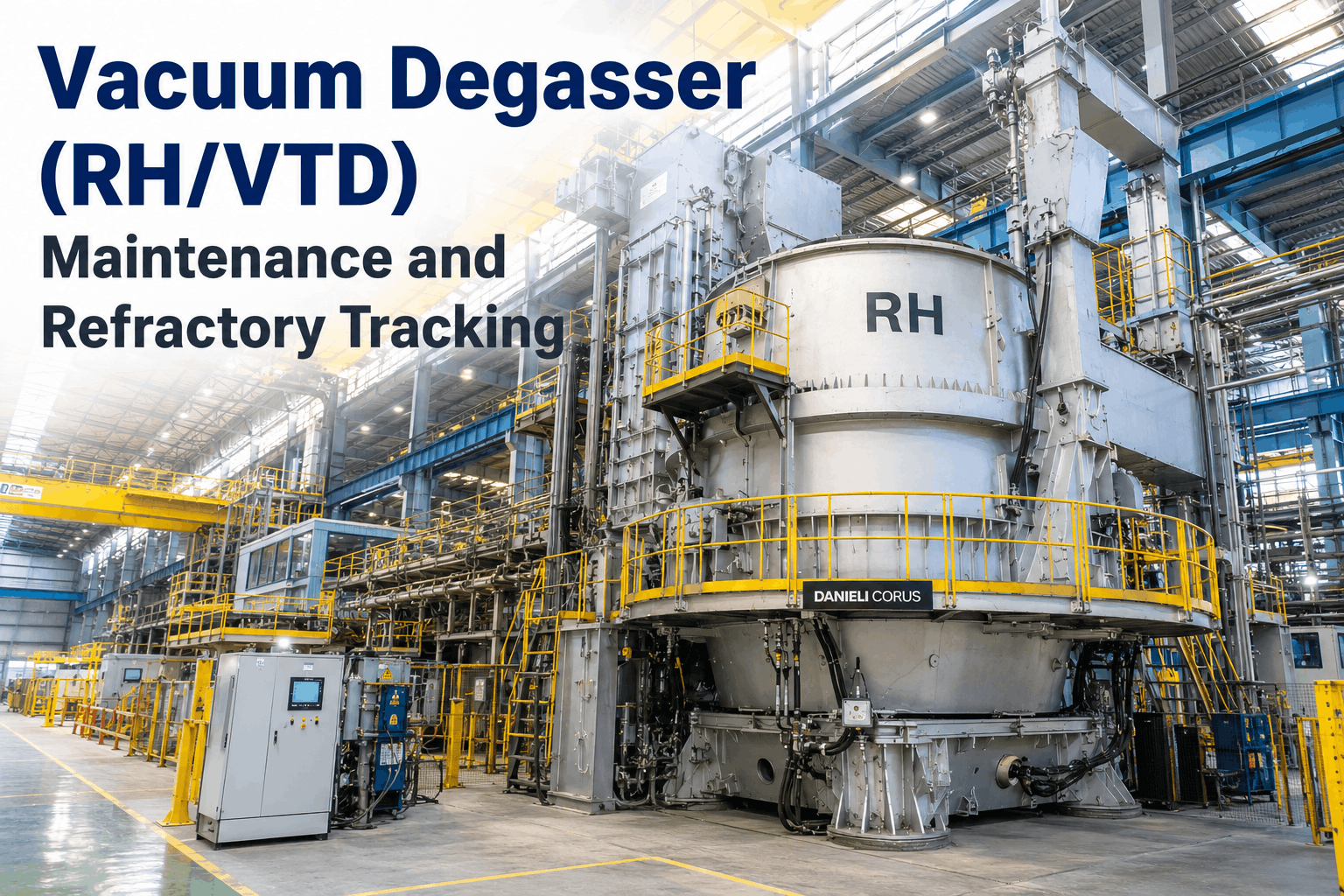
Vacuum Degasser (RH/VTD) Maintenance and Refractory Tracking
Track snorkel refractory consumption per heat, monitor vacuum system integrity per shift, predict refractory campaign remaining life, schedule proactive relining before failures occur, and manage RH/VTD equipment condition across secondary metallurgy with integrated refractory and mechanical maintenance history.
The Vacuum Degasser Maintenance Triad — Refractory, Vacuum System, Mechanical
The RH (Ruhrstahl Heraeus) vacuum degasser is engineered to perform one task: reduce carbon and hydrogen in liquid steel under vacuum. The precision required — maintaining stable vacuum (0.5–2 mbar), circulating molten steel at 1,600°C through refractory snorkels, injecting inert gas, controlling chemistry — creates a harsh maintenance environment. Three independent systems must perform simultaneously for the degasser to function: the refractory lining (snorkels, vessel walls, tuyere protection), the vacuum system (pump, seals, flanges, check valves), and the mechanical systems (ladle connection coupling, circulation tube rotation, electrode drives). A single failure in any one system cascades into degasser unavailability. Most plants manage these three systems independently — refractory tracked by quality, vacuum by operations, mechanics by maintenance. The result: visibility gaps. A vacuum flange is silently leaking (vacuum slowly degrades) until a heat fails to deboil because vacuum is insufficient — discovered mid-production. A snorkel is losing refractory thickness — undetected until failure — because nobody is logging refractory condition heat-by-heat. Mechanical coupling wear is accelerating — invisible until catastrophic failure stops the drive. OxMaint unifies all three maintenance domains into a single equipment record, with automated tracking for each and alert thresholds that catch degradation before cascade failures occur.
Snorkel Refractory Campaign Life Prediction — From Manual Logbooks to Automated Forecast
Snorkel refractory consumption is the single largest driver of RH/VTD availability. A snorkel campaign that was expected to last 600 heats but fails at 480 heats means 4.5 unplanned days offline per year (one premature failure). Multiply by the fact that most plants have 1–3 RH/VTD units, and unplanned refractory failures account for 8–15 days/year of secondary metallurgy unavailability across the plant. The consumption rate is not constant. Early heats (Heats 1–100) wear at 0.4 mm/heat as refractory sets and densifies. Middle campaign (Heats 100–500) wears at 0.8 mm/heat (steady state erosion). Late campaign (Heats 500+) wears at 1.2–1.5 mm/heat as material becomes saturated and micro-cracking accelerates. Steel grade affects wear: ultra-low carbon steels (<0.01% C) with aggressive boiling cause more snorkel erosion than calmer grades. Treating temperature (1,600–1,650°C) also affects wear rate. OxMaint calculates remaining campaign life by: (1) logging actual refractory thickness measurements every 50 heats, (2) tracking steel grade and treatment temperature per heat, (3) computing wear rate trend (mm/heat), and (4) forecasting campaign end date. When forecast shows campaign ending in 30 heats, an alert fires: "Snorkel A refractory campaign ending in 4–5 days. Schedule relining window." Planners schedule the refractory change during planned maintenance, not during peak production.
Vacuum System Leak Detection — Real-Time Pump Performance Monitoring
A vacuum system leak is silent — operators do not feel a pressure change, and displays may show nominal vacuum if the pump is compensating by running faster or longer. Meanwhile, degasser performance degrades: treatment cycles lengthen, carbon boil-off slows, hydrogen removal stalls. The heat still completes, but with marginal deboil or incomplete hydrogen removal. The quality failure often goes undetected until ladle analysis at the next process station. By then, the leak has been present for 12–18 hours (multiple heats), causing multiple off-spec heats. OxMaint detects vacuum leaks by continuously monitoring pump discharge pressure, pump-down rate (vacuum achieved per minute), and pressure decay (how fast vacuum rises when pump cycles off). When pump-down rate falls 15–20% below baseline, a leak is developing. When pressure decay accelerates 2–3× normal, a seal is likely failing. Real-time alerts to shift supervisor enable investigation and preventive seal replacement before quality failures cascade.
RH/VTD Maintenance History & Regulatory Compliance
Secondary metallurgy equipment maintenance carries regulatory weight — API 510 pressure vessel code requires documented inspection and repair history for the RH vessel itself. In many jurisdictions, refractory management and vacuum system integrity also fall under process control compliance (cGMP, ISO 9001, steelmaking process control standards). Plants must maintain audit-verifiable records: refractory consumption logs, vacuum system repair history, mechanical wear inspections, spare parts consumption. Most plants maintain these records in paper logbooks or disjointed spreadsheets — impossible to audit and prone to gaps. OxMaint centralizes all RH/VTD maintenance into a single system with full traceability: refractory thickness measurements timestamped per heat, vacuum system PM completions with photos, mechanical repair work orders with spare parts consumed. When a regulatory audit arrives, the system generates a complete compliance report in minutes — inspections performed, repairs executed, spare parts history, and all corrective actions documented.
Frequently Asked Questions
Stop Unplanned Degasser Outages — Predict Refractory Failure Weeks in Advance.
OxMaint tracks snorkel refractory consumption per heat, monitors vacuum system integrity per shift, predicts campaign remaining life, and alerts planners 4–5 days before relining is needed — enabling scheduled maintenance instead of emergency outages.