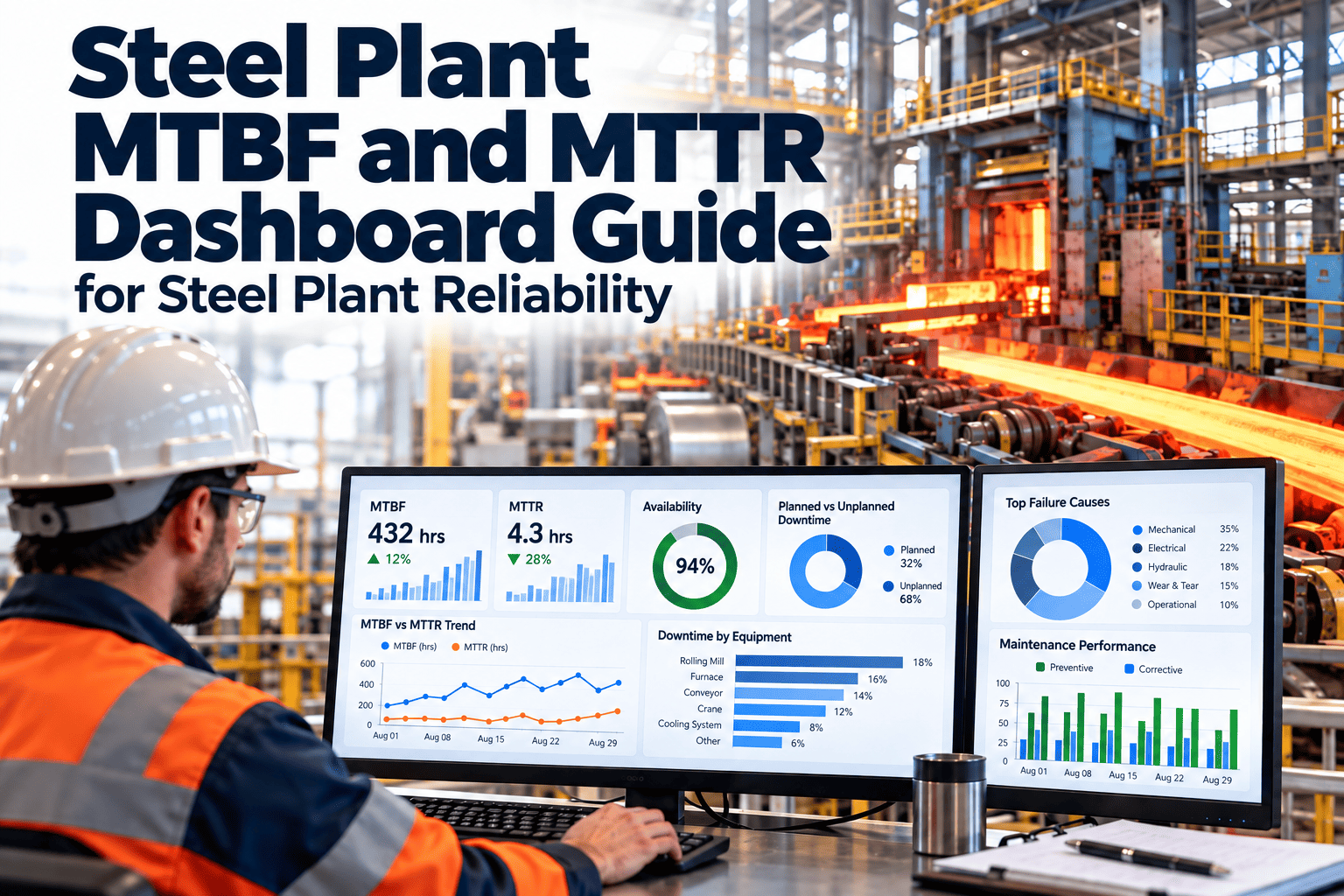
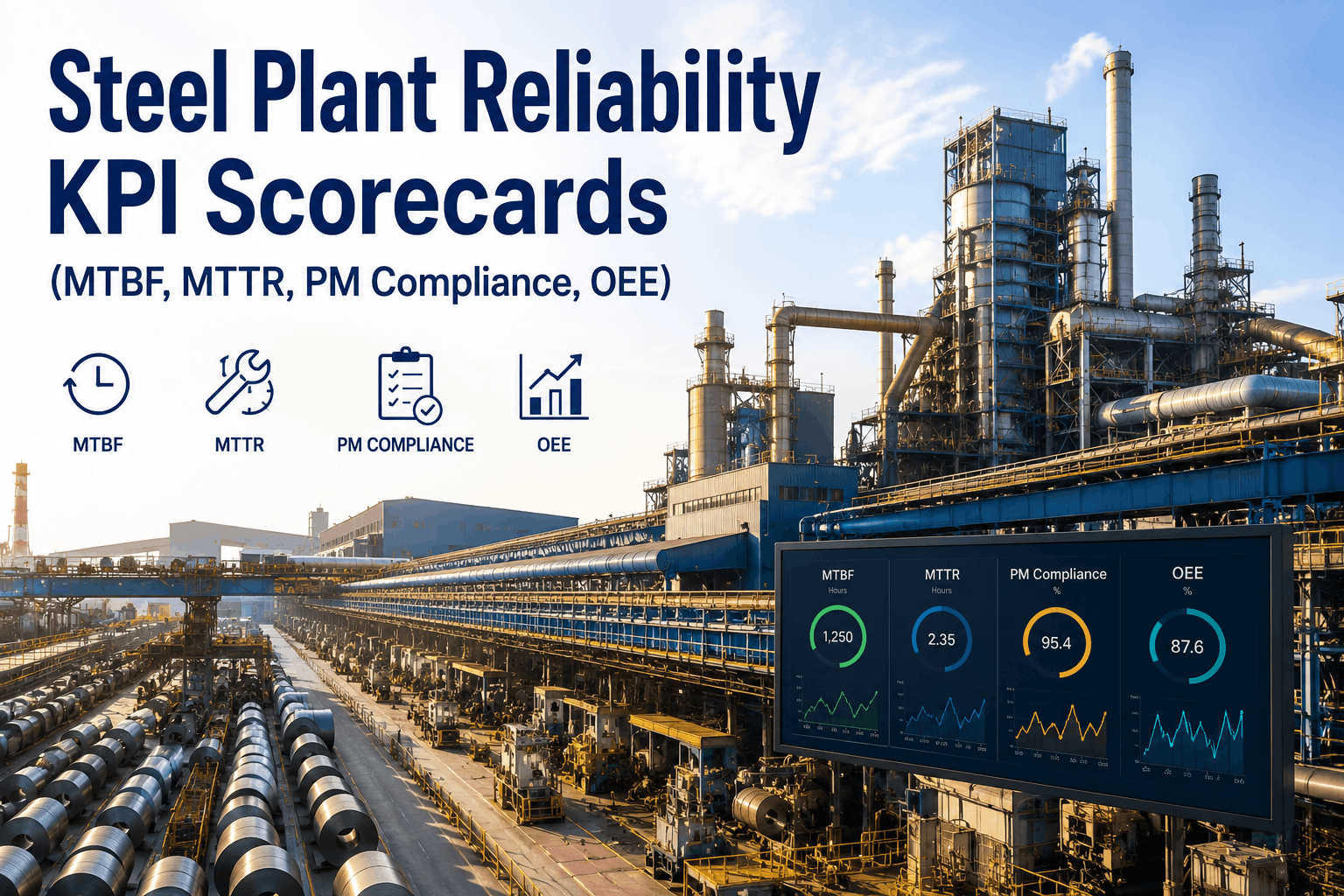
A blast furnace with Mean Time Between Failures (MTBF) of 1,200 hours is reliable. The same furnace with MTBF declining from 1,200 to 900 to 650 hours over six months is degrading toward catastrophic failure — but the decline is invisible without trend analysis. Most steel plants track equipment reliability using static annual reports: "Furnace A had 3 failures this year." Useful for historians; useless for preventing the fourth failure. Modern reliability management requires real-time MTBF and MTTR (Mean Time To Repair) tracking per asset, per shift, with immediate alerts when MTBF trends downward or MTTR spikes above baseline. When you know that MTBF is declining and can correlate it to deferred PM intervals or specific failure modes, you can mobilize corrective resources before the asset fails on critical path. OxMaint calculates MTBF, MTTR, OEE, and 15+ reliability KPIs automatically from work order data, delivering real-time reliability dashboards to shift supervisors, maintenance planners, and plant managers with role-specific views and alert thresholds.
Calculate MTBF, MTTR, OEE, and 15+ reliability metrics automatically from work orders and sensor data. Track asset health per shift, identify degradation trends before failures occur, and deliver role-specific dashboards to shift supervisors, planners, and plant management without manual reporting.
23%Improvement in MTBF at plants using real-time tracking vs. static annual reporting
31%Reduction in MTTR when teams can access work history and spare parts status in real time
87% → 94%Typical OEE improvement within 18 months of CMMS deployment with KPI visibility
6–8 hrsAverage hidden OEE loss per day from micro-stoppages under 5 minutes (invisible without sensors)
The Five Core Reliability Metrics — What They Measure, Why They Matter, How to Improve
Reliability management is drowning in acronyms and spreadsheet metrics that update monthly, after failures have already happened. The five core metrics below are leading and lagging indicators that together tell the story of equipment health: where failures happen (MTBF), how fast teams recover (MTTR), and what percentage of productive time is actually available (availability). MTBF is a lagging indicator — by the time it drops, failures have occurred. But when paired with leading indicators like PM compliance and predictive condition scores, MTBF decline becomes predictable. MTTR is actionable today — high MTTR usually means either parts unavailability (address with spare parts forecasting) or knowledge gaps (address with training and documentation). OEE combines availability, performance, and quality into a single metric that reveals true productive capacity. A plant running at 87% OEE is giving away 13 percentage points — worth $1.2M–$2.8M annually at mid-size facilities. The metrics below are ordered by actionability: start with PM compliance (fully in your control), progress to MTTR (controllable through parts and training), then track MTBF (outcome of sustained PM execution).
Increase PM ratio toward 70% through CMMS scheduling, spare parts availability, and crew discipline. Shifts to preventive work eliminate reactive emergencies.
The Reliability Maturity Progression — From Firefighting to Predictive Maintenance
Reliability maturity is not a destination — it is a progression where each phase builds on the previous. A plant that maintains a 50% planned maintenance ratio (reactive firefighting) cannot jump to predictive maintenance without first establishing baseline MTBF tracking and 65%+ PM compliance. The progression below shows typical transition timelines and the KPI changes you should expect at each phase. Plants typically spend 12–18 months in each phase, though early phases can be compressed with disciplined CMMS deployment and training. The progression is not linear — plants can slide backward if PM discipline lapses, supervisor turnover interrupts continuity, or budget cuts defer preventive work. OxMaint's dashboard makes maturity visible: if PM ratio drops below target or MTBF starts declining, an alert fires immediately, allowing management to course-correct before the plant slides back into reactive mode.
Add condition monitoring (vibration, temperature, oil analysis). PLC/sensor data feeds CMMS. Predictive alerts trigger work orders before failures.
Months 14–24
Phase 4: Predictive & Optimized
MTBF: Stable at 95–98% of design spec. PM Ratio: 70%+. MTTR: 2–4 hrs. OEE: 85%+
AI models predict component degradation weeks in advance. Maintenance scheduled to prevent failure, not repair failure. Spare parts forecast matches predicted demand.
Month 24+
MTBF Degradation Warning System — Catching Equipment Decline Before Catastrophic Failure
MTBF degradation is a leading indicator of imminent failure. When MTBF declines 10–15% over 3 months, the asset is headed toward failure — but this decline is only visible if you track MTBF continuously and set alert thresholds. Without alerts, the decline is discovered at month-end report review, weeks after the trend started. By then, the asset may already have failed. OxMaint calculates MTBF automatically from work order failure events and updates it weekly per asset. When 3-month rolling MTBF declines more than 5% from the previous 3-month baseline, an alert fires to the maintenance planner: "Pump A MTBF declining. Recommend increased inspection frequency and spare parts availability validation." This alert allows 2–4 weeks for preventive action before catastrophic failure occurs. The alert threshold (5% decline) is configurable per asset type — critical equipment gets tighter thresholds, less-critical equipment tolerates more variance.
MTBF Status per Major Equipment Class — 6-Month Trend, Alert Status
Blast Furnace Main Pump
1,080 hrs
1,040 hrs
✓ Stable
EAF Electrode Drive Motor
960 hrs
800 hrs
⚠ Watch — 16.7% decline
Hot Rolling Mill Main Gearbox
1,320 hrs
1,300 hrs
✓ Healthy
Caster Hydraulic Pump
1,200 hrs
920 hrs
? Critical — 23.3% decline
Ladle Furnace Transformer
2,600 hrs
2,560 hrs
✓ Stable
Casting Tundish Pump
840 hrs
760 hrs
⚠ Alert — 9.5% decline
Frequently Asked Questions
What is a good MTBF target for steel plant equipment?
MTBF targets vary by equipment type and age. New equipment should match manufacturer design spec (1,200–2,400 hours for critical furnace equipment, 800–1,200 for pumps). Declining MTBF is the concern — if MTBF drops >10% over 3 months, maintenance intervention is needed.
How does OxMaint calculate MTBF from work orders?
OxMaint counts all failure events (work orders marked as "failure" or "breakdown") and total operating hours per asset. MTBF = Operating Hours ÷ Failure Count. Calculation updates weekly as new failure work orders are recorded, enabling real-time trend monitoring.
What should I do if MTTR is above 8 hours?
High MTTR usually comes from: (1) parts unavailable (address with spare parts forecasting), (2) technician knowledge gaps (address with training and work procedure documentation), or (3) tool/access delays (address with tool staging and planning). Segment MTTR by root cause and prioritize the largest contributor.
How much does OEE typically improve with CMMS deployment?
Plants typically see 3–7 point OEE improvement within 18 months of CMMS deployment (e.g., from 81% to 87%). Improvement comes from: PM compliance driving availability up, reduced micro-stoppages (better scheduling), and reduced scrap (better quality control and documentation).
What percentage of maintenance should be planned (PM ratio)?
Best-practice PM ratio is 70%+ planned, 30% or less reactive. Industry average: 50–60% planned. PM ratio below 50% indicates reactive firefighting mode. Shifting toward 70% requires discipline: PM scheduling, spare parts availability, and crew commitment to preventive work over emergency response.
What does a declining MTBF trend mean for equipment?
Declining MTBF means equipment is degrading and failures are becoming more frequent. A 10–15% MTBF decline over 3 months is a strong warning that the asset will fail soon without intervention. OxMaint alerts you to MTBF decline immediately, allowing 2–4 weeks for preventive action.
Can OxMaint integrate with condition monitoring sensors?
Yes. OxMaint connects to vibration sensors, thermal imaging, oil analysis, PLC data, and other condition monitoring sources via OPC-UA, Modbus, or direct API. Sensor data feeds reliability calculations — condition scores trigger predictive work orders before failures occur.
Track Equipment Health in Real Time — MTBF Decline → Action Within 48 Hours.
OxMaint calculates MTBF, MTTR, OEE, and 15+ reliability KPIs automatically. Alerts fire immediately when MTBF trends downward or PM compliance slips below target — enabling preventive intervention before catastrophic failure and production loss.
.png)