Crane Maintenance for Steel Plants: EOT Ladle and Charging Cranes
By Alex Jordan on June 12, 2026
Overhead traveling (EOT) cranes and ladle handling cranes are the highest-risk assets in integrated and mini steel mills — a single unplanned EOT crane failure halts entire production floors and costs $50,000+ per hour in downtime. Unlike maintenance tasks that tolerate some delay, crane safety cannot be deferred: a failed brake, a compromised hook, or degraded hoisting rope creates catastrophic failure risk that no production schedule can justify. OxMaint's crane maintenance module brings together preventive maintenance scheduling, mandatory third-party inspection tracking, and real-time work order management — transforming crane maintenance from a compliance checkbox into a systematic operation that prevents failures before they occur.
Crane Maintenance · Industry Guide · 2026
EOT and Ladle Crane Maintenance for Steel Mills: Prevent Critical Failures
Systematic EOT and ladle crane inspections, predictable third-party certification scheduling, mandatory component testing, and real-time maintenance tracking — ensure cranes remain safe and production-ready continuously.
12Critical inspection points across EOT and ladle crane systems
47%Reduction in unplanned crane downtime with systematic preventive maintenance
100%Third-party inspection compliance tracking and certification management
18 minAverage time to document complete crane inspection with OxMaint checklist vs. manual forms
Crane Maintenance Challenges in Steel Production
Steel plant cranes operate in hostile environments — molten metal splash accelerates rope degradation, electromagnetic radiation from electric arc furnaces interferes with sensors, vibration from heavy loads stresses brake components, and high ambient heat (130°F+) reduces lubricant viscosity and bearing life. The Occupational Safety and Health Administration (OSHA) and American Society of Mechanical Engineers (ASME) mandate regular crane inspection and certification to mitigate catastrophic failure risk. However, many steel mills execute crane maintenance reactively, responding only when a component shows obvious signs of failure — this approach leads to unexpected downtime, emergency repairs at premium cost, and potential safety incidents.
A mini steel mill in Pittsburgh reported a crane failure scenario: an EOT crane's limit switch failed without warning, causing the crane to exceed its designed height limit. The operator stopped the crane manually (preventing a collision), but the facility had to crane-dock the affected hoisting system for 3 days while a replacement limit switch was sourced and installed. Production loss: $156,000. Root cause analysis revealed that the limit switch had not been tested in 14 months — the facility had no systematic inspection schedule. An OxMaint customer in the same region discovered a similar limit switch during a routine quarterly inspection and replaced it proactively, avoiding a comparable failure.
5 Crane Systems Requiring Systematic Maintenance and Inspection
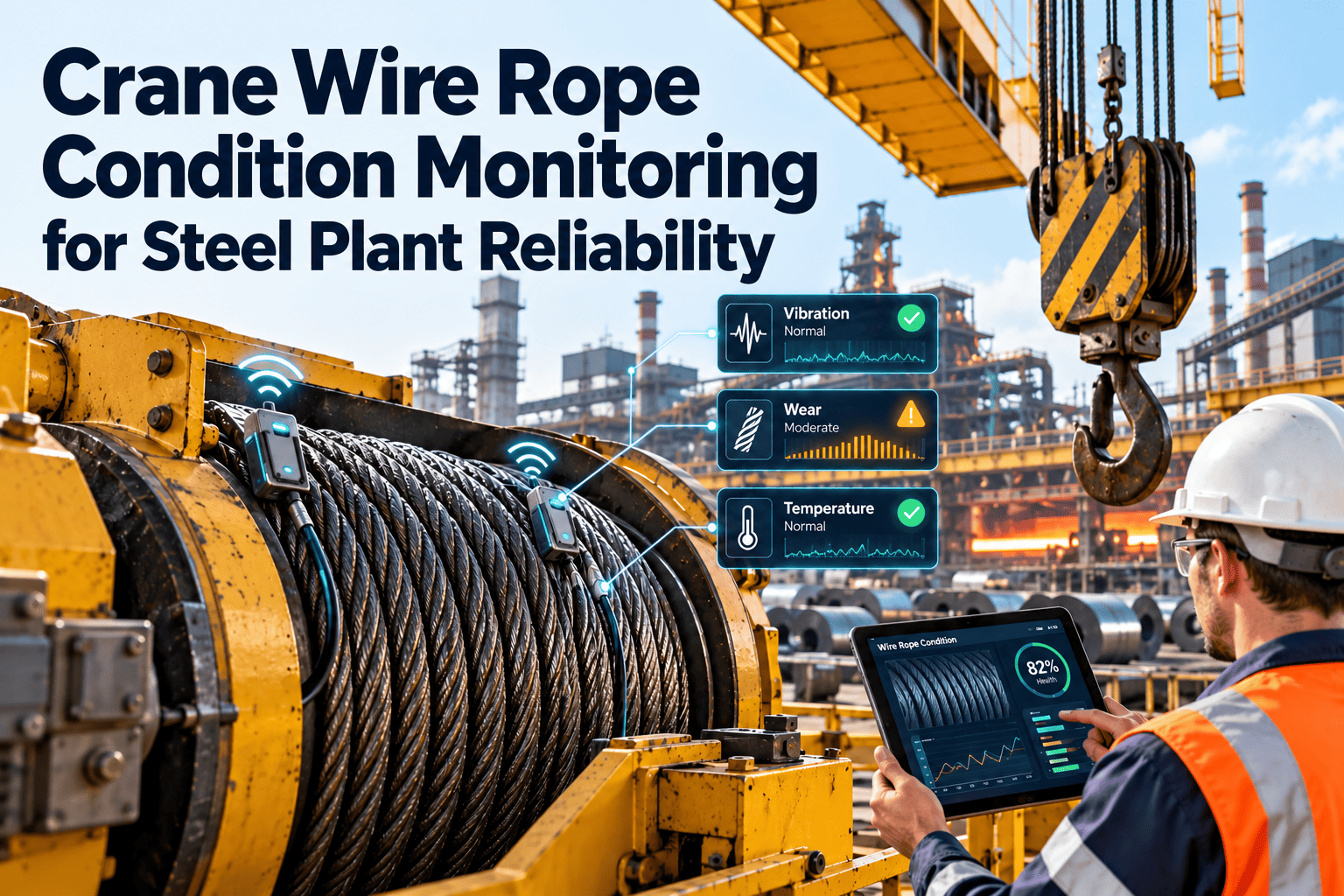
Wire Rope and Sling Systems
Inspect diameter degradation, kink formation, and abrasion damage. Replace ropes at 12-month intervals or per manufacturer specifications. Ladle cranes require more frequent inspection due to thermal stress from molten metal contact.
Visual inspection for cracks, bending, and permanent deformation. Hooks must be replaced if throat opening exceeds 15% of nominal dimension. Shackle pins require quarterly lubrication and rotation to prevent galling.
Inspection Points: Hook deformation measurement, shackle pin rotation, load pin condition, attachment bolt tightness, nondestructive testing (NDT) for subsurface cracks, last certified load test date.
Brakes, Limit Switches, and Safety Controls
Brake shoe wear must not exceed 50% of pad thickness. Limit switches require functional testing every 90 days — position each limit switch to confirm the crane stops at intended boundaries. Emergency stop buttons require mechanical actuation testing quarterly.
Inspection Points: Brake shoe wear measurement, hydraulic brake pressure test, limit switch functionality test, emergency stop response time measurement, control pendant button response verification, hoist overload protection testing.
Motor, Gearbox, and Drive Systems
Monitor gearbox oil temperature and viscosity. Replace or filter gearbox oil at 6-month intervals if the crane operates 8+ hours daily. Motor bearing condition requires vibration monitoring — elevated vibration indicates imminent bearing failure.
Inspection Points: Gearbox oil condition (color, viscosity, metal particle count), motor bearing vibration analysis, coupling alignment verification, thermal imaging for overheating zones, electrical insulation resistance testing.
Inspection Points: Rail wear depth measurement, wheel bearing radial play measurement, structural bolt torque verification, wheel rim condition assessment, runway electrical conductor bar integrity, trolley movement smoothness evaluation.
Crane Maintenance and Inspection Checklist — OxMaint Implementation
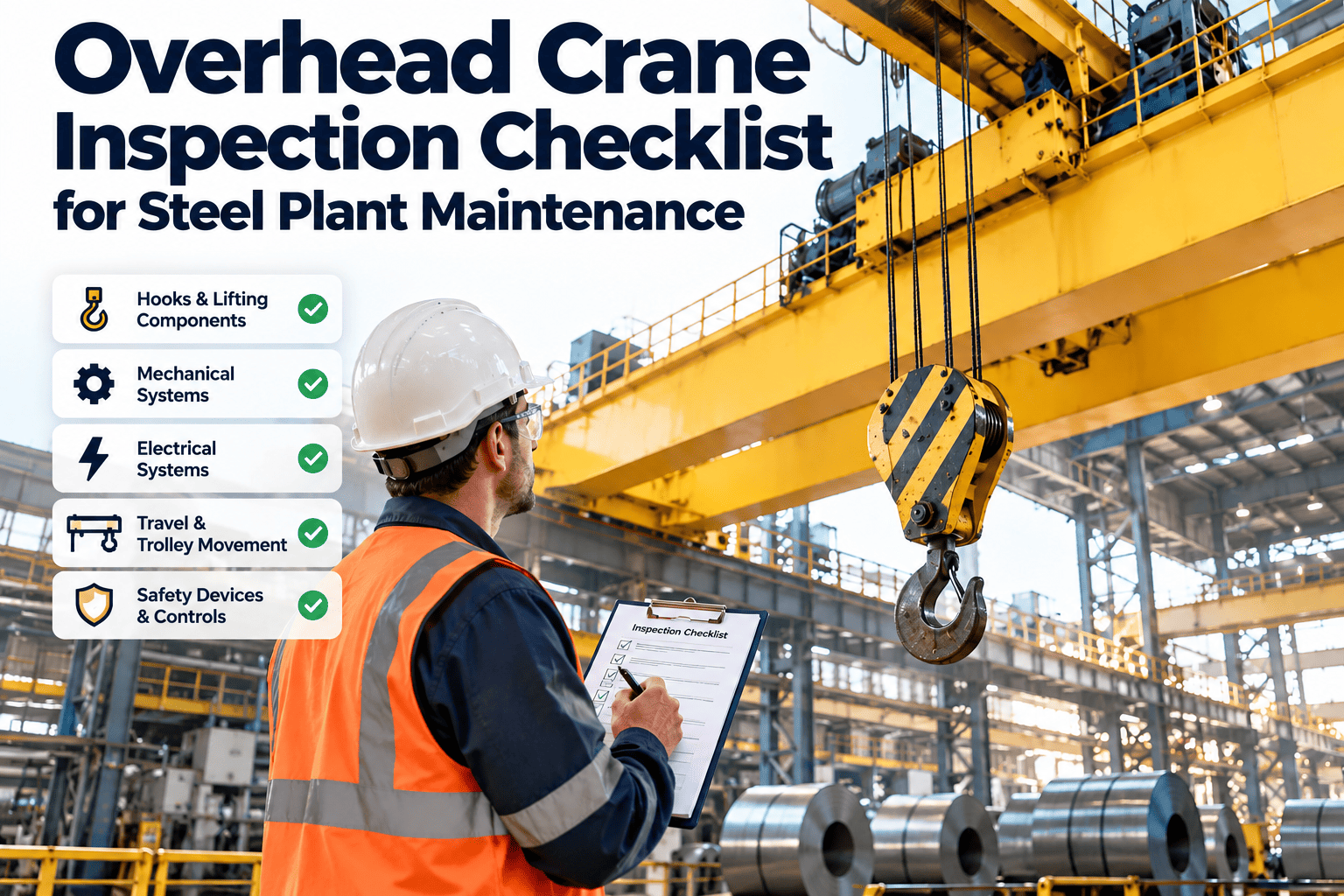
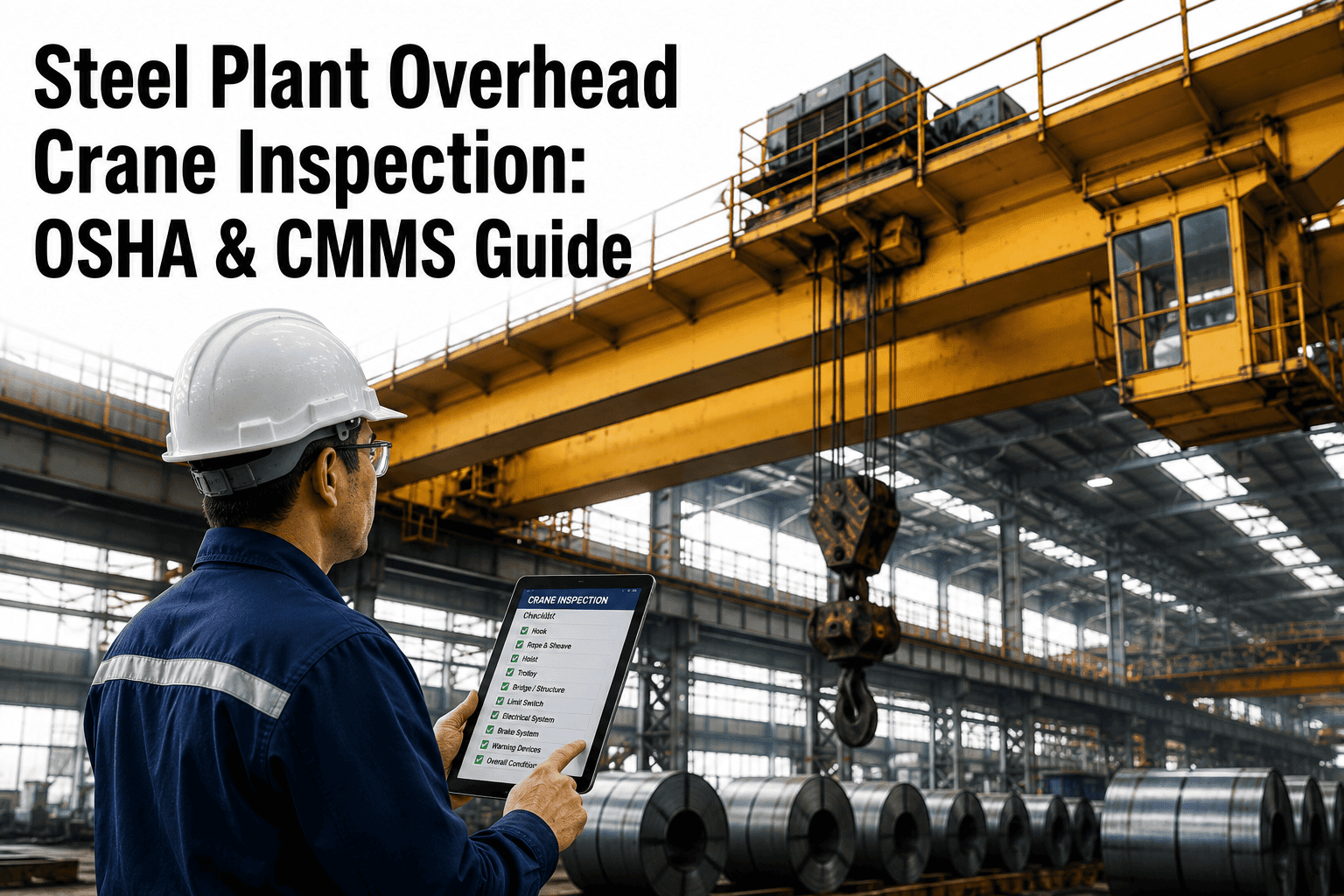
The following inspection checklist represents the minimum required maintenance intervals and observation points for EOT and ladle cranes in integrated and mini steel mills. OxMaint configures this checklist as a structured work order template — technicians complete each section with yes/no selections, measurement entry fields, and photo attachments. The checklist automatically flags any non-conformance and generates a compliance record that satisfies OSHA and ASME audit requirements.
Inspection Item
Frequency
Pass Criteria
Failure Action
Wire Rope Visual Inspection
Monthly
No broken strands, no diameter reduction >5%, no corrosion
Schedule rope replacement within 10 days; tag crane out of service
Rope Diameter Measurement
Quarterly
Diameter within 2% of baseline (measure 3 points along rope length)
Order replacement rope; plan 48-hour replacement window
Hook Throat Opening Measurement
Quarterly
Opening <15% larger than baseline (measure upper and lower)
Order replacement hook; remove crane from service; expedite delivery
Brake Shoe Wear Measurement
Monthly
Shoe thickness ≥50% of original (measure all brake pairs)
Order brake shoe kit; schedule replacement within 30 days
Limit Switch Functional Test
Quarterly
Crane stops at both height limits; no overshoot
Investigate limit switch mechanism; replace switch if adjustment fails
Emergency Stop Button Test
Monthly
Button actuates mechanical stop instantly; no delay
Repair or replace control pendant immediately; remove from service
Gearbox Oil Condition
Monthly (if 8+ hrs/day operation)
Oil color golden-clear; no burnt smell; metal particle count <100ppm
Change oil immediately if color is black or burnt smell present
Motor Bearing Vibration (Spike Energy)
Quarterly
Vibration spike <5mV; no increasing trend week-over-week
Schedule bearing replacement within 30–45 days; increase monitoring frequency
Rail Wear Depth Measurement
Quarterly (annually if light duty)
Rail wear depth <0.2 inches across all measurement points
Plan rail replacement within 120 days; inspect wheels closely
Wheel Bearing Radial Play
Quarterly
Bearing play <0.05 inches (measure at 3-o'clock and 9-o'clock positions)
Schedule bearing replacement within 45 days; increase daily inspection
Structural Bolt Torque Verification
Quarterly
All bolts within ±10% of target torque specification
Current certification from ASME-qualified inspector; dated within 365 days
Schedule third-party inspection immediately; remove crane from service if expired
Third-Party Crane Inspection and Certification Management
ASME B30.2 and OSHA regulations require that cranes undergo load testing and certification by a qualified third-party inspector at least annually. The certification process includes a complete crane load test (applying 125% of rated capacity and confirming the crane halts smoothly), documentation of all safety components, and issuance of a certification card that must be visibly displayed on the crane. OxMaint integrates third-party inspection scheduling, automatic renewal reminders, and compliance tracking — ensuring that certification never lapses and audit-ready documentation is always available.
Annual Load Test Scheduling
OxMaint tracks the expiration date of each crane's third-party certification and issues automated alerts 60 days before expiration. Maintenance managers coordinate with third-party inspectors and schedule the load test during a planned production maintenance window. The scheduling module integrates with plant calendars to avoid conflicts with production deadlines.
Load Test Documentation
When the third-party inspector performs the load test, they document all observations, measurements, and findings in OxMaint using mobile capture. Test results are tied to the crane asset record, creating a continuous maintenance history. Any deficiencies discovered during the load test generate automatic work orders to address the issues before the crane returns to production.
Certification Record and Compliance Audit
The load test certificate is uploaded to OxMaint as a PDF attachment to the crane asset record. The system generates a compliance report showing all active certifications, upcoming expirations, and any certification gaps. This report satisfies OSHA inspection requirements and demonstrates systematic crane safety management.
Non-Conformance and Remediation Tracking
If the load test reveals issues (e.g., brake inefficiency, limit switch overshoot), OxMaint automatically creates corrective action work orders. Technicians address the issues, document repairs with photos, and receive closure notification. The closure is recorded in the compliance audit trail.
A major integrated steel mill in Gary, Indiana operates 14 EOT cranes across multiple production floors (hot strip mill, cold rolling, finishing) plus 6 ladle handling cranes that move molten metal from the ladle furnace to continuous casting. Prior to implementing OxMaint's crane maintenance module, the facility managed crane maintenance through a combination of reactive repairs and annual third-party inspections. Technicians performed inspections informally — a technician might notice worn brake shoes and initiate a repair, but there was no systematic inspection schedule. Third-party load tests were performed annually, but findings were documented in PDF reports that were printed and filed — no integration with the work order system meant that non-conformances often remained unaddressed.
A ladle crane failure in January 2023 exposed the gaps in this approach. During a routine pour, the limit switch failed, allowing the ladle crane to rise beyond its designed height limit. The operator stopped the crane manually using the control pendant's emergency stop, but the incident triggered an OSHA investigation. The inspection found that the limit switch had not been tested in 14 months — a violation of ASME B30.2 standards. The mill faced a $120,000 fine and a mandatory facility-wide crane safety audit.
Following the incident, the mill deployed OxMaint's crane maintenance module across all 20 cranes. Technicians were trained to execute monthly inspections using the mobile app checklist (wire rope visual, brake shoe wear, limit switch function, emergency stop test). Quarterly inspections added detailed measurements (rope diameter, brake shoe thickness, wheel bearing play). Annual third-party inspections were scheduled through OxMaint's scheduling module, and load test certificates were attached to crane asset records.
Within 6 months of OxMaint implementation, the mill had baseline measurements on all 20 cranes. The data revealed three cranes with accelerated wear: one had brake shoes at 42% thickness (approaching replacement threshold), another had motor bearing vibration trending upward, and a third had rail wear of 0.19 inches (near the 0.2-inch replacement threshold). The mill proactively scheduled component replacements during planned production maintenance windows, avoiding reactive failures and unplanned downtime.
The year after OxMaint implementation, the mill experienced zero unplanned crane failures — compared to 3 failures in the prior year. Unplanned downtime attributed to cranes dropped from 28 hours annually to 0 hours. Planned maintenance windows (necessary for component replacement) averaged 2.5 hours per crane — managed, predictable downtime versus the 16-hour emergency repair that had characterized prior failures. The total cost of preventive maintenance (approximately $62,000 in parts, labor, and lost production time) was offset by the avoidance of a single major crane failure (estimated $280,000 in emergency repairs and production loss).
Frequently Asked Questions — Crane Maintenance and Safety
How often should EOT cranes be inspected for safety compliance?
ASME B30.2 mandates monthly inspections for frequent-use cranes (8+ hours daily) and quarterly inspections for light-duty cranes. Annual load testing by a qualified third-party inspector is required. OxMaint automates scheduling and tracks all inspections.
What is the typical service life of a crane wire rope in a steel mill?
Wire rope typically lasts 12–24 months in heavy-duty steel mill environments. Ladle cranes experience accelerated degradation due to molten metal thermal stress — rope life may be 8–12 months. Quarterly diameter measurements help predict replacement timing and prevent unexpected failures.
How do limit switch failures impact crane safety and production?
A failed limit switch allows the crane to exceed designed height or horizontal boundaries, creating collision risk with overhead structures or adjacent equipment. The operator must use the emergency stop button to halt the crane, creating production delays and safety exposure. Functional testing every 90 days prevents silent failures.
What does ASME B30.2 require for third-party crane load testing?
ASME B30.2 mandates load testing to 125% of rated capacity, documentation of all safety components, and issuance of a certification card annually. The load test must be performed by a qualified (certified) third-party inspector. OxMaint integrates certification tracking and alerts when renewal is due.
How can brake shoe wear monitoring prevent crane failures?
Brake shoe wear reduces braking force gradually — a crane with worn brake shoes stops more slowly, increasing overshoot and collision risk. Monthly wear measurements (target: >50% of original thickness) enable proactive replacement before braking is compromised.
What is the cost of an unplanned crane failure in a steel mill?
Unplanned EOT crane failures in integrated mills cost $40,000–$280,000 depending on failure type and production impact. Emergency repairs often require weekend or night shift labor at premium rates. Preventive maintenance costs 8–15% of failure cost, making systematic inspection a strong financial investment.
Does OxMaint integrate with existing CMMS systems for crane maintenance records?
Yes — OxMaint connects to SAP, Oracle, and other enterprise systems via API. Crane inspection records, load test certificates, and maintenance history synchronize between OxMaint and the enterprise CMMS, creating a unified asset history that prevents duplicate data entry.
"
A crane failure shut down our hot strip mill for 16 hours — cost us $180,000 in lost production. The failure could have been prevented with systematic inspections. We deployed OxMaint to track crane maintenance across all 14 EOT cranes and 6 ladle cranes. Within 6 months, we identified three cranes with accelerated wear and replaced components proactively during planned maintenance windows. We have not had an unplanned crane failure since. Every steel mill should have this level of crane safety discipline.