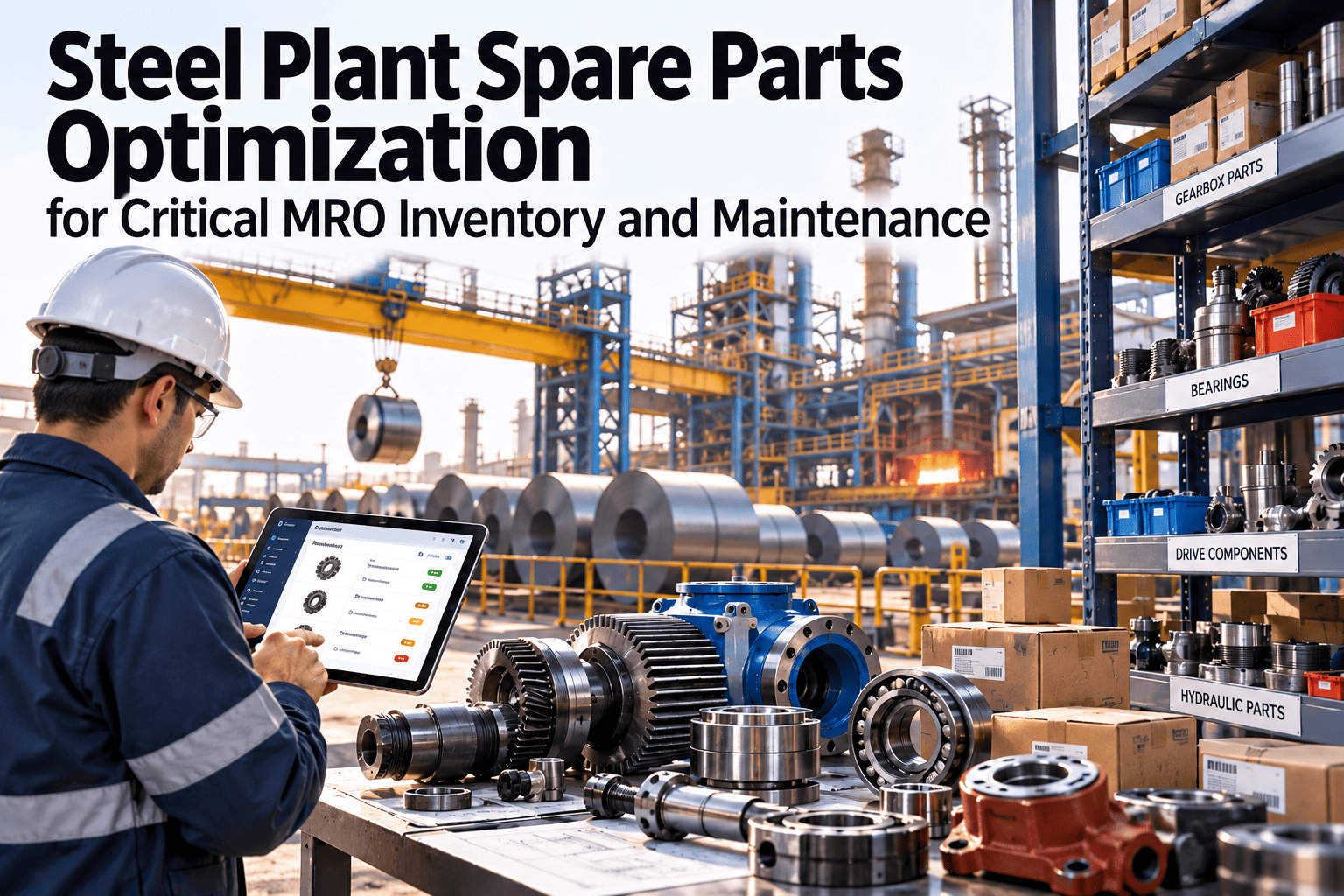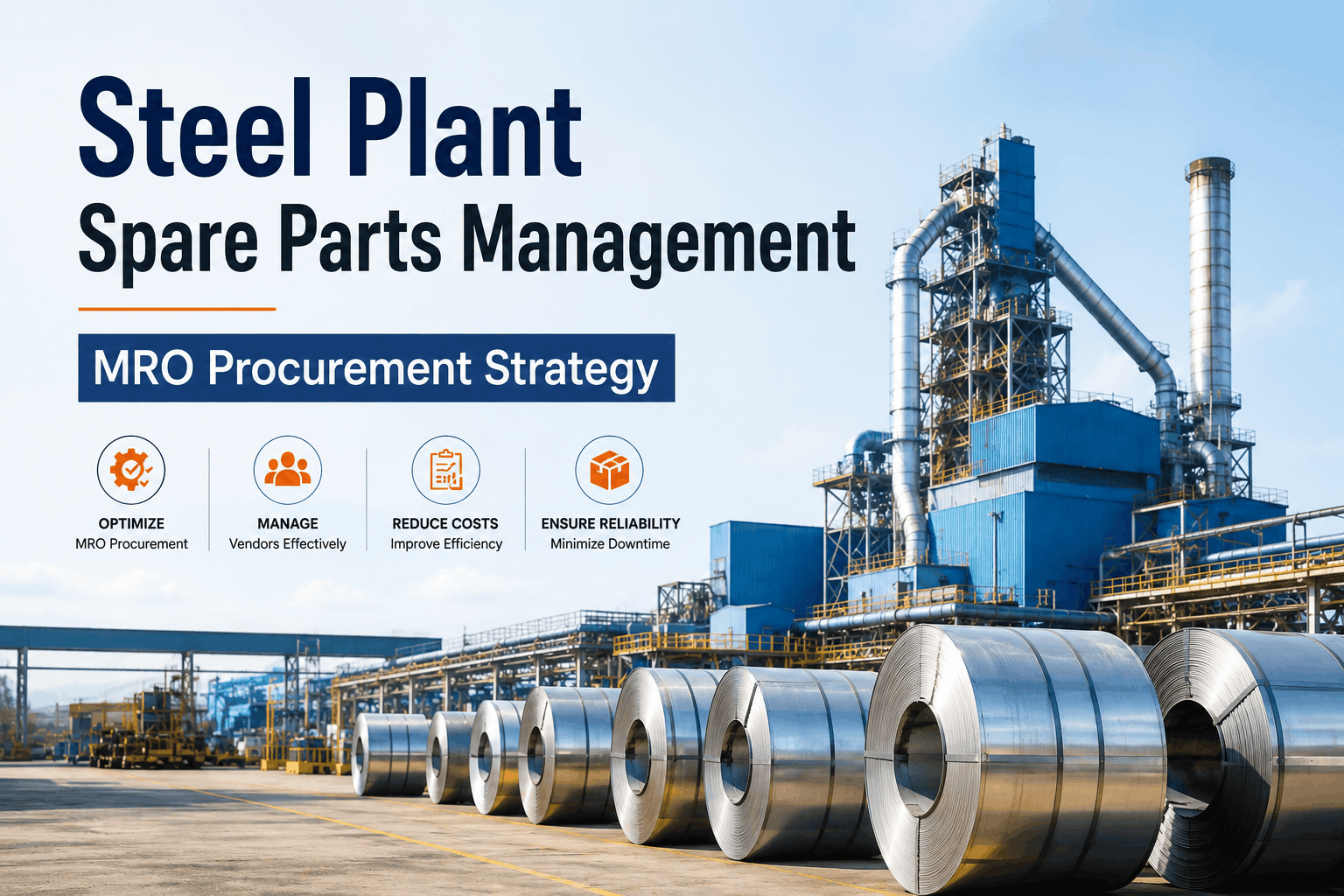
Steel mill spare parts inventory management operates at an intersection of cost pressure and operational necessity — a critical spare part in stock that never gets used represents locked capital and warehouse expense, yet being one day short of a needed part during a major equipment failure costs tens of thousands in production downtime. Integrated and mini steel mills manage 800–3,000 active spare parts across furnaces, casting machines, rolling mills, and auxiliary equipment. OxMaint's MRO procurement module automates vendor management, tracks consignment inventory in real-time, predicts parts consumption based on maintenance schedules, and prioritizes spending on high-criticality items — transforming spare parts from a cost liability into a strategic operational asset.
Steel Plant Spare Parts MRO Strategy: Vendor Management and Consignment Inventory
Optimize spare parts spending with data-driven vendor selection, consignment inventory agreements, parts standardization, and predictive procurement workflows that balance cost with equipment availability.
The Spare Parts Problem in Steel Production
A continuous casting machine's rolls fail suddenly — a furnace's refractory lining cracks during production — a rolling mill's motor bearing begins to fail. Each event demands an immediate replacement part to restore production. Steel mills historically respond to this reality by maintaining large safety stock of high-use components: bearing kits, seal assemblies, coupling components, motor brushes, and refractory materials sit in warehouses consuming floor space and cash. This approach is expensive — a typical integrated mill carries 2,500+ spare parts valued at $1.2–$2.4 million in inventory. However, overstock solves only part of the problem: specialized components (large bearing housings, custom coupling adapters, rare motor windings) cannot be held economically in inventory and must be sourced when failure occurs — leading to 2–7 day delays while suppliers manufacture or source the component. The MRO procurement challenge is fundamentally a prediction problem: which parts will be needed when, and how many units should be in stock? Traditional approaches rely on manually set reorder points that are often outdated — a reorder point set to 3 units for a part that is now consuming 6 units per year gets depleted faster than anticipated, leading to stock-outs. OxMaint integrates maintenance scheduling data (when PM tasks consume specific parts) with historical consumption patterns to predict parts demand 30–60 days in advance, triggering procurement workflows before stock is depleted.
5 Core Strategies for Steel Mill MRO Procurement
MRO Procurement and Inventory Management — Operational Framework
A structured MRO procurement process reduces decision-making time and ensures parts are sourced at optimal cost. OxMaint automates the workflow from maintenance schedule (which identifies upcoming parts requirements) through vendor selection, purchase order generation, goods receipt, and consumption tracking. The framework below reflects best practices from integrated mills managing 2,000+ active parts and mini mills with leaner inventories.
OxMaint Process: System forecasts parts consumption 30–60 days ahead based on PM schedule and historical burn rate. Alert triggers when consumption forecast exceeds current inventory level.
Outcome: Procurement team knows which parts to source and when, eliminating surprises and rush orders.
OxMaint Process: System ranks vendors by lead time, price, and performance score. Procurement manager selects preferred vendor and confirms availability before creating purchase order.
Outcome: Consistent sourcing from best-performing suppliers reduces lead time variability and quality risk.
OxMaint Process: Purchase order is generated automatically with delivery address, part specifications, quantity, and expected delivery date. Approval workflow routes the PO to designated manager based on order value. Digital PO is sent to vendor via email or EDI.
Outcome: Purchase order issued within 2 hours of demand alert — faster than manual requisition process.
OxMaint Process: Warehouse team receives parts and verifies against purchase order (quantity, serial numbers, packaging condition). OxMaint captures receipt with photo and barcode scan. System matches receipt to purchase order and updates inventory location.
Outcome: Parts are inventory-tracked within 4 hours of arrival; no reconciliation delays between receiving and accounting.
OxMaint Process: Technician scans part barcode when removing from inventory. System reduces inventory count immediately and records which technician consumed the part on which work order. Consumption triggers next replenishment order if inventory falls below safety stock level.
Outcome: Real-time inventory visibility; reorder cycle is automatic and data-driven.
OxMaint Process: System matches vendor invoice against purchase order and goods receipt confirmation (three-way match). OxMaint releases payment based on standard terms (Net 30, Net 45) and routes invoice to accounts payable for processing.
Outcome: Three-way reconciliation eliminates billing disputes; vendor relationships improve through accurate, timely payment.
Consignment Inventory Management — Model and Implementation
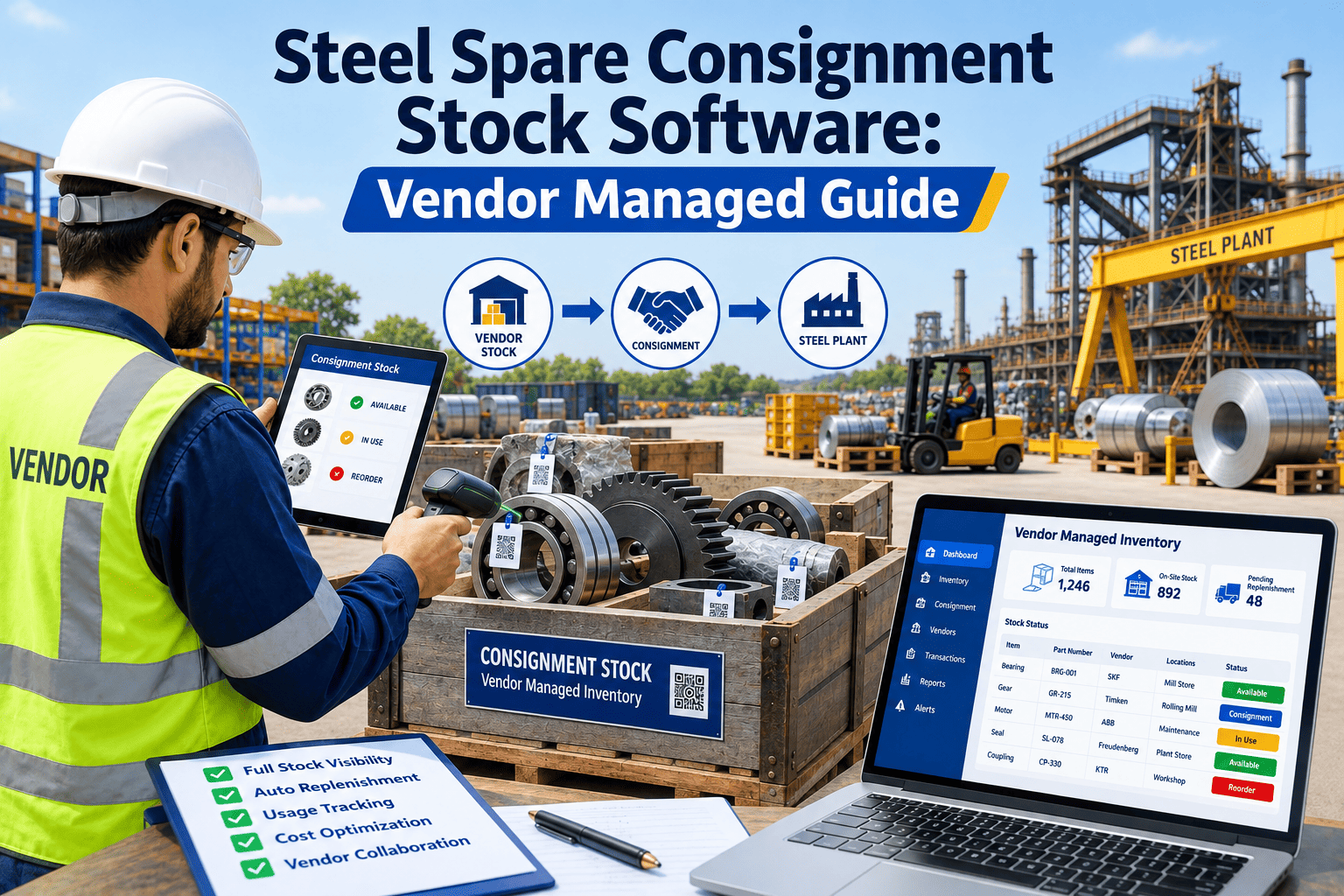
Consignment inventory agreements shift the cost burden from the mill to the supplier until parts are consumed. High-value, high-frequency items (large bearing kits, motor components, coupling assemblies) are ideal for consignment. OxMaint tracks consignment inventory separately from standard purchased stock, monitors bin locations and expiration dates, and triggers vendor replenishment when consumption falls below agreed thresholds.
Real-World Case Study: Mini Steel Mill Spare Parts Optimization — Charlotte, North Carolina
A 120-person mini steel mill in Charlotte, North Carolina operates a single 100-ton electric arc furnace and a 6-stand hot rolling line. The facility manufactures specialty steel products (tool steel, stainless grades) with 8–12 product changeovers per week. Prior to implementing OxMaint's MRO module, the mill maintained a spare parts inventory valued at $680,000 to support furnace and rolling line operations. Inventory levels were set manually — the maintenance manager would review consumption patterns semi-annually and adjust reorder points based on intuition and past failures. This approach resulted in both overstock (redundant materials stored indefinitely) and stock-outs (parts needed but unavailable, triggering emergency procurement at premium cost). In 2023, the facility implemented OxMaint's spare parts management module to track inventory, predict demand, and manage vendor relationships. The first action was a complete parts inventory audit — technicians scanned every part in the warehouse using mobile tablets, verifying part numbers against the asset registry and identifying slow-moving or obsolete stock. The audit revealed $190,000 in inventory that was either obsolete or duplicated — parts that had been purchased but not used in 2+ years. The mill wrote off the obsolete stock and consolidated duplicate parts (three different bearing kit models that performed identical functions were standardized to a single supplier). With baseline inventory established, OxMaint configured predictive procurement based on maintenance schedules. The facility's furnace is relining scheduled every 18 months (next relining planned for June 2024). The system calculated that the June relining would consume 420 refractory bricks, 180 ceramic fiber logs, and 24 anchor pin kits. Rather than maintaining 3-year stock of refractory materials (consuming floor space and capital), the mill configured a consignment agreement with their refractory supplier. Vendor maintains 500 bricks and 200 logs on-site at the mill, owned by the vendor until consumption. When the refractory inventory falls below 300 bricks, the vendor automatically ships replacement stock. OxMaint estimated that this consignment agreement reduced tied-up capital by $34,000 while maintaining guaranteed availability. For high-use items (bearing kits, motor brushes, coupling components), OxMaint's predictive forecast triggered purchase orders 30–45 days in advance based on PM schedule and historical burn rate. A motor bearing kit used on average 2.4 units per month was set to a reorder point of 6 units (covers 2.5 months of consumption). When inventory fell to 6 units, the system automatically triggered a purchase order to the preferred vendor (5-day lead time). The mill received the bearing kits before consuming the existing inventory, eliminating stock-outs. By the end of year 1, the Charlotte mill had reduced total spare parts inventory from $680,000 to $412,000 (40% reduction) while increasing parts availability from 82% (parts available when needed) to 94% (same measure). The availability improvement was driven by predictive ordering — parts were sourced before demand occurred, rather than after emergency notification. The cost reduction came from eliminating obsolete stock, standardizing parts, and shifting high-value materials to consignment inventory. Annual capital freed up: $268,000. Annual savings in carrying cost (warehouse rent, inventory interest, obsolescence): $31,000. Three-year financial impact: $365,000 in capital freed + $93,000 in carrying cost savings = $458,000 net benefit.
Frequently Asked Questions — MRO Procurement and Spare Parts Management
Before OxMaint, we had $680,000 in spare parts inventory and still experienced stock-outs that forced emergency procurement at 40% premium cost. We were holding refractory materials for two years before use and had redundant bearing kits on the shelf. OxMaint forecasted demand based on our maintenance schedule, identified obsolete stock ($190,000), and moved high-value items to consignment agreements with our suppliers. We cut inventory to $412,000, improved parts availability from 82% to 94%, and freed up $268,000 in working capital. That's the financial impact of bringing data into procurement.
Optimize Spare Parts Spending and Free Up Working Capital.
OxMaint predicts parts demand, manages vendor relationships, and tracks consignment inventory. Reduce carrying costs 25–35% while improving parts availability. Free to start.