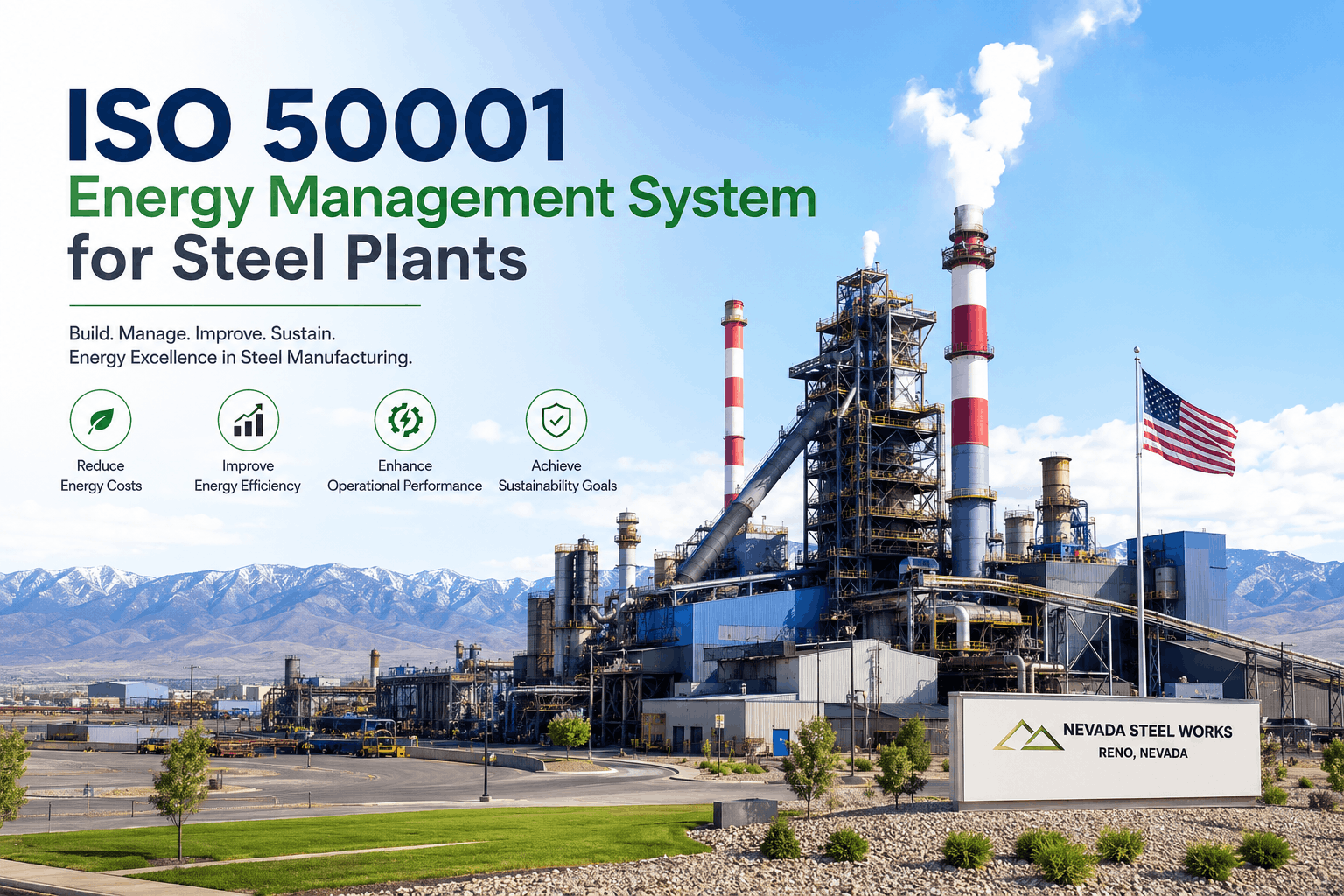
ISO 50001 Energy Management System for Steel Plants
By Alex Jordan on June 12, 2026
Steel mills are among the most energy-intensive manufacturing operations in the world — an integrated steel mill consumes 12–15 megawatt hours (MWh) of electricity per ton of steel produced. With global electricity prices ranging from $80–$180 per MWh, energy cost represents 15–22% of total production expense for a competitive mill. ISO 50001 Energy Management System certification establishes a framework for identifying energy waste, measuring consumption against established baselines, and continuously improving energy performance. OxMaint's energy management module automates data collection from production equipment, tracks consumption metrics by furnace and process, identifies deviation from baseline performance, and generates the documentation required for ISO 50001 audit and certification.
Energy Management · Certification Guide · 2026
ISO 50001 Energy Management System for Steel Plants: Implementation and Certification
Achieve ISO 50001 certification through systematic energy measurement, baseline establishment, continuous improvement planning, and real-time consumption monitoring — reduce energy cost while demonstrating environmental responsibility.
8–18%Typical energy savings achieved within first 12 months of ISO 50001 implementation
$240k–$880kAnnual energy cost reduction for integrated mill (5,000 tons annual capacity)
100%ISO 50001 audit-ready documentation generated automatically by OxMaint
6 monthsAverage time from system deployment to ISO 50001 certification readiness
Energy Management Challenges in Steel Production
Steel production involves multiple energy-intensive processes operating in parallel: arc furnaces consuming electricity for melting scrap metal, rolling mills using mechanical force to shape steel, cooling systems dissipating heat from high-temperature operations, and motor-driven compressors powering pneumatic systems. Energy consumption data is scattered across equipment — a furnace has its own power meter, a rolling mill has a separate electrical panel, a cooling system tracks flow rates. Without a centralized energy management system, these data points remain isolated, and energy improvement opportunities go unidentified. A furnace operating at 12% above baseline consumption is an anomaly that should trigger investigation, but without trend analysis, the waste is invisible. ISO 50001 certification requires that facilities establish energy baselines, identify significant energy uses, set improvement targets, and demonstrate continuous progress toward those targets — tasks that are impossible to execute manually across dozens of equipment pieces and thousands of daily readings.
Additionally, energy management is entangled with maintenance performance: a furnace refractory lining degrades gradually, requiring more electrical energy to reach target temperatures — an issue that is both an energy problem and a maintenance problem. A bearing that is not lubricated properly experiences increased friction and draws more power than baseline. A compressor with a clogged intake filter forces the motor to work harder. ISO 50001 certification requires that energy improvement initiatives be linked to maintenance actions — cleaning the compressor intake, replacing furnace refractory, or lubricating bearings — to close the loop between asset condition and energy performance.
5 Core Components of ISO 50001 Implementation
Energy Baseline Establishment
Define baseline energy consumption for each significant energy use (furnace, mill, compressor) based on 12 months of historical data. Baseline becomes the reference point against which future performance is measured. ISO 50001 requires baseline review annually and adjustment if operational changes justify recalibration.
Significant Energy Use Identification
Identify which equipment consumes the most energy and represents the greatest improvement opportunity. Typically, 3–5 assets account for 70–80% of total facility energy use (arc furnace, rolling mill, casting machine). Focus monitoring and improvement initiatives on these significant uses.
Energy Performance Indicators (EnPI)
Define KPIs that track energy performance independently of production volume. For furnaces, EnPI may be MWh per ton of steel produced. For rolling mills, EnPI may be kWh per ton-kilometer of material rolled. Track EnPI trends and alert when performance deviates from baseline by >5%.
Energy Improvement Planning
Identify and prioritize energy improvement opportunities (furnace refractory replacement, motor efficiency upgrades, waste heat recovery). Set realistic targets for energy reduction (5–10% annual) and assign accountability for implementation. OxMaint links energy improvement projects to maintenance work orders.
Measurement, Verification, and Reporting
Continuously monitor energy consumption and compare against baseline and targets. Measure impact of improvement projects (did the furnace refractory replacement actually reduce consumption?). Generate quarterly and annual reports documenting progress toward energy targets, required by ISO 50001 certification audits.
Energy Data Collection and KPI Calculation Framework
ISO 50001 certification requires that energy data be collected from equipment meters at regular intervals, aggregated by facility and by significant energy use, and analyzed for trends and anomalies. OxMaint automates this process by connecting to facility energy management systems (Siemens, ABB, Schneider Electric) and extracting meter readings daily. The system calculates energy performance indicators (EnPI) by dividing total consumption by a production metric (tons produced, operating hours) to normalize consumption for production volume.
Equipment Type
Energy Meter Type
Data Collection Frequency
EnPI Calculation
Electric Arc Furnace
Power meter + billing meter (kWh)
Hourly (continuous)
MWh per ton of steel melted; baseline 0.65 MWh/ton
Continuous Casting Machine
Power meter (kW) + flow meter for cooling water (GPM)
Continuous (5-min intervals)
MWh per ton cast; baseline 0.12 MWh/ton
Hot Rolling Mill
Power meter (kW) for drive motors
Real-time (monitoring system)
kWh per ton-km of material rolled; baseline 18 kWh/ton-km
Compressed Air System
Compressor power meter (kW)
Hourly
kWh per 1,000 scfm of air delivered; baseline 7.2 kWh/1000 scfm
Water Treatment and Cooling
Pump power meter (kW)
Continuous
kWh per million gallons of water treated; baseline 45 kWh/million gal
Facility-Wide Electrical
Utility billing meter (kWh)
Monthly (utility billing)
MWh per ton of steel produced; baseline 1.45 MWh/ton
ISO 50001 Certification Roadmap — 6-Month Path to Audit Readiness
Achieving ISO 50001 certification typically requires 4–8 months from system deployment to successful third-party audit. The roadmap below reflects the sequence and timing recommended by accreditation bodies and has been validated by OxMaint customers in the steel industry. Success depends on early commitment of maintenance, operations, and management resources — energy management is not an IT project, it is a business transformation that changes how equipment is maintained and operated.
Month 1
Energy Baseline and Scope Definition
Conduct facility energy audit — identify all significant energy uses and collect 12 months of historical consumption data. Define facility energy baseline (MWh/month) and per-unit baselines (MWh/ton of steel). Establish energy policy signed by top management and communicated to all employees. Baseline and policy are non-negotiable starting points for ISO 50001; all subsequent improvement targets are relative to baseline.
Month 2
Meter Installation and Data Collection Setup
Deploy sub-meters on significant energy uses (furnace, mill, compressor) to measure consumption granularly. Connect sub-meters and main utility meter to OxMaint energy management system. Configure automated daily meter reading at 11:59 PM and automatic calculation of energy KPIs (EnPI by equipment, EnPI by product type). Validate data accuracy by comparing OxMaint readings against utility billing for the first month.
Month 3
Energy Opportunity Assessment and Improvement Planning
Analyze three months of OxMaint energy data to identify equipment operating above baseline (opportunity) or below baseline (already performing well). Conduct energy opportunity workshops with operations and maintenance teams to identify potential improvements: furnace refractory replacement, motor efficiency upgrade, compressed air leak repair, insulation enhancement. Rank opportunities by investment cost and potential energy savings (ROI). Select 3–5 high-impact improvements for Year 1 implementation.
Month 4
Energy Target and Action Plan Approval
Set facility-wide energy reduction target for Year 1 (typically 5–8% reduction vs. baseline) and specific targets for each significant energy use. Create detailed action plan for each improvement project: work order description, assigned technician(s), required materials, timeline, expected energy savings. Obtain executive approval of targets and action plan. OxMaint links action plan items to maintenance work orders so improvements are tracked through completion.
Month 5
Energy Management System Documentation and Training
Document the energy management system: energy policy, baseline calculation methodology, EnPI definitions, improvement opportunity identification process, and roles/responsibilities of energy management team. Conduct training for all operations and maintenance staff on energy awareness, EnPI interpretation, and their role in achieving energy targets. OxMaint generates the documentation automatically, reducing manual creation effort to 60% of traditional approaches.
Month 6
Internal Audit and Pre-Certification Readiness Review
Conduct internal audit to verify energy management system compliance with ISO 50001 standard. Review energy data collection, baseline calculations, EnPI tracking, improvement action plan progress, and documentation completeness. Address any non-conformances identified in internal audit. Prepare for external certification audit by compiling evidence of baseline establishment, target setting, improvement activities, and measurement/verification of energy savings. OxMaint generates audit-ready reports automatically.
Real-World Case Study: Integrated Steel Mill ISO 50001 Certification — Pittsburgh, Pennsylvania
An integrated steel mill in Pittsburgh, Pennsylvania produces 385,000 tons annually across electric arc furnace, continuous casting, and hot rolling operations. Prior to ISO 50001 implementation, the mill consumed 557,000 MWh annually at a cost of $71.8 million (at $129/MWh average utility rate). Energy management was minimal — equipment operated to production schedules with little attention to consumption efficiency. A motor bearing failure that increased mechanical friction might go undetected for weeks, wasting energy without triggering any alarm. Equipment refractory lining degradation occurred gradually, requiring progressively more electrical energy to reach target temperatures — the energy waste was blamed on "aging equipment" rather than identified as a maintenance issue.
In Q1 2023, the mill deployed OxMaint's energy management module connected to existing sub-meters on the arc furnace, casting machine, rolling mill, and facility-wide electrical system. Baseline energy consumption was calculated as 1.447 MWh per ton of steel produced (557,000 MWh ÷ 385,000 tons). The facility set an initial Year 1 target of 6% energy reduction (1.361 MWh per ton), driven by planned improvements: furnace refractory replacement, compressed air leak repair, and motor bearing condition monitoring.
Within the first month of monitoring, OxMaint identified an anomaly: the arc furnace was consuming 9.8% above baseline energy during the night shift (11 PM to 7 AM), while day shift consumed 1.2% above baseline. Investigation revealed that the night shift furnace operator was starting the furnace an hour earlier than necessary, allowing the chamber to reach target temperature before production began — the facility was paying for an hour of furnace energy with no corresponding production. A simple procedural change (start furnace 45 minutes before production, not 60 minutes) eliminated the waste without affecting production readiness. Savings: 8,200 MWh annually ($1.06 million).
The facility executed the planned improvement projects over months 3–6: furnace refractory replacement (completed month 4), compressed air leak repair (completed month 3), and installation of motor bearing vibration monitors on all rolling mill drive motors (completed month 5). Each improvement was tracked in OxMaint as a maintenance work order with before/after energy consumption comparison. The furnace refractory replacement reduced energy consumption by 5.8% on that equipment (from 0.72 MWh/ton to 0.68 MWh/ton). The compressed air leak repair saved 2.1% facility-wide energy (identified by reduction in compressor run time). Motor bearing monitoring enabled early lubrication intervention, preventing friction-driven energy waste.
After 12 months of ISO 50001 implementation, the mill achieved 8.3% total energy reduction: 8,200 MWh from the night shift procedure change, 7,100 MWh from furnace refractory, 3,800 MWh from compressed air repair, and 2,400 MWh from motor maintenance — total 21,500 MWh annual savings. At $129/MWh, the facility reduced energy cost by $2.77 million annually. Against a $380,000 investment in energy meters, sub-meters, and OxMaint software, the facility achieved full ROI in 1.6 months. The mill pursued ISO 50001 certification and passed third-party audit without non-conformances in month 6, becoming a certified energy management facility.
Frequently Asked Questions — ISO 50001 Energy Management
What is an energy baseline and how is it calculated?
Energy baseline is the facility's historical energy consumption over a 12-month reference period, used as the benchmark for measuring improvement. For steel mills, baselines are normalized: MWh per ton of steel produced (accounts for production volume variations). OxMaint calculates baseline from 12 months of meter data automatically.
How often do energy baselines need to be updated in ISO 50001?
ISO 50001 requires baseline review at least annually. If operational changes occur (equipment replacement, production process change), baseline may be recalculated to adjust for the change. OxMaint tracks operational changes and flags when baseline should be reviewed.
What is a typical energy improvement target for steel mills?
Steel mills typically set Year 1 energy reduction targets of 5–8% below baseline. This is achievable through operational improvements (procedure changes, bearing lubrication) and facility upgrades (refractory replacement, motor efficiency). Multi-year targets (3–5 years) of 12–18% reduction are common for programs combining multiple improvement initiatives.
Which equipment should be prioritized for energy monitoring and improvement?
Focus on significant energy uses that account for 70–80% of total consumption. For steel mills, typically arc furnace (40–50% of total), rolling mill (20–25%), and auxiliary equipment (20–30%). OxMaint identifies significant uses automatically through energy data analysis.
How long does it take to achieve ISO 50001 certification from system deployment?
Certification typically requires 6–8 months from system deployment: baseline establishment (month 1–2), improvement project execution (month 3–6), internal audit (month 5), and external certification audit (month 6–8). OxMaint accelerates timeline by automating data collection and documentation.
What documentation is required for ISO 50001 certification audit?
Required documentation includes: energy policy statement, baseline calculation and review records, energy targets and action plans, EnPI definitions and calculation methods, improvement project records with before/after energy measurements, monitoring and measurement procedures, internal audit reports, and management review meeting records. OxMaint generates all of this automatically.
Can energy improvement projects be linked to maintenance work orders in OxMaint?
Yes — OxMaint links energy improvement initiatives to maintenance work orders. A furnace refractory replacement is created as a work order, and its completion is marked in the energy management system. Energy consumption before and after the work order is compared to calculate actual energy savings.
"
We were paying $71.8 million annually for electricity with no visibility into where it was going. OxMaint's energy monitoring revealed that we had a night shift procedure wasting 8,200 MWh annually — one simple change saved us $1.06 million. That finding paid for the entire system. Over 12 months of ISO 50001 implementation, we achieved 8.3% energy reduction (21,500 MWh, $2.77 million savings) through a combination of operational improvements and targeted equipment upgrades. The path to ISO 50001 certification was clear because OxMaint tracked every data point and generated audit-ready documentation automatically. This is how you bring data discipline to energy management.
Reduce Energy Cost and Achieve ISO 50001 Certification.
OxMaint automates energy monitoring, tracks consumption vs. baseline, and generates ISO 50001 audit documentation. Reduce energy cost 5–8% in year one. Free to start.