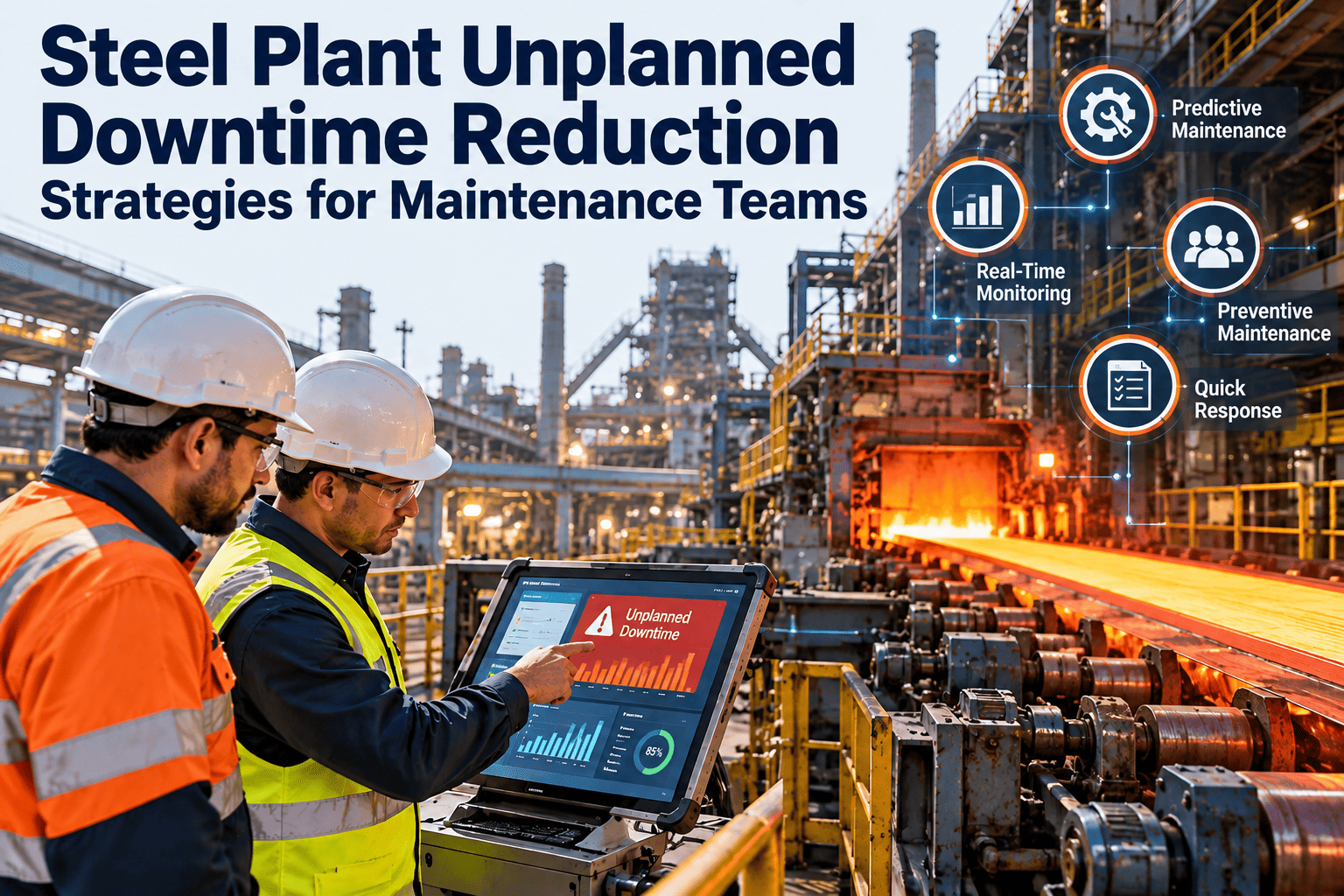
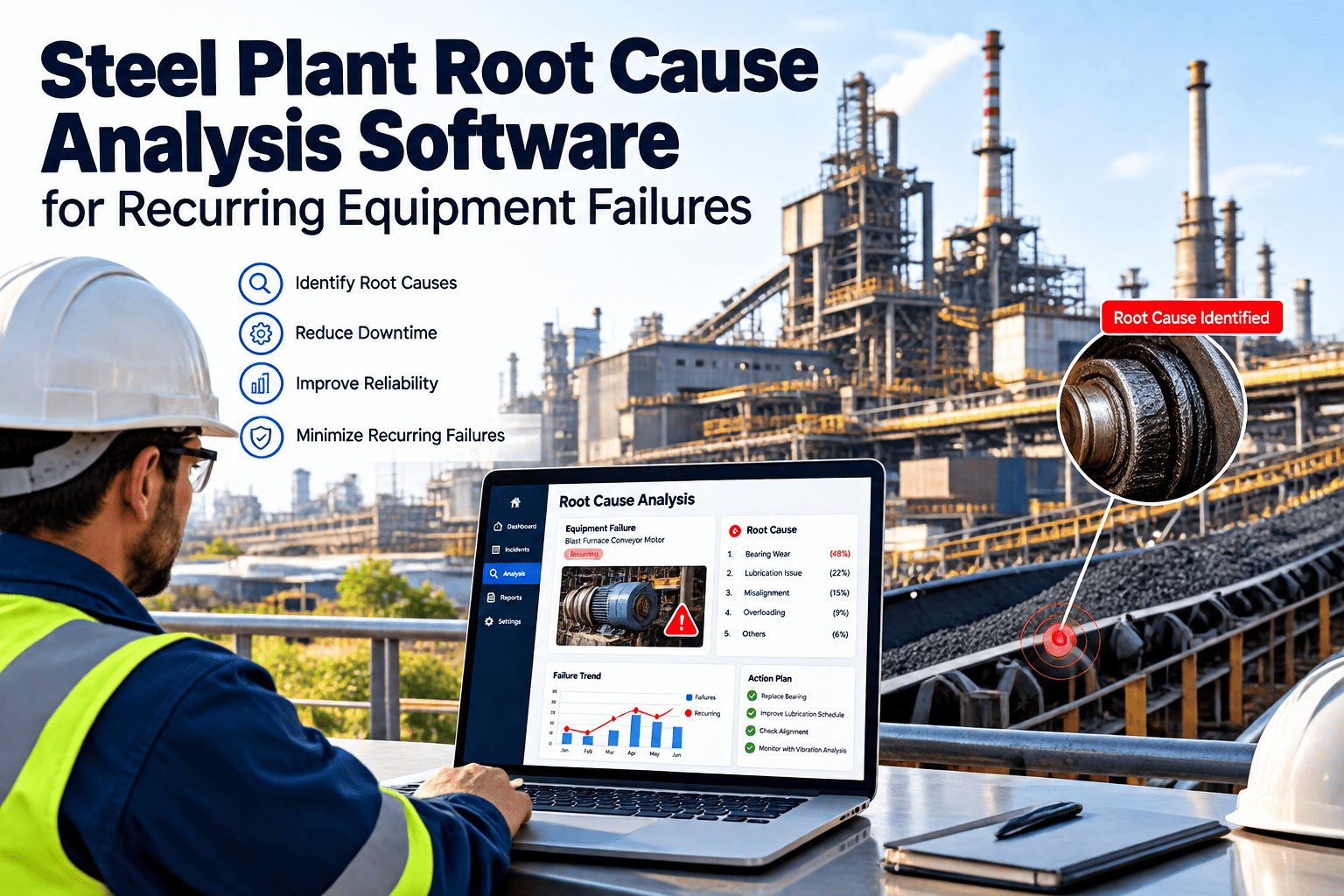
Downtime Analysis in Steel Manufacturing: Root Cause Identification Framework
By Lebron on March 11, 2026
Steel plants lose an average of 800 to 2,200 hours of production time annually to unplanned downtime — yet fewer than 35% of downtime events in a typical mill ever receive a formal root cause analysis. The rest are filed under "fixed it" and forgotten, only to recur weeks or months later with the same failure mode, the same emergency repair cost, and the same production loss. A steel mill operating two electric arc furnaces and a continuous caster tracked their downtime for an entire year and discovered a staggering pattern: 68% of their unplanned downtime hours came from just 12 recurring failure modes that had each occurred five or more times during the year. Every single recurrence was a failure of analysis, not a failure of equipment — because nobody had ever asked "why" beyond the first obvious symptom. A hydraulic leak on the caster withdrawal rolls was repaired eleven times in ten months at a total cost of $1.4 million in parts, labour, and lost production. When a structured root cause analysis was finally conducted on the twelfth occurrence, the team discovered in 45 minutes that the root cause was a misaligned mounting bracket installed during a capital project two years earlier — a $3,200 fix that would have prevented all eleven subsequent failures.
Downtime analysis in steel manufacturing is not about documenting what broke — it is about systematically identifying why it broke, why the conditions that caused it to break were allowed to exist, and what permanent countermeasures will prevent it from ever breaking again. The difference between a steel plant that accepts 1,800 hours of annual downtime and a steel plant that drives it below 400 hours is not better equipment — it is a structured root cause identification framework embedded in daily operations and supported by a CMMS that captures every event, guides every analysis, tracks every countermeasure, and verifies every result. Oxmaint delivers the integrated CMMS platform purpose-built for steel manufacturing that transforms downtime events from reactive repairs into permanent elimination opportunities. Start your free trial to deploy structured root cause analysis across every furnace, caster, and rolling mill in your steel plant.
Steel Plant RCA Framework 2026
Downtime Analysis in Steel Manufacturing: Root Cause Identification Framework
A structured framework for capturing every downtime event, classifying root causes by category, applying proven analysis methodologies, implementing permanent countermeasures, and verifying results — purpose-built for EAFs, continuous casters, rolling mills, reheat furnaces, and finishing lines. This is the definitive guide to transforming reactive repair culture into systematic failure elimination across steel manufacturing operations.
800+Avg Hours Lost Per Year
68%From Recurring Failures
$12M+Typical Annual Cost
75%Preventable With RCA
The Five-Step Root Cause Identification Framework
Effective downtime analysis in steel manufacturing requires a structured, repeatable process that moves from event detection through permanent elimination. Most steel plants only execute the first step — recording that a failure occurred — and skip the remaining four steps where all the value lives. The five-step framework below transforms every downtime event into a learning opportunity that prevents future recurrences and recovers hidden production capacity.
1
Detect & Capture
Automated real-time downtime event capture from PLC and SCADA systems the instant equipment stops. Every event timestamped, duration-tracked, and fault-coded without relying on operator memory or end-of-shift manual entry. The foundation of accurate downtime analysis — you cannot analyse what you do not capture.
Every downtime event classified into structured reason code trees: mechanical, electrical, process, human, material, or environmental. Events simultaneously categorised into OEE loss types — equipment failure, setup, minor stoppage — enabling both maintenance root cause analysis and production effectiveness tracking from a single data source.
Systematic analysis using proven methodologies — 5-Why, Fishbone, FMEA, Fault Tree — guided by CMMS templates that ensure consistency across all analysts. The investigation goes beyond the first "obvious" cause to identify the systemic conditions that allowed the failure to occur: missing PM tasks, inadequate procedures, design weaknesses, or training gaps.
5-Why AnalysisFishbone DiagramsFMEA TemplatesCross-Functional Teams
4
Implement Countermeasures
Corrective and preventive actions generated as tracked CMMS work orders with owners, deadlines, and completion verification. Countermeasures range from immediate fixes to PM schedule updates, procedure revisions, design modifications, training programmes, and spare parts stocking changes — each linked to the root cause it addresses.
CMMS Work OrdersOwner AssignmentDeadline TrackingPM Updates
5
Verify & Standardise
Post-implementation monitoring confirms the countermeasure eliminated the root cause — tracked by MTBF improvement, repeat failure rate, and OEE impact. Successful countermeasures are standardised into updated SOPs, PM schedules, and training materials. Failed countermeasures trigger re-analysis. The closed loop prevents both recurrence and knowledge loss.
MTBF TrackingRecurrence MonitoringSOP UpdatesKnowledge Base
Six Root Cause Categories in Steel Plant Downtime
Every downtime event in a steel plant traces back to one of six root cause categories. Understanding these categories is essential for building effective reason code trees, prioritising RCA resources, and targeting improvement programmes at the highest-impact failure domains. The distribution below reflects industry averages across integrated steel operations — your plant's specific distribution will vary, but the categories are universal.
Mechanical Failure35%
Bearing seizure, gearbox failure, hydraulic system breakdown, drive shaft fracture, coupling failure, and structural fatigue across furnace tilting mechanisms, caster withdrawal rolls, rolling mill stands, and material handling equipment.
BearingsGearboxesHydraulicsDrivesCouplings
Electrical Failure22%
Motor burnout, VFD faults, sensor malfunction, wiring degradation, control system failures, transformer issues, and power supply interruptions affecting furnace electrodes, caster drives, mill motors, and automation systems.
MotorsVFDsSensorsControlsWiring
Process Deviation18%
Temperature excursions, chemistry out-of-spec, cooling system failures, mould level instability, cobbles from rolling misalignment, and process parameter drift that forces equipment shutdown to prevent product damage or safety incidents.
TemperatureChemistryCoolingCobblesAlignment
Human Error12%
Incorrect operating procedures, missed PM inspections, improper equipment setup, wrong material loaded, communication failures between shifts, and training gaps that lead to equipment misuse, process upsets, or delayed response to developing problems.
ProceduresSetup ErrorsTrainingCommunication
Material Related8%
Raw material quality variation (scrap contamination, alloy impurities), consumable failure (refractory erosion, electrode breakage, roll surface degradation), and spare parts quality issues that cause premature component failure after replacement.
Scrap QualityRefractoryElectrodesRoll Surface
Environmental / External5%
Power grid instability, cooling water supply interruption, extreme weather events, supply chain delays for critical spares, and regulatory-mandated shutdowns. While less frequent, these events often cause the longest individual downtime durations.
Power GridWater SupplyWeatherSupply Chain
The Downtime Analysis Funnel: From Event to Elimination
The critical gap in steel plant downtime management is not the initial failure — it is the systematic dropout of events at every stage of the analysis process. Most plants capture fewer than 80% of events, root cause fewer than 35%, implement countermeasures on fewer than 20%, and permanently eliminate fewer than 12%. The funnel below shows how a structured RCA programme with CMMS integration transforms these dropout rates. Discover how Oxmaint closes every gap in this funnel.
Downtime Event Analysis Funnel — Without vs With Structured RCA
All Downtime Events Occurring100%
Properly Recorded & Classified78% typical98% with CMMS
Root Cause Identified35% typical85% with RCA
Countermeasure Implemented20% typical75% with RCA
Permanently Eliminated12% typical60% with RCA
Root Cause Analysis Impact Benchmarks for Steel PlantsMeasured improvements after deploying structured RCA programmes with CMMS integration
Repeat Failure Reduction75%
Root Cause Identification Rate85%
Unplanned Downtime Reduction65%
Corrective Action Closure Rate90%
Mean Time Between Failures Increase+55%
First-Year Cost Recovery92%
RCA Programme Implementation Roadmap
Deploying a structured root cause analysis programme in a steel plant requires a phased approach that builds capability systematically — from basic event capture through advanced predictive analytics. Attempting to jump to advanced RCA without first establishing reliable data collection and classification produces analyses built on incomplete information. The roadmap below sequences implementation across five phases over 12 months.
Phase 1: FoundationMonth 1–2
Deploy CMMS with automated PLC-connected downtime capture on pilot production lineDesign and implement structured reason code trees for mechanical, electrical, process, human, material, and environmental categoriesTrain operators on real-time event confirmation and reason code selection at line-side terminalsEstablish baseline downtime metrics: MTBF, MTTR, frequency, and cost per event category
Phase 2: Classification MasteryMonth 2–4
Validate reason code accuracy weekly — target 90%+ correct classification within 60 daysGenerate first automated Pareto analyses ranking downtime causes by cost, frequency, and durationIdentify top 10 recurring failure modes consuming 80% of total downtime hoursExpand automated capture to all major production lines — EAF, caster, rolling mill, finishing
Phase 3: Analysis CapabilityMonth 4–7
Train cross-functional RCA teams on 5-Why, Fishbone, and FMEA methodologiesConduct formal RCA on top 5 recurring failures — document root causes and implement countermeasuresIntegrate RCA findings into CMMS — link root causes to corrective action work orders with owner and deadlineEstablish weekly RCA review meeting: new events, open investigations, countermeasure status
Phase 4: Countermeasure ExecutionMonth 7–10
Track countermeasure implementation rate — target 80%+ on-time closure of corrective actionsMonitor MTBF improvement for each addressed failure mode — verify root cause was truly eliminatedUpdate PM schedules, SOPs, and training materials based on RCA findings systemwideBuild RCA knowledge base — searchable database of all completed analyses with outcomes
Phase 5: Predictive MaturityMonth 10–12
Deploy failure pattern recognition — CMMS identifies emerging failure signatures before breakdown occursIntegrate condition monitoring data (vibration, thermal, oil analysis) with RCA failure historyAutomate RCA triggers: system initiates analysis workflow when repeat failure thresholds are breachedManagement ROI report: quantify downtime hours eliminated, costs avoided, and MTBF improvements from RCA programme
Transform Every Failure Into a Permanent Elimination
Oxmaint captures every downtime event automatically, guides structured root cause analysis with built-in 5-Why and Fishbone templates, tracks corrective actions to completion, and monitors MTBF to verify that root causes stay eliminated. Stop fixing the same failures year after year.
Most steel plants sit at Level 1 — reactive repair culture where breakdowns are fixed and forgotten without any formal root cause investigation. Understanding your RCA maturity level determines the implementation path, the expected timeline for results, and the magnitude of recoverable downtime hidden inside recurring failure patterns.
Level 1: Reactive — Fix and Forget
No Formal RCAPaper LogsRepeat Failures AcceptedNo MTBF Tracking
68% of downtime comes from recurring failures. Average MTBF declining. Maintenance costs increasing year over year. Root causes unknown for 90%+ of events. Knowledge lost with every crew change and retirement.
Level 2: Systematic — Structured but Manual
CMMS Deployed5-Why on Major EventsReason Codes ActiveMonthly RCA Reviews
Top 20 failure modes formally analysed. Repeat failure rate declining 15–25% annually. Countermeasures tracked but verification inconsistent. RCA knowledge exists but is not yet searchable or systematically reused.
Level 3: Predictive — Data-Driven Elimination
Auto RCA TriggersPattern RecognitionKnowledge BasePredictive Analytics
Repeat failure rate below 15%. CMMS auto-triggers RCA when patterns emerge. Condition monitoring data integrated with failure history. Every RCA feeds searchable knowledge base. New failures proactively prevented through failure prediction models.
ROI: Reactive Repairs vs Structured RCA Programme
Annual Cost Impact: Integrated Steel Production FacilityFix-and-forget reactive approach vs structured root cause analysis programme with CMMS
Six Root Cause Analysis Methodologies for Steel Plants
Different failure types require different analysis methodologies. A single bearing failure calls for 5-Why. A complex multi-system failure needs Fault Tree Analysis. A chronic quality defect requires FMEA. The six methodologies below are the essential RCA toolkit for steel manufacturing — each one suited to a specific type of downtime problem and steel process application.
01
5-Why Analysis
Asks "why" iteratively until the systemic root cause is reached — typically 3 to 5 levels deep. Simple, fast, and effective for single-event failures where the causal chain is linear. Ideal for operator-led analysis of mechanical breakdowns on casters and rolling mills.
Best for: Single-event failures with linear cause chains
02
Fishbone (Ishikawa) Diagram
Maps potential causes across six categories — Machine, Method, Material, Man, Measurement, Environment — revealing all contributing factors to a failure. Essential for complex events where multiple root causes interact, such as surface defect clusters on slab output.
Best for: Multi-factor problems with interacting root causes
03
FMEA — Failure Mode & Effects
Systematically evaluates every potential failure mode for a system, ranking each by severity, occurrence probability, and detection capability (RPN score). Proactive rather than reactive — identifies failures before they occur. Critical for new equipment commissioning and process changes.
Best for: Proactive risk assessment and prevention planning
04
Fault Tree Analysis (FTA)
Top-down deductive analysis starting from the failure event and working backward through logic gates (AND/OR) to identify all possible cause combinations. Used for catastrophic or safety-critical failures where understanding every possible pathway is essential — such as EAF electrode failures or caster breakouts.
Best for: Complex catastrophic failures with multiple pathways
05
Pareto Analysis
Ranks all downtime causes by frequency, duration, or cost to identify the vital few driving the majority of losses. The 80/20 principle consistently applies in steel plants — 20% of failure modes cause 80% of downtime. Essential for prioritising which failures to RCA first for maximum impact.
Best for: Prioritising which failures deserve RCA resources first
06
Failure Chronology Analysis
Constructs a detailed timeline of all events, conditions, and actions leading up to the failure — minute by minute. Reveals hidden contributing factors that other methods miss: delayed responses, ignored alarms, concurrent events, and environmental conditions present at the time of failure.
Best for: Major events requiring detailed forensic investigation
Built-In RCA Templates for Every Failure Type
Oxmaint includes structured 5-Why, Fishbone, and FMEA templates embedded directly in the CMMS workflow — guiding analysts through each methodology step by step, linking findings to corrective action work orders, and building a searchable knowledge base that prevents repeat failures across your entire steel operation.
CMMS Integration: Connecting Analysis to Elimination
Root cause analysis without CMMS integration is an academic exercise. The analysis produces findings, the findings get filed, and the same failures recur. The six capabilities below describe how Oxmaint connects every stage of the RCA process — from automated event capture through countermeasure verification — into a closed-loop system that turns analysis into permanent elimination.
01
Automated Downtime Event Capture
Direct PLC and SCADA integration captures every downtime event with sub-minute precision — timestamp, duration, fault code, equipment ID, and production context. Operators confirm reason codes via touchscreen within 2 minutes. No events lost to memory fade, shift handover gaps, or manual data entry errors. The foundation of accurate root cause analysis.
02
Structured Root Cause Database
Every completed RCA is stored with full detail: failure description, analysis methodology used, root causes identified, contributing factors, evidence collected, and countermeasures implemented. The database is searchable by equipment type, failure mode, root cause category, and time period — enabling analysts to check whether a similar failure has been investigated before.
03
Corrective Action Workflow
Every countermeasure from an RCA automatically generates a tracked CMMS work order with assigned owner, deadline, required resources, and completion criteria. The system monitors overdue actions, sends escalation alerts, and prevents RCA closure until all countermeasures are verified as implemented. No countermeasure falls through the cracks.
04
Failure Pattern Recognition Engine
Automated analysis of downtime event history identifies recurring patterns that human reviewers miss: failures clustering on specific shifts, seasonal temperature correlations, failures following specific product grades, and progressive MTBF degradation trends. The system auto-triggers RCA workflows when repeat failure thresholds are breached.
05
Lessons Learned Knowledge Base
Every RCA feeds a plant-wide knowledge base accessible to all maintenance and operations personnel. When a technician encounters a failure, the system surfaces relevant past analyses with proven solutions — reducing investigation time from hours to minutes and preventing the loss of institutional knowledge through retirements and turnover.
06
Executive RCA Performance Reporting
Monthly and quarterly management reports quantify RCA programme impact: number of analyses completed, root causes identified, countermeasures implemented, repeat failures eliminated, MTBF improvements achieved, downtime hours recovered, and dollar savings confirmed. Proves programme ROI and justifies continued investment in analysis capability.
Frequently Asked Questions
Q. What is root cause analysis in steel manufacturing and why does it matter?
Root cause analysis (RCA) in steel manufacturing is a systematic process of investigating downtime events to identify not just the immediate cause of a failure (the symptom) but the underlying systemic cause that allowed the failure to occur (the root cause). For example, the immediate cause of a caster withdrawal roll bearing failure might be "bearing seized." But the root cause might be "lubrication schedule changed during a PM optimisation project six months ago, reducing grease frequency from weekly to monthly without validating the change against bearing manufacturer specifications." Without RCA, the maintenance team replaces the bearing and the failure recurs in 4–6 months. With RCA, they identify the lubrication gap, restore the correct schedule, and prevent all future recurrences. RCA matters because steel plants typically find that 60–75% of their unplanned downtime comes from recurring failure modes that have never been root-caused — representing millions of dollars in avoidable annual losses.
Q. Which RCA methodology should steel plants use — 5-Why, Fishbone, or FMEA?
The correct methodology depends on the failure type. 5-Why analysis is best for straightforward, single-event failures with a linear cause chain — such as a single bearing failure, a specific sensor malfunction, or a hydraulic line rupture. It is fast (30–60 minutes) and can be led by maintenance technicians. Fishbone (Ishikawa) analysis is best for complex failures with multiple contributing factors — such as recurring surface defects on cast slabs where machine condition, material quality, operator practice, and process parameters all interact. FMEA is best used proactively to assess risk before failures occur — during new equipment commissioning, process changes, or when designing PM programmes. Most steel plants should train teams in all three methodologies and select the appropriate one based on the failure complexity. Sign up for Oxmaint to access built-in RCA templates for all three methodologies.
Q. How do you prioritise which downtime events to root cause analyse?
Not every downtime event warrants a formal RCA — the key is prioritising events that deliver the highest return on analysis effort. Use Pareto analysis to rank all downtime events by three criteria: total cost impact (downtime cost + repair cost + quality loss), recurrence frequency (events that have occurred 3+ times), and duration severity (any single event exceeding a threshold such as 4 hours). Any event that ranks in the top 20 on any of these three criteria is an RCA candidate. Additionally, any safety-related event, any event causing collateral damage to other equipment, and any event representing a new or previously unseen failure mode should trigger mandatory RCA regardless of ranking. A typical steel plant finds that formal RCA on the top 20–30 recurring failure modes addresses 75–80% of total avoidable downtime.
Q. How long does it take to see results from an RCA programme in a steel plant?
Steel plants implementing structured RCA programmes typically see measurable results within 60–90 days and significant financial impact within 6 months. The first 30 days establish accurate downtime data capture — which itself often reveals 15–25% more downtime than was previously reported through manual tracking. By day 60–90, the first formal RCAs are completed on top recurring failures, and initial countermeasures are implemented. By month 6, the repeat failure rate on analysed failure modes typically drops 40–60%, and the programme has usually paid for itself through a single major recurring failure elimination. By month 12, mature programmes show 65–75% reduction in repeat failures, 40–55% increase in MTBF on analysed equipment, and net annual savings of $4M–$15M+ depending on plant size. Book a demo to see the implementation timeline for your specific steel operations.
Q. What role does CMMS play in root cause analysis for steel manufacturing?
CMMS is the backbone of effective RCA in steel manufacturing, serving five critical functions. First, it captures downtime events automatically with the accuracy and completeness that manual logging cannot achieve — ensuring the data feeding RCA is reliable. Second, it provides the historical equipment failure data that reveals patterns, trends, and recurrences that trigger RCA investigations. Third, it hosts structured RCA templates (5-Why, Fishbone, FMEA) that guide analysts through consistent, thorough investigations. Fourth, it converts RCA findings into tracked corrective action work orders with assigned owners, deadlines, and completion verification — ensuring countermeasures are implemented, not just documented. Fifth, it monitors equipment performance after countermeasure implementation to verify that root causes have been truly eliminated, closing the loop between analysis and results. Without CMMS integration, RCA becomes a standalone exercise disconnected from the maintenance execution system — producing reports that gather dust while failures recur.