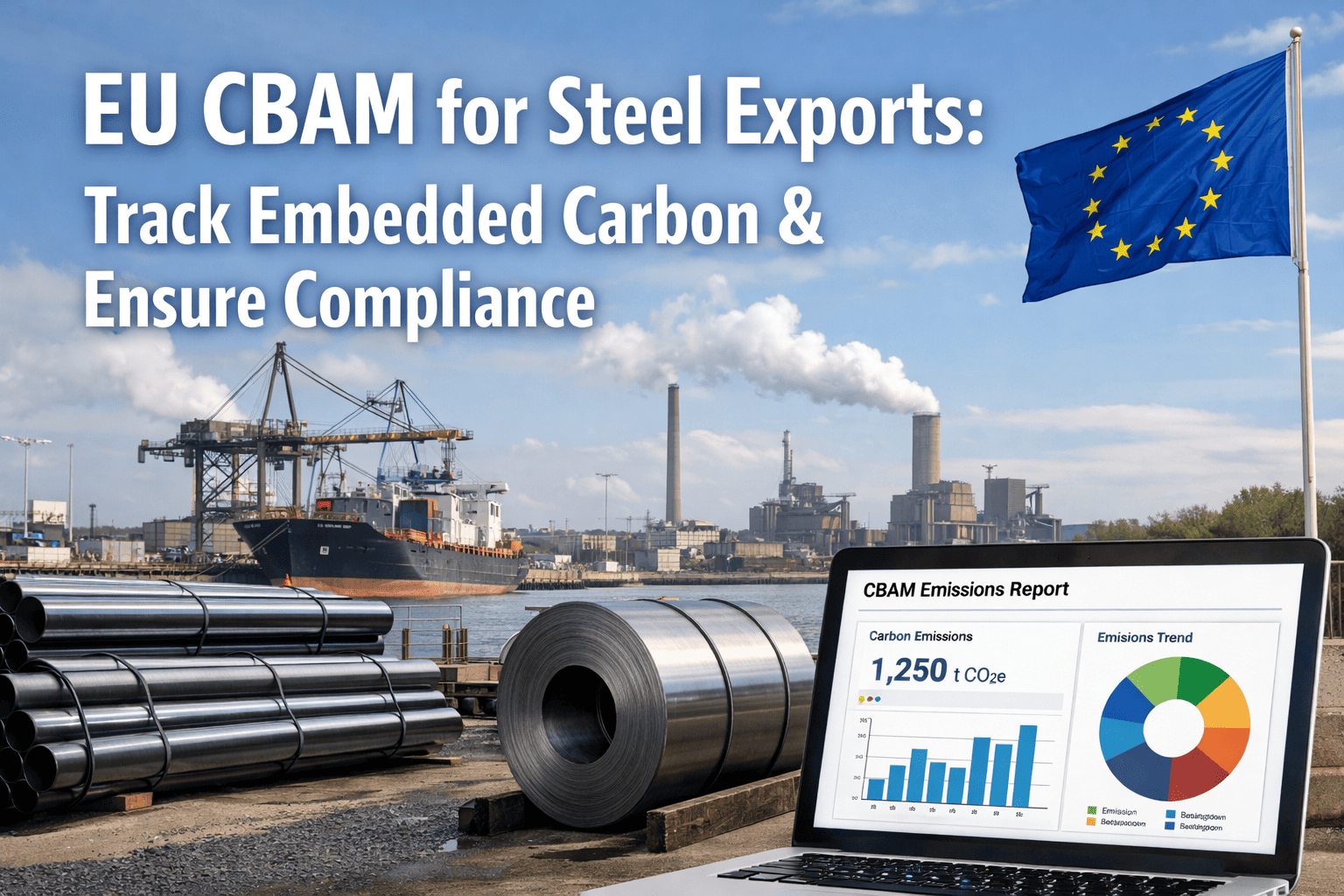
Starting January 2026, any steel exported to the European Union without documented embedded carbon data will trigger CBAM certificate charges that could add €30–€150 per tonne to your landed cost — on top of existing logistics and tariff structures. Steel producers in India, Turkey, Ukraine, China, and South Korea who have been pricing EU contracts without factoring in CBAM exposure are facing a fundamental repricing of their market access. The difference between steel plants that maintain EU export volumes and those that lose them to European producers is not quality or delivery performance. It is whether their emissions data is traceable, verifiable, and formatted to meet EU CBAM reporting requirements. Sign up for Oxmaint to start building your CBAM-compliant emissions record today.
EU CBAM Regulatory Timeline: Where Steel Exporters Stand Now
CBAM has been in effect since October 2023. Steel producers exporting to the EU who have not yet built their embedded carbon data infrastructure are already behind — and face accelerating compliance risk as full enforcement activates in 2026. Understanding exactly what is required at each phase is the starting point for your compliance program.
CBAM Regulation (EU) 2023/956 entered the transitional phase. EU importers of steel (CN codes 7206–7229, 7301–7326) were required to register and submit quarterly embedded carbon reports based on actual production data. No financial obligation in this phase — but embedded carbon data collection became mandatory for all exporters selling to EU importers.
EU importers must report embedded direct and indirect emissions using the CBAM Regulation methodology. Exporters without actual production data force their EU importers to use conservative default values — which are set above actual emissions for most modern mills and create cost pressure that EU importers immediately transfer back to export price negotiations. Steel producers providing verified actual data have had a commercial advantage since 2024. Sign up for Oxmaint to begin building your verified data record.
From January 2026, EU importers of steel must surrender CBAM certificates equal to the embedded carbon in their imported goods. Certificate prices track the EU ETS carbon market — currently €50–€80 per tonne CO2, projected to reach €100–€150 per tonne by 2030. Steel with verified lower embedded carbon than the default values pays proportionally fewer certificates. The financial advantage of actual data over default values becomes directly quantifiable in Euros per shipment. Book a demo to see how Oxmaint generates CBAM-ready embedded carbon reports.
EU producers currently receive free ETS allowances that partially shield them from carbon costs. CBAM is calibrated to phase these free allocations out between 2026 and 2034, with non-EU producers' CBAM obligations rising proportionally each year. By 2034, full CBAM applies at 100% of the embedded carbon cost differential — making accurate emissions data an existential requirement for competitive EU market access.
Full parity between EU and non-EU carbon costs on all goods covered by CBAM. Steel exported to the EU from any country without verified, low embedded carbon will carry the full EU ETS carbon cost as a certificate obligation — making maintenance-driven emissions reduction a direct financial return on investment.
What CBAM Counts as Embedded Carbon in Steel — Scope 1, 2 & Indirect Precursors
CBAM applies to direct (Scope 1) and indirect (Scope 2, electricity) embedded emissions in the goods and their precursor materials. Understanding exactly what must be measured — and at which boundary — is the foundation of a compliant reporting program.
Emissions released directly at the steel production installation during the production process. These must be measured or calculated per GHG Protocol methodology and reported at the installation level — not estimated at a national average.
- Blast furnace combustion of coke and coal — CO2 from calcination and combustion
- Basic oxygen converter process gas CO2 from carbon-in-iron oxidation
- Sinter plant, coke oven, and reheating furnace fuel combustion
- Limestone calcination in blast furnace charge — non-combustion process CO2
- EAF process gas from carbon-in-scrap and electrode oxidation
Emissions from the generation of purchased electricity consumed during steel production. For EAF-route steelmakers, electricity emissions dominate — making grid emission factors and renewable electricity procurement the primary CBAM levers. Electricity must be attributed using either the EU methodology or default country-level emission factors.
- EAF electricity consumption — grid emission factor per kWh consumed
- Rolling mill, pumping, and auxiliary system electricity
- Electrolyzer electricity for green hydrogen production
- Compressed air generation across the entire plant footprint
CBAM requires the embedded carbon of significant input materials (precursors) to be attributed to the finished steel product. Iron ore, DRI, hot metal, and scrap each carry embedded carbon from their production that must be tracked and added to the steel product's CBAM declaration.
- Direct reduced iron (DRI) — embedded carbon from natural gas or hydrogen reduction
- Hot metal purchased from external blast furnaces — embedded process emissions
- Ferroalloys — manganese, chromium, nickel embedded carbon per tonne added
- Scrap steel — attributed zero embedded carbon under current CBAM methodology
Four Things Steel Exporters Get Wrong About CBAM Compliance
CBAM is technically more demanding than most steel companies anticipated in the transitional phase. These four misunderstandings are the most common sources of non-compliance exposure for steel exporters in 2025–2026.
CBAM requires embedded carbon data at the installation level — not country-level or industry-level averages. A steel producer who submits "Indian average BF-BOF emissions" instead of actual per-installation data will default to EU's conservative default values. Your CMMS must generate installation-specific production records with direct measurement linkage to your energy and process meters.
During the transitional phase, many steel exporters tracked only direct Scope 1 emissions assuming electricity emissions were optional. From January 2026, indirect electricity emissions are included in the certificate calculation for steel — meaning EAF producers and any integrated producer with large electricity purchases must have sub-metered electricity attribution records per production unit, not just plant-wide invoices. Sign up for Oxmaint to configure electricity sub-metering attribution.
CBAM charges are proportional to embedded carbon. Steel produced at 1.4 tCO2/tonne instead of the default 1.85 tCO2/tonne pays 24% fewer certificates per tonne — a direct cost reduction of €10–€36 per tonne at current carbon prices. Maintenance programs that improve combustion efficiency, reduce energy intensity, and optimize process operations are CBAM cost reduction programs. The CMMS data that documents these improvements also documents the lower CBAM liability. Book a demo to see how Oxmaint calculates your actual vs. default emissions gap.
From January 2026, embedded carbon data submitted for CBAM must be third-party verified by an EU-accredited verifier. Self-reported data without verification is not accepted. Verifiers require the same evidence package as GHG Protocol assurance reviews: meter calibration certificates, production records, fuel delivery documentation, and a clear audit trail from raw measurement to reported figure. Building this evidence trail in your CMMS from day one of production is far easier than reconstructing it for a retroactive verification audit.
CBAM Financial Impact by Steel Product Type — Actual vs. Default Emissions
The financial penalty for using EU default values instead of actual verified emissions varies significantly by production route and product type. This table quantifies the per-tonne cost advantage of providing actual installation data versus defaulting to EU conservative defaults at a €75/tCO2 certificate price.
| Steel Product / Route | EU Default tCO2/t | Modern Mill Actual tCO2/t | Saving at €75/t CO2 | Annual Saving (100kt export) | Oxmaint Can Track? |
|---|---|---|---|---|---|
| Hot-rolled coil — BF-BOF route | 2.04 | 1.65–1.75 | €22–€29/t | €2.2M–€2.9M | Yes — full Scope 1+2 |
| Cold-rolled coil — BF-BOF + cold rolling | 2.28 | 1.85–1.95 | €25–€32/t | €2.5M–€3.2M | Yes — including rolling energy |
| Hot-rolled coil — EAF scrap route (EU grid) | 0.95 | 0.55–0.70 | €19–€30/t | €1.9M–€3.0M | Yes — electricity sub-metering |
| Wire rod — BF-BOF route | 2.07 | 1.70–1.80 | €20–€28/t | €2.0M–€2.8M | Yes — full scope tracking |
| Sections / structural steel — BF-BOF | 2.12 | 1.75–1.85 | €20–€28/t | €2.0M–€2.8M | Yes |
| Seamless tubes — integrated route | 2.35 | 1.90–2.05 | €23–€34/t | €2.3M–€3.4M | Yes |
| DRI pellets as precursor input | 0.70 (natural gas) | 0.45–0.55 | €11–€19/t | €1.1M–€1.9M | Yes — DRI process tracking |
Swipe to view full CBAM impact table
Every Quarter Without Verified Embedded Carbon Data Is a Quarter Your EU Customers Pay Default Penalty Rates
Steel exporters who provide actual verified embedded carbon data to EU importers reduce their customers' CBAM certificate costs by €20–€35 per tonne versus default values — creating a direct commercial advantage over competitors still relying on estimates. Oxmaint builds that data record from your existing production and maintenance systems.
What Data Your CMMS Must Capture to Support Full CBAM Compliance
CBAM compliance is not a separate data system — it is built on production and maintenance data that your CMMS should already be generating. These tags represent every data category required for a complete, verifiable CBAM submission. Sign up for Oxmaint to map your existing data sources to CBAM requirements.
Our EU customers started asking for CBAM-ready embedded carbon declarations in 2024, and we were completely unprepared. We had plant-level energy bills but no per-heat or per-product attribution. Our competitors in Turkey who had already implemented digital production tracking were immediately able to provide the data and undercut our price to EU buyers because their certificate cost was lower. We lost two significant EU contracts in the first six months of the transitional period. That was the wake-up call that drove us to implement Oxmaint's carbon tracking module across all three of our integrated production units.
EU CBAM Steel Compliance — Frequently Asked Questions
CBAM covers steel products under CN (Combined Nomenclature) codes 7206–7229 and 7301–7326, which include iron and non-alloy steel in primary forms, flat-rolled products, bars and rods, wire, tubes and pipes, and structural steel sections. This covers the vast majority of steel exports to the EU by volume. Downstream manufactured goods containing steel (vehicles, machinery, appliances) are not currently covered, but the EU Commission has committed to reviewing product coverage expansion. Sign up for Oxmaint to map your product portfolio against covered CN codes.
EU importers must use the EU's published default values — which are calculated as the average emissions of the worst-performing 10% of EU producers plus a margin. For BF-BOF steel, the default is approximately 2.04 tCO2/tonne versus modern mill actuals of 1.65–1.75 tCO2/tonne. This means EU importers pay 15–25% more certificates than necessary, and they will either demand a price reduction from the exporter to cover the cost difference or shift procurement to producers who can provide lower actual data. From 2026, providing default-level data is a commercial disadvantage, not just a compliance gap. Book a demo to see how quickly Oxmaint can generate your actual embedded carbon baseline.
Yes. CBAM applies to the embedded carbon of the final steel product exported to the EU — regardless of how many processing steps or countries it passed through. If a Turkish rolling mill imports Indian hot-rolled coil and cold-rolls it for EU export, the CBAM obligation applies to the cold-rolled product's embedded carbon including the carbon embedded in the hot-rolled input. This means the entire production chain's emissions must be documented and attributed to the final product entering the EU market.
Oxmaint links energy consumption and fuel usage records to production output records at the heat or cast level. For each production unit, fuel inputs (by type and quantity), electricity consumption (sub-metered by asset), and process data (coke rates, limestone charges, gas flows) are combined with current emission factors to calculate tCO2 per tonne of steel produced. This calculation runs continuously as data enters the system — producing a running actual embedded carbon figure per product grade that feeds directly into CBAM quarterly reports. Sign up to configure your embedded carbon calculation parameters.
Yes — but only if the exporting country's carbon pricing system meets EU recognition criteria. CBAM allows a deduction for carbon prices effectively paid in the country of production, provided the carbon pricing mechanism covers the relevant emissions without rebates or exemptions that effectively reduce the cost below the stated price. Countries with carbon trading schemes or carbon taxes that meet these criteria — currently very few outside the EU — can offset CBAM obligations by the equivalent carbon price already paid. This creates a strong incentive for non-EU countries to implement robust carbon pricing, which is part of CBAM's stated policy intent. Understanding whether your country's carbon pricing qualifies for deduction requires legal review of both the national scheme and EU delegated regulations.
EU Market Access for Your Steel Starts With Verified Embedded Carbon Data
The steel producers winning EU contracts in 2026 and beyond are the ones who can prove their embedded carbon — not estimate it. Oxmaint gives you the operational data infrastructure to track, verify, and report actual emissions from your production assets, automatically, in the format EU importers and CBAM verifiers require.