Material Flow Risk Detection for Ore Handling Conveyors

By James Smith on May 6, 2026

material-flow-risk-detection-ore-handling-conveyors

Steel plants handling thousands of tons of ore daily face constant risk from conveyor failures — chute blockages, belt overloads, and material spillage that halt production for hours. OxMaint's IoT-powered conveyor monitoring detects these risks in real time, before they escalate into costly downtime. This article explores how bulk material handling teams can use sensor data to prevent ore handling failures and protect production continuity.

Material Handling · IoT Sensor Integration

Material Flow Risk Detection for Ore Handling Conveyors

How steel plants eliminate chute blockages, belt overloads, and conveyor failures before production loss occurs

73% of unplanned downtime from conveyor failure
$180K average cost per conveyor incident
4.2 hrs average detection delay — without IoT

The Conveyor Risk Reality in Steel Plants

01
Chute Blockages

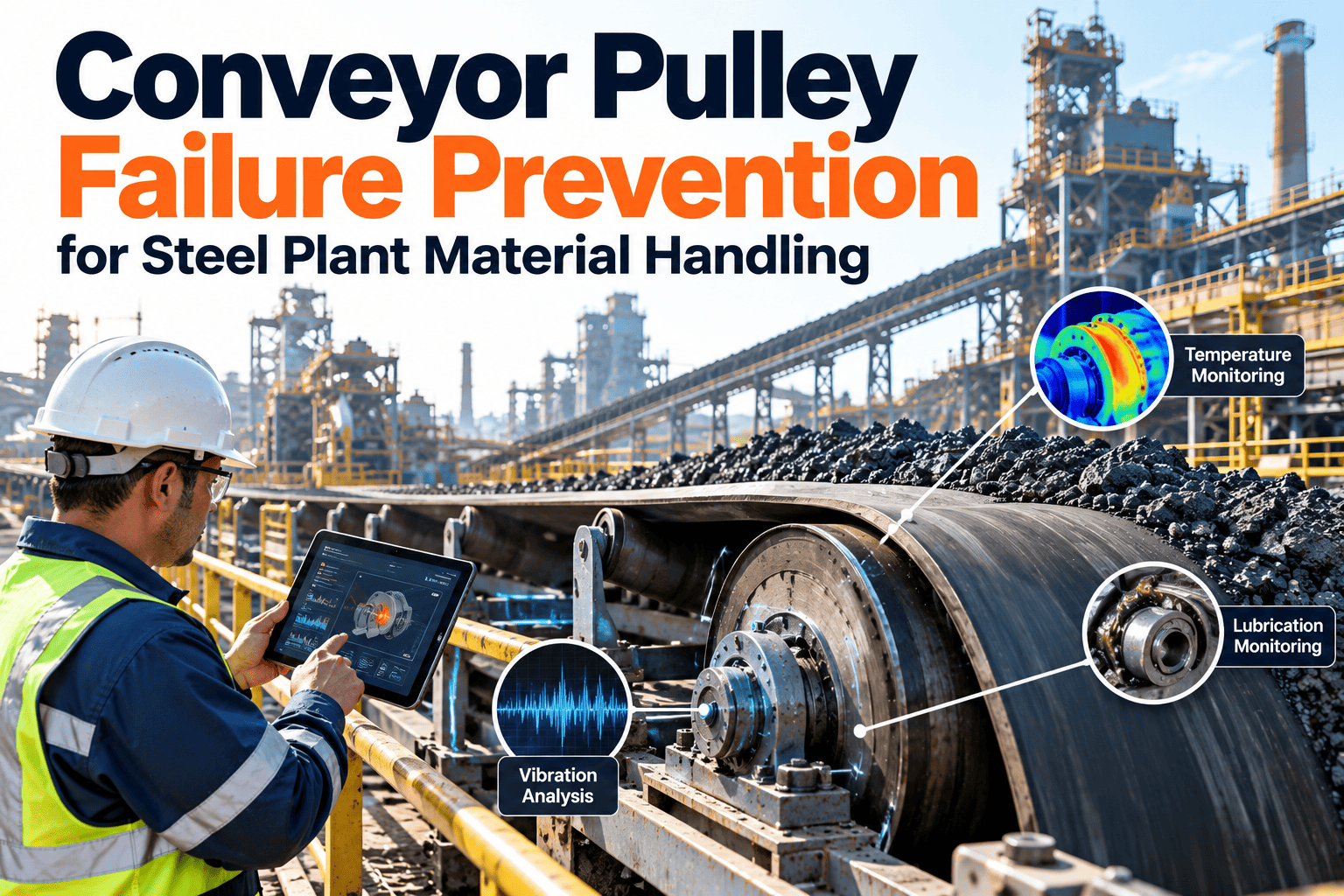
Wet ore, oversized lumps, or sticky material accumulate in transfer chutes silently. By the time operators notice, material backup has already stalled the entire feeding line upstream.

02
Belt Overload

Sudden surge in ore feed from reclaim systems causes belt overloads. Excess material weight strains the drive motor, causing thermal trips that take 2–3 hours to reset and restart safely.

03
Spillage & Misalignment

Belt tracking deviation causes ore to spill at idler frames. Spillage accumulates under conveyors, creating fire hazards, roller damage, and safety risks for field workers doing cleanup.

04
Idler Bearing Failure

Ore dust ingress into idler bearings accelerates wear. Failed idlers cause belt sag, uneven load distribution, and eventual belt damage — repair costs exceed ₹4–8 Lakhs per incident.

See how OxMaint detects conveyor risks before failure Live demo with your plant's asset data

Live Alert Feed — Ore Conveyor System

Simulated real-time sensor events from a 3.5 MTPA steel plant ore yard


CRITICAL CV-07 Transfer Chute: Material blockage detected — belt load 142% of rated capacity
2 min ago

WARNING CV-12 Idler Row 34: Bearing vibration anomaly — thermal signature +18°C above baseline
7 min ago

AUTO WO Work Order #WO-4421 auto-created for CV-12 — assigned to Belt Maintenance Team B
7 min ago

WARNING CV-03 Ore Reclaim: Belt deviation +45mm right — spillage risk at idler frame 22
15 min ago

RESOLVED CV-09 Stacker: Overload condition cleared — drive motor temperature back to normal range
22 min ago

Live KPI Dashboard — Conveyor Health

84.6%
Overall Equipment Effectiveness

2.3 hrs
Avg. Downtime This Week

47 min
MTTR — Conveyor Faults

312 hrs
MTBF — Ore Handling Lines

8 Active
Open Work Orders

₹12.4L
Maintenance Cost — This Month

Before vs. After OxMaint IoT Monitoring

Risk Parameter Before OxMaint After OxMaint Improvement
Chute Blockage Detection Time 4.2 hrs (visual patrol) 8 min (sensor alert) 96% faster
Belt Overload Incidents/Month 11 incidents 2 incidents 82% reduction
Unplanned Conveyor Downtime 38 hrs/month 7 hrs/month 81% reduction
Idler Bearing Replacement Cost ₹6.8L/quarter ₹1.9L/quarter 72% savings
Work Order Auto-Creation Manual — 2 hr delay Automated in seconds 100% automated

Downtime Comparison — Ore Handling Lines

Monthly unplanned downtime hours tracked across 6-month period

Jan (Before)
38h
Feb (Before)
35h
Mar (Rollout)
22h
Apr (After)
11h
May (After)
8h
Jun (After)
7h
Before OxMaint Transition After OxMaint

Detection-to-Resolution Event Timeline

1
Detection
IoT vibration + load sensor detects chute blockage anomaly — 8 minutes after onset

2
Alert
AI engine triggers critical alert to shift supervisor + maintenance lead via mobile app

3
Action
Work order auto-created and assigned. Belt slowed, ore feed adjusted within 12 minutes

4
Resolution
Chute cleared, conveyor resumed — total downtime: 34 minutes vs. previous 4+ hours

Predictive Risk Insights — Active Assets

CV-12 — Ore Stacker Belt
Failure Probability

78% in next 14 days
Recommended: Idler row inspection + lubrication this weekend
CV-03 — Reclaim Conveyor
Failure Probability

42% in next 30 days
Recommended: Belt tension check + tracking adjustment next planned shutdown
CV-07 — Transfer Chute Line
Failure Probability

18% in next 30 days
Status: Cleared after blockage intervention. Monitor feed rate for 48 hrs

Expert Review

RK
Rajesh Krishnamurthy
Senior Reliability Engineer — 18 yrs in Steel Plant Operations
"The biggest blind spot in ore handling is the transfer chute — it's not instrumented in most legacy plants. IoT sensors on chute load and vibration change that entirely. We've seen plants reduce conveyor-related production loss by over 75% within the first quarter of deployment. The ROI is immediate and measurable."

75%+ production loss reduction in Q1
ROI typically within 90 days
AI detects 3x more faults than manual patrol

Frequently Asked Questions

What sensors does OxMaint use for conveyor risk detection?
OxMaint integrates IoT vibration sensors, load cells, thermal cameras, and belt deviation sensors on conveyors and transfer chutes. These sensors feed continuous data into the OxMaint AI engine, which identifies anomalies in real time. You can connect existing sensor infrastructure or deploy new sensors through OxMaint's certified hardware partners. Visit app.oxmaint.ai to explore the sensor integration module.
How quickly can OxMaint detect a chute blockage compared to manual rounds?
Manual patrol cycles in most steel plants happen every 2–4 hours, meaning a blockage can go undetected for the entire interval. OxMaint's sensor-based system detects load anomalies within 5–10 minutes of onset and immediately triggers an alert to the shift supervisor's mobile device. This alone reduces blockage-to-resolution time by over 90% in most deployments.
Can OxMaint automatically create work orders when a conveyor risk is detected?
Yes — OxMaint's CMMS integration allows fully automated work order creation when a sensor threshold is breached. The system assigns the WO to the right maintenance team, logs the sensor event, and tracks resolution time end-to-end. This eliminates the 1–2 hour delay between detection and team mobilization that is common in manual processes. Book a demo to see this in action.
What is the typical ROI for IoT conveyor monitoring in steel plants?
Based on deployments across 3.5–8 MTPA steel facilities, plants typically recover their OxMaint investment within 60–90 days through reduced downtime, lower emergency repair costs, and extended belt and idler life. A single prevented major conveyor failure — costing ₹8–15 Lakhs in repairs and lost production — often covers the full annual platform cost. Predictive scheduling also reduces spare part inventory by 30–40%.
Stop reacting to conveyor failures. Start predicting them. OxMaint IoT monitoring — built for steel plant reliability teams

Share This Story, Choose Your Platform!