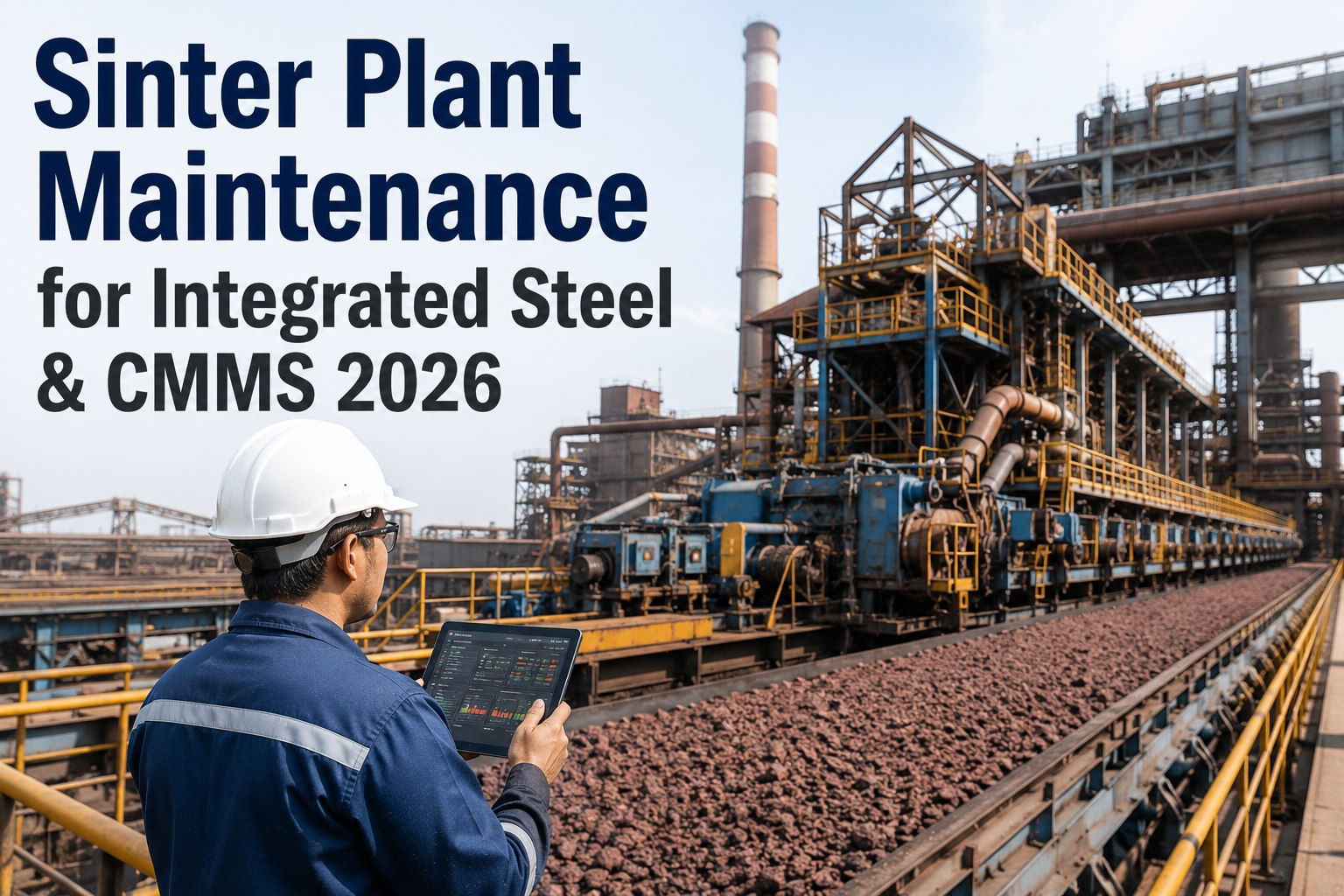
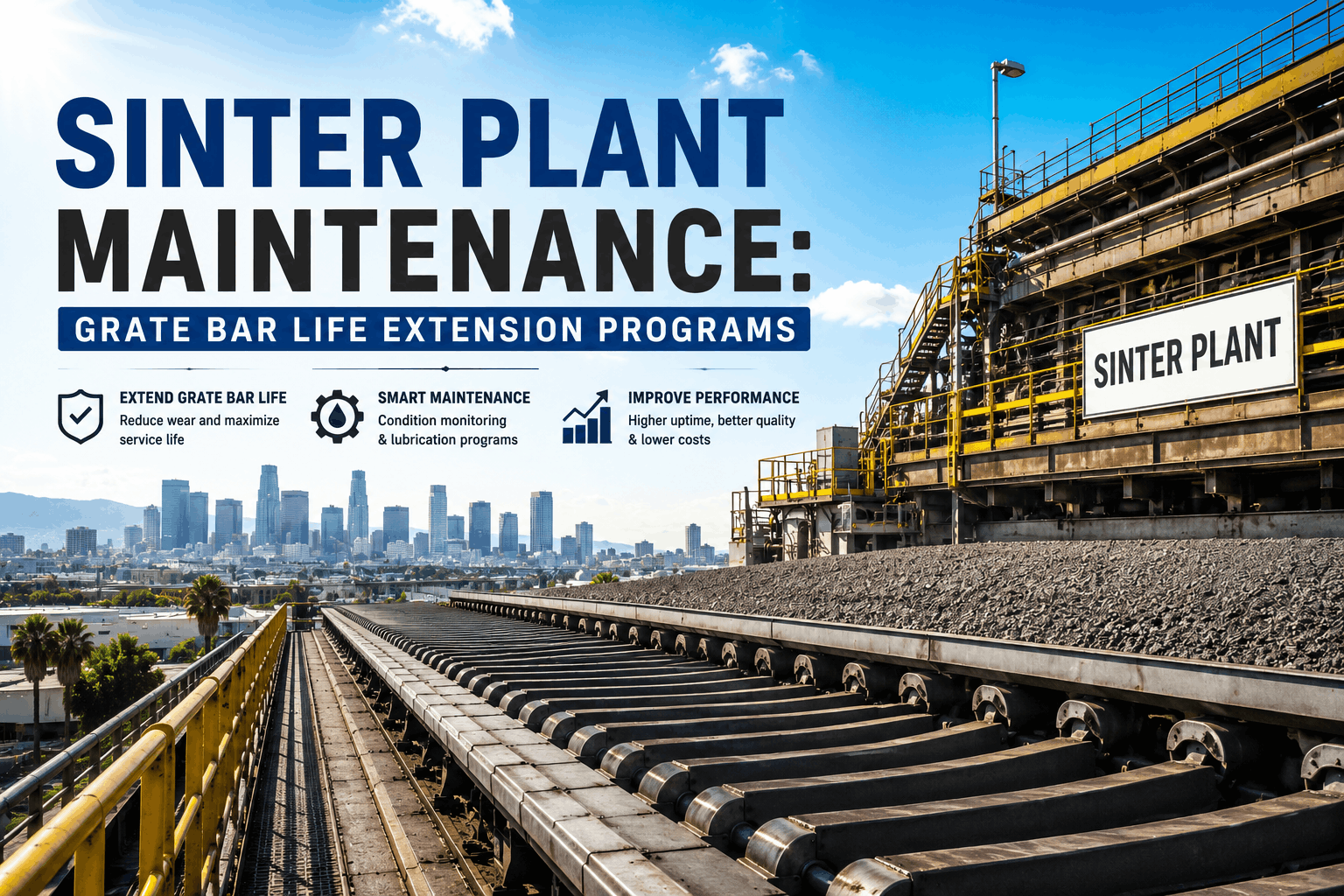
Sinter plants operate at 1,300–1,400°C continuously, transforming iron ore fines into the porous, agglomerated material that forms the primary burden material for blast furnaces. Every ton of hot metal produced in a blast furnace depends on sinter quality, consistency, and uninterrupted supply — approximately 70% of global blast furnace feed originates from sinter plants. The traveling grate system — consisting of pallet cars carrying multiple grate bars — cycles material through preheating, ignition, sintering, and cooling zones continuously, with production rates reaching 1,000–2,500 tons per day per strand. This means the grate system operates under extreme thermal cycling, abrasive material contact, and heavy mechanical loading 24/7/365. Grate bars, pallet car wheels, chain links, and bearing seals experience some of the harshest duty conditions in all of heavy industry. Most facilities continue operating with reactive grate bar management — replacing bars only when burnout is visible or a pallet fails mechanically — creating production instability, safety hazards from sudden failures, and premature wear of adjacent equipment. This guide explores the complete lifecycle of sinter plant pallet cars and grate bars, the condition monitoring approaches that enable predictive replacement, and how Oxmaint transforms grate management from crisis response into planned maintenance that extends equipment life while maximizing strand availability.
Grate Bar Failure Modes — Thermal, Mechanical, and Chemical
Grate bars — typically stainless steel or high-alloy castings 40–60 mm wide and 10–15 mm thick — support the sinter bed while allowing air to pass through the ignition and combustion zones. They experience three distinct failure mechanisms simultaneously. Thermal burnout occurs when bars lose thickness through oxidation and corrosion at 1,300°C, eventually perforating and allowing material to drop through. Corrosion from coal tar, sulfur compounds, and moisture creates pitting and stress riser sites where cracks initiate. Mechanical abrasion from material discharge and pallet acceleration produces edge rounding and surface roughness that concentrates stress. Burnout typically manifests as through-holes or severe thinning; corrosion appears as dark discoloration and pitting; mechanical wear shows as edge rounding and step formation. Most mills replace grate bars individually during production — a reactive approach where quality inspections cannot be performed during brief maintenance gaps, where replacement bar chemistry may not match remaining bars (creating inconsistent thermal expansion), and where rushed work produces installation gaps or misalignment causing accelerated wear of adjacent bars. A planned grate bar rotation program — where complete pallets are cycled through a maintenance bay on schedule — enables proper inspection, consistent material replacement, and alignment verification. Oxmaint enables this transition by tracking individual bar condition (thickness, corrosion signature, mechanical damage), predicting which bars will reach failure criteria within 2–3 weeks, and clustering predictions by pallet to optimize maintenance scheduling.
Pallet Car Assembly — Five Critical Components
Stainless steel or manganese alloy, 40–60 mm wide. Thickness loss of 2–4 mm per year from combined thermal and corrosion. Individual bar replacement every 500–1,000 operating hours. Planned rotation eliminates mid-campaign failures.
Cast iron wheels, typically 300–400 mm diameter, operating on rail surfaces at 1,200–1,400°C. Flange thickness loss of 3–5 mm per year from wear. Wheel replacement scheduled when flange thickness approaches 20 mm from nominal. Bearing lubrication every 4–6 months.
High-alloy steel chain, typically 50–80 mm pitch. Elongation of 0.5–1.0% per year from thermal cycling and bearing wear. Chain is replaced when elongation reaches 2–2.5%, indicating imminent sprocket wear. Sprocket wear accelerates once chain elongation exceeds 1.5%.
Hydrodynamic or roller bearings operating at extreme temperatures. Temperature rise of 8–15°C above baseline indicates incipient spalling. Vibration signature analysis detects bearing degradation 2–3 weeks before noise or temperature spike. Proactive replacement prevents wheel seizure.
Ceramic or firebrick linings protect pallet frames from 1,300°C furnace gas. Spalling releases fragments that contaminate sinter product. Seal degradation allows air leakage, reducing process efficiency. Visual inspection every 500 hours; replacement when spalling exceeds 5% of surface area.
Condition Monitoring Strategies — Measurement & Trending
Effective grate bar management requires systematic measurement of bar thickness, corrosion depth, and mechanical damage. Modern sinter plants employ ultrasonic thickness measurement on cold pallets — taking readings at multiple positions across each bar to detect thinning progression and corrosion pitting. Thickness trending per bar per cycle reveals bars approaching failure criteria; bars thinning faster than adjacent bars indicate localized corrosion hot-spots or thermal cycling stress. Chain elongation is measured using chain tension and sprocket tooth engagement; a 30-ton chain elongating 0.1% represents roughly 35–50 mm of length increase, measurable through drive motor current draw (elongated chain requires higher tension to maintain drive torque). Wheel flange thickness is measured at defined gauge points using calipers or thickness gauges; wear exceeding 8 mm from baseline per year indicates surface roughness or bearing clearance issues requiring investigation. Bearing temperature is monitored continuously using infrared sensors or thermocouples; sudden temperature jumps of 20–30°C or sustained elevation above 60°C above baseline indicate accelerating wear. Oxmaint aggregates all these measurements — bar thickness, chain elongation, wheel wear, bearing temperature — into a single lifecycle model per pallet car, predicting which components will fail within 2–4 weeks and enabling planned replacement schedules that minimize total downtime.
Oxmaint Sinter Plant Pallet Management — Predictive Lifecycle Tracking
Individual bar thickness measurements logged per pallet cycle. Thinning rate acceleration, localized corrosion signatures, and through-hole risk are predicted 2–3 weeks in advance. Bars approaching failure are clustered by pallet for planned maintenance.
Continuous infrared monitoring on all wheel bearings. Temperature rise >2°C per day above baseline, or sustained elevation >60°C above ambient, triggers bearing replacement work order. Prevents catastrophic bearing seizure and secondary wheel damage.
Drive motor current or tension load trending detects chain elongation. When elongation reaches 1.5%, sprocket inspection is triggered. Replacement at 2.0–2.5% prevents catastrophic chain failure mid-campaign. Sprocket life extension through planned chain replacement.
Flange wear measured at four cardinal positions per wheel. Wear >8 mm per year indicates abnormal stress. When flange approaches minimum safe thickness (typically 20 mm), wheel replacement is scheduled during planned pallet maintenance.
Frequently Asked Questions — Sinter Pallet Car Maintenance
"Our sinter strand availability improved from 88% to 94% after implementing Oxmaint's grate bar trending. Emergency failures dropped from 4–5 per month to nearly zero. We're now scheduling pallet overhauls 3 weeks in advance instead of reacting to sudden breakdowns. The planning predictability alone allows us to coordinate with ironmaking so we never run short of sinter."
— Sinter Plant Manager, Integrated Steel Mill, USA · 2025
Monitor grate bars, pallet cars, chains, and bearings — schedule maintenance 2–3 weeks in advance instead of responding to breakdowns that disrupt production.