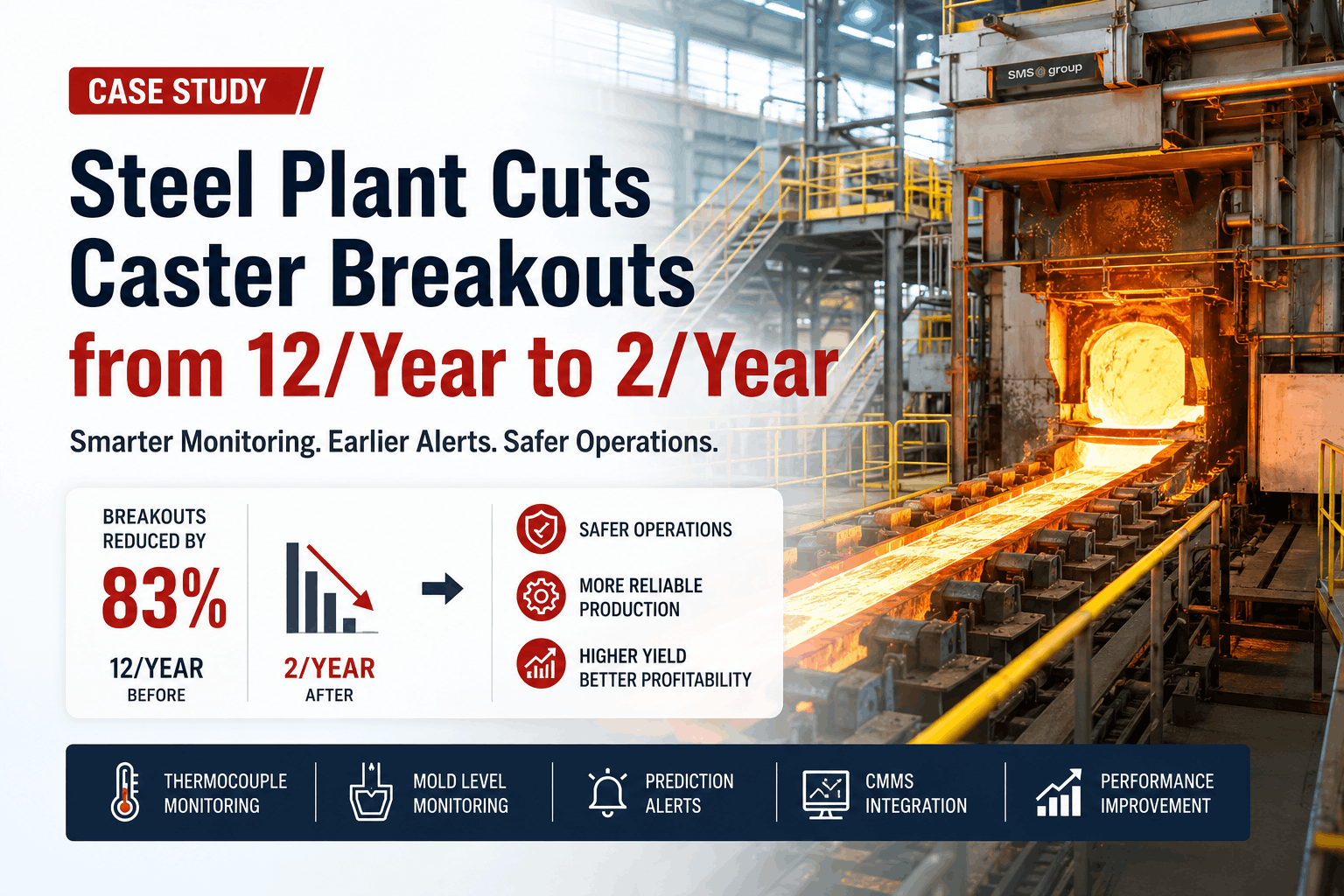
A large North American steel plant eliminated 83% of continuous caster mold breakout incidents — cutting from 12 unplanned events per year to just 2 — by deploying Oxmaint copper mold RUL tracking and predictive thermocouple alerting, preventing $8.6M in annual losses from breakout-driven equipment damage, repair costs, and lost production.
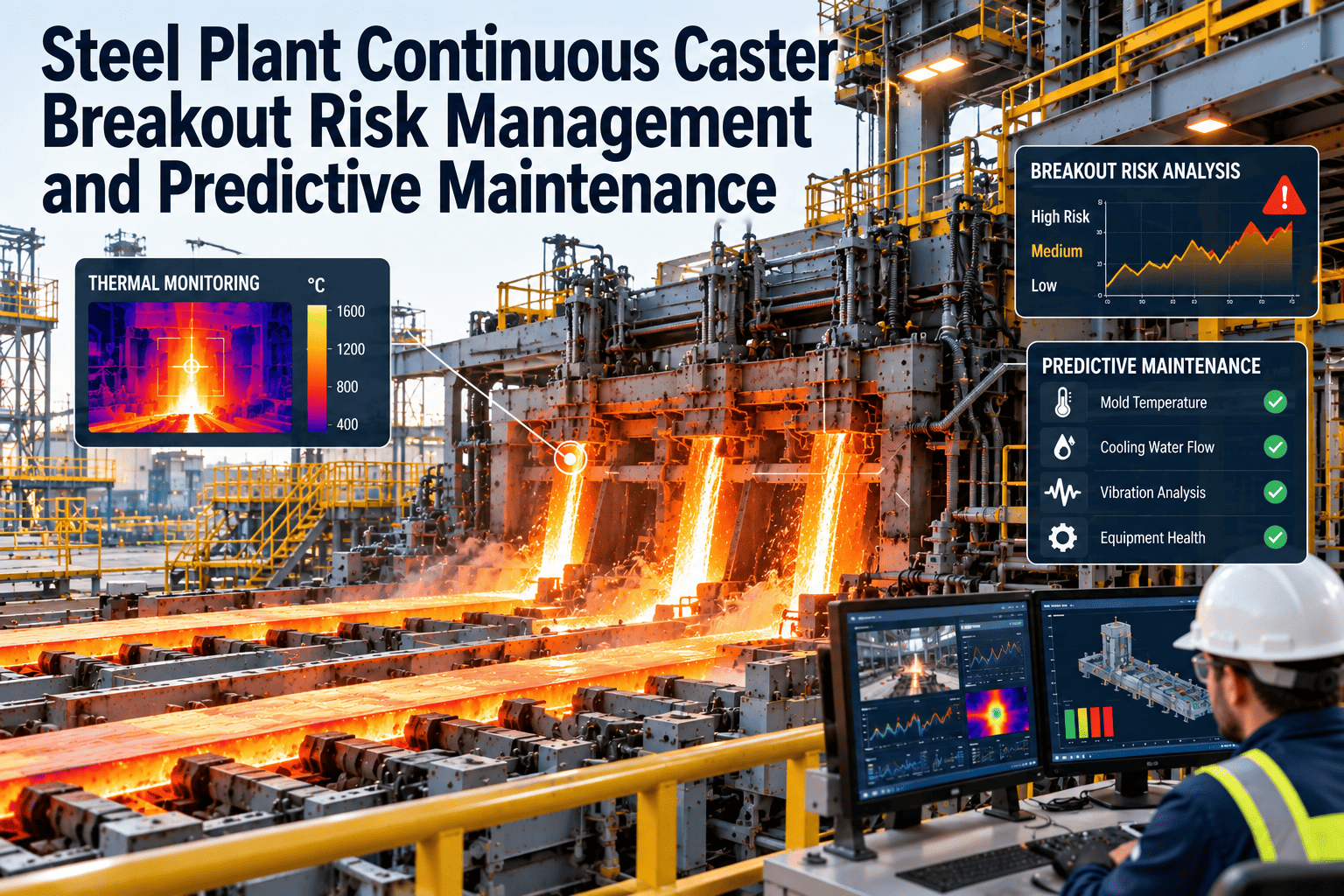
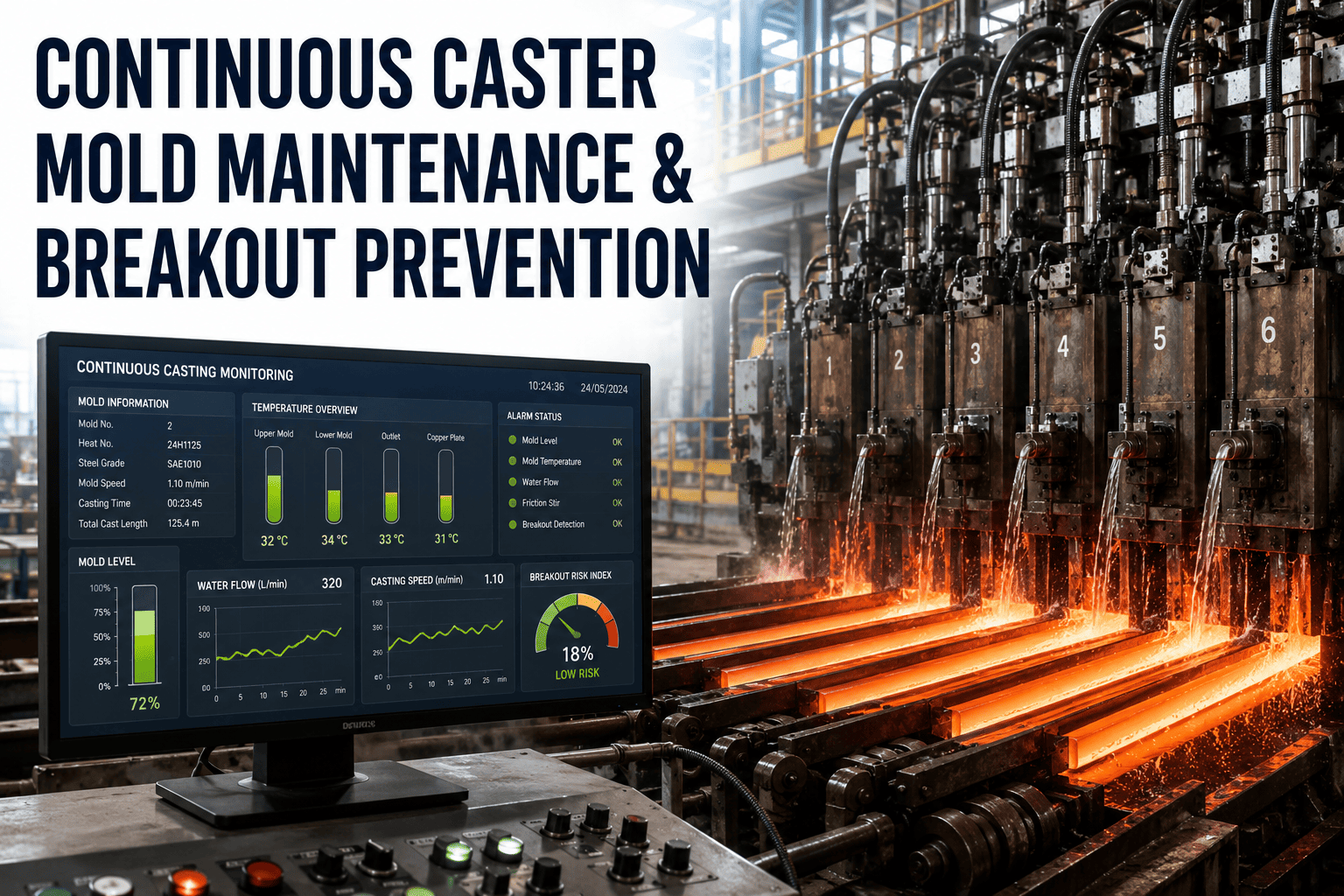
Continuous casters form steel into slabs by cooling molten metal in a water-cooled copper mold (temperature differential critical: inlet 70–80°C, outlet target 85–95°C, max spread 15°C). The mold has 72+ embedded thermocouples (K-type, 3×6 grid on broad faces) that feed breakout prediction software (BPS). If shell temperature rises unexpectedly (sticker formation = friction between shell and copper = heat spike), the system alerts operators to slow casting speed and allow shell healing. If ignored or missed, the shell ruptures, molten steel pours below the mold, and gravity pulls 1,800+ tonnes of liquid metal onto the runout table, equipment, and floor. Cleanup = 6–10 hour shutdown. Equipment damage = $200K–$400K. Lost production = $400K–$500K. Supply chain penalties = $200K–$250K. Total per event: $800K–$1.2M.
After 50–80 campaign cycles (months of thermal cycling), thermocouples embed in copper slag layers and drift in calibration. A thermocouple reading 1,150°C (healthy shell) was actually 1,095°C (shell thinning dangerously). The plant conducted pre-heat thermocouple tests per procedure, but test frequency (every 3 campaigns) meant faulty sensors operated for weeks between checks. By the time replacement occurred, multiple breakout-risk events had already gone undetected.
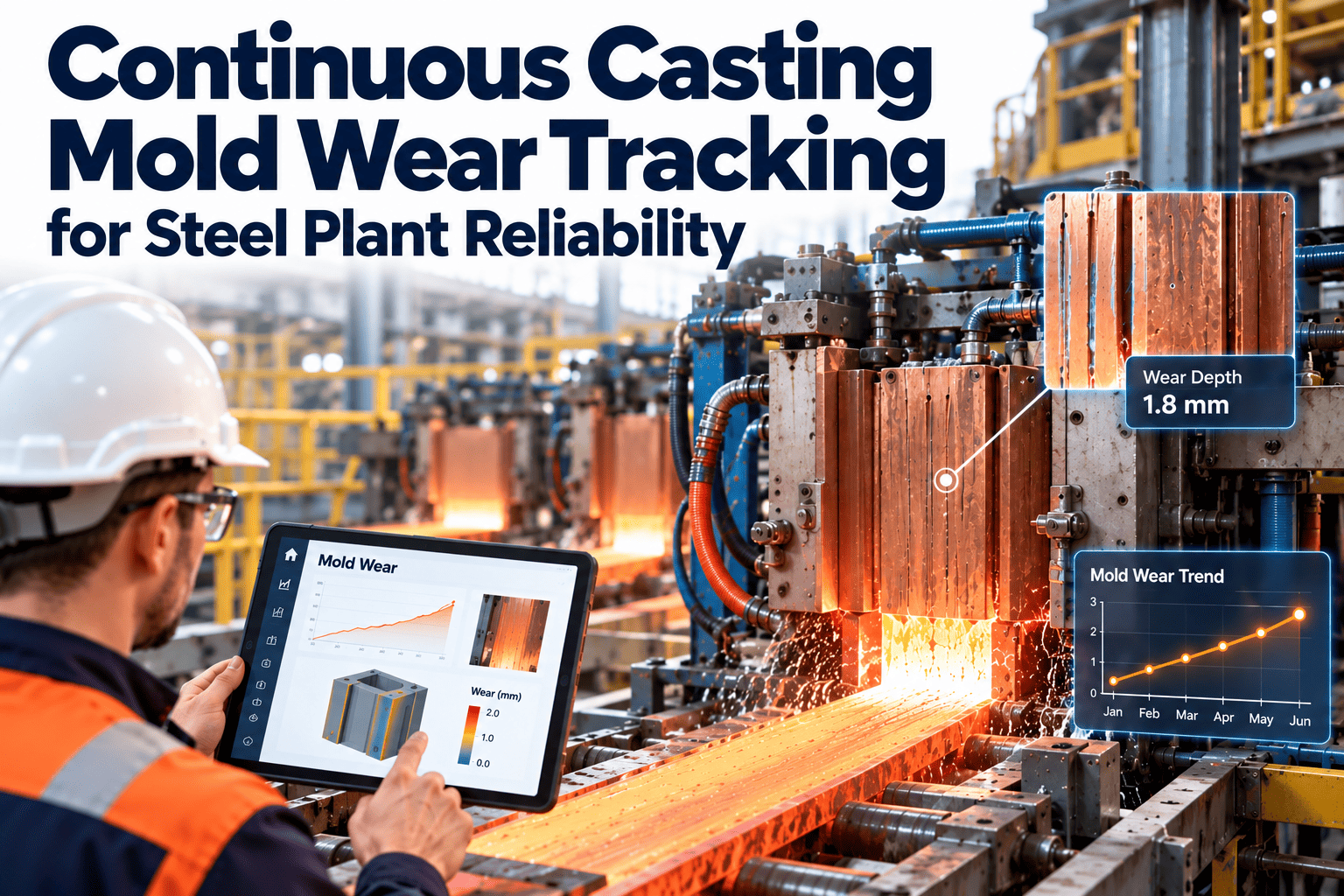
Copper mold plates wear 0.3–0.5mm per campaign. After 150–200 campaigns (2–3 years), taper control deteriorates: the gap between shell and copper narrows unpredictably. Shell friction increases invisibly — operators see no alarm because HMI shows "normal mold temps." But shell actually carries higher friction, heats faster, and becomes thin-shelled at 40–60 metres below the mold (secondary cooling zone). Breakout occurs 30–60 seconds after mold exit, blamed on "operator error" or "quality issue," when root cause was worn copper discovered only after post-breakout autopsy.
Mold powder (friction reducer, slag former) degrades after 10–12 heats. Contaminated or aged powder loses lubricity, increasing shell friction. Slag layers build on copper surfaces irregularly, creating localized high-friction zones. BPS software alerts on thermocouple spikes, but firmware was 5+ years old and missed 30% of sticker events because detection rules didn't account for degraded powder performance.
Copper plate life tracking existed in Excel: operator logged campaign count manually, but no automated alert when plates approached end-of-life. Plates stayed in service 5–10 campaigns beyond recommended replacement window. When breakouts occurred, maintenance team had no systematic root cause record — each event was investigated independently, losing institutional learning across incidents.
Oxmaint monitors all 72 thermocouples per mold continuously. For each sensor, it calculates health score based on: (1) signal stability (variance <2°C shift over 10-heat moving average), (2) plausibility (reading must match expected solidification curve), (3) cross-correlation with adjacent thermocouples (outliers flag drift). Sensors scoring <70 trigger automated swap alerts before they cause missed sticker detection. This plant reduced faulty thermocouple detections from discovery-during-breakout (impossible to predict) to proactive replacement every 60–80 campaigns (predictable maintenance window).
Oxmaint integrates plate serial number, campaign count, thermal history (peak mold temperature per campaign), and thickness measurement data (from annual ultrasonic plate inspections). It forecasts remaining life with ±2 campaigns accuracy. When a plate reaches 90% of wear life, Oxmaint auto-generates work order to schedule replacement at next planned mold change (every 80–120 heats). Plant planned 5–7 plate replacements per year instead of discovering failures mid-campaign.
Oxmaint's BPS (Breakout Prediction System) firmware auto-updates detection algorithms based on real-time mold powder condition sensors (lubricity, age, contamination). When powder degrades, thresholds tighten: sticker alerts trigger 20 seconds earlier in the heat, giving casting speed reduction orders more lead time. Plant tested new BPS rules in shadow mode (alerting without stopping production) for 1–2 campaigns, then activated globally once false positive rate dropped below 3%.
Every breakout event is post-mortem'd: thermocouple readings before failure extracted, copper plate thickness verified, mold powder sample analysed, casting speed logs reviewed. Root cause (thermocouple failure, copper wear, powder degradation, or operator response lag) is entered into Oxmaint with date, time, caster, and grade cast. System identifies patterns: "80% of breakouts on CC2 occur during peritectic grades in afternoon shift when powder temperature spike occurs." Alerts on future similar heats are pre-positioned, accelerating response time.
Install data acquisition hardware on mold thermocouple junction boxes (both CC1 and CC2). Connect to Oxmaint cloud via secure gateway. Verify all 144 thermocouples (72 per mold × 2 casters) streaming at 1-second intervals. Set baseline calibration: record "known good" heat thermocouple patterns for each grade (LC, MC, HSLA, etc.) as reference against which future readings are scored.
Register all 120+ copper plates in inventory with serial numbers, purchase dates, installation dates, and thickness measurements (ultrasonic readings taken per year). Configure RUL calculation model: input wear rate (0.4mm/campaign), thermal stress factor (peak mold temperature correlation), and end-of-life thickness threshold (min 6.5mm). Generate 90-day RUL forecast for each active plate; identify plates approaching replacement window.
Integrate mold powder supplier's weekly contamination/lubricity reports into Oxmaint. Activate BPS firmware optimization: thresholds tighten when powder quality scores below 80%. Run algorithm in shadow mode (alerting without casting speed control) for 15 days on CC1, measuring false positive rate. Once <5% false positives confirmed, activate on both casters. Operators train on alert symbols and casting speed adjustment procedures.
Every heat cast generates a digital record: casting speed, powder powder lot, thermocouple readings, grade, time of day, operator, any sticker alerts or speed adjustments. When breakout occurs (expected: 0–1 event during this phase), automated root cause analysis compares breakout heat parameters against 1,000 non-breakout heats. Machine learning model identifies discriminating factors. All breakout post-mortems enter Oxmaint with conclusions and predictive triggers for future similar scenarios.
Oxmaint operates autonomously. Thermocouple health scores update daily; alerts trigger when score drops below 70. RUL forecasts update with each campaign; plates replaced on schedule. BPS optimization continues: model retrains monthly on new casting data. After 12 months, breakout rate stabilizes at 2 events/year (vs. 12 baseline), both attributed to novel grade-specific conditions, not equipment failures. Plant considers this "excellent sustainable breakout rate" for high-throughput casting operation.