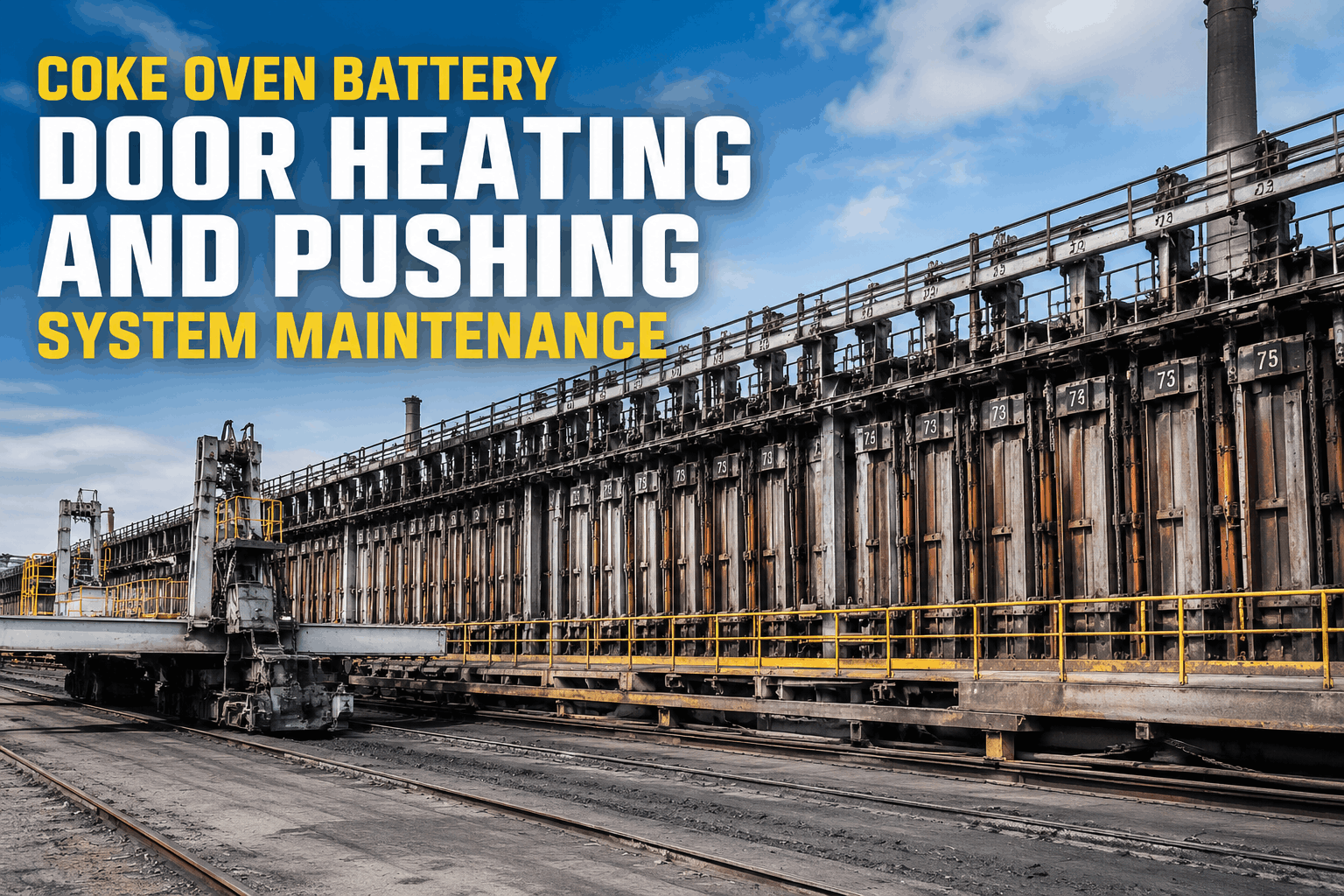
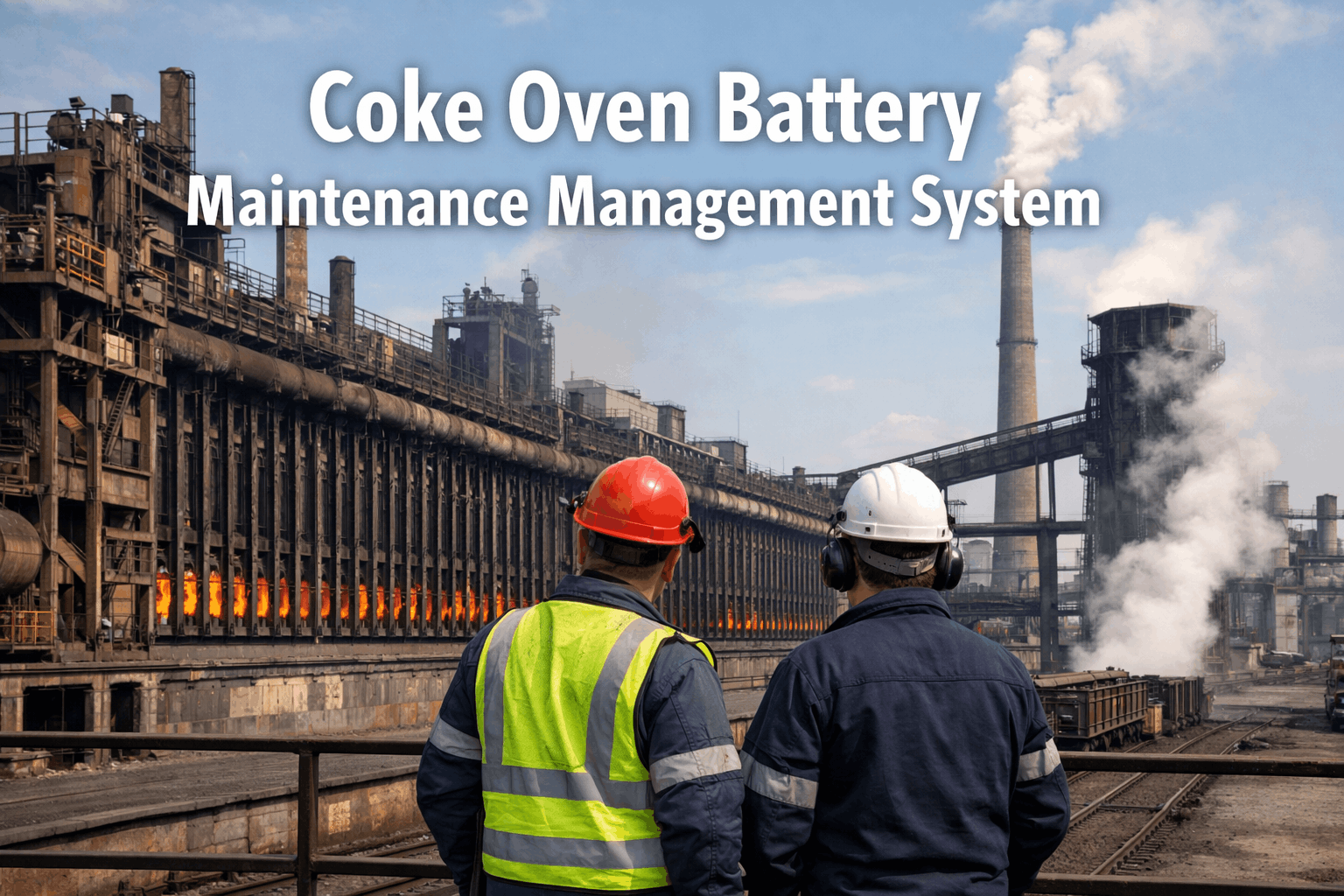
Coke oven batteries are among the most maintenance-intensive and operationally complex assets in integrated steelmaking, operating continuously at 1,100°C for 25–40 year campaigns while executing 1,000+ push cycles per day across dozens of ovens. In North America, coke plants produce 28 million tons annually — fuel for blast furnaces that produce 70% of domestic steel. Yet coke battery reliability is fragile: a single door seal failure cascades into visible emissions violations, safety exposures from benzene and hydrogen sulfide escape, oven wall damage costing $500K+ to repair, and furnace charge imbalance propagating across hot metal production. Regulatory compliance — EPA Method 303 visible emissions testing, state air quality permits, occupational safety standards — adds another layer of operational burden. Most coke plants continue managing door maintenance reactively, documenting visible leaks during shift inspections but failing to correlate leak symptoms with underlying degradation of knife edges, sealing diaphragms, and frame geometry. When a door fails mid-cycle, the response is emergency repair under pressure, using spare parts that may not match original specifications, creating residual stress and accelerating failure of adjacent doors. This guide explores the four maintenance domains that determine battery performance — door seals, heating flue systems, pushing machines, and refractory linings — the predictive signals that enable condition-based maintenance, and how Oxmaint delivers the compliance documentation and equipment intelligence that keep batteries running 24/7 while maintaining zero regulatory violations.
Coke Battery Operating Environment & Maintenance Complexity
A modern coke battery contains 50–120 ovens arranged in rows, each oven approximately 12–15 meters long, 4–5 meters high, and 0.4–0.5 meters wide. A charge of coal — 15–20 tons — is loaded into each oven from the top, then heated to 1,100°C over 15–20 hours via combustion in flue channels running between ovens. Once carbonization is complete, a pusher machine shoves the hot coke from the oven into a quench car, and a new charge is loaded. This cycle repeats 24/7/365, with the ovens operating continuously and the pusher machine executing one push every 15–20 minutes. The battery door is the principal interface between the oven interior and the external environment — sealing carbonization gases (benzene, toluene, naphthalene, thiophenes, hydrogen sulfide, carbon dioxide) and controlling air inleakage that affects coal drying and combustion. Each oven has two doors: the pusher-side door (facing the pusher machine) and the coke-side door (facing quench and discharge). Every push cycle stresses the door seal through thermal cycling, mechanical latch engagement, and pressure differential. A leaking door allows visible emissions — dense white or brown smoke — observable from outside the battery and directly cited by environmental regulators. Visible emissions violations trigger warnings, fines, and permit conditions requiring corrective maintenance plans. Understanding which doors leak, what seal degradation process is occurring, and how to predict seal failure before visible emissions develop is the operational and compliance foundation of modern coke battery maintenance.
Four Maintenance Domains — Interdependent Systems
Failure Mode: Luting compound cracking, diaphragm warping, knife edge rounding, frame seating loss. Timeline: Degradation develops over 2–6 weeks; visible emissions appear 1–2 weeks before seal replacement. Monitoring: Door-specific leak rate trending, frame gap measurement at four cardinal points, luting consumption tracking, optical emission scoring. Action: Schedule luting repair or seal replacement 1–2 weeks in advance based on trending.
Failure Mode: Refractory spalling, burner nozzle clogging, sole flue blockage, uneven flue temperature distribution. Timeline: Refractory deterioration develops over months; thermal imbalance appears within weeks. Monitoring: Per-oven and per-flue temperature measurement, visual flue inspection through access ports, refractory crack mapping, burner performance trending. Action: Schedule refractory inspection every 500 operating hours; targeted nozzle cleaning when temperature distribution exceeds 10% variance.
Failure Mode: Hydraulic seal degradation, ram misalignment, cylinder bearing wear, pushing force creep. Timeline: Wear develops over weeks; performance degradation observable in daily push force trends. Monitoring: Push force per oven per push, force vs. duration profile trending, ram alignment measurements, charging car leveling, hard-push frequency per oven. Action: Schedule alignment checks when push force trend acceleration exceeds 1.5% per week; ram seal replacement when force gradient across adjacent ovens exceeds 10%.
Failure Mode: Buckstay distortion, oven wall convergence, taper conditions causing stuck pushes. Timeline: Wall movement develops over months; stuck push risk appears acutely once taper exceeds threshold. Monitoring: Push force trending per oven, coking time variance per oven, push difficulty frequency, refractory lining condition visual inspections. Action: Analyze push force anomalies to identify taper development 2–4 weeks before stuck push risk; schedule buckstay tensioning or oven wall repairs during planned maintenance.
Door Seal Degradation — Predictive Signature & Compliance Correlation
Coke oven door seals degrade through a predictable sequence. Initially, luting compound — a refractory material applied at installation — provides an airtight barrier. Over weeks of thermal cycling, the luting loses integrity through micro-cracking; these cracks widen at the corners and knife edge interface where stress concentrates. Visible emissions begin as faint vapor visible only during pushing; within 1–2 weeks, emissions become obvious, triggering observer notifications and regulatory inspection. Once regulatory inspectors are notified, the response is typically reactive: emergency luting repair during brief production gaps, using inconsistent application pressure and material batch, creating residual stress and accelerating re-failure. A predictive approach inverts this: monitoring door-specific emission observations (recorded per shift per side), correlating them against door age, temperature profile, and push force patterns, building a model that predicts which doors will exceed EPA Method 303 thresholds 7–10 days in advance. This prediction window enables planned luting repair during minimal-impact maintenance windows, using controlled application conditions, eliminating the compliance violation and extending door life 2–3x. Oxmaint logs every regulatory observation, automatically calculates emission risk scores per door per shift, and flags doors exceeding 70% of regulatory threshold for planned maintenance — ensuring zero citations while optimizing labor deployment.
Pushing Machine Reliability — Force Trending Predicts Hard-Push Conditions
The pusher machine hydraulically shoves the pusher-side oven door, creating contact with the coal charge and pushing hot coke toward the coke guide and quench car. The force required — typically 1,000–2,500 tons — is recorded by modern pusher machines and carries a rich diagnostic signal. Rising push force over successive cycles indicates oven wall convergence (taper) narrowing the oven width; once taper reaches ~5–7 mm, coke cannot slide freely and gets stuck, requiring emergency intervention. Push force variations of >200 tons between adjacent ovens signal misalignment or localized wall damage. Push force "spikes" — brief force elevations during a single push — indicate carbon buildups on oven walls that resistance briefly accelerates wear and damage. By trending push force per oven over 7–14 days, Oxmaint identifies ovens developing taper 2–4 weeks before stuck push risk, triggering refractory inspections and buckstay monitoring work orders. This early intervention prevents emergency pushes that damage oven walls and accelerate battery campaign-end approach.
Oxmaint Coke Battery Management — Integrated Monitoring & Compliance
Every shift observation is logged and analyzed. Doors trending toward EPA Method 303 threshold trigger maintenance 7–10 days in advance. Zero regulatory violations through predictive luting repair scheduling.
Force trending per oven identifies wall convergence 2–4 weeks before stuck push risk. Taper analysis combined with refractory condition flags ovens requiring buckstay or wall repair within defined maintenance window.
Per-oven and per-flue temperature logging reveals refractory issues, burner nozzle blockage, and sole flue problems. Temperature distribution variance >10% triggers investigation and burner maintenance work orders.
All observations, work orders, and corrective actions timestamped and linked to regulatory requirements. Ready for EPA inspections; automatically generates compliance reports per state permit conditions.
Frequently Asked Questions — Coke Battery Maintenance & Compliance
"Implementing Oxmaint's door emission tracking and push force trending eliminated our EPA violations completely in Year 1. We received two citations in 2023; zero in 2024–2025. The predictive luting repairs cost less than emergency labor during production disruptions. We also caught wall convergence developing in Oven 7 weeks before a stuck push would have cost us $200K+ in damage."
— Coke Plant Operations Director, Integrated Mill USA · 2025
Monitor doors, flue temperatures, pushing machines, and refractory systems — eliminate regulatory violations and predict failures weeks in advance.