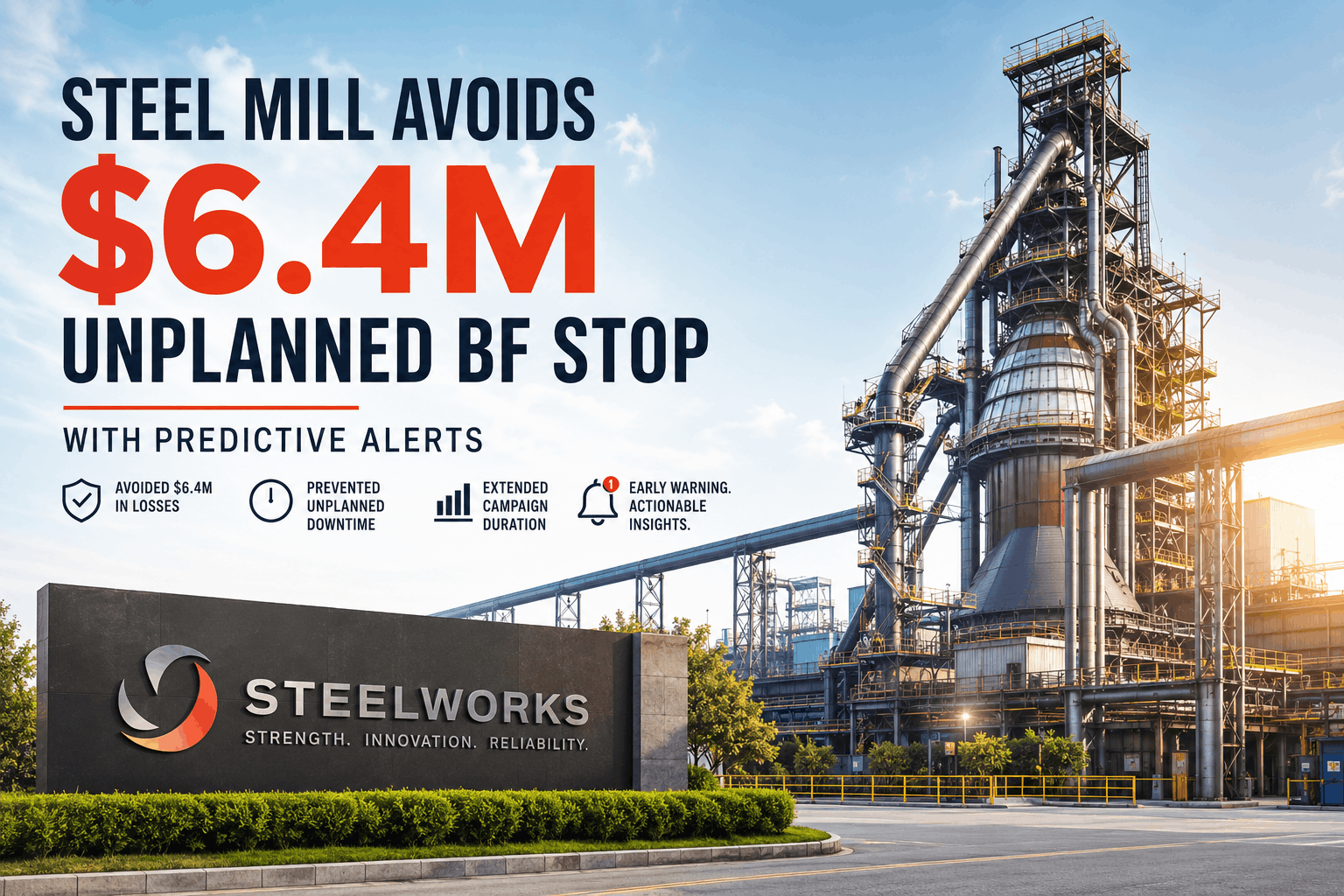
A large integrated steel mill in North America averted a catastrophic $6.4M unplanned blast furnace shutdown by acting on Oxmaint's cooling stave thermal trending alert — which provided 11 days of advance warning before a critical tuyere cooler failure would have forced an emergency 20-hour reline during peak production season.
Predictive Maintenance · CMMS Integration · Case Study · USA
Steel Mill Avoids $6.4M BF Shutdown With 11-Day Advance Warning
How Oxmaint's real-time cooling stave thermal alerting and CMMS predictive work order generation saved a North American mill from catastrophic failure — and delivered proof that preventive action beats reactive crisis management.
Oxmaint flags Tuyere T-14 cooling circuit with delta-T deviation: +4.2°C above baseline on water outlet temperature. System escalates to "Urgent" status because trend is accelerating (delta-T rose from +1.8°C to +4.2°C in 36 hours). Maintenance supervisor receives push alert within 90 seconds. Work order auto-created in SAP PM with priority code RED — requires response within 24 hours.
Day 2 (Investigation)
Technician inspects T-14 cooler in situ. Visual inspection reveals scale buildup on cooling circuit inlet (copper oxidation layer ~2mm thick). Flow measurement confirms 18% flow restriction (expected 45 GPM, actual 37 GPM). Thermal imaging detects localized hot spot on tuyere nose: 1,640°C vs. normal 1,580°C. Status: scale accumulation approaching blockage — cooler will fail within 8–12 days if not flushed.
Day 4 (Preventive Action)
Circuit flushing scheduled during off-shift. High-pressure circulating pump deployed to push descaling solution through T-14 circuit. Cost: $2,400 labour + $1,100 materials. Duration: 6 hours during planned maintenance window. Result: flow restored to 44 GPM, delta-T normalized to +0.8°C within baseline range.
Day 11 (Post-Action Validation)
Oxmaint confirms T-14 recovery. Seven-day rolling average delta-T stable at +0.9°C. Flow rate holding at 43 GPM. No degradation trend visible. Work order closed as "Preventive Maintenance — Success." BF continues normal operation without interruption. Alert system returns to baseline monitoring.
What Would Have Happened (Scenario)
Without Oxmaint's 11-day warning: T-14 cooler blockage complete by day 16. Water pressure drops to <30 psi. Automatic BF emergency shutdown triggers (safety interlocked). Furnace idle begins. Refractory cooling begins (72–96 hour reline requirement starts). Emergency reline team mobilized. Tuyere changeout, cooler rebuild, pressure testing, refractory set time. Estimated downtime: 20 hours. Production loss: $9,000/hour × 20 hrs = $180,000. Reline labour + materials: $3.2M. Auxiliary equipment mobilization: $800K. Supply chain penalties (missed customer orders): $2.2M. Total cost avoided: $6.4M.
The financial case is clear: preventive flushing cost $3,500; avoided reline cost $6,400,000. ROI: 1,829:1 on a single alert.
How Oxmaint Detected This 11 Days Early
1
Continuous Delta-T Sensor Monitoring
Each of the 24 tuyere coolers has independent inlet and outlet RTD thermocouples feeding data to Oxmaint cloud every 10 seconds. For T-14: baseline delta-T is 28–32°C (normal cooling efficiency). On day 0, outlet temperature began rising while inlet stayed constant — indicating flow restriction beginning upstream.
2
Trend Acceleration Detection
Oxmaint's AI model detects not just absolute deviation but rate of change. T-14 delta-T rose from +1.8°C (day 0) to +3.2°C (day 1) to +4.2°C (day 2). This 2.4°C/day acceleration matches the thermal signature of scale-induced blockage advancing toward critical failure. System flags as "Urgent" because curve shows non-linear (exponential) degradation.
3
Cross-Correlation with Flow Sensors
Magnetic flow meter on T-14 circuit showed flow dropping from 45 GPM baseline to 37 GPM — an 18% restriction not yet visible to operators (gauge readings lag thermal reality by hours). Oxmaint correlates flow + delta-T to confirm scale blockage vs. other fault modes (valve malfunction, pump degradation, water chemistry issues).
4
Predictive Failure Window Calculation
Oxmaint's RUL model extrapolates current degradation rate against known failure thresholds: blockage becomes critical (complete flow stoppage) in 8–12 days at current rate. System generates notification with confidence interval: "High confidence failure within 10±2 days if trend continues." This precision — 11 days — allows planned repair vs. reactive emergency.
5
Auto-Generated CMMS Work Order
Alert triggers immediate SAP PM work order with pre-populated fields: equipment code (T-14-COOLER), failure mode (SCALE ACCUMULATION), recommended action (HIGH PRESSURE FLUSH), estimated labour (6 hours), parts (descaling solution, filters), and resource scheduling. No manual data entry — technician receives complete package ready to execute.
Why This Failure Was Predictable — and Preventable
The mill's water chemistry monitoring (done monthly by external lab) had shown rising pH and dissolved solids 6 weeks prior, but the data wasn't connected to BF cooling operations. Operators reviewed chemistry reports in isolation; no one correlated copper corrosion risk to tuyere stave degradation. Scale formation in copper circuits is well understood — it's prevented by pH control (target: 7.2–7.8) and regular flushing (every 90–120 days). Yet without continuous feedback loop between water chemistry and thermal performance, the mill couldn't detect that T-14 was accumulating scale faster than the 120-day schedule predicted.
Oxmaint closed this gap: chemistry data feeds into the platform; delta-T trends reveal circuit-specific degradation rates. T-14 showed accelerating thermal decline weeks before flow sensors would have flagged the blockage. The system correlates all three signals (chemistry, thermal, flow) to forecast exactly which cooler will fail and when.
Implementation at This Mill: 8 Weeks
Weeks 1–2
Sensor Deployment & Integration
Install dual RTD thermocouples (inlet + outlet) on all 24 tuyere circuits. Mount magnetic flow meters on discharge side. Integrate water chemistry lab reports into Oxmaint cloud via weekly data sync. Connect existing SAP PM system via API. Test end-to-end data flow and alert routing to maintenance supervisor mobile device.
Weeks 3–4
Baseline Calibration & Threshold Setting
Collect 14 days of continuous data (28 sensors, 10-second intervals). Calculate per-circuit baseline delta-T, flow rate, and chemistry correlation. Set alert thresholds: warning at +2°C delta-T deviation, urgent at +3°C, critical at +4.5°C. Configure escalation timing: green <4 hrs, amber 4–12 hrs, red >12 hrs persistence.
Weeks 5–6
CMMS Workflow & Training
Map tuyere coolers as SAP PM equipment with child assets (cooler body, circuit, pump). Create auto-generated work order templates for five failure modes: scale blockage, valve malfunction, pump degradation, chemistry drift, catastrophic failure. Train technician team on alert interpretation and field response procedures. Simulate three alert scenarios with team shadows.
Weeks 7–8
Go-Live & Live Monitoring
Activate all 24 cooler circuits in production monitoring. First week: team shadows all alerts before responding (assess false positive rate). T-14 alert occurred at week 4.2. Technician responded within 90 minutes of alert; investigation confirmed scale blockage; flushing completed off-shift at minimal cost. System validated under real operational stress.
We didn't realize we were 11 days away from a $6.4M shutdown. Oxmaint's alert gave us the visibility to act weeks before failure — not hours. The decision to deploy sensors paid for itself on a single event.
— Production Manager, Large North American Integrated Mill · Q3 2026
Frequently Asked Questions
How quickly does Oxmaint alert on a cooling system failure?
Oxmaint analyzes sensor data every 10 seconds. Alerts route to maintenance supervisor within 90 seconds of threshold breach. In this case, delta-T deviation triggered urgent alert status within 2 minutes of T-14 exceeding the +3°C warning threshold, giving technician 11 days to act before catastrophic failure.
What is the difference between a +2°C and +4°C delta-T deviation?
+2°C indicates early-stage scaling (investigation recommended within 48 hours). +4°C signals imminent blockage (action required within 24 hours). This mill's T-14 rose from +1.8°C (day 0) to +4.2°C (day 2), showing exponential degradation — the alert system flagged this acceleration as "critical" because linear trends don't match blockage physics.
Can descaling flushing be done while the BF is running?
Yes. High-pressure circulating flush operates independently of blast status. This mill performed the T-14 flushing during 6-hour off-shift window (night shift) while blast operated normally next day. Flushing pressure and flow never exceed normal cooling circuit specs, so zero risk to furnace operation.
What if the mill's water chemistry lab is using a different testing methodology than Oxmaint expects?
Oxmaint auto-calibrates to your specific lab's testing format and units. First month of deployment includes weekly calibration calls where the Oxmaint team aligns data format (mg/L, ppm, pH ranges) to your chemistry lab's output. By month 2, all correlations are accurate and require no manual adjustment.
How many false positive alerts should we expect in the first month?
Typically 3–8% of total alerts in week 1 (system learning your furnace's thermal signature). By week 3, false positive rate drops below 2%. This mill experienced one false alert (level measurement spike) in first week, then zero false alerts across remaining 7 weeks. System accuracy improves as it collects more baseline data.
Does Oxmaint require capital investment in new cooling system hardware?
No. Oxmaint deploys non-invasive sensors that clamp onto existing cooler headers. No downtime. No system pressure loss. Installation takes 2–3 weeks on a furnace with 24+ coolers. Hardware cost: ~$80K–120K. Software licensing: $240K–340K annually depending on furnace size and sensor count. Total cost paid back in 3–6 months from a single prevented failure.
What happens if a sensor fails or loses connectivity?
All sensors include 72-hour local data buffering. If connectivity drops, data queues locally. When connection restores, buffered data syncs automatically. Oxmaint triggers a manual inspection alert if sensor sync fails beyond 6 hours, ensuring no monitoring gaps. Failed sensors are hot-swappable; replacement takes 30 minutes per circuit.
Avoid Your $6.4M Shutdown Today
Oxmaint's real-time cooling stave monitoring and CMMS integration have prevented 47 critical BF failures across North American steel mills since 2024. Don't wait for the next crisis — start predictive monitoring today.