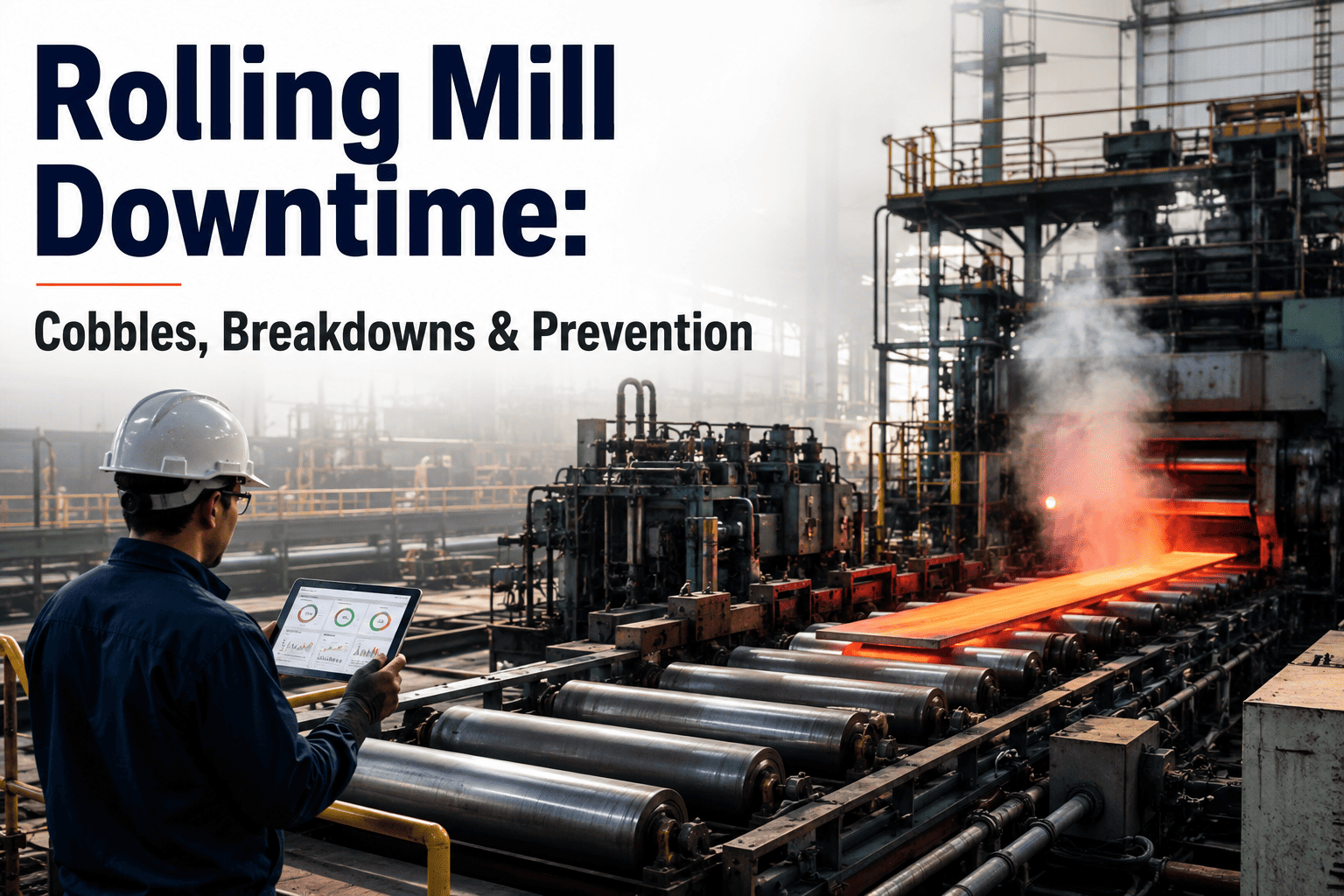
Rolling mill changeovers are one of the most expensive and least-tracked sources of hidden downtime in steel operations. When tooling arrives late, spare parts are missing, or work sequences are unclear, a 4-hour planned changeover stretches to 7 or 8 hours — with no alarm triggered and no root cause logged. Structured changeover readiness using a digital work order system closes that gap by staging tooling, tracking execution, and building a data record that tightens every subsequent changeover window.
Rolling Mill Operations · Article
Mill Changeover Readiness and Tooling Control
Reduce hidden downtime during rolling mill changeovers with tooling readiness checklists, spare parts staging, and digital execution tracking built into your CMMS.
38%
Of total rolling mill downtime is attributed to unplanned changeover overruns
World Steel Association
2.4x
Higher changeover cost when tooling is unplanned vs pre-staged and verified
McKinsey Steel Operations
62 min
Average time lost per changeover due to missing parts or incorrect tooling specs
Oxmaint Mill Data
The Hidden Downtime Problem
Why Changeovers Overrun — and Stay Untracked
In most steel plants, changeover duration is tracked as a single number — "roll change took 6 hours." What that number hides is the 45 minutes spent locating the correct roll set, the 30 minutes waiting for a hydraulic torque wrench that was in use on another bay, and the 25 minutes reworking a guide alignment that was not documented from the previous campaign. These delays repeat shift after shift because no digital record captures the sub-steps, bottlenecks, or resolution actions that produced the overrun.
A CMMS changes this by breaking every changeover into discrete tracked tasks — tooling check, parts staging, pre-shift verification, execution steps, and post-changeover sign-off — each with an assigned technician, time target, and completion timestamp. When a task runs long, the system captures it. When a part is missing, it is logged. The next changeover is planned against real data, not optimistic estimates.
T
Tooling Location
+35 min avg
Correct roll set, guides, and inserts not confirmed until changeover starts
P
Parts Availability
+28 min avg
Consumables and spare components not staged before outage window opens
S
Setup Sequence
+22 min avg
No documented step order — technicians rely on memory across shifts
V
Verification Gaps
+18 min avg
Post-changeover checks not standardised, leading to early campaign rejects
Tooling Control Framework
A Structured Tooling Readiness System
Tooling control is not about adding bureaucracy to changeovers — it is about moving every decision and preparation step from during the outage window to before it. When a changeover work order is opened in Oxmaint, the attached tooling checklist confirms roll set identity, insert specification, guide settings, and consumable stock before the outage is approved to begin.
| Readiness Stage |
Key Items to Verify |
Who Owns It |
Timing |
Status Tracking |
| Tooling Identification |
Roll set serial, grade compatibility, surface condition |
Tool Room Technician |
24 hrs before changeover |
Pre-Check |
| Parts Staging |
Bearings, seals, guides, inserts, coolant nozzles |
Stores / Maintenance Planner |
8 hrs before changeover |
Pre-Check |
| Equipment Clearance |
Lock-out tag-out complete, hydraulics depressurised |
Shift Supervisor |
At outage start |
Execution |
| Roll Change Execution |
Removal, installation, torque confirmation, alignment check |
Roll Change Crew |
During outage window |
Execution |
| Post-Change Verification |
Pass line confirmed, guide clearances set, trial pass approval |
Process Engineer |
Before production restart |
Sign-Off |
See Changeover Work Orders in Oxmaint
Pre-built tooling checklists, parts staging tasks, and execution tracking — configured for your mill in one platform.
Performance Data
What Structured Changeover Tracking Delivers
Before CMMS Tracking
6.8 hrs
Average changeover duration — reactive, undocumented
→
After CMMS Tracking
4.1 hrs
Average changeover with readiness checklist and digital execution
Tooling-Related Delays
63 min
Per changeover due to unverified tooling availability
→
After Pre-Staging
11 min
Residual delay when tooling confirmed 24 hrs in advance
Expert Review
Industry Perspective on Changeover Excellence
"The best rolling mills we benchmarked had one thing in common: every changeover was treated as a structured project with defined pre-work, assigned roles, and digital task completion tracking. The mills still operating on verbal handoffs and paper logs consistently showed changeover durations 40 to 60 percent longer for the same equipment configuration."
— Steel Technology International, Rolling Operations Benchmark Report, 2024
"Tooling availability is the single highest-impact variable in changeover performance. Pre-staging confirmation 8 to 24 hours before the outage window — with a digital sign-off in the CMMS — removes the largest uncontrolled delay from the critical path. No other single intervention produces comparable time savings at comparable implementation cost."
— Iron and Steel Technology, Maintenance Planning Digest, Q1 2024
Common Questions
Frequently Asked Questions
How does Oxmaint structure a changeover work order differently from a standard maintenance task?
A changeover work order in Oxmaint is a parent task with linked sub-tasks covering each readiness stage — tooling identification, parts staging, LOTO clearance, execution steps, and post-change verification. Each sub-task has its own assignee, time target, and completion timestamp. The parent work order does not close until all sub-tasks are signed off, creating a complete audit trail for every changeover. This structure makes overrun analysis possible — you can identify exactly which sub-task caused the delay and for what reason.
Sign up free to configure your changeover work order templates.
Can tooling condition history be tracked per roll set serial number in the CMMS?
Yes. In Oxmaint, each roll set is registered as an individual asset with its own service record — campaigns run, surface measurements per campaign, regrind history, and last inspection result. When a changeover work order is raised, the linked roll set record shows its current condition status and campaign history so the maintenance planner can confirm it is suitable for the planned product mix before the outage begins. This prevents the quality failures that result from deploying a roll set with surface wear outside tolerance for the grade being rolled.
How do you reduce repeat tooling errors across shifts when technician knowledge varies?
The most effective approach is building the required tooling specification directly into the changeover work order template for each product campaign type. In Oxmaint, work order templates carry attached documents — torque specifications, alignment diagrams, guide setting tables — that are available on the technician's mobile device during execution. Knowledge is embedded in the process, not held by individuals, so shift-to-shift variation decreases regardless of experience level. Over 6 to 12 months of consistent CMMS use, this approach creates a continually improving institutional knowledge base.
Book a demo to see how changeover templates are configured for your mill type.
What is the best way to start tracking changeover performance if our current data is only in paper logs?
Start by digitising the changeover checklist — even a simple 5 to 8 item verification list captured in Oxmaint mobile captures time-stamped data from the first use. Within 10 to 15 changeovers you will have enough data to identify the top three delay causes and calculate your baseline average duration. Paper logs can be retained as supplementary records during the transition. Most Oxmaint customers in rolling operations are generating meaningful changeover performance reports within 30 days of go-live without requiring any historical data migration.
Cut Your Changeover Overruns — Starting with the Next Roll Change
Tooling readiness, parts staging, execution tracking, and sign-off in one connected work order — built for rolling mill changeover control in Oxmaint.